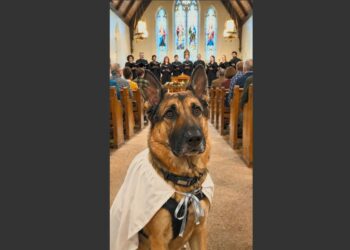
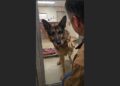
The retired German Shepherd had been standing quietly in the shelter hallway when an older man appeared at the far end.
Until that moment, the dog had shown little excitement about anything.
He followed instructions.
Walked calmly on his leash.
Ate his meals.
And settled wherever the shelter staff asked him to rest.
He was well behaved, just as everyone expected from a former working K9.
But something seemed missing.
The staff had noticed how often he watched the hallway.
Sometimes he’d look toward the entrance when someone came through.
Other times, he’d stand quietly as visitors passed, following their movements with his eyes.
He never caused trouble.
He simply seemed to be waiting.
Then, one afternoon, an older man stepped into the corridor.
The German Shepherd spotted him.
And everything about the dog changed.
His ears shot forward.
His body became alert.
He stopped paying attention to the shelter worker holding his leash.
For a split second, he stood perfectly still.
Then he started pulling.
Not toward a toy.
Not toward another dog.
But toward the man walking down the hallway.
The leash tightened as the German Shepherd leaned forward, determined to close the distance between them.
The shelter worker could see that this was different from the way he’d greeted anyone else.
The dog wasn’t casually investigating a stranger.
He appeared to recognize someone he’d been waiting to see.
And when the older man finally came close enough to speak, he said the words that made the moment even more emotional.
“Hi, boy. It’s me. I missed you so much.”
The Dog Who Had Learned to Follow Orders
A working K9’s life is built around routine.
Training.
Commands.
Responsibility.
And, often, a close relationship with the person who handles him.
For years, a working dog may spend more time beside a trusted handler than almost anyone else.
They learn each other’s movements.
Their voices.
Their habits.
The small signals that tell a dog what comes next.
Eventually, those familiar patterns become part of everyday life.
Retirement can change all of that.
The work stops.
The environment changes.
And sometimes the people and routines a dog has known for years are no longer part of his daily life.
For this German Shepherd, the transition had brought him to an animal shelter.
The account doesn’t explain exactly how he ended up there or how long he’d been separated from the older man.
But the shelter workers knew he had a working background.
They could see it in his behavior.
He was steady on a leash.
Responsive to instructions.
And generally calm around people.
There was no obvious problem with his manners.
If anything, he was easier to handle than many of the dogs in their care.
Yet the staff noticed something about him.
He rarely seemed excited.
When someone approached, he watched.
When they moved away, he let them go.
He followed the shelter’s routines without much fuss.
But he didn’t show the enthusiastic interest the workers hoped to see.
It was as though he’d learned how to behave in his new surroundings without becoming entirely comfortable in them.
The Hallway He Kept Watching
Shelter life continued around him.
Doors opened.
People arrived.
Leashes jingled.
Dogs barked from nearby kennels.
Staff members moved through the corridors, caring for the animals.
The German Shepherd seemed familiar with the routine.
He knew when it was time to walk.
He knew when someone wanted him to follow.
And he rarely needed much encouragement.
But he had a habit of watching the hallway.
The workers noticed how his attention sometimes turned toward the entrance.
They couldn’t know what he was thinking.
Perhaps he was simply responding to movement.
Perhaps he was watching for someone familiar.
Dogs can remember people they’ve formed strong relationships with, even after significant periods apart.
But no one at the shelter could say whether this dog was expecting a particular person to return.
They only knew that he seemed unusually quiet.
And that something about his behavior changed completely when the older man arrived.
The Moment His Ears Lifted
The reunion began during an ordinary walk through the shelter.
A staff member held the German Shepherd’s leash.
The dog stood calmly beside them.
There was no barking.
No pulling.
Nothing to suggest the next few seconds would be unusual.
Then someone appeared at the far end of the corridor.
An older man.
Walking toward them.
The German Shepherd noticed him almost immediately.
His head lifted.
Both ears turned forward.
And his posture changed.
The staff member felt the difference through the leash.
The dog was no longer standing casually beside them.
He was focused.
His attention stayed fixed on the approaching figure.
For a moment, he seemed to be taking in what he saw.
Then he moved.
The German Shepherd stepped forward with sudden determination.
The leash pulled tight.
The worker held on, surprised by the strength and urgency of the response.
The dog kept trying to move toward the man.
He wasn’t looking around the shelter anymore.
He wasn’t interested in anything else happening in the corridor.
His eyes remained on one person.
And with every step, the distance between them grew smaller.
“Hi, Boy. It’s Me.”
The older man continued approaching.
By then, the German Shepherd was visibly eager to reach him.
The dog who had been so calm and reserved was now pulling against the leash, trying to get closer.
Then the man spoke.
“Hi, boy.”
His voice was gentle.
Familiar.
“It’s me.”
The man paused.
“I missed you so much.”
There was no need for a long explanation in that moment.
The dog’s response had already shown that the man’s presence meant something to him.
He had recognized a familiar person.
Someone connected to a part of his life before the shelter.
And he wanted to reach him.
The words made the reunion especially touching because they suggested the recognition went both ways.
The older man hadn’t forgotten the dog.
And the German Shepherd’s sudden excitement suggested that he hadn’t forgotten the man either.
For the shelter staff, it was a remarkable contrast.
They were accustomed to seeing this dog behave with almost constant restraint.
Now they were watching him respond with an enthusiasm they hadn’t seen before.
The same dog.
The same hallway.
The same leash.
But one familiar person had changed everything about the moment.
A Bond That Outlasted Their Time Apart
Working dogs learn commands through training and repetition.
They can become exceptionally skilled at following directions, staying focused, and responding to their handlers.
But their relationships with people aren’t limited to commands.
Dogs also form attachments.
They recognize familiar voices, faces, scents, and patterns of interaction.
And when they encounter someone important from their past, their behavior can change dramatically.
That appeared to be what happened in the shelter hallway.
The German Shepherd had been calm around strangers.
He’d followed instructions and accepted the staff’s care.
But when he spotted the older man, he responded differently.
His ears lifted.
His attention sharpened.
And he pulled toward him with an urgency that surprised the person holding his leash.
We can’t know exactly what the dog remembered.
Perhaps the man’s face was familiar.
Perhaps his movement, scent, or voice helped confirm the recognition.
Dogs rely on several senses when identifying people.
Whatever the combination, the response was immediate.
And the man seemed to understand exactly why.
“Hi, boy. It’s me.”
Simple words.
But after time apart, they carried a great deal of meaning.
The Difference Between Obedience and Happiness
One of the most moving details in this story is how well behaved the German Shepherd had been before the reunion.
He wasn’t creating problems.
He wasn’t refusing food.
He wasn’t acting aggressively.
He simply went through his daily routine.
If someone asked him to follow, he followed.
If it was time to rest, he rested.
To someone who didn’t know his history, he might have appeared perfectly content.
But the shelter workers had noticed his lack of enthusiasm.
And then they saw what happened when he recognized the older man.
The contrast was impossible to miss.
Suddenly, the dog was animated.
Focused.
Eager to move forward.
It doesn’t prove that he’d spent every day consciously waiting for this specific person.
We can’t make that claim.
But it does reveal something important about the bond between them.
The man was familiar enough, and meaningful enough, to bring out a reaction the shelter staff hadn’t seen from him before.
And for anyone who has ever shared a strong bond with a dog, that part is easy to understand.
There are people a dog greets politely.
People a dog enjoys spending time with.
And sometimes, there is someone whose arrival seems to make the animal forget everything else around him.
This appeared to be one of those moments.
The Reunion Nobody Had to Explain
Imagine standing in that hallway.
You have a calm, retired German Shepherd beside you.
He’s been easy to walk.
He’s followed every instruction.
And he’s shown little interest in the people passing through.
Then an older man appears at the far end.
The dog’s ears rise.
His whole body becomes alert.
And before anyone can say much, he’s pulling toward the man with a determination you haven’t seen from him before.
The leash grows tight.
The man approaches.
And then comes that familiar greeting.
“Hi, boy. It’s me. I missed you so much.”
There is something deeply affecting about a reunion like that.
Not because it needs a dramatic speech.
Not because anyone has to explain years of shared experiences.
But because the dog’s reaction is so clear.
Someone from his past has returned.
Someone he recognizes.
And he wants to be close.
The account doesn’t tell us whether the older man was able to take the German Shepherd home afterward.
It doesn’t tell us exactly how long they’d been apart or what circumstances separated them.
Those details matter, and they shouldn’t be invented.
What the story does give us is a brief, powerful moment of recognition.
A dog who had spent his shelter days quietly following routines suddenly saw someone familiar.
And for the first time in a while, he seemed unable to contain his excitement.
“You Came Back.”
I think the most memorable part of this story happens before the man says anything.
It’s the moment the German Shepherd looks down the hallway.
He sees the older figure approaching.
His ears lift.
He becomes alert.
And the leash suddenly tightens because he’s already trying to reach him.
The staff member doesn’t need to tell him who the man is.
The older man doesn’t need to introduce himself.
Something about him is already familiar.
Then comes the greeting.
“I missed you so much.”
And the dog’s response gives the moment its meaning.
Whatever happened during the time they were apart, the connection between them still mattered.
The dog had learned to live with different routines.
Different surroundings.
Different people caring for him.
But when someone familiar returned, he recognized him.
And he wanted to be near him again.
He had been a trained working dog, accustomed to following commands and keeping his attention on the task in front of him.
But the moment he recognized that older man, there was only one place he wanted to go.
Straight toward him.
Sometimes a reunion doesn’t need many words.
A familiar voice.
A pair of ears suddenly standing tall.
And a German Shepherd pulling toward someone he hasn’t seen in a long time.
“Hi, boy. It’s me.”
For that moment, the shelter hallway was no longer just another place the dog had been asked to walk.
It was the place where someone important from his past finally appeared again.
And if his sudden excitement could have been put into words, they might have been the simplest words of all.
“You came back.” ❤️🐾
Editor’s Note: This story is adapted from an account that has not been independently verified. The circumstances of the K9’s retirement, separation, and reunion have not been independently confirmed. It is shared to celebrate the lasting bonds dogs can form with people who have been important in their lives.