For the first four visits, Daisy wouldn’t come anywhere near her.
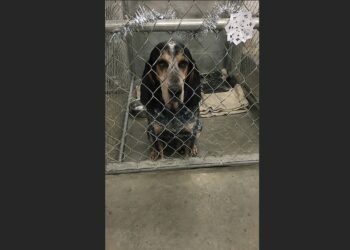
The retired racing greyhound stayed at the back of her kennel, nearly ten feet from the elderly woman sitting outside.
Sometimes Daisy stood facing the wall.
Sometimes she curled tightly on her blanket.
And whenever footsteps passed through the shelter hallway, her head lifted and her body stiffened.
Margaret didn’t try to call her closer.
She didn’t reach through the gate.
She didn’t offer treats or ask the dog to sit.
She simply opened her book and began reading.
At seventy-nine, Margaret had spent a decade volunteering at the shelter. She knew that frightened dogs didn’t always respond well to attention, no matter how kindly it was offered.
So she gave Daisy something different.
Twenty minutes of a calm, familiar human voice.
Nothing more.
On their fifth visit, something happened that made Margaret stop halfway through a sentence.
Daisy stood up.
Walked slowly toward the front of the kennel.
And lay down beside the fence, only three feet from Margaret’s chair.
The old woman looked at her.
Daisy didn’t look back.
But one of her ears turned toward Margaret’s voice.
Margaret smiled.
Then she lowered her eyes to the book and continued reading.
She would later say that it was one of the most rewarding moments in her ten years at the shelter.
And all she’d done was sit in a folding chair and read a mystery novel.
The Volunteer Who Could No Longer Walk
Margaret had started volunteering at the animal shelter when she was sixty-nine.
Back then, she could spend hours on her feet.
She cleaned kennels, prepared food, changed bedding, and walked dogs around the shelter grounds.
Some were young and energetic.
Others were elderly, nervous, or recovering from difficult experiences.
Margaret liked them all.
She especially enjoyed working with the dogs that other people found challenging.
The ones that barked too much.
The ones that hid at the back of their kennels.
The ones that needed someone to move slowly and give them time.
For ten years, the shelter had become an important part of her routine.
She knew the employees.
She knew the volunteers.
And she knew that certain dogs needed patience far more than they needed another person trying to get their attention.
Then her hip began giving her trouble.
At first, she shortened her walks.
Instead of taking dogs around the entire property, she’d walk them along the grass beside the parking lot.
When the pain worsened, she tried doing more indoor tasks.
But eventually, even the long concrete aisles became difficult.
Three years ago, she had to stop doing regular kennel duty and dog walks.
She was disappointed.
She still wanted to help.
Her body simply wasn’t cooperating.
The shelter director understood how much volunteering meant to her.
And she wasn’t willing to lose someone with Margaret’s experience.
So they began discussing other ways she could spend time with the animals.
That’s how the reading program began.
A Folding Chair and an Open Book
The idea was simple.
Margaret would bring a book to the shelter twice a week.
A staff member would help her set up a folding chair at a safe distance outside a dog’s kennel.
Then Margaret would read aloud for twenty minutes.
No dramatic voices.
No exaggerated excitement.
No calling the dog over.
Just the steady, ordinary sound of someone reading.
It wasn’t a new concept.
Animal shelters in different parts of the country had used similar programs to help dogs become accustomed to people in a low-pressure environment.
Some nervous animals find direct interaction overwhelming.
A stranger walking straight toward them, staring into their eyes, or reaching out a hand can be frightening, even when the person has the best intentions.
Reading offers a different kind of experience.
The dog can hear a person nearby without having to approach.
It can move closer if it feels comfortable.
Or stay where it is.
Nothing is demanded.
Margaret liked that approach.
She had always believed that helping animals sometimes meant allowing them to make their own decisions.
And she was perfectly capable of sitting down with a good book.
The first time she tried it, she felt a little silly.
She was accustomed to doing physical work at the shelter.
Cleaning.
Walking.
Carrying supplies.
Now she was being asked to sit still.
But the director encouraged her to continue.
And Margaret soon began to understand how valuable quiet consistency could be.
The Greyhound Who Didn’t Know How to Relax
Daisy arrived at the shelter after the closure of a racing kennel operation.
She was four years old.
A tall, slender greyhound with a muscular body, long legs, and an expression that made her look perpetually uncertain.
She had spent most of her life in a highly structured environment.
Everything was familiar there.
Feeding schedules.
Exercise routines.
Kennel sounds.
The people who handled her.
But when the racing operation shut down, that world disappeared.
Daisy was surrendered and entered shelter care.
The transition was difficult.
She was frightened by sudden movements.
She flinched when people approached too quickly.
And she wouldn’t take food directly from someone’s hand.
Staff members worked to make her surroundings more predictable, but progress came slowly.
Daisy wasn’t aggressive.
She didn’t threaten anyone.
She simply seemed unsure how to respond to people in an unfamiliar environment.
A kennel worker could place food near her, and she’d eventually eat.
But an outstretched hand was another matter.
She kept her distance.
The staff understood that retired racing greyhounds can have very different experiences adapting to life outside a racing kennel.
Some settle into new environments quickly.
Others need considerable time to become comfortable with unfamiliar sounds, spaces, and interactions.
For Daisy, nearly everything seemed to require an adjustment.
By the time Margaret began reading to her, Daisy had been at the shelter for months.
She needed someone willing to move at her pace.
And Margaret was very good at that.
Twenty Minutes Without Asking for Anything
Margaret selected Daisy’s kennel during her second week with the reading program.
The first session was uneventful.
Margaret settled into her folding chair and opened a mystery novel.
Daisy remained at the back of the run.
The dog barely acknowledged her.
Margaret read for twenty minutes.
Then closed the book and left.
Two days later, she returned.
Same chair.
Same gentle tone.
Same distance from the kennel.
Daisy stayed at the back.
Margaret read another section of the novel.
On the third visit, nothing obvious changed.
The fourth was much the same.
A few volunteers wondered whether Daisy was paying attention.
Margaret didn’t seem concerned.
She wasn’t trying to entertain the dog.
She wasn’t waiting for applause.
And she wasn’t measuring success by whether Daisy came to the gate.
She simply wanted the dog to have repeated experiences of a person being nearby without anything unpleasant happening.
When the twenty minutes ended, Margaret closed her book.
She left Daisy in peace.
And she came back the next time.
Then, during the fifth session, Daisy stood.
Three Feet Closer
Margaret had just begun reading when she noticed movement at the back of the kennel.
Daisy was getting up.
The greyhound stretched her long legs and walked slowly toward the front.
Margaret kept her eyes on the page.
She didn’t want Daisy to feel that approaching meant she would suddenly become the center of attention.
The dog stopped beside the fence.
Then lowered herself onto the floor.
She was now about three feet from Margaret.
Instead of ten.
Daisy settled there for the remainder of the session.
One ear turned toward the woman’s voice.
Margaret continued reading.
She resisted the urge to speak directly to her.
No excited praise.
No sudden movement.
No attempt to reach out.
Just the next paragraph.
And the one after that.
When the twenty minutes ended, Margaret closed the book.
Daisy remained where she was.
The old woman smiled as she packed up.
She knew the dog hadn’t suddenly overcome all her fears.
But she’d made a choice.
For the first time, Daisy had decided to rest closer to the person sitting outside her kennel.
And nobody had asked her to.
The Mystery Novel
Over the following six weeks, Margaret continued reading to Daisy.
A chapter at a time, she worked her way through most of the mystery novel.
She enjoyed telling the staff about it afterward.
There was a suspicious neighbor.
A missing piece of evidence.
And a detective who, in Margaret’s opinion, should have figured everything out about fifty pages earlier.
She had no idea whether Daisy cared about any of that.
Probably not.
But the greyhound kept choosing the place near the fence.
She’d settle down, stretch out her long legs, and turn one ear toward Margaret’s voice.
Some days she appeared relaxed.
Other days she was more watchful.
Margaret accepted both.
There was no expectation that every visit would be better than the last.
Progress with a frightened animal rarely happens in a straight line.
A dog may feel comfortable one day and uncertain the next.
A new sound or unexpected movement can bring back old fears.
Margaret understood.
So she kept showing up.
Twice a week.
With her folding chair.
And her book.
Twenty quiet minutes.
For Daisy, that consistency became something familiar in an otherwise busy shelter.
The Treat on the Floor
Daisy’s progress wasn’t limited to the reading sessions.
When she first arrived, she wouldn’t accept food from a person’s hand.
Even gentle offers made her hesitant.
Shelter staff avoided pressuring her and gave her space around food.
Over time, she began accepting treats placed on the ground.
It was a small change.
But for a dog who had struggled so much with human interaction, the staff considered it meaningful progress.
She still didn’t take treats directly from people’s fingers.
Nobody forced the issue.
There was no deadline.
The important thing was helping Daisy feel safer around the people caring for her.
Margaret was pleased when she heard about it.
But she didn’t suddenly change her approach.
She didn’t start offering Daisy treats while she read.
She didn’t try to pet her through the kennel.
She kept the same routine.
Because whatever was helping Daisy, Margaret didn’t want to make the sessions more demanding.
The little greyhound had begun choosing to come closer.
That was enough.
The Woman Who Thought She Had Nothing Left to Offer
There was another side to the reading program that Margaret hadn’t expected.
For years, she’d measured her usefulness at the shelter by what she could physically accomplish.
How many kennels she cleaned.
How many dogs she walked.
How much she helped the staff get through a busy morning.
When her hip became too painful for that work, she’d felt as though she was losing her place.
She was still willing to help.
But willingness didn’t make the concrete floors any easier to walk.
The reading program changed the way she thought about volunteering.
She didn’t have to move quickly to make a difference.
She didn’t need to carry heavy supplies.
And she didn’t need to be the person leading a dog around the yard.
She could sit quietly and offer the one thing she had plenty of.
Her time.
There was something comforting about that realization.
At seventy-nine, Margaret wasn’t as physically capable as she’d been ten years earlier.
But she still had patience.
Experience.
And a voice that could fill twenty minutes without asking anything in return.
Daisy didn’t care whether Margaret could walk five miles.
She didn’t care that the elderly volunteer needed a folding chair.
She seemed content to rest nearby while Margaret read.
And Margaret was content to keep reading.
Teaching Others to Do Less
Eventually, the shelter expanded the program.
Two more volunteers joined Margaret.
She helped train them herself.
Not by giving long lectures.
By showing them what to do.
She would sit in her folding chair outside a kennel, open her book, and read.
Then she’d explain the most important part.
Don’t try too hard.
Don’t stare at the dog.
Don’t keep calling its name.
Don’t assume you need to reach out and touch it.
And don’t be disappointed if nothing seems to happen.
For many anxious dogs, being allowed to remain at a comfortable distance is an important part of feeling safe.
The goal wasn’t to make the dog perform.
It was to offer a peaceful experience with a person nearby.
Margaret encouraged the new volunteers to notice subtle changes without turning those changes into demands.
A dog that had been pacing might settle.
One hiding at the back might begin watching from a distance.
Another might simply remain relaxed while someone spoke.
Those moments were worth recognizing.
But they weren’t invitations to rush forward.
Sometimes, she explained, the most helpful thing a volunteer can do is stay exactly where they are.
And keep reading.
The Dog Who Still Hasn’t Been Adopted
Daisy is still waiting for a permanent home.
She has been in shelter care for eight months.
She remains sensitive to sudden movements.
She still prefers people to approach her carefully.
And she still needs a family willing to understand that retired racing dogs can require patience while adjusting to a different kind of life.
Margaret can’t promise that reading to Daisy will make her comfortable with every stranger.
She can’t guarantee that the greyhound will suddenly become confident or ready for adoption.
Behavioral recovery is more complicated than that.
But she can point to what has changed.
Daisy once stayed ten feet away at the back of her kennel.
Now, during Margaret’s visits, she often settles near the front.
She once avoided taking treats from people altogether.
Now she sometimes accepts them when they’re placed on the ground.
And for twenty minutes twice a week, she can spend time near a person without being expected to interact.
Those are modest changes.
But they’re real.
And for Daisy, they may be the beginning of something larger.
One Ear Turned Toward Her
On a Tuesday afternoon, Margaret arrives with her book tucked under one arm.
A staff member helps arrange the folding chair outside Daisy’s kennel.
Margaret sits down carefully.
Her hip bothers her more when the weather changes, and she takes a moment to get comfortable.
Then she opens the mystery novel to the page where she stopped last time.
Inside the kennel, Daisy lifts her head.
She watches Margaret settle into the chair.
The old woman doesn’t call her.
She doesn’t wave.
She simply begins to read.
Daisy gets up.
Crosses the kennel.
And lies down near the fence.
Three feet away.
One ear turns toward the familiar voice.
Margaret glances at her for only a moment.
Then returns to the book.
The detective is finally close to solving the mystery.
Margaret thinks it’s about time.
She reads another paragraph.
Daisy rests her head on her paws.
Outside the kennel, people continue walking through the shelter.
Dogs bark.
Doors open and close.
Someone wheels a cart down the hallway.
And in the middle of all that activity, a seventy-nine-year-old woman sits quietly with a frightened greyhound, reading aloud as though there’s nowhere else she’d rather be.
Margaret used to think helping shelter dogs meant getting them outside.
Giving them exercise.
Teaching them to walk on a leash.
Doing something that required energy and strong legs.
Now she knows that sometimes helping looks very different.
Sometimes it’s a folding chair.
An open book.
And the decision not to ask an animal for anything it isn’t ready to give.
Margaret doesn’t know how Daisy’s story will end.
She hopes the greyhound finds a family who understands her.
A patient person who won’t mistake fear for stubbornness.
A home where she can learn that people and everyday life don’t have to be frightening.
Until then, Margaret will keep coming.
Twice a week.
Twenty minutes at a time.
And if Daisy wants to stay at the back of the kennel one day, that’s fine.
If she wants to lie beside the fence, that’s fine too.
Margaret will read either way.
Because after ten years of volunteering, she’s learned that not every dog needs someone to make a big gesture.
Some simply need a person willing to show up, sit nearby, and let them feel safe.
And if a frightened greyhound chooses to move a few feet closer, that can be something worth celebrating.
Margaret turns another page.
Daisy’s ear remains pointed toward her.
The old woman smiles to herself.
Then she keeps reading.
Editor’s Note: This story is adapted from the account provided, preserving Margaret’s reading program, Daisy’s background, and the gradual changes observed during their sessions. Some scene-setting and personal reflections have been added for storytelling. Daisy’s eventual adoption or long-term outcome has not been established, and the account has not been independently verified.