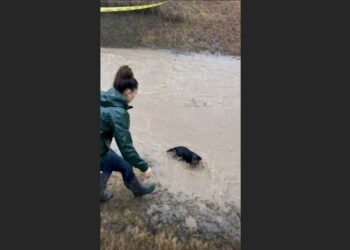
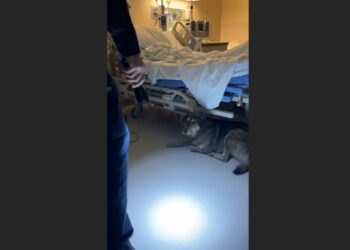
For ten cold December days, a German Shepherd remained beside an abandoned shopping cart at a bus stop outside Manchester.
Rain darkened his coat.
Frost covered the pavement in the mornings.
Buses arrived, opened their doors, and pulled away again.
Still, the dog stayed near the cart.
Sometimes he sat beside it.
Sometimes he curled underneath the narrow shelter and slept.
When strangers approached too directly, he backed away. Once they left, he returned.
Residents brought food and water. A few tried coaxing him toward their cars.
Nothing worked for long.
The dog always came back to the same place.
His name, I would later learn, was Bruno.
The battered shopping cart beside him had belonged to the person who mattered most in his world, a 65-year-old woman named Evelyn Cartwright.
And Evelyn had not abandoned him.
She had nearly died.
My name is Daniel Foster. I had worked as a social worker for twelve years when Bruno and Evelyn entered my life.
I thought I had become accustomed to seeing people lose homes, health, relationships, and almost everything they owned.
I was wrong.
There are some kinds of waiting you do not forget.
The First Time I Saw Bruno, I Thought He Was a Stray
A colleague mentioned the dog during an outreach shift.
“There’s a Shepherd hanging around a bus stop,” she said. “People say he’s been there for days.”
I expected to find an animal roaming the neighborhood.
Instead, Bruno was exactly where she had described him.
The shopping cart stood near one end of the shelter.
A blanket, soaked from rain, was folded badly inside it. There were a few plastic bags, an old scarf, an empty water bottle, and clothing protected under a torn sheet of plastic.
Bruno sat beside one wheel.
He was lean but not severely underweight.
His coat was dirty.
He watched every person who passed.
More than anything, though, he watched the road.
Whenever a bus slowed, his head lifted.
When a car stopped nearby, he stood.
Then the vehicle moved on, and Bruno settled again.
The Neighbors Knew More Than I Did
A man who worked at a nearby shop told me the cart belonged to an older woman named Evelyn.
She had been sleeping rough in the area for some time.
Bruno was always with her.
“They went everywhere together,” he said.
Then, roughly a week and a half earlier, Evelyn became seriously ill.
Someone found her struggling to breathe near the bus stop and called an ambulance.
Paramedics took her away.
Bruno could not go with her.
In the confusion, the shopping cart remained behind.
So did the dog.
Several people had tried helping him since.
He accepted food when it was left at a distance.
He drank.
He apparently wandered short distances at night.
But he repeatedly returned to the cart.
I Did Not Believe Bruno Understood What Had Happened
He could not know what pneumonia was.
He could not understand why an ambulance arrived or where it had taken Evelyn.
What he had experienced was much simpler and, in its own way, just as difficult.
A familiar person had been beside him.
Then unfamiliar people arrived.
She left in a vehicle.
Her belongings stayed behind.
And Bruno remained near the last place where his routine with her had made sense.
Dogs can develop powerful associations with places, scents, voices, and daily patterns.
Evelyn’s cart was saturated with familiar scent.
So was the blanket inside it.
The bus stop had been part of their shared life.
Bruno did not need a human concept of abandonment for his behavior to make sense.
Everything familiar was concentrated in that small patch of pavement.
Getting Him Somewhere Warm Was Not Easy
The weather concerned us.
A German Shepherd has a substantial coat, but repeated exposure to cold rain is still dangerous, especially when an animal is stressed and we do not know his health history.
I contacted animal welfare services and a local rescue group.
We agreed that chasing Bruno would be the worst approach.
The bus stop stood near traffic.
If frightened, he could run into the road.
Instead, food was placed consistently in one location.
Water was refreshed.
People were asked not to crowd him.
We tried establishing enough routine that somebody might eventually be able to secure him safely.
But another question had become just as urgent.
Where was Evelyn?
Finding Her Took Three Days
Knowing a first name and an approximate age is not the same as having permission to open every medical record in a city.
There were privacy rules.
Different agencies.
Hospital systems.
Outreach services.
Temporary accommodation records.
People who knew Evelyn by sight but not by her full legal name.
Eventually, through the appropriate social-service channels, I learned that a woman matching her details had been hospitalized with severe pneumonia.
She had survived the most dangerous period.
Afterward, she had been transferred to a convalescent facility while she regained strength.
Once contact was properly arranged, I went to see her.
I carried no grand plan.
I simply needed to ask one question.
“Do you have a German Shepherd named Bruno?”
Evelyn Started Crying Before I Finished the Sentence
Her hands trembled.
“Bruno?”
“Yes.”
“Is he alive?”
That was when I understood what the previous days had been like for her too.
Evelyn remembered the ambulance.
She remembered trying to tell someone about her dog.
After that, much of the night was confused by illness, oxygen, fear, and exhaustion.
When she woke properly in hospital, she did not know where Bruno had gone.
She had no family member who could simply collect him.
No permanent address where someone could bring him.
And while she recovered, the unanswered question followed her.
“Where is he?” she asked me.
“At the bus stop.”
She covered her mouth.
Bruno Had Been With Her for Four Years
Evelyn told me she had found him when he was young.
He had been roaming near an industrial area.
Whether he had been abandoned or simply lost was never established.
She reported him, asked around, and eventually became the person caring for him.
At the time, Evelyn still had temporary accommodation.
Later, her housing situation deteriorated.
Bruno stayed with her through it.
They slept in shelters when places allowed dogs.
Other nights were more complicated.
Food was shared when money became tight.
She worried about him in summer heat and winter cold.
“He kept me moving,” she said.
Then she corrected herself.
“We kept each other moving.”
That sounded more accurate.
I Asked Evelyn to Record Something for Him
There was no guarantee Bruno would react dramatically.
I told her that.
Dogs can recognize familiar voices, although phone speakers distort sound and voice alone might not overcome his caution.
Still, it was worth trying as part of a larger plan to get him somewhere safe.
I held out my phone.
Evelyn stared at it.
“What should I say?”
“Anything you’d normally say to him.”
She thought for a moment.
Then her voice changed.
The tiredness was still there, but something warmer came through.
“Bruno, boy. It’s Evelyn. Good lad. Come on, sweetheart.”
She repeated a phrase she often used when it was time to move on from somewhere.
Then she laughed through tears.
“He’ll know that one.”
Perhaps he would.
Perhaps he would only recognize her tone.
Either possibility could help.
The Next Morning, We Went Back to the Bus Stop
A rescue worker came with me.
So did a secure lead and equipment we hoped we would not need to use.
A few residents gathered at a distance.
Bruno was beside the cart.
When I approached, he watched carefully.
I stopped well short of him.
Then I played Evelyn’s recording.
At first, Bruno remained still.
Then both ears came forward.
His head tilted.
I played it again.
“Bruno, boy. It’s Evelyn.”
He stood.
His nose moved rapidly.
He looked beyond me.
Then toward the phone.
His tail moved.
Just once at first.
Then again.
The Recording Did Not Tell Bruno Where Evelyn Was
He could not understand that she was recovering in a medical facility.
He did not know that I had spent three days looking for her.
But he knew the voice.
That recognition changed his behavior enough to give us an opportunity.
I sat down rather than approaching.
The rescue worker remained farther back.
We played the recording once more.
Bruno moved several feet toward me.
Stopped.
Then came closer.
Food helped with the last distance.
Eventually, he allowed me to touch the side of his neck.
We secured the lead.
For the first time since Evelyn had been taken away, Bruno walked away from the shopping cart with another person.
Not because he understood our plan.
Because enough familiar cues and careful handling had finally made that step possible.
Bruno Was Examined Before Any Reunion
The veterinarian found that he was dehydrated and tired but fortunately had avoided severe injury.
His paws were sore from prolonged exposure to wet pavement.
He needed rest, food, warmth, and monitoring.
Otherwise, he was in better condition than we feared.
The larger challenge was arranging contact with Evelyn.
Medical facilities cannot simply allow an unverified dog to walk through patient areas.
There were infection-control concerns.
Permission had to come first.
With staff cooperation, an appropriate visit was organized in a controlled area once Evelyn’s condition allowed it.
I barely slept the night before.
Bruno Recognized Her Before We Reached Her
He had been walking slowly.
Then his head lifted.
His pace changed.
Evelyn was sitting in a chair with a blanket around her shoulders.
The moment she spoke, Bruno pulled forward.
“Bruno.”
He went straight to her.
Not violently.
Not with the explosive jumping I had worried about.
He pressed his nose against her hand.
Then his head moved against her lap.
Evelyn bent as far as her recovering body allowed and put both hands into his fur.
“Oh, my boy.”
That was all she managed.
Nobody in That Room Needed a Speech
Bruno stayed close.
He sniffed Evelyn’s sleeves.
Her hands.
The blanket.
Then he settled beside her chair.
Evelyn cried.
One nurse quietly left and returned with tissues.
Another stood in the doorway longer than necessary.
I felt my own throat tighten.
Still, what moved me was not some idea that Bruno understood illness or miraculous survival.
It was recognition.
A familiar scent.
A familiar voice.
A familiar person suddenly present again after days of absence.
For Evelyn, the meaning was much more complex.
She had been afraid she would never see him again.
Now her hand was resting against his head.
Reuniting Them for an Afternoon Was Easier Than Solving What Came Next
Evelyn was recovering.
She still had no stable home.
Bruno could not live indefinitely at the convalescent facility.
A rescue group offered temporary foster care.
Evelyn was frightened by the idea at first.
She had already lost sight of Bruno once.
I explained that the foster home would keep him safe while we worked on something more permanent.
Visits could be arranged where possible.
She agreed.
Bruno left with the foster carer that evening.
This time, however, we knew where both halves of the pair were.
That changed everything.
Their Story Reached the Local Community
One of the people who had been feeding Bruno beside the bus stop contacted a local reporter.
With Evelyn’s consent, the story was published.
I worried at first.
Stories involving homelessness can easily become sentimental while stripping the person at the center of them of dignity.
Evelyn did not want to be portrayed simply as a helpless woman with a loyal dog.
She wanted people to understand something more practical.
She had survived pneumonia.
She needed stable housing.
And she wanted to remain with the animal who had shared four difficult years of her life.
The response surprised all of us.
Donations Began Arriving
Some people offered dog food.
Others donated clothing.
A local group offered basic household items if housing could be secured.
Most importantly, people familiar with housing services began asking whether there was a pet-friendly option suitable for Evelyn’s mobility and recovery needs.
Community generosity alone could not bypass eligibility rules or create housing from nothing.
Still, attention opened conversations.
Organizations coordinated.
Paperwork moved.
An appropriate ground-floor flat eventually became available.
It was modest.
Small kitchen.
Living room.
One bedroom.
Easy outdoor access.
Pets allowed.
To Evelyn, it looked enormous.
Bruno Arrived After She Did
We wanted Evelyn settled first.
The donated furniture was basic.
A table.
Two chairs.
A bed.
A secondhand sofa.
Warm blankets.
Bowls for Bruno.
Someone brought a large dog bed.
Evelyn laughed when she saw it.
“He’ll sleep on the floor.”
She was right.
When Bruno arrived, he explored every room.
Then he returned to Evelyn.
For the first night, he slept beside the sofa.
The expensive donated bed remained untouched three feet away.
I told Evelyn that rescue dogs and costly beds have a longstanding disagreement.
She laughed harder than I had heard her laugh before.
The Shopping Cart Was Not Part of Their New Home
Evelyn did not want it.
Most of the belongings had already been sorted.
Anything useful or personally important came with her.
The damaged cart itself belonged to the supermarket and was eventually collected.
I wondered whether Evelyn would feel something symbolic about letting it go.
She did not.
“I’m tired of pushing that thing,” she said.
That answer stayed with me.
For everyone else, the cart had become the dramatic center of Bruno’s story.
For Evelyn, it represented years of hauling everything she owned through streets in every kind of weather.
She was ready to stop.
Bruno Needed Time to Adjust Too
He did not immediately behave as though he understood that the flat was permanent.
For several nights, he slept close to the front door.
When Evelyn moved between rooms, he often followed.
If she went outside without him briefly, he became alert.
That was not surprising.
His routines had been disrupted repeatedly.
So they built new ones.
Morning walk.
Breakfast.
Rest.
Afternoon outing.
Evening.
Evelyn left for appointments and returned.
Bruno learned the building.
The neighbors.
The sound of the lift.
The route to the small patch of grass outside.
Gradually, the front door became just another door.
Evelyn’s Recovery Continued
Stable housing did not erase everything that had happened.
She still had medical follow-ups.
She tired easily at first.
There were financial and social-service issues to resolve.
Years of instability did not disappear because newspapers printed a hopeful story.
But a secure address changed what was possible.
Medication could be stored properly.
She could rest.
Bruno had a predictable place for food and water.
Neither had to plan every evening around where they would sleep.
Those practical changes mattered more than any inspirational slogan.
Months Later, Evelyn Started Helping at a Community Center
Not full time.
Not as some dramatic transformation from receiving help to saving everyone else.
She began by volunteering a few hours when her health allowed it.
She knew many of the people who came through the doors.
She understood the embarrassment of asking for clean socks.
The anxiety of navigating forms.
The frustration of being spoken about rather than spoken to.
Bruno occasionally accompanied her when the center permitted it.
Mostly, he slept beside her chair.
People learned his name.
Some already knew it.
He had become locally famous as the dog from the bus stop.
Evelyn found that amusing.
“He’s always thought he was important,” she told me.
I Visited Them One Winter Morning
Nearly a year had passed.
The weather was cold enough to remind me of those first days.
I knocked.
Bruno barked once from inside.
Then I heard Evelyn tell him to settle.
When she opened the door, he stood behind her.
Healthy.
Dry.
Thicker through the body.
His coat had improved.
He sniffed me.
Apparently I passed inspection.
Inside, there was tea on the table and dog hair on the sofa.
The large dog bed sat in the corner.
Unused.
“He sleeps beside my bed now,” Evelyn said.
Of course he did.
We Eventually Drove Past the Old Bus Stop
Evelyn had an appointment, and I offered transportation.
Bruno was with us.
Traffic was heavy.
The shelter still stood beside the road.
The shopping cart was long gone.
Bruno looked out the window.
His nose moved.
I wondered whether he recognized the location.
Maybe he did.
Dogs can retain strong environmental associations.
But there was no dramatic reaction.
He did not whine.
He did not try to climb forward.
Within seconds, his attention shifted elsewhere.
Evelyn looked out too.
“I thought I’d die there one winter,” she said quietly.
Then we continued driving.
People Still Talk About Bruno’s Loyalty
I understand why.
A German Shepherd stayed near the last place where his familiar person and her belongings had been.
That image is powerful.
But I have become cautious about the way we tell it.
Bruno did not prove some abstract moral truth about loyalty.
He did not understand hospitals, homelessness, bureaucracy, or pneumonia.
He responded to attachment, scent, routine, and sudden absence.
What happened afterward depended on people.
Neighbors fed him.
Rescuers handled him carefully.
Medical staff made a reunion possible.
A foster family provided temporary care.
Housing workers found an option.
Community members donated what they could.
Evelyn did the hard work of rebuilding her own daily life.
Bruno was part of that life.
He was not responsible for fixing it.
The Voice Recording Was Only a Beginning
People who heard the story often focused on the moment I played Evelyn’s voice.
They imagined Bruno hearing it and suddenly understanding everything.
That was not what happened.
His ears lifted.
His body became more animated.
He recognized something familiar.
That familiar sound helped us reduce his uncertainty enough to approach safely.
The real work came afterward.
Veterinary care.
Temporary placement.
Visitation.
Housing applications.
Coordination.
Follow-up.
There is usually a great deal of ordinary work behind an extraordinary-looking moment.
Ten Days Beside a Shopping Cart Did Not Define Bruno
That matters to me most.
For a while, he was “the dog at the bus stop.”
Then “the loyal German Shepherd.”
Then “the dog who waited for the homeless woman.”
All of those labels reduced him.
Bruno was also a dog who liked cheese far too much.
A dog who disliked puddles despite spending days in December rain.
A dog who snored.
A dog who positioned himself precisely where Evelyn needed to walk.
A dog who learned the sound of the community-center cupboard where treats were kept.
Once he had stability again, his personality had room to become visible.
Evelyn Was More Than the Woman He Waited For Too
She was funny.
Stubborn.
Sharp.
Occasionally impatient with anyone who tried to make decisions for her.
She had survived years of housing instability before pneumonia nearly killed her.
Her relationship with Bruno mattered deeply.
But it was not the only thing about her worth knowing.
That may be the most important correction to the sentimental version of their story.
Neither Evelyn nor Bruno was simply rescued by love.
They needed systems that worked.
Housing.
Medical treatment.
Animal care.
People willing to coordinate instead of walking away.
Affection gave people a reason to care.
Practical action changed what happened next.
Bruno No Longer Waits in the Cold
These days, when Evelyn leaves the flat, Bruno often watches from inside.
Sometimes he accompanies her.
Sometimes he stays with someone she trusts.
Then she returns.
That repetition has become ordinary.
The bus stop has become part of their past rather than the center of their lives.
I still occasionally travel through that neighborhood.
Whenever I pass it, I remember the abandoned cart.
The wet blanket.
The German Shepherd sitting beside one wheel and lifting his head whenever a vehicle slowed.
At the time, I thought I was looking at a dog refusing to leave.
Now I see something slightly different.
I was looking at an animal holding close to the only familiar pieces of his life still available to him.
What changed Bruno’s future was not that he finally understood Evelyn would return.
It was that enough people paid attention to what his behavior was telling us.
We found her.
We found him.
Then we did the much harder work of making sure their reunion did not last only one afternoon.
Months later, I visited Evelyn’s flat on another cold day.
Bruno was asleep beside the radiator.
Evelyn was drinking tea.
Outside, rain struck the windows.
Neither of them needed to go anywhere.
For a dog who had once spent ten December days beside a shopping cart at a bus stop, that ordinary scene seemed like more than enough.
Editor’s Note: The characters in this story are fictional. Through these stories, we hope to share the intelligence, loyalty, compassion, and loving nature of dogs with people everywhere.