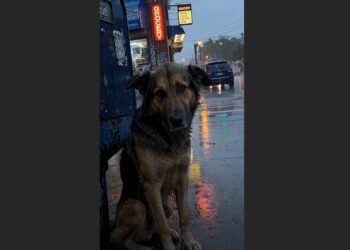
Every evening, our German Shepherd, Rex, waited in the northeast corner of the backyard.
From there, he could see the bend in the road.
He knew the sound of my brother Michael’s car, and whenever that familiar engine approached, his ears stood straight up.
His tail began wagging.
Then he’d hurry toward the driveway.
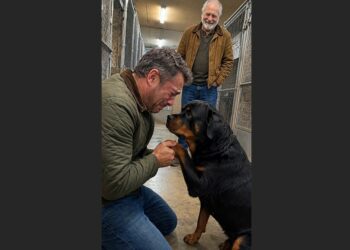
Michael would get out, kneel, and wait for Rex to reach him.
The big German Shepherd always did the same thing.
He gently rested his head against my brother’s knees.
Michael would spend a moment with him before going inside.
It was such a familiar part of our evenings that we hardly thought about it anymore.
They repeated that greeting for eight years, four months, and eleven days.
Then, one Tuesday, Michael was killed in the line of duty.
That evening, Rex went to the northeast corner as usual.
He sat facing the road.
Cars passed.
The light faded.
And the familiar engine never came.
We brought him inside, but he remained restless, frequently looking toward the door.
The next evening, he returned to the corner.
And the evening after that.
For nine months, Rex continued going back to the same place.
I didn’t know what he understood about Michael’s absence.
But I knew he’d spent years associating that corner of the yard with the person he loved most.
And watching him wait became one of the hardest parts of losing my brother.
The Officer and His German Shepherd
My name is Emily.
My brother Michael was a police K9 officer, and Rex was his working partner.
For eight years, they shared a relationship built through training, daily routines, and the demands of police work.
They spent countless hours together.
Michael learned to recognize Rex’s behavior and respond to the signals he gave.
Rex became familiar with Michael’s voice, movements, and expectations.
Working with a police dog requires more than simply issuing commands. A handler needs to understand the animal well enough to recognize when he’s focused, uncertain, tired, or responding to something important.
Michael took that responsibility seriously.
Over time, their partnership became one of the most consistent parts of his life.
I saw how comfortable Rex was around him.
The dog paid close attention when Michael spoke, and he seemed happiest when they were together.
But their relationship didn’t end when Michael finished work.
At home, Rex was just as attached to him.
He followed my brother through the house and preferred resting wherever Michael happened to be.
To us, Rex wasn’t only a police dog.
He was a member of the family.
The Shadow Who Followed Michael Everywhere
When Michael sat outside, Rex usually settled beside his chair.
Sometimes he’d rest there quietly while my brother spent time outdoors.
If Michael got up and walked into another room, Rex often followed.
There was nothing especially dramatic about it.
It was simply the way they lived together.
Michael moved.
Rex followed.
Michael sat down.
Rex found somewhere nearby to rest.
Their days had a familiar rhythm.
I had watched that relationship develop over the years, and it was clear how accustomed they were to each other’s company.
Rex was a powerful German Shepherd, trained for demanding work.
But at home, he also enjoyed the ordinary comforts of being close to someone he knew.
He didn’t need constant activity or instructions.
Sometimes he simply wanted to lie beside Michael.
I think that’s what I remember most clearly about their time together.
Not the difficult work they performed.
Not the occasions when Michael returned home tired after a long day.
But those quiet moments when my brother sat down and Rex settled beside him as though that was exactly where he belonged.
The Corner With a View of the Road
The northeast corner of our backyard wasn’t particularly special to anyone else.
It was simply a place where Rex could see the bend in the road.
But it became an important part of his evening routine.
He seemed to recognize when Michael’s car was approaching.
The sound of that particular engine often brought him to his feet.
His ears would rise.
His tail would begin moving.
And he’d become visibly excited.
Moments later, Michael would arrive.
Rex would hurry toward him.
My brother would kneel in the driveway, and Rex would lower his head against Michael’s knees.
It wasn’t something we’d trained Rex to do as a special performance.
It was simply their greeting.
I saw it so many times that I could almost picture the entire interaction before it happened.
The approaching car.
The dog’s ears lifting.
Michael getting out.
And Rex moving close enough to rest his head against him.
For eight years, four months, and eleven days, that routine was part of our lives.
Then came the Tuesday when everything changed.
The Day Michael Didn’t Come Home
Michael was killed in the line of duty.
Even now, writing those words is difficult.
One day, my brother was part of our everyday life.
Then our family was facing the reality that he would never come home again.
The news devastated us.
There were conversations to have and arrangements to make.
People reached out to express sympathy.
Fellow officers came together to honor Michael’s courage and service.
Our family was surrounded by reminders of how much he’d meant to the people who knew and worked with him.
But amid everything that followed, I kept thinking about Rex.
He’d spent years working beside Michael.
At home, he’d rarely been far from him.
And now the person who had shaped so much of his daily routine was gone.
We couldn’t explain the loss to Rex in a way he would understand as another person might.
He didn’t know the meaning of a line-of-duty death.
He couldn’t understand why Michael would never return.
All we could do was continue caring for him and pay attention to how he responded.
That first evening, Rex went to his familiar corner.
The First Night of Waiting
Rex settled in the northeast corner of the yard.
He faced the road.
For years, that had been the place where he waited before greeting Michael.
Now he was there again.
The hours passed.
Cars moved along the street.
Occasionally, Rex raised his head when he heard an engine approaching.
But none of the vehicles was Michael’s.
The familiar car didn’t appear around the bend.
As darkness fell, Rex remained outside.
Eventually, we brought him indoors.
He seemed restless.
He looked toward the door repeatedly and had difficulty settling into his usual routine.
I stayed near him when I could.
I wanted to offer comfort.
But I also knew that Rex’s relationship with Michael was different from the relationships he had with the rest of us.
We cared about him deeply.
He knew us.
Still, we’d never been the people he worked beside every day or greeted in the driveway each evening.
I couldn’t replace that familiarity simply by sitting beside him.
So I didn’t try.
I gave him company, a quiet place to rest, and as much consistency as we could manage during a terribly difficult time.
The Funeral
Michael’s funeral brought together people who had known him through his work and personal life.
Fellow officers gathered to honor him.
Our family tried to support one another as we faced the loss.
Rex was there.
He stayed quietly beside Michael’s casket.
His ears were lowered, and he barely moved.
I watched him for a while.
I couldn’t know what he understood about the ceremony.
Dogs may respond to familiar scents, unfamiliar environments, changes in routine, and the behavior of people around them.
But Rex couldn’t understand a funeral in the way we did.
I was careful not to imagine that he knew everything we knew.
Still, seeing him so quiet was difficult.
He had been Michael’s working partner for years.
Now he was beside him for the last time.
On the way home, Rex made a long, low whining sound.
I’d never heard him vocalize quite like that before.
I looked toward him, wishing I could help him settle.
But there was nothing I could say that would make Michael return.
And when we reached the house, Rex headed back toward the yard.
Back to the Same Corner
Rex went straight to the northeast corner.
The spot hadn’t changed.
The road was still visible from there.
Vehicles still passed.
And the bend where Michael’s car had appeared for so many years looked exactly as it always had.
Rex settled down and watched.
I stood nearby, remembering the countless evenings when we’d seen his ears lift at the sound of Michael approaching.
I knew dogs develop strong associations with familiar sounds, places, and daily routines.
Rex had practiced this one for more than eight years.
It wasn’t surprising that he continued returning to the same spot.
But knowing that didn’t make it easier to watch.
I wanted him to come inside and rest.
I wanted him to feel comfortable.
And I wanted to stop looking down the road myself.
Because sometimes, when I stood there beside Rex, I found myself imagining Michael’s car appearing just as it once had.
I knew that couldn’t happen.
But the familiar setting made his absence especially noticeable.
Rex wasn’t the only one who had to adjust to a life without my brother.
When Days Turned Into Weeks
As the days passed, Rex continued returning to the corner.
The routine became one of the things we noticed most.
Sometimes he’d sit there for a while.
Other times, he’d remain longer, watching the road.
Passing engines still caught his attention.
He would lift his head and look toward the bend.
Then the vehicle would continue past.
We made sure he had food, water, shelter, and company.
We encouraged him to rest indoors.
We stayed beside him whenever he seemed to need reassurance.
But the changes in his behavior concerned us.
He was becoming less interested in his meals.
He spent more time withdrawn from ordinary activity.
And he didn’t seem to have the energy we’d once associated with him.
I remembered the confident German Shepherd who had worked beside Michael and hurried eagerly toward the driveway.
Now he moved with less enthusiasm.
Some of that change might have reflected the disruption of losing his familiar handler and daily routine.
But we knew we couldn’t assume every physical or behavioral change was caused by grief.
Rex needed veterinary care and a proper assessment.
The Changes We Couldn’t Ignore
Over the following months, Rex’s appetite gradually diminished.
We became increasingly concerned about his strength.
His coat lost some of its shine.
His muzzle grew grayer.
And the dog we’d once known as a powerful, active working partner became slower and more fragile.
We sought veterinary care as his condition declined.
The professionals caring for him helped us monitor his health and comfort.
I tried not to draw conclusions beyond what we actually knew.
Rex was getting older.
His life had changed dramatically.
And he was experiencing physical problems that required attention.
There wasn’t one simple explanation for everything we observed.
But it was painful to see him becoming weaker.
Some days, he could still manage a short walk around the garden.
On other days, he preferred resting on his cushion.
Even then, he often positioned himself facing toward the road.
It was a familiar direction.
One that had been part of his evening routine for years.
I couldn’t know whether he was expecting Michael to return each time he looked that way.
But I knew that spot still mattered to him.
Caring for the Dog Michael Loved
As Rex became less active, our family adjusted the way we cared for him.
We made sure he had a comfortable place to rest.
We watched his appetite and followed veterinary advice.
We stayed nearby when he appeared unsettled.
And when he was able to spend time outside comfortably, we allowed him to enjoy the yard.
I thought often about what Michael would have wanted for him.
My brother had spent years looking after Rex’s training, health, and daily needs.
He knew how important the dog was, both as a working partner and a companion.
Now that responsibility belonged to us.
We couldn’t give Rex the relationship he had shared with Michael.
But we could make sure he wasn’t neglected.
We could provide care, patience, and familiar surroundings.
And we could recognize when his health required more support than affection alone could provide.
There were days when Rex seemed a little more comfortable.
Other days were harder.
I learned to appreciate the quieter moments.
When he settled peacefully on his cushion.
When he accepted attention.
Or when he was able to enjoy a short walk through the garden.
I wanted his remaining time to be as comfortable as possible.
Nine Months Without Michael
Nine months passed after Michael’s death.
Rex was now very weak.
The months had changed him noticeably.
His movements were slower, and he needed more rest.
The energetic K9 I remembered had become an elderly dog requiring gentle care.
I found myself thinking about the difference between his first years with Michael and the months after we lost him.
For so long, Rex had been part of a working partnership.
His days had involved training, activity, and the familiar company of the same person.
Now those routines were gone.
Our family had done what we could to provide stability, but Rex’s health had continued declining.
We were watching him carefully with veterinary guidance.
His comfort had become our priority.
I didn’t want him to suffer simply because we weren’t ready to say goodbye.
But I also found the possibility of losing him terribly difficult.
Rex was one of the strongest living connections we still had to Michael’s everyday life.
When I looked at him, I remembered my brother.
The walks.
The time spent together outside.
And those evening greetings in the driveway.
Now we were facing another loss.
One Last Evening in the Backyard
One evening, nine months after Michael died, the setting sun gave our backyard a golden glow.
Rex was resting on his cushion.
I sat beside him.
The road was quiet.
The trees moved gently in the evening breeze.
I didn’t expect anything unusual to happen.
I simply wanted to spend time with him.
His health had declined so much that ordinary moments together felt especially valuable.
I looked toward the familiar bend in the road.
For years, I’d watched Rex greet Michael there.
Now the street was empty.
As I sat beside him, Rex lifted his head.
His ears rose slightly.
For a brief moment, his eyes appeared more alert.
His tail moved softly against the cushion.
I followed his gaze.
I couldn’t see anything unusual.
No familiar car.
Nothing I recognized as the cause of his attention.
I didn’t know what he’d heard or noticed.
Perhaps a distant sound had caught his attention.
Perhaps a scent had carried through the yard.
Or perhaps he was simply responding to something ordinary in a familiar place.
Whatever it was, the moment passed quietly.
The Gentle Movement of His Tail
I watched Rex lower his head again.
He settled back against the cushion.
I remained beside him.
That small movement of his tail stayed with me.
There was a time when his entire body seemed to come alive whenever he heard Michael’s car.
His ears would rise immediately, and he’d hurry toward the driveway.
Now he was too weak for that kind of greeting.
But he’d still raised his head.
He’d still shown interest in something beyond the yard.
I was glad to see him have a peaceful moment outdoors.
I didn’t interpret it as a sign that he had somehow seen Michael.
There was no way to know what had caught his attention.
I simply appreciated being there.
I thought about how many evenings Rex had spent in that corner.
Before Michael died, it had been a place associated with excitement and reunion.
Afterward, it became the place Rex continued returning to while his daily life changed around him.
Now I was sitting there with him, hoping he was comfortable.
I gently stayed near him as the light faded.
The Decision We Didn’t Want to Make
Rex’s health continued failing.
With veterinary guidance, our family faced the decision no one wants to make for an animal they love.
His comfort had become our most important concern.
We had watched him grow weaker over the months.
We’d sought professional care.
And we’d tried to make his days as peaceful as possible.
But there came a point when we had to consider whether continuing was fair to him.
I wanted more time.
I think everyone who has loved an aging animal understands that feeling.
You remember the dog as he once was.
You remember the walks, the familiar habits, and the ordinary moments that made him part of your home.
And you wish there were a way to keep those things forever.
But Rex needed us to consider his present condition, not only our memories.
With veterinary guidance, we made the heartbreaking decision to let him go peacefully.
We stayed with him in the familiar corner of the yard, surrounded by people who loved him.
The place where he’d spent so many evenings watching for Michael.
We wanted his final moments to be calm.
And we wanted him to have familiar people nearby.
The Yard After Rex Was Gone
After Rex died, the backyard felt different.
For years, I’d grown accustomed to seeing him near that corner.
Sometimes he was sitting upright, watching the road.
Other times, he was resting comfortably nearby.
But there had almost always been a dog there.
Now the space was empty.
I found myself looking toward it automatically.
It reminded me of the first weeks after Michael died, when we were still adjusting to the absence of his car in the driveway.
The familiar places remained.
But the people and animals who had made them meaningful were gone.
I missed Rex’s presence.
I missed the sound of him moving through the house.
And I missed seeing him settle outside in the evenings.
Losing him also brought back memories of Michael.
For eight years, the two had been so closely connected that thinking about one naturally reminded me of the other.
Now we had to remember them both without having either nearby.
Our family wanted to do something with the corner of the yard.
Something simple.
Something that would allow us to remember the years they spent together.
The Flowering Shrub
We planted a flowering shrub where Rex used to rest.
We chose that corner because it had been part of his life for so long.
From there, he’d watched the road.
He’d recognized Michael’s car.
And he’d hurried to greet him countless times.
It was also where he’d continued returning during the nine months after my brother’s death.
We wanted the place to remain meaningful.
Every spring, beautiful blue blossoms appear on the shrub.
I enjoy seeing them.
They remind me of Rex without requiring anything elaborate.
Sometimes I stand beside the flowers and look toward the road.
I remember the bend where Michael’s car used to appear.
I remember how quickly Rex’s ears would lift when he heard the engine.
And I remember my brother kneeling in the driveway, waiting for his partner to reach him.
The memories are ordinary.
That’s what makes them so important to me.
For years, the greeting was simply part of our routine.
We didn’t know how precious it would become.
The Working Partner Who Was Also Family
People sometimes talk about police dogs mainly in terms of their service.
Their training.
Their discipline.
The dangerous situations they help their handlers navigate.
Those things mattered in Rex’s life.
He was Michael’s K9 partner, and the work they performed together required trust and cooperation.
But when I think about Rex, I also remember the dog he was at home.
The one who followed Michael from room to room.
The one who lay beside his chair when he sat outside.
And the one who seemed to know the sound of his car before any of us noticed it approaching.
Rex had a life beyond his work.
He was a companion who had developed a close attachment to a familiar person.
And Michael had cared for him in return.
Their relationship grew through years of shared experiences.
We couldn’t know exactly how Rex understood that relationship.
But we saw the behaviors that reflected it.
The attention he gave Michael.
The comfort he showed in his presence.
And the familiar greeting they repeated every evening.
Those memories remain part of how I remember my brother.
The Nine Months That Followed
Sometimes people ask how long Rex continued going to the corner after Michael died.
Nine months.
During that time, his behavior gradually changed.
His appetite declined.
He became less active.
And as his health worsened, he needed increasing care.
But he continued showing a preference for the familiar place where he’d once waited for Michael.
I don’t know whether Rex spent those months expecting his handler to return.
I can’t know whether he understood Michael was gone.
Dogs don’t understand death and permanent separation exactly as people do, and it wouldn’t be fair to turn Rex’s behavior into a certainty about what he was thinking.
But I know what we observed.
A dog who’d followed the same evening routine for more than eight years continued returning to the same place after that routine was disrupted.
He responded to passing vehicles.
He often looked toward the bend in the road.
And even as he grew weaker, that part of the yard remained familiar to him.
Our family continued caring for him.
We did our best to make his final months comfortable.
And when his health failed, we stayed beside him.
The Last Time I Saw His Ears Lift
Of all the moments I remember from Rex’s final months, one remains especially clear.
The evening when I sat beside him on his cushion.
The warm light from the setting sun.
The quiet road.
And the gentle movement of his ears as he lifted his head.
I turned to see what he’d noticed.
There was nothing I could identify.
But for a moment, he seemed interested in something beyond the yard.
Then his tail moved softly.
He lowered his head and rested again.
I was grateful I’d been sitting beside him.
Not because I believed the moment carried some hidden explanation.
But because it was one more quiet evening spent with a dog who had been part of our family for years.
I knew his time was limited.
I knew he was no longer the powerful working dog I’d watched beside Michael.
But he was still Rex.
Still the German Shepherd who had followed my brother everywhere.
Still the dog who loved sitting in that familiar corner.
And still deserving of gentle care and company.
Where the Blue Flowers Grow
Every spring, when the blue flowers bloom, I find myself thinking about two very different evenings.
The first belongs to the years when Michael was alive.
Rex sits near the northeast corner of the backyard.
A familiar engine approaches.
His ears lift, and his tail begins wagging.
Michael turns into the driveway.
Then Rex hurries forward.
My brother kneels.
And the big German Shepherd rests his head against his knees.
The second memory comes from nine months after Michael’s death.
Rex is older and weak, resting on his cushion.
I’m sitting beside him.
The sun is setting, and the yard is quiet.
He lifts his head briefly, then settles again.
Both memories belong to the same place.
And both remind me how much Michael and Rex meant to one another.
For eight years, four months, and eleven days, their evening greeting was part of our family life.
After Michael was killed, Rex continued returning to that corner for nine more months.
I can’t know everything he understood.
But I know how closely their lives had been connected.
And I know how much we loved them both.
Sometimes I stand beside the flowering shrub and look toward the bend in the road.
I remember Michael stepping out of his car.
I remember Rex hurrying toward him.
And I remember the gentle way the dog rested his head against my brother’s knees.
I like to imagine them together again, somewhere beyond that familiar bend.
Not because I can know what lies beyond this life.
But because the memory of their companionship still brings me comfort.
The yard is quiet now.
The car no longer turns into the driveway.
And Rex no longer waits in his corner.
But every spring, the blue flowers return.
And for a moment, standing beside them, I can almost picture that familiar evening greeting again.
Michael kneeling.
Rex approaching.
And two old partners happy simply to be together.
Editor’s Note: The characters in this story are fictional. Through these stories, we hope to share the intelligence, loyalty, compassion, and loving nature of dogs with people everywhere.