She Arrived on a Rainy Afternoon
Daisy came into my life on a rainy afternoon, in the kind of ordinary way that gives you no warning something important is happening.
A woman who lived two buildings away from me had become seriously ill and was moving in with her daughter. She had a small Shih Tzu mix named Daisy, still a puppy then, with scruffy fur and a cautious way of watching people before deciding whether to move closer.
No one in the family could take her.
People met Daisy and said versions of the same thing.
“She’s sweet, but I can’t.”
At the time, I understood them more than I wanted to admit. I was young, busy, and still trying to figure out my own life. I had no plan for a dog, especially one who seemed unsure of every new person and every unfamiliar room.
So I agreed to help temporarily.
A few weeks, I told myself.
Maybe a month.
Just until someone better came along.
I had no idea how completely wrong that plan would turn out to be.
The Laundry Room Was Supposed to Be Temporary Too
When Daisy first arrived, I set up a small area for her in the downstairs laundry room. There was a bed, food and water bowls, a blanket, and a few toys.
I thought giving her a quiet space would help both of us adjust.
Instead, she disappeared into the narrow gap between an old storage bin and the wall.
For the first two days, she barely moved.
She watched me whenever I entered the room, but she kept her body tucked tightly into that corner. If I stepped too close, she trembled.
She did not bark.
She did not whine.
She simply watched.
At the time, I found myself assigning human meaning to that look. It felt as though she expected to be unwanted again. I cannot know what Daisy understood about losing her first home or arriving in mine.
What I could see was fear.
She was in a new place with unfamiliar smells, unfamiliar sounds, and a person she did not yet trust.
So I stopped trying to hurry her.
On the Third Night, I Sat on the Floor
The third night, I sat down on the laundry-room floor.
I stayed there for nearly an hour.
I did not reach into the corner. I did not try to pull Daisy toward me. I kept my body low, spoke quietly, and let her decide what distance felt manageable.
Mostly, I talked because the silence felt strange.
I told her things she could not possibly understand in human language. I told her I was not going to hurt her. I told her she could take her time. I told her she did not have to come out until she was ready.
The words probably mattered less than my tone and stillness.
After a long while, Daisy moved.
One small step.
Then another.
She stopped several times before reaching me.
When she finally came close enough, I lifted her carefully. She did not struggle. She tucked her face against my chest and relaxed enough for me to feel her breathing slow.
That was the first time she chose to stay near me.
I carried her upstairs and placed her beside me on the couch.
She curled into my lap.
That was supposed to be another temporary arrangement.
It became her place for the next 13 years.
Somehow, the Foster Never Ended
There was no dramatic moment when I officially decided Daisy was mine forever.
It happened more quietly than that.
Days became weeks.
Her food stayed in the kitchen.
Her leash appeared by the door.
Her bed moved upstairs.
She learned where I slept and how long I usually stayed in the shower. She learned the sound of my keys at the front door and the exact moment a snack bag might produce something interesting.
At some point, the idea that another person would come take her stopped making sense.
Daisy had become part of the shape of my day.
I was still young. I was still figuring out my life. None of that changed.
But now there was a small dog waiting for breakfast in the morning and settling beside me at night.
The responsibility did not make my life simpler.
It made it less empty.
She Was There Through Every Version of Me
Daisy knew me before I had much figured out.
She was there when money was tight and dinner sometimes came from whatever cheap food I could manage while sitting on the couch.
She was there when I got my first real job and came home too tired to do much more than take off my shoes and sit down.
She was there through heartbreaks, moves, new beginnings, late nights, and quiet mornings.
Dogs do not understand résumés, rent payments, breakups, promotions, or the stories people tell themselves about becoming adults.
But they do understand routine.
Daisy knew when I left.
She knew when I came home.
She knew where I sat when I was tired and where I kept the treats.
For years, no matter what else changed, I could count on the same small body finding its way toward me at the end of the day.
Every night, Daisy slept nearby.
Sometimes she curled against my legs.
Sometimes she worked her way toward the pillow.
Sometimes she pressed so closely against my side that I wondered how such a small dog could occupy so much of a bed.
Then My Life Grew Around Her
Eventually, I met the woman who would become my wife.
By then, Daisy and I had been a pair for so long that I worried about how the change might affect her. I did not want her pushed aside or overwhelmed by a new person entering the routines she already knew.
Daisy handled it in her own way.
There was no instant movie-scene friendship.
She watched.
She took her time.
She gradually allowed another person into the rhythms of the house.
Later, our daughter was born.
Then our son.
The home that had once held one young man and one nervous little dog became louder, busier, and filled with new smells, new schedules, baby equipment, toys, and footsteps.
Daisy, by then well past puppyhood, became the oldest member of the household.
She adapted again.
The Children Learned to Grow Up Around an Older Dog
Daisy was patient with the children, but we never treated patience as permission for them to do whatever they wanted.
When they were babies, she often rested near their blankets without crowding them.
As they began walking, she moved slowly around their unsteady steps.
As they got older, we taught them to approach her gently, to let her rest, and to notice when she wanted space.
Those lessons became more important as Daisy aged.
Children often want to love animals physically—to hug, carry, chase, or touch them constantly.
Daisy taught ours a quieter form of care.
A soft hand.
A little distance.
A blanket left undisturbed.
A sleeping dog allowed to keep sleeping.
She had entered my life as a frightened puppy who needed someone not to rush her.
Years later, the children learned the same principle from her.
The Backyard Became One of Her Favorite Places
Our backyard was small.
Daisy never seemed to care.
She had favorite patches of sun in the grass and familiar places along the fence where she liked to stop and sniff after rain.
In her younger years, windblown leaves were enough to start a game.
She would trot after them across the patio, rarely catching anything, then turn around with the alert expression of a dog who had accomplished exactly what she intended.
As the years passed, the games changed.
Running became walking.
Walking became slower walking.
She spent more time lying in warm grass and less time chasing whatever moved.
Her world became smaller in distance but not necessarily poorer in interest.
There was still the fence line after rain.
There was still sunlight.
There were still kitchen smells drifting through an open door and children moving around the yard.
Aging did not erase Daisy.
It simply changed what comfort looked like.
First She Stopped Jumping
The changes came gradually enough that I could pretend they were minor.
First, Daisy stopped jumping onto the couch.
Then the stairs became difficult.
Her face turned almost completely white. Her hearing declined. Her eyes grew cloudy.
Some mornings, she needed longer before standing.
We adjusted.
I lifted her when she could not manage the stairs safely.
We made sure she had softer places to rest.
Walks became slower and shorter.
She still wagged her tail when I came home.
She still appeared near the kitchen whenever someone opened a bag that sounded promising.
She still tried to claim my side of the bed.
It simply took longer for her to get there.
That was the dangerous thing about gradual aging.
Each individual change felt manageable.
Together, they were telling me something I did not want to hear.
I Kept Bargaining for More Time
Of course I knew Daisy was old.
Thirteen years is long enough to watch a puppy become a senior and then something more fragile than that.
But knowing is not the same as accepting.
I kept moving the future farther away.
One more spring, I thought.
At least one more summer.
A few more warm evenings with Daisy sleeping in the grass while the children played outside.
There was always another small milestone I wanted.
Another ordinary day.
Another morning with the sound of her moving through the house.
Another night of complaining because she had somehow taken over my side of the bed again.
I did not need a grand experience.
I wanted repetition.
The same things, over and over.
That was what 13 years with Daisy had taught me to value.
Then One Morning, She Stayed in Bed
The morning everything changed did not begin dramatically.
Daisy simply did not come into the kitchen.
That was wrong enough to get my attention.
Even when she moved slowly, food still interested her. She normally wandered in while breakfast was being prepared and watched the floor as though gravity might eventually send something useful in her direction.
That morning, she stayed in her bed.
She refused breakfast.
She would not drink.
When I touched her, she looked at me, but she seemed more deeply exhausted than usual.
We took her to the veterinarian.
Tests followed.
Then came the words I had not prepared myself to hear.
Kidney failure.
Severe inflammation.
The veterinarian explained that Daisy’s body was under serious strain.
We tried the reasonable treatments available to us.
Medication.
Fluids.
Supportive care.
No one promised us that these things would reverse what was happening.
They were attempts to help her feel better and to see whether her body could stabilize.
For a while, I let myself believe she might.
Hope Is Hard to Give Up After 13 Years
Daisy had always looked smaller than the things she survived.
She had lost her first home as a puppy.
She had entered mine frightened enough to hide behind a storage bin.
She had adjusted to moves, new routines, marriage, babies, children, aging, weaker legs, and a world that kept changing around her.
I knew none of that meant she could overcome kidney failure simply by being determined.
Illness does not work that way.
Still, memory is powerful when you love an old dog.
You remember every earlier difficulty that passed.
You remember all the mornings when they seemed tired and were better by dinner.
You remember how many times you worried unnecessarily.
And some part of you keeps waiting for this moment to become one of those.
We brought Daisy home for the night.
What followed became one of the last complete days I had with her.
She Spent One More Warm Day in the Yard
The weather was mild.
Not hot.
Not cold.
The kind of day Daisy had always enjoyed.
I carried her outside and placed her on her favorite blanket near the patio.
She did not run or explore.
She rested.
Our daughter drew with chalk.
Our son kicked a soccer ball against the fence.
My wife sat beside me.
Daisy watched the movement around her.
Every so often, I looked at her and said the same things I had said for years.
Good girl, Daisy.
My sweet girl.
You’re home.
I probably repeated myself far more than she needed.
But the words were not really for information.
They were part of being with her.
For much of her life, Daisy had been in the background of ordinary family moments.
That day, the ordinary family moment became precious because I understood it might be one of the last.
A child drawing.
A soccer ball striking a fence.
My wife beside me.
An old dog resting on a blanket in the yard.
Nothing extraordinary happened.
That is why I remember it so clearly.
That Night, I Kept One Hand on Her
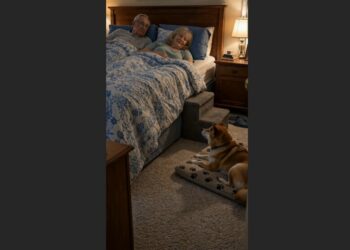
Daisy slept beside me that night.
I barely slept at all.
I kept one hand on her body, feeling the small rise and fall of her breathing.
For years, I had fallen asleep without thinking about the fact that she was there.
Now I could think about nothing else.
By morning, her condition had worsened.
She still would not eat.
She would not drink.
She could not stand without help.
I remember looking at her and feeling that she had reached a point I did not want to acknowledge.
It would be too much to claim Daisy understood what was going to happen or was asking me, in human terms, to make a decision.
What I could see was that she was profoundly weak.
Her body was no longer doing the things it had done even a few days earlier.
We called the veterinarian and took her back.
The Last Car Ride Brought Me Back to the First One
The drive was quiet.
I held Daisy the whole way.
My mind kept returning to the first time I carried her upstairs 13 years earlier.
She had been so small.
So tense.
So uncertain.
I had thought I was giving her a safe place for a few weeks while someone else figured out the rest of her life.
Instead, she had become part of mine.
I remembered the storage bin.
The laundry-room floor.
The couch.
The nights when she slept against my legs.
The children learning to pet her gently.
The backyard.
The leaves she used to chase.
The stairs I later carried her up.
A whole life reduced itself to images that passed through my head faster than I could hold onto them.
At the veterinary office, we stayed with her.
I Talked to Her Until the End
The veterinarian helped us understand where Daisy was medically and what comfort meant at that point.
Her kidney failure was severe.
She was not eating or drinking.
She could no longer stand on her own.
Continuing treatment did not guarantee recovery, and keeping her comfortable had become the most important concern.
We made the decision no one who loves an old dog wants to make.
I held Daisy.
I talked to her.
I told her she was loved.
I told her she was safe.
I told her she did not have to be afraid.
Whether she understood the words themselves did not matter.
She knew my voice.
She knew my scent.
She knew the feel of being held by someone who had carried her thousands of times before.
Daisy died in my arms.
The dog I thought I would keep for a month had stayed for 13 years.
In the end, I was holding her almost exactly the way I had on the night I first brought her upstairs.
Only this time, there was nowhere else for us to go.
The House Became Quiet in Specific Places
Several weeks have passed.
Grief has not made the house completely silent.
The children are still here.
There are still dishes, footsteps, doors, television noise, homework, conversations, and all the ordinary sounds of family life.
But some places are quiet in ways they were not before.
Daisy’s bed is still in the corner.
Her bowl is still in the kitchen.
I sometimes step around the place where she used to sleep before remembering there is no reason to.
At night, my eyes still move toward the end of the bed.
For 13 years, Daisy occupied that space in one form or another.
A warm body against my legs.
A white face on the pillow.
A small shape curled into herself.
Now the space looks larger than it ever did when she was in it.
Old Habits Outlast the Dog
I scroll through photographs more than I expect to.
Daisy asleep in sunlight.
Daisy beside the children.
Daisy with messy fur and half-closed eyes.
Daisy in the backyard.
Daisy younger than I remember her being.
I do not cry every time anymore.
But grief is unpredictable.
A sound can bring it back.
The faint memory of nails on the floor.
The rustle of a snack bag.
The habit of looking down before moving a chair.
Sometimes I think I hear the little sigh Daisy made when she had finally found the right sleeping position.
For years, those details were too ordinary to notice.
Now they are the things I miss most.
She Was Never Temporary
I do not know what dogs understand about permanence.
I do not know whether Daisy understood that the first house she lost would be replaced by a home she would keep for the rest of her life.
I cannot know whether she thought in terms like forever, family, or belonging.
Those are human words.
What Daisy knew was more immediate.
The same door.
The same people.
The same bed.
The same backyard.
Meals arriving.
Hands she recognized.
Children growing taller.
A familiar voice coming home at the end of the day.
Those repetitions became her life.
And she became ours.
For years, I thought of the third night in the laundry room as the moment Daisy learned to trust me.
Now I see it differently.
I was learning something too.
I was learning that a temporary decision could become a responsibility.
That responsibility could become routine.
And routine, repeated long enough, could become love.
The Place Beside Me Is Empty Now
There are still moments when I imagine Daisy young again.
Not because I believe love can undo age or illness.
It cannot.
Her body grew old. Her hearing faded. Her eyes clouded. Her kidneys failed.
Those things were real.
But memory does not have to obey the final version of someone you loved.
Sometimes I remember the senior dog who needed help with the stairs.
Sometimes I remember the white-faced dog sleeping in the yard while the children played.
And sometimes I remember the scruffy puppy who finally stepped out from behind a storage bin and crossed the floor toward me.
That image stays with me more than any idea of an afterlife.
One small step.
Then another.
A frightened dog deciding, for reasons I could never fully know, that coming closer felt safe enough.
Thirteen years later, I was still beside her.
The bed is emptier now.
The house has one less set of footsteps.
Her bowl remains in the kitchen because I am not ready to move it.
But when I think about Daisy’s life, I no longer think first about how it ended.
I think about the rainy afternoon when I agreed to keep her for a little while.
A few weeks.
Maybe a month.
Just until someone better came along.
No one ever did.
And eventually, I understood why.
She was already home.
Editor’s Note: The characters in this story are fictional. Through these stories, we hope to share the intelligence, loyalty, compassion, and loving nature of dogs with people everywhere.