Luna didn’t run to the front of her kennel when visitors arrived.
She didn’t jump against the gate.
She didn’t bark for attention or wag her tail as families walked through the shelter.
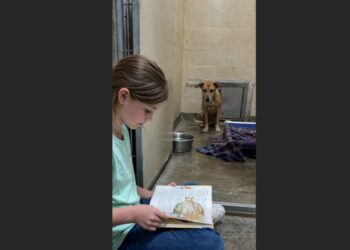
She stayed near the back wall, keeping her body low and watching people from a distance.
And because she rarely approached anyone, most visitors passed her by.
The shelter volunteers had been caring for Luna for so long that some of them had quietly changed the way they talked about her future.
They used to say, “When Luna gets adopted.”
Now, more often, it was, “If Luna gets adopted.”
Not because she was aggressive.
Not because she was difficult.
Luna was a gentle dog.
She was simply frightened.
And in a shelter filled with animals eager to greet visitors, a quiet dog hiding at the back of her kennel was easy to overlook.
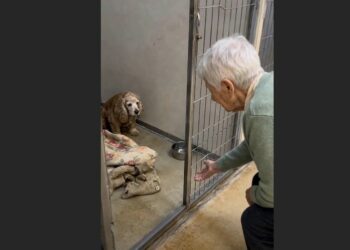
Then, on a Tuesday afternoon, a woman named Linda stopped outside Luna’s enclosure.
She hadn’t come to the shelter intending to adopt anyone that day.
She only wanted to look around.
Maybe ask a few questions.
Maybe come back another time when she felt more prepared.
But when she saw Luna watching her from the shadows, Linda stopped walking.
She didn’t try to make the dog come forward.
She didn’t ask why Luna wasn’t acting like the others.
She simply stood there for a while.
And before the afternoon was over, Linda made a decision the shelter staff had been hoping someone would make.
She was taking Luna home.
That evening, Linda showed her new dog the quiet house she’d prepared.
There was a comfortable bed.
Fresh water.
A bowl of food.
But Luna ignored everything.
She walked into the kitchen, lowered her body, and disappeared beneath the table.
Linda didn’t pull her out.
She sat on the floor a few feet away and placed one open hand on the ground.
“Luna,” she whispered, “it’s okay. Take your time.”
For several minutes, the frightened dog didn’t move.
Then her nose appeared from beneath the table.
One paw followed.
And what happened next was the smallest gesture Linda could have hoped for.
But it was enough to make her eyes fill with tears.
The Dog at the Back of the Kennel
At the shelter, Luna had developed a familiar routine.
When the hallway was quiet, she rested near the back of her kennel.
When people approached, she raised her head and watched.
She noticed footsteps.
Hands reaching toward gates.
Voices coming from unfamiliar visitors.
And the movement of people walking past.
But she rarely came forward.
Her body remained low.
If someone spoke loudly, she often retreated farther into the corner.
Sudden movements made her turn away.
The shelter employees understood that Luna wasn’t trying to be unfriendly.
She appeared uncomfortable around unfamiliar people and needed more time than many visitors were prepared to give her.
But the shelter was busy.
Families came looking for dogs they could imagine bringing home.
Some wanted an affectionate companion who would approach immediately.
Others wanted an energetic dog who was eager to play.
Luna couldn’t offer that kind of first impression.
She didn’t seem ready to trust a stranger within a few minutes.
So people would read the information on her kennel.
Look toward the back where she was resting.
Offer a sympathetic smile.
And continue walking.
Then another family would arrive.
And the same thing would happen again.
When “When” Became “If”
The volunteers cared about Luna.
They knew she was gentle.
They understood that a frightened dog could behave very differently once she became comfortable in a suitable home.
But the longer Luna remained at the shelter, the more concerned they became.
They’d seen other dogs arrive and leave.
Confident dogs.
Playful dogs.
Dogs who seemed to know exactly how to attract a visitor’s attention.
Luna remained.
She wasn’t doing anything wrong.
But she was missing the moments when potential adopters formed their first impressions.
Many people wanted a connection they could recognize immediately.
A wagging tail.
A friendly approach.
A dog leaning into their hand.
Luna’s fear made those moments difficult.
Eventually, some volunteers stopped speaking confidently about when she’d find a home.
They began wondering whether she would find one at all.
It wasn’t a judgment of her worth.
It was the worry that comes from watching an animal wait while people repeatedly choose someone else.
Luna still deserved a family.
Someone who understood that fear wasn’t the same as rejection.
Someone who wouldn’t expect affection immediately.
And someone willing to give her time.
That person walked into the shelter on a Tuesday afternoon.
Linda Had Only Planned to Look
Linda wasn’t expecting to leave with a dog.
She’d come to the shelter to explore the possibility of adoption.
She wanted to see the animals.
Learn about the process.
And think carefully before making a commitment.
She knew that adopting a dog involved responsibilities.
Regular meals.
Veterinary care.
Exercise.
Training and patience.
And a willingness to make room for another living creature in her daily life.
She didn’t want to make an impulsive decision.
So she walked slowly through the shelter, looking at the dogs and reading the information posted on their kennels.
Some greeted her enthusiastically.
Others watched with interest.
Then she reached Luna.
The dog was resting near the back wall.
She didn’t move toward the gate.
She simply watched Linda.
Something about her quiet behavior made Linda stop.
There wasn’t a dramatic exchange.
No excited bark.
No tail wag.
Not even an attempt to approach.
Just a frightened dog looking toward an unfamiliar woman.
Linda remained there longer than she’d expected.
And for the first time that afternoon, she began thinking seriously about bringing a particular dog home.
The Dog Who Didn’t Ask for Attention
Linda watched Luna carefully.
The dog appeared to notice every movement in the hallway.
When someone walked past, her eyes followed.
When a sound came from nearby, she became more alert.
She didn’t seem interested in attracting attention.
If anything, she appeared to prefer being left alone.
Linda wondered what had made her so cautious.
She didn’t know Luna’s full history.
And she didn’t assume that every frightened dog must have experienced deliberate cruelty.
Dogs can become fearful for many reasons, including unfamiliar environments and stressful changes.
What Linda knew was what she could see.
Luna was uncomfortable.
And she wasn’t ready to approach a stranger simply because that stranger wanted to meet her.
Linda didn’t take it personally.
She didn’t think Luna was unloving.
She simply recognized that this dog might need a different kind of introduction.
So she stayed outside the kennel without demanding anything.
Luna continued watching from the back.
They didn’t touch.
They didn’t play.
But Linda didn’t walk away.
What the Shelter Staff Told Her
When Linda asked about Luna, the staff were honest.
They explained that she was sweet but very nervous.
She had difficulty feeling comfortable with unfamiliar people.
And she might need considerable time to adjust to a new home.
They didn’t promise that bringing her into a quiet house would immediately solve everything.
They wanted Linda to understand what adoption might actually look like.
Luna might not run happily through the doorway.
She might not climb onto the couch for affection.
She might refuse to approach her food while someone was nearby.
She might choose a corner or hide beneath furniture.
And she might need many calm, predictable experiences before she began to relax.
Linda listened.
These weren’t the things she’d imagined when she’d considered adopting a dog.
Most people picture the happy beginning.
The ride home.
The first walk.
A dog curling up in a new bed.
But Luna’s beginning might look very different.
There might be no joyful greeting.
No immediate affection.
And no clear sign that she understood she’d reached a permanent home.
Linda considered all of that.
Then she looked toward Luna again.
The dog was still at the back of her kennel.
Linda made her decision.
“I’ll Give Her Time.”
The staff wanted to be certain Linda understood the responsibility.
A fearful dog needed more than sympathetic feelings.
She needed a suitable environment.
Consistent care.
And someone prepared to recognize when she was uncomfortable.
Linda understood that Luna might not become affectionate within a few days.
She might need weeks or longer.
There could be setbacks.
Some days might be easier than others.
And there was no guarantee Luna would ever behave like the outgoing dogs Linda had passed earlier.
But Linda wasn’t choosing her because she expected instant affection.
She wanted to give Luna the opportunity to become comfortable in a home.
Without having to perform for strangers.
Without constantly hearing unfamiliar dogs barking.
And without needing to approach a kennel gate to attract someone’s attention.
After discussing Luna’s needs and completing the adoption arrangements, Linda prepared to take her home.
For the shelter workers, it was a moment they’d hoped would come.
The quiet dog who had waited so long was leaving.
For Luna, however, the change was just beginning.
She couldn’t know what the adoption meant.
She only knew that another unfamiliar experience was happening.
The First Evening
When Linda brought Luna into her house, she tried to keep everything calm.
She didn’t invite people over to meet the new dog.
She didn’t expect Luna to explore every room.
And she didn’t insist on showing her all the comfortable places available.
She had prepared the basic things Luna needed.
A soft bed.
Water.
Food.
A quiet environment where she could begin adjusting.
Linda hoped the dog would become curious.
Perhaps she’d sniff around.
Maybe she’d investigate her bed.
Or find a comfortable place to lie down.
But Luna had other ideas.
She stepped inside with her body held low.
She looked around cautiously.
Then she moved toward the kitchen.
Before Linda could do much more than watch, Luna slipped beneath the table.
She pressed herself into the sheltered space.
And stayed there.
Linda stopped a few feet away.
The new bed remained untouched.
The food was still in the bowl.
And the dog she’d just adopted was hiding beneath her kitchen table.
The Bed That Stayed Empty
Linda looked toward the bed she’d prepared.
It was soft and comfortable.
Exactly the kind of place she’d imagined Luna might enjoy.
But the dog hadn’t even investigated it.
Instead, Luna had chosen the space beneath the table.
Linda understood why it might appeal to her.
The table provided some cover.
It kept her away from the middle of the room.
And it allowed her to watch the surroundings without feeling completely exposed.
It wasn’t the comfortable first evening Linda had imagined.
But it was the first evening Luna was capable of managing.
So Linda left the bed where it was.
She didn’t try to lure Luna out by moving it closer.
She didn’t reach beneath the table to pull her into the open.
And she didn’t insist that Luna needed to understand immediately that everything was safe.
She decided the bed could wait.
There would be another opportunity tomorrow.
And another after that.
For now, Luna had found somewhere she wanted to stay.
Linda would respect that choice.
The Food Bowl
The food remained untouched too.
Linda noticed it.
She’d hoped Luna would eat after arriving.
But the dog was too uncertain to approach.
Linda knew an animal adjusting to unfamiliar surroundings might temporarily hesitate around food.
She would need to monitor Luna carefully and seek veterinary guidance if eating difficulties continued.
But she also understood that repeatedly pushing food toward a frightened dog could create more pressure.
So she left the bowl accessible.
Fresh water remained available.
And she allowed Luna the opportunity to approach when she felt comfortable.
Linda wasn’t trying to prove how quickly she could help.
She was beginning to learn what Luna needed.
The first lesson was simple.
Don’t force the dog to behave as though she’s already settled.
Give her room to adjust.
And notice what makes her uncomfortable.
Linda looked toward the table again.
Luna was still watching.
Her eyes followed Linda’s movements.
But she didn’t come out.
Not yet.
Linda Sat on the Floor
After a while, Linda lowered herself onto the kitchen floor.
She chose a place several feet from the table.
Not so close that Luna would feel crowded.
Not so far away that she couldn’t see her.
Then Linda settled quietly.
She rested an open hand on the floor.
Palm facing upward.
There was nothing in it.
No toy.
No leash.
No attempt to trick Luna into coming closer.
Just her hand.
“Luna,” she said softly, “it’s okay.”
The dog watched.
“Take your time.”
Linda stopped speaking.
She didn’t repeat Luna’s name over and over.
She didn’t call excitedly or reach beneath the table.
She simply waited.
For several minutes, nothing changed.
Luna remained in the shadows.
Linda could see her eyes.
She noticed the cautious way the dog watched every movement.
And she reminded herself of what the shelter staff had said.
Luna was gentle.
But she needed time.
So Linda gave her time.
The Silence Between Them
The kitchen was quiet.
Linda sat on the floor.
Luna remained beneath the table.
There was no obvious sign of progress.
No excited tail wag.
No sudden approach.
No affectionate greeting.
A person expecting an immediate connection might have become discouraged.
Linda didn’t.
She understood that Luna was experiencing a major change.
Everything familiar about the shelter had been replaced by a new environment.
The rooms were different.
The smells were unfamiliar.
And the person sitting nearby was someone she’d only met that afternoon.
Linda couldn’t know what Luna was thinking.
But she could see that the dog was cautious.
She didn’t need to turn that caution into a problem that had to be solved immediately.
For a while, she simply remained still.
The food could wait.
The bed could wait.
And Luna could stay beneath the table for as long as she needed.
Linda wasn’t in a hurry.
She had brought Luna home because she was willing to offer something the dog hadn’t received from most shelter visitors.
Patience.
The First Movement
After several minutes, Linda noticed a small change.
Luna’s nose moved forward.
Just a little.
The dog remained beneath the table.
But she seemed interested in the hand resting on the floor.
Linda didn’t move.
She kept her breathing steady and her body relaxed.
Luna stretched her nose forward slightly farther.
Then stopped.
Linda waited.
A moment later, one of Luna’s paws shifted.
The movement was small enough that someone standing across the room might not have noticed.
But Linda saw it.
She wanted to encourage her.
She wanted to say something cheerful or reach a little closer.
Instead, she remained quiet.
Luna had taken the initiative.
Linda didn’t want to interrupt that.
After another pause, the dog moved her paw forward.
Then stopped again.
She was still mostly beneath the table.
Still cautious.
But she was moving toward Linda.
And that was more than Linda had expected on their first evening together.
One Paw, Then Another
Luna’s movements were slow.
She extended her nose toward the open hand.
Then shifted one paw.
Her body remained low.
Linda continued sitting quietly.
There was no pressure to finish crossing the distance.
If Luna changed her mind and withdrew, Linda would allow it.
She reminded herself that choosing to approach was different from being pulled toward someone.
She wanted Luna to have that choice.
The dog paused again.
Her eyes remained fixed on Linda.
Then she moved a little closer.
It was difficult to believe that such a small distance could feel so significant.
Only a few feet separated them.
But for a dog who had spent so long withdrawing from unfamiliar people, approaching those few feet required something she hadn’t been able to offer most shelter visitors.
Linda stayed still.
She didn’t reach out.
And she didn’t ask Luna to come closer.
She simply kept her hand open.
The Moment Her Nose Reached Linda’s Hand
Eventually, Luna came close enough to investigate Linda’s hand.
Her nose moved toward the palm.
She sniffed cautiously.
Linda didn’t try to pet her.
She allowed the dog to investigate without interruption.
Then Luna moved her head slightly.
And gently lowered it into Linda’s hand.
For a moment, Linda hardly dared to move.
The dog’s head rested against her palm.
It wasn’t a dramatic embrace.
Luna didn’t climb onto her lap.
She didn’t suddenly become playful.
Her body was still cautious.
But she had chosen to come close.
Linda looked down.
She could feel the quiet weight of Luna’s head.
And for the first time that evening, the dog was allowing contact that she had initiated herself.
Linda’s eyes filled with tears.
She had expected that building trust might take a long time.
She still believed it would.
But this was the first small indication that Luna might eventually feel comfortable in her new home.
A Moment That Lasted Only Seconds
Luna didn’t remain against Linda’s hand for very long.
It was a brief moment.
Almost easy to miss.
A cautious dog lowering her head into an open palm.
Then lifting it again.
But Linda didn’t try to make it last longer.
She didn’t grab Luna when she moved.
She didn’t follow her beneath the table.
She simply allowed the interaction to end when the dog was ready.
That mattered.
Luna had approached voluntarily.
She had investigated.
And she had experienced contact without being restrained or overwhelmed.
Linda wanted to keep future interactions just as predictable.
She didn’t assume the dog would repeat the gesture the next morning.
Luna might need more time.
She might retreat again when she heard an unfamiliar sound.
And she might remain hesitant about eating, resting openly, or moving through the house.
None of that would erase what had happened.
On her first evening, Luna had been frightened enough to hide beneath a kitchen table.
Then she’d chosen to come close enough to rest her head against Linda’s hand.
It was a beginning.
What Luna Hadn’t Learned Yet
Luna didn’t know how long she would live in Linda’s home.
She couldn’t understand the adoption paperwork.
She didn’t know that Linda had chosen her after seeing the way she hid at the shelter.
And she certainly couldn’t understand the promises people make when they adopt an animal.
Those things would have to become meaningful through experience.
Linda would prepare meals.
Maintain a routine.
Provide a comfortable place to sleep.
And continue giving Luna opportunities to explore without unnecessary pressure.
Over time, the dog might learn that the house was familiar.
That the food bowl remained available.
That ordinary household sounds didn’t always signal something frightening.
And that Linda’s movements were predictable.
But those lessons couldn’t be completed in a single evening.
Trust wasn’t something Linda could simply announce.
It would develop through repeated experiences in which Luna felt comfortable enough to participate.
The gesture beneath the kitchen table showed that the process might already be beginning.
Nothing more.
And nothing less.
The Dog Nobody Noticed
At the shelter, Luna’s fear had made her easy to overlook.
Visitors walked past because she didn’t greet them.
They chose dogs who appeared more confident.
Dogs who made the possibility of adoption feel simple and exciting.
Luna had stayed near the back wall, watching.
Her gentle nature wasn’t always obvious during a brief visit.
Linda had done something different.
She stopped.
She listened to what the shelter staff told her.
And she considered whether she could provide the environment Luna needed.
She didn’t adopt the dog because she expected a dramatic transformation.
She knew the adjustment might be difficult.
She knew Luna might spend the first night hiding.
And she accepted that possibility before bringing her home.
Now, sitting on the kitchen floor, Linda was experiencing exactly the kind of beginning the staff had warned her about.
The bed was untouched.
The food remained in the bowl.
The new dog was hiding.
But she’d also seen Luna take a small step toward connection.
For Linda, that was enough reason to keep going.
Not Every Homecoming Looks Happy at First
People often imagine a dog’s first day in a new home as a celebration.
The dog runs through the door.
Investigates every room.
Finds a soft bed.
And settles beside the person who’s adopted them.
Sometimes it happens that way.
But not every animal is ready for excitement.
For some, a new home is simply another unfamiliar environment.
Even when the change is positive, adjusting can be difficult.
Luna wasn’t ready to explore confidently.
She wasn’t interested in toys or affection.
She didn’t understand the bed Linda had prepared.
Instead, she chose the safety of the space beneath the kitchen table.
Linda respected that.
She didn’t measure the success of the adoption by how quickly Luna began wagging her tail.
She didn’t expect the dog to show gratitude.
And she didn’t interpret hiding as a rejection of her kindness.
Luna was frightened.
So Linda responded with calm, predictable behavior.
And when the dog finally approached, she allowed the interaction to happen without forcing anything more.
What Linda Understood About Fear
Linda had been told that Luna was sweet.
She believed the shelter staff.
But she also understood that sweetness doesn’t always appear as immediate affection.
A frightened dog may avoid contact.
She may watch from a distance.
She may need time to determine whether an unfamiliar person is safe to approach.
That doesn’t make her incapable of companionship.
It simply means her comfort needs to be respected.
Linda couldn’t know exactly why Luna had become so nervous.
And she didn’t need to invent an explanation.
She could observe what was happening.
The dog became tense around unfamiliar sounds and sudden movements.
She preferred sheltered spaces.
And she seemed more comfortable when Linda remained still.
Those observations were enough to guide their first evening.
Linda didn’t need to fix Luna overnight.
She needed to begin learning how to care for her.
And Luna needed opportunities to become familiar with that care.
The moment her head rested against Linda’s palm suggested that, under calm conditions, she was capable of approaching.
It was a small but meaningful discovery.
The Open Hand
Linda kept thinking about how little she’d actually done.
She hadn’t offered a complicated training exercise.
She hadn’t tried to persuade Luna to come out by waving a treat.
She hadn’t picked her up or carried her to the dog bed.
She’d simply sat down a few feet away.
Rested her hand on the floor.
And waited.
That was all.
But the choice had changed the interaction.
Luna could decide whether to approach.
She could stop.
She could retreat.
And she could investigate when she felt comfortable.
Eventually, she chose to move closer.
Her nose appeared first.
Then one paw.
Then another cautious movement.
Finally, she rested her head against Linda’s hand.
It lasted only a moment.
Yet it gave Linda a reason to feel hopeful.
Not because she believed the dog’s fear had disappeared.
But because Luna had been given a choice and had become comfortable enough to make it.
The Evening Didn’t Need a Perfect Ending
Linda knew there was still plenty to do.
Luna needed regular care.
She needed time to become familiar with her surroundings.
And if her fear or difficulty eating continued, Linda would need appropriate veterinary or behavioral guidance.
The first evening wasn’t the end of that work.
It was the beginning.
Linda didn’t know how long Luna might continue hiding beneath the table.
She didn’t know when she’d become comfortable using her bed.
Or when she’d begin exploring the house.
Those things would come later, if and when Luna was ready.
For now, she had a frightened dog who’d chosen to approach her once.
Linda didn’t need to turn that into a bigger accomplishment than it was.
The gesture was already meaningful.
After so much time being overlooked at the shelter, Luna had finally been given a chance to adjust to a home without being rushed.
And Linda had begun learning how to give her that chance.
The Tuesday She Was Finally Chosen
Earlier that afternoon, Linda had entered the shelter planning only to look around.
She’d wanted to ask questions.
Meet a few dogs.
And perhaps return when she was ready to adopt.
Then she’d seen Luna.
Quiet.
Nervous.
Resting at the back of her kennel.
The kind of dog people often passed because she didn’t come forward to greet them.
Linda had stopped.
She’d listened to the staff explain that Luna needed time and patience.
Then she’d made a decision.
She would give Luna a home.
The shelter volunteers couldn’t promise that the first night would be easy.
And it wasn’t.
Luna hid beneath the kitchen table.
She ignored her comfortable bed.
She left her food untouched.
But when Linda sat quietly nearby, the dog eventually moved toward her.
One cautious step at a time.
Until her head rested briefly in Linda’s open hand.
It wasn’t the joyful homecoming people often imagine.
But it was something real.
Luna had found a person who was willing to wait.
“Take Your Time, Luna.”
Linda looked down at her hand after Luna lifted her head.
For a moment, she remained seated on the kitchen floor.
The room was quiet.
The dog was still cautious.
The bed remained unused.
And there was no guarantee that tomorrow would be easier.
But Linda was no longer thinking about the happy first-day photographs people sometimes share.
She wasn’t worried that Luna hadn’t run toward her.
She wasn’t disappointed that the dog hadn’t immediately settled onto the couch.
She was thinking about the few feet between the kitchen table and her open palm.
And how carefully Luna had crossed them.
The shelter staff had told her that Luna might need a long time to become comfortable.
Linda had believed them.
Now she understood a little more clearly what that patience would involve.
Not making Luna come closer.
Not demanding affection.
But giving her the opportunity to choose contact when she felt ready.
Linda gently lowered her hand back to the floor.
She didn’t call again.
If Luna wanted to approach, she could.
If she needed to remain beneath the table, that was all right too.
“Take your time, Luna,” Linda whispered.
And she meant it.
The Dog Who Finally Had Someone Willing to Wait
Luna had spent so long at the shelter that the volunteers had begun wondering whether she would ever be adopted.
She was gentle.
But she was frightened.
And her fear made her difficult for visitors to get to know.
She stayed near the back of her kennel.
Watched unfamiliar people approach.
And often turned away when someone moved too quickly.
Linda noticed her on a quiet Tuesday afternoon.
She hadn’t planned to choose a dog.
But she saw Luna.
And instead of expecting an immediate greeting, she stopped long enough to learn about her.
The staff explained that Luna would need time.
They warned that the first evening might be difficult.
Linda adopted her anyway.
And when they arrived home, the staff’s warnings proved accurate.
Luna slipped beneath the kitchen table.
She didn’t eat.
She didn’t use the bed.
She remained hidden, watching.
Linda could have tried to pull her out.
She could have insisted that Luna explore the house or accept affection.
Instead, she sat on the floor.
A few feet away.
She rested her open hand on the ground.
And quietly said:
“Luna, it’s okay. Take your time.”
For several minutes, the dog didn’t move.
Then her nose appeared.
One paw followed.
She paused.
Looked toward Linda.
Then moved a little closer.
Until, finally, she lowered her head into the woman’s open palm.
Just for a moment.
It didn’t mean Luna was suddenly confident.
It didn’t mean she’d forgotten every frightening experience or become comfortable with every part of her new home.
But it meant she’d approached someone voluntarily.
And that was something she’d rarely managed at the shelter.
Linda stayed still and allowed her to move away when she was ready.
They would have other evenings.
Other meals.
Other opportunities to get to know one another.
Nothing needed to be rushed.
The dog who had spent so long hiding at the back of a kennel now had a home where she could adjust at her own pace.
And a woman who understood that affection couldn’t be demanded.
For Luna, the first evening began beneath a kitchen table.
With an untouched bed.
An untouched bowl.
And a room full of unfamiliar things.
But it ended with one small moment of contact.
A frightened dog’s head resting in the hand of someone who had chosen her.
Linda didn’t know what the next morning would bring.
Maybe Luna would still be hiding.
Maybe she’d venture out a little farther.
Whatever happened, Linda intended to keep providing the same quiet care.
Because she hadn’t adopted Luna for the greeting she’d receive on the first day.
She’d adopted her for the life they might gradually build together.
And that first evening, sitting patiently on the kitchen floor, she had already begun.
Editor’s Note: The characters in this story are fictional. Through these stories, we hope to share the intelligence, loyalty, compassion, and loving nature of dogs with people everywhere.