In the first hours after Venezuela’s devastating June 2026 earthquakes, rescuers moved through landscapes that barely resembled the neighborhoods people had known the day before.
Concrete floors had collapsed onto one another.
Walls had disappeared.
Homes had been reduced to piles of broken masonry, twisted metal, furniture, dust, and shattered glass.
Every opening had to be treated carefully.
Every sound mattered.
Then, while searching through the wreckage of one collapsed structure, rescuers found another survivor.
Not a person.
A dog.
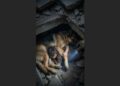
Video from the rescue showed workers reaching the trapped animal through the debris, giving him water before carefully removing him from the wreckage and carrying him to safety. The footage spread quickly after being reported by outlets including the Times of India and other international news organizations.
In the middle of a disaster where thousands of families were desperately waiting for news, the rescue lasted only a few minutes on video.
For the dog underneath the rubble, those minutes meant everything.
Two Powerful Earthquakes Struck Within Moments of Each Other
The disaster began on June 24, 2026.
A magnitude 7.2 earthquake struck northern Venezuela, followed less than a minute later by an even stronger magnitude 7.5 quake, according to the U.S. Geological Survey. The shaking caused widespread structural damage across northern and central Venezuela, with Caracas and the coastal state of La Guaira among the areas hit especially hard.
Buildings collapsed.
Roads were damaged.
Electricity and communications failed in many places.
Hospitals were overwhelmed.
Thousands of people were initially listed as missing or unaccounted for as families searched shelters, hospitals, streets, and piles of debris.
In La Guaira, entire sections of residential buildings had fallen.
Across affected neighborhoods, professional rescue teams worked alongside residents who sometimes searched with whatever tools they could find.
And among all those missing lives were animals.
Dogs.
Cats.
Birds.
Pets suddenly separated from families when doors broke open, walls collapsed, or terrified people fled buildings during the shaking.
The Dog Was Found Among the Wreckage
One of the early animal-rescue videos emerged the day after the earthquakes.
Reports described rescuers working through the remains of a collapsed structure when they located a mixed-breed dog trapped beneath debris.
The animal could not simply walk out.
Concrete and other wreckage surrounded him.
Rescuers had to clear enough material to reach him without causing additional collapse.
At least one report said a team of roughly ten rescuers took part in the effort.
Before attempting the final extraction, they gave the dog water while he remained trapped.
That detail became one of the most widely shared parts of the footage.
A hand reaches through the broken structure.
Water is offered.
The dog drinks.
Then the work continues.
Water Came Before Celebration
The rescuers did not treat the discovery as though finding the dog automatically meant the danger was over.
He had been trapped after a major earthquake.
They did not know how dehydrated he was.
They did not know whether he had injuries that were not immediately visible.
And unstable debris remained around him.
So the rescue proceeded carefully.
Video published by international outlets shows responders giving the dog water while continuing to remove material around him. One rescuer can reportedly be heard encouraging the animal as the team works closer.
Eventually, they created enough room to lift him free.
The dog was carried away from the wreckage.
After hours surrounded by debris, he was finally above ground again.
Nobody Needed to Know His Name Before Helping Him
The early reports did not identify the dog’s family or give a confirmed name.
That did not change the response.
He was alive.
He was trapped.
That was enough.
In large disasters, rescue teams must constantly make difficult decisions about where to work, how to enter unstable structures, and which hazards they can safely manage.
Human life understandably remains the central priority of urban search and rescue.
Still, when animals are encountered and can be reached safely, rescuers often help them too.
They are part of the affected population.
They may be injured.
Disoriented.
Dehydrated.
Separated from the only homes and people they know.
In this case, once rescuers found the dog, leaving him under the rubble was not an acceptable ending.
The Footage Captured Only a Small Part of the Work
A rescue video compresses time.
Viewers see the hand offering water.
The workers shifting debris.
The dog being carried out.
Then the clip ends.
What the camera cannot easily show is the risk assessment behind every movement.
After an earthquake, collapsed structures can remain unstable.
Concrete slabs may be supported by small pieces of debris.
Removing the wrong object can shift weight elsewhere.
Aftershocks can arrive without warning.
Sharp metal, broken glass, gas leaks, damaged electrical systems, and unstable walls add additional dangers.
That is why rescuers do not simply climb into every opening.
Finding a survivor is only the first problem.
Reaching that survivor without creating another collapse is the next.
The Dog Was One of Several Animals Found Alive
As search efforts expanded after the earthquakes, more stories involving animals began emerging.
Dogs and cats were found in damaged homes and collapsed residential complexes.
International rescue teams arriving in Venezuela encountered pets alongside human survivors.
One widely reported later rescue involved a dog found alive in the ruins of Residencias Karina in Caraballeda, La Guaira, more than four days after the earthquakes.
Salvadoran search-and-rescue teams located that dog after hearing signs of life from inside the collapsed building. Authorities said the animal appeared to be in surprisingly good condition and publicly asked the owner to come forward with photographs or video proving ownership.
Another dog, later identified as Giselle, was also pulled from rubble after days trapped following the disaster.
The videos began forming a parallel record of the earthquake.
Not separate from the human tragedy.
Part of it.
Pets Can Become Invisible Casualties After Disasters
When buildings collapse, families do not always have time to gather animals.
A frightened dog may run through an open door.
A cat may disappear into a damaged structure.
A carrier may be left behind during an emergency evacuation.
An owner may be hospitalized without anyone knowing a pet remains at home.
Other animals become trapped in exactly the same way people do.
Under floors.
Behind walls.
Inside apartments whose entrances no longer exist.
Their difficulty is obvious.
They cannot tell responders their address.
They cannot explain how many hours they have been trapped.
They cannot say whether their owner escaped.
They cannot point toward an injury.
Sometimes the only evidence that an animal is still alive is movement or sound from somewhere rescuers are already searching.
The Dog Did Not Have to Understand Rescue
It is tempting to describe the moment as the dog realizing that people had finally come to save him.
We cannot know that.
A frightened animal trapped beneath wreckage is responding to immediate sensations.
Noise.
Movement.
Human voices.
Thirst.
Hands approaching.
The opening around him becoming larger.
What the video does show is something concrete.
He accepted water.
Rescuers kept working.
Then they carried him out.
That is enough.
No human interpretation of courage or gratitude is necessary to make the scene moving.
The dog had survived the collapse.
Then people reached him before the rubble became his final resting place.
Search Teams Had Far More Work Ahead
The rescue of one dog could not change the scale of the disaster.
By the days that followed, casualty figures rose dramatically as crews entered more damaged areas and debris was removed.
The June 24 earthquakes became one of Venezuela’s worst natural disasters in generations.
Search teams from Venezuela and numerous foreign countries joined the effort, bringing trained personnel, specialized equipment, medical teams, and search dogs.
NASA later documented substantial ground displacement around Caracas and La Guaira using satellite radar imagery, illustrating the extraordinary physical force involved.
The dog rescue occurred against that enormous background.
That context is important.
The moment was hopeful precisely because so much around it was not.
Rescue Dogs Were Searching Too
There was another canine presence throughout the disaster.
Working search dogs.
Teams arriving from other countries brought trained dogs capable of locating human scent in collapsed structures.
Those animals worked beside handlers through unstable environments while human crews followed their alerts and used engineering knowledge and tools to reach potential survivors.
Search dogs do not perform the entire rescue.
They are one part of a larger system.
Handlers interpret their trained behavior.
Structural specialists determine safe access.
Rescue crews move debris.
Medical teams take over when survivors are reached.
Throughout Venezuela, those systems operated alongside residents searching for family members with their own hands.
Meanwhile, other dogs were on the opposite side of the operation.
Not searching.
Waiting to be found.
Every Animal Rescue Also Raises Another Question
Where is the family?
A dog pulled from earthquake debris may have survived when an owner did not.
Or the owner may be hospitalized.
Living in an emergency shelter.
Searching from another part of the city.
Unable to return because authorities have closed the neighborhood.
That makes post-disaster animal care more complicated than simply removing a dog from rubble.
Animals need somewhere secure to go.
They need veterinary evaluation.
Identification should be checked when possible.
Photographs can be circulated.
Microchips may help.
Temporary foster systems may be necessary until families can be located.
Local animal advocates in Venezuela organized food and assistance for pets after the earthquake, while rescuers tried to keep recovered animals safe until owners could be identified.
The rescue itself may last minutes.
Reunion can take far longer.
The Video Spread Because the Gesture Was So Simple
Give him water.
Clear a path.
Lift him out.
There was nothing elaborate about the final sequence.
That simplicity may explain why so many people responded to it.
A natural disaster can become difficult to comprehend once the numbers become enormous.
Thousands injured.
Thousands dead.
Buildings destroyed.
Neighborhoods displaced.
People still missing.
Statistics are necessary, but they can also become overwhelming.
Then a camera shows one living animal beneath broken concrete.
One cup of water.
One pair of human hands.
One dog being carried out.
Suddenly, the scale becomes personal again.
Compassion Did Not Distract From the Human Rescue
After disasters, animal rescues sometimes draw criticism from people who ask why time is being spent on pets when humans remain missing.
In practice, the situations are rarely that simple.
Rescue operations are distributed across many teams.
Animals are often discovered while crews are already examining structures.
Removing an accessible animal does not mean abandoning human search operations elsewhere.
Animals can also provide information about survivable spaces inside collapsed buildings.
Most importantly, professional teams make these decisions on scene, based on safety, access, resources, and immediate conditions.
The rescuers in this video encountered a living dog they could reach.
So they reached him.
Then they continued their work.
The Disaster Changed Thousands of Human and Animal Lives at Once
An earthquake does not distinguish between a bedroom and a kennel.
Between a hospital and an apartment.
Between the family inside a building and the dog sleeping near their door.
When the ground moves violently enough, the routines that make a home understandable disappear in seconds.
Doors no longer lead where they did.
Walls collapse.
Familiar smells become buried beneath dust.
People flee.
Animals run.
For a dog trapped in that environment, the world does not need to be understood in terms of tectonic plates or emergency declarations.
Everything familiar simply changes at once.
Then there are voices in the rubble.
Hands.
Water.
Light.
The Rescue Was Real Enough Without Embellishment
There is no need to say the dog consciously refused to surrender.
No need to claim he waited with faith that rescuers would eventually find him.
No need to invent an owner or a dramatic reunion if one has not been documented.
The verified details already carry weight.
Two enormous earthquakes struck Venezuela on June 24.
The following day, rescuers found a dog alive beneath collapsed debris.
They worked carefully around him.
They gave him water.
Then they removed him alive and carried him to safety.
That is the story the video preserves.
Sometimes Survival Is Quiet
There are rescue stories built around shouting.
Sirens.
Crowds cheering.
People calling names into ruins.
This one had another image at its center.
A dog beneath broken concrete, drinking water from someone who had stopped searching long enough to help him.
He could not explain what hurt.
He could not tell the rescuers whether someone else had been beside him before the building came down.
He could not tell them where his family had gone.
He was simply alive.
In a disaster zone, that fact is an instruction.
Keep going.
The Hands That Found Him Did Not Ask Whether His Life Was Important Enough
They already had their answer.
They gave him water.
Made space around his body.
Lifted him from the wreckage.
Then carried him away from the building that had nearly become his grave.
Elsewhere, teams continued calling for human survivors.
Families continued waiting.
Other animals remained missing.
The earthquake recovery would continue for months and years.
But for one brief moment beneath a collapsed structure, the enormous disaster narrowed to a task small enough to understand.
There was something alive under the rubble.
Someone found it.
And they did not leave it there.
That is why the video still matters.
Not because rescuing one dog changed the catastrophe.
Because in the middle of a catastrophe too large for any one person to fix, rescuers still made room for one more life.
And one more life made it out.