Seven families took Jasper home.
Seven families brought him back.
By the time the shelter stopped listing him for adoption, the Labrador mix had already learned what it meant to leave through the front doors and return through them again.
Sometimes the stay lasted a few weeks.
Once, only eleven days.
Another adoption ended in less than ten.
Jasper was not young or conventionally handsome. One eye was cloudy. Part of an ear was missing. A slow-growing tumor rose from his shoulder and became more noticeable as the years passed.
Visitors saw those things immediately.
Many moved on.
Yet whenever a frightened puppy arrived at the rural Tennessee shelter, crying or trembling in an unfamiliar kennel, Jasper behaved differently.
He moved toward the bars.
He waited.
If a volunteer opened his enclosure, he walked over to the newcomer and quietly lay down.
More than 300 puppies would eventually spend some of their first difficult shelter nights beside him.
Most went on to families.
Jasper never did.
He died at 19 in Kennel 14B, the place that had become his permanent home.
But by then, the dog nobody had managed to keep had helped hundreds of younger dogs learn that an unfamiliar place did not always have to be frightening.
Jasper Arrived in 2009 With Injuries People Noticed First
Jasper came to the small shelter in rural eastern Tennessee in early 2009.
He was believed to be about four years old.
Physically, he was sturdy.
A Labrador mix with the broad body and calm expression that might have made him easy to overlook in another setting.
But several features stood out.
His left eye was cloudy, likely from an old untreated infection.
Part of his right ear had been torn away.
Most noticeable was a lump protruding from one shoulder.
A veterinarian examined it and determined that the tumor appeared to be growing slowly and did not pose an immediate danger.
Jasper was comfortable.
He could walk.
Eat.
Rest.
Interact normally.
Still, shelter visitors noticed the lump.
And once they noticed it, some stopped seeing much else.
His First Adoption Lasted Eleven Days
In March, a family chose Jasper.
Staff hoped the older dog had finally found somewhere permanent.
Eleven days later, he came back.
The family left a note explaining that his cloudy eye frightened their children.
Jasper returned to the shelter routine.
A kennel.
Food bowl.
Walks.
Volunteers.
Then another family showed interest.
This one kept him for several weeks.
They returned him because the tumor made them uncomfortable.
A third family took Jasper home.
He was back in fewer than ten days.
Their explanation was shorter.
“He wasn’t what we had hoped for.”
Seven Attempts Ended the Same Way
Over the next two years, Jasper went through seven adoptions.
Every one ended with a return.
There was no single dramatic incident.
No report that he had bitten someone.
No destructive behavior that made him impossible to manage.
Instead, the reasons centered on appearance, discomfort, expectations, and fit.
Each time, staff welcomed him back.
Each time, Jasper settled again into the strange half-life of a shelter dog who had briefly lived somewhere else.
Eventually, workers reached a difficult conclusion.
Repeated adoptions were not helping him.
So after the seventh return, Jasper disappeared from the public listings.
Kennel 14B Became His Permanent Space
The shelter moved him to a quieter rear hallway.
His new space was Kennel 14B.
It was not an adoption success story.
Nobody pretended otherwise.
Jasper had not found a couch.
He did not have a fenced backyard or someone coming home from work every evening specifically to see him.
What he had was consistency.
The same staff.
The same volunteers.
The same hallway.
The same enclosure.
For a dog who had been moved back and forth repeatedly, predictability mattered.
The shelter stopped asking Jasper to prove that he could fit into somebody else’s idea of the right dog.
Then, during his second year there, he found a role nobody had anticipated.
A Litter Arrived Behind a Gas Station
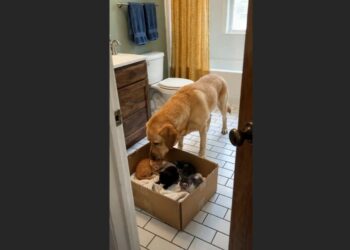
One evening, a volunteer brought in several tiny puppies.
They had been found behind a gas station.
The litter was only a few weeks old.
The puppies were cold, weak, and frightened by everything around them.
They cried constantly.
The unfamiliar smells of the shelter did not help.
Neither did the echo of barking dogs or the absence of the mother they should have been sleeping beside.
Staff warmed them and began providing care.
Still, the crying continued.
Across the hallway, Jasper noticed.
He Pressed Himself Against the Bars
Jasper moved to the side of his kennel closest to the puppies.
Then he leaned against the metal.
He stayed there.
One hour passed.
Then another.
The puppies continued crying.
Jasper did not retreat to the back of his enclosure.
Instead, he remained as close to them as the barrier allowed.
A volunteer watched him for a while.
Eventually, curiosity overcame caution.
She decided to see what Jasper would do if he could get closer.
Jasper Did Not Rush the Puppies
The volunteer opened his kennel.
She guided him toward the litter.
Jasper approached quietly.
Then he lowered himself beside them.
He did not nose his way into the group.
He did not paw at them.
He simply lay there and allowed the puppies to decide what happened next.
One crawled toward his side.
Then another.
Before long, the entire litter had gathered against his body.
Their crying began to fade.
Within minutes, the room sounded different.
He Could Not Replace Their Mother
Jasper could not feed them.
He could not provide everything a mother dog would.
The puppies still needed human care, medical attention, warmth, and proper feeding.
But Jasper could offer something simple.
A warm body.
Breathing beside them.
The smell and presence of another dog.
A place to lean.
For very young animals suddenly removed from familiar surroundings, that kind of physical companionship can matter.
That first night, Jasper stayed.
Then he stayed again.
For nine nights, he rested beside the litter.
When the puppies were ready, they left for adoptive homes.
Jasper returned to Kennel 14B.
The Staff Began Watching Him More Carefully
After that first litter, shelter workers noticed a pattern.
When a frightened puppy arrived, Jasper became attentive.
Sometimes he approached the kennel bars and waited.
Other times, he remained standing near the front until someone noticed.
Once volunteers allowed him near the newcomer, his behavior remained strikingly consistent.
He settled.
He stayed calm.
He let the younger dog decide how much contact it wanted.
A puppy might curl against his chest.
Another might lie several inches away at first, gradually moving closer.
Jasper did not seem to demand interaction.
He made room for it.
“Jasper’s Nights” Became Part of Shelter Life
Eventually, the arrangement became routine.
New puppies, especially those arriving frightened or distressed, sometimes spent their first nights near Jasper.
Staff began calling those evenings “Jasper’s nights.”
The phrase stuck.
Volunteers stopped treating his involvement as an unusual event and began thinking of it as one of the shelter’s useful tools.
Medical treatment cared for a puppy’s body.
Food and warmth addressed immediate physical needs.
Jasper offered something less clinical.
He made an unfamiliar room feel less empty.
Not Every Puppy Arrived the Same Way
Some puppies cried continuously.
Others trembled.
A few flattened themselves against the backs of their enclosures and avoided eye contact.
Some were defensive simply because they were frightened.
Jasper responded in much the same way regardless.
He lay down.
Waited.
Allowed the younger dog to approach.
That mattered because not every scared dog wants immediate contact.
Pushing interaction too quickly can make fear worse.
Jasper seemed naturally inclined toward the opposite approach.
Presence first.
Contact second.
If the puppy chose it.
The Shelter Eventually Stopped Counting Every Visit
At first, volunteers kept individual notes.
Which puppies had spent the night with Jasper.
How they behaved.
How long he stayed.
Over the years, the pattern became so common that detailed records stopped.
The shelter later estimated that Jasper had comforted more than 300 puppies.
The exact number could not be reconstructed.
It had simply happened too many times.
A litter arrived.
Jasper waited.
A volunteer opened his kennel.
Then, sooner or later, a frightened puppy settled beside him.
Many of Those Puppies Left Before Jasper Did
That became one of the quiet realities of his life.
Puppies came into the shelter scared.
They received care.
They grew.
They became more confident.
Then families chose them.
One by one, they left.
Jasper remained.
He did not understand adoption paperwork or why some dogs left while he stayed.
Still, the contrast was visible to the people caring for him.
A puppy could spend its first miserable night pressed against Jasper’s side.
Weeks later, that same puppy might walk out the front door with a family.
Then another puppy arrived.
And Jasper did it again.
Staff Believed His Presence Helped
No one claimed Jasper alone transformed every frightened puppy.
Shelter animals improve for many reasons.
Veterinary treatment.
Reliable food.
Warmth.
Clean bedding.
Human socialization.
Time.
But volunteers repeatedly noticed that some puppies relaxed more quickly in Jasper’s company.
Crying stopped.
Bodies loosened.
A puppy that had remained rigid might finally sleep.
The shelter staff came to believe his companionship played a meaningful part in that adjustment.
Beside Jasper, the puppies did not have to spend their first difficult night alone.
Meanwhile, Jasper Kept Aging
The years changed him slowly.
His eyesight worsened.
The tumor on his shoulder continued growing.
By 2018, it was roughly the size of a lemon.
Veterinarians continued monitoring it.
It did not appear to be causing significant pain.
Still, visitors saw it immediately.
Some people would approach Jasper’s area, notice the mass, and lose interest.
By then, he had not been publicly listed for adoption in years.
Even so, staff could not help noticing the irony.
The feature that made strangers hesitate did not matter to the puppies.
They did not care about his cloudy eye.
Or the torn ear.
Or the lump on his shoulder.
They cared that he was warm and calm.
His Body Slowed Down
As Jasper entered old age, his walks became shorter.
He slept longer.
Standing took more effort.
Staff adjusted his care.
Soft bedding became more important.
So did routine veterinary monitoring.
Some days, Jasper preferred to remain stretched out in his kennel while shelter activity continued around him.
Then a puppy would arrive.
A frightened cry could bring his head up.
Sometimes it brought him all the way to his feet.
He would walk toward the kennel entrance.
Then wait.
The Younger Dogs Seemed to Give Him a Reason to Move
Nobody could know exactly what motivated him.
Perhaps he was simply attracted to the sound of puppies.
Maybe years of repetition had turned their arrival into another familiar routine.
It would be easy to assign him a human sense of duty.
That is unnecessary.
His behavior was enough.
Old joints.
Failing eyesight.
A growing tumor.
Then the sound of a frightened puppy.
Jasper stood.
And if someone opened the gate, he went.
By Nineteen, Time Was Catching Up With Him
In January 2024, Jasper stopped eating.
At first, staff tried familiar foods.
Then different foods.
His appetite did not return.
The veterinarian examined him.
His kidneys were failing.
At 19 years old, his body no longer had much reserve.
He was not showing signs of severe uncontrolled pain.
However, his strength was fading.
Staff understood what that meant.
The dog who had spent roughly 15 years in their care was nearing the end.
His Final Evening Brought One More Puppy
That night, a volunteer arrived with a small gray puppy.
The youngster had been found beneath a bridge.
No mother was nearby.
No littermates had been located.
The puppy was frightened and alone.
Someone brought it toward Jasper.
By then, he did not have enough strength for the old routine.
He did not stand and walk toward the kennel door.
He simply raised his head.
The puppy came closer.
Jasper Gave the Puppy a Gentle Nudge
With his nose, he drew the small dog nearer.
The puppy settled against him.
Jasper lowered his chin onto his front paws.
Then he closed his eye.
There was no dramatic transformation.
No sudden return of strength.
He was an elderly dog with failing kidneys at the end of an unusually long life.
The gray puppy simply remained beside him.
It was the same basic arrangement Jasper had offered hundreds of times.
An older dog.
A frightened youngster.
Two bodies close enough that neither occupied the space alone.
Jasper Died the Following Morning
He was still in Kennel 14B.
The kennel where so much of his life had unfolded.
The shelter workers had known the day was coming.
That did not make the hallway feel normal afterward.
For years, Jasper had been part of the building’s rhythm.
Volunteers knew where to find him.
New employees learned his story.
Puppies spent nights beside him.
Visitors might walk past without realizing how much of the shelter’s history was resting in that rear hallway.
Then one morning, he was gone.
Staff Did Not Want His Life Reduced to Seven Returns
That would have been an easy story to tell.
The dog nobody wanted.
Seven families returned him.
He died in a shelter.
All of those facts were sad.
They were also incomplete.
Jasper’s life had contained something else.
Hundreds of frightened puppies had encountered him during their first uncertain nights.
He had become useful not because somebody trained him for a formal job, but because staff recognized a behavior worth supporting.
So the shelter shared his story.
They kept the description simple.
A dog who had repeatedly been returned.
A permanent kennel.
A habit of comforting puppies.
More than 300 younger dogs helped over the years.
Then people began paying attention.
Donations Arrived in Jasper’s Name
Within weeks, the shelter received enough support to help cover medical treatment for dozens of other dogs.
That part of Jasper’s story felt especially appropriate to the staff.
Health problems had made people hesitate over him.
Now his name was helping animals with medical needs that might otherwise make adoption harder.
A tumor had once been one of the first things visitors noticed about Jasper.
After his death, money given because of him helped other animals receive care.
It did not change what happened to Jasper.
It changed what could happen next.
Then the Shelter Created “Jasper’s Watch”
Staff also decided to preserve the role he had quietly developed.
Older dogs who struggled to attract adopters would be given opportunities to spend supervised time with vulnerable puppies.
The idea was not that every senior dog could become another Jasper.
Temperament mattered.
Safety mattered.
Not every adult dog is comfortable around puppies.
But when the right older dog showed calm, gentle behavior, staff could allow that relationship to help both animals.
They named the program “Jasper’s Watch.”
Kennel 14B Was Retired
The shelter stopped using Jasper’s old enclosure.
A small plaque went onto the door.
His name remained there.
Not because Kennel 14B had been an ideal home.
It had not.
Staff would have preferred Jasper find a permanent family years earlier.
But the kennel had become the place where his unexpected role began.
For volunteers who had known him, using it as though nothing had happened felt wrong.
So they left it empty.
Jasper Never Got the Ending People Usually Want
There was no late-life adoption.
No elderly couple who suddenly saw what everyone else had missed.
No final year sleeping beside someone’s fireplace.
No photograph of him stretched across a family couch.
Inventing that ending would make the story easier.
It would also erase what actually made Jasper’s life unusual.
He stayed at the shelter.
That was the truth.
The Shelter Became the Only Lasting Home He Had
It was not the home workers would have chosen for him.
Still, over the years, Kennel 14B became familiar.
The staff knew him.
Volunteers knew him.
His medical needs were monitored.
His habits were understood.
And somewhere along the way, the dog who repeatedly failed to fit into adoptive homes found a place in the shelter that nobody else occupied.
He became the dog they brought to frightened puppies.
There Is Something Difficult About Watching Other Dogs Leave
Humans naturally imagine what Jasper must have felt each time a puppy was adopted.
We cannot know.
Dogs do not understand adoption the way people do.
Still, they notice changes.
Familiar animals disappear.
Kennels become empty.
New scents arrive.
Old ones fade.
Jasper spent years living through those cycles.
The puppies came.
Stayed beside him.
Then left.
What remained consistent was Jasper himself.
More Than 300 Puppies Went On Without Him
Most of the puppies Jasper comforted eventually entered homes of their own.
Some were probably adopted quickly.
Others may have needed more time.
The shelter did not track every later outcome closely enough to reconstruct all of them.
But staff knew many left calmer than when they arrived.
Jasper had been one small part of that transition.
For a frightened young dog, one peaceful night does not solve everything.
Sometimes it simply makes the next morning easier.
That was enough.
His Appearance Had Once Made People Look Away
The cloudy eye.
The torn ear.
The shoulder tumor.
Those features followed him his entire shelter life.
They were reasons people hesitated.
The puppies never treated them as reasons to stay away.
They climbed against him.
Slept near him.
Leaned into his side.
The things that made humans uncertain did not seem especially important to them.
What mattered was how Jasper behaved.
Slow.
Calm.
Predictable.
Close.
His Last Companion Was Another Dog Who Needed That
The gray puppy under the bridge knew nothing about Jasper’s history.
It did not know seven families had returned him.
It did not know hundreds of puppies had slept beside him before.
It did not understand that the old dog was dying.
It simply found warmth beside him.
Jasper lifted his head.
Nudged the puppy closer.
Then rested.
By morning, his long life was over.
Jasper Never Found a Family Couch
That detail remained painful for the people who loved him.
He spent his final years in a shelter hallway.
No sentimental retelling should pretend that was the same as a permanent adoptive home.
It was not.
Yet his life was not empty because the ending people wanted never arrived.
Meaning can exist inside an imperfect outcome.
Jasper did not get the home staff hoped for.
He still mattered enormously inside the place where he stayed.
Kennel 14B Is Quiet Now
His plaque remains.
The program bearing his name continues.
Somewhere in the shelter, an older dog may lie near a frightened puppy.
The puppy may hesitate at first.
Then inch closer.
Perhaps the crying stops.
Perhaps it sleeps.
Staff may think of Jasper when that happens.
Not as a saint.
Not as a dog who understood some grand mission.
Simply as the old Labrador mix who repeatedly made space beside himself for animals that were scared.
Seven Families Brought Him Back
That will always be part of his story.
But it is no longer the largest part.
Jasper arrived at the shelter at about four years old with a cloudy eye, a damaged ear, and a tumor that made strangers hesitate.
He was adopted seven times.
Returned seven times.
Eventually, the shelter stopped asking him to leave.
Then one evening, a litter of frightened puppies arrived.
Jasper moved close to the bars.
Someone opened the door.
He lay down.
The puppies came to him.
That small event repeated itself for years.
More than 300 puppies eventually passed through nights beside Jasper.
Most found families.
He did not.
At 19, he died in Kennel 14B with one final frightened puppy curled against him.
He never had a family’s couch to stretch across.
Never had a home that lasted beyond the shelter walls.
But hundreds of puppies did.
And before many of them left for those homes, they spent one of their hardest nights beside Jasper.
Editor’s Note: The characters in this story are fictional. Through these stories, we hope to share the intelligence, loyalty, compassion, and loving nature of dogs with people everywhere.