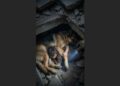
When rescuer Zuly Ventura Vasquez found the mother dog during a bitter Texas cold spell in early 2026, very little of the animal was visible beyond ribs, thin fur, and the curve of her body.
She had wrapped herself tightly around a small white puppy.
The baby’s head barely showed beneath her.
The mother was extremely thin.
She was exposed to the cold.
Yet instead of stretching out or moving away, she remained curled around the puppy, placing as much of her own body as possible between him and the weather.
The two would later be named Leia and Luke.
Their names came from Star Wars, but there was nothing cinematic about the circumstances in which they were found.
They were simply two homeless dogs facing temperatures that could become dangerous very quickly, especially for an underfed adult and a young puppy.
Vasquez understood that leaving them outside was not an option.
She contacted Houston K-911 Rescue.
The organization agreed to take both dogs.
That intervention began a journey that would eventually carry mother and puppy hundreds of miles from Texas to Colorado.
Luke would find a permanent family.
Leia would have a slower path.
For the first time, she had to learn something survival had never taught her.
How to rest.
The Photo Showed a Mother Doing What Dogs Naturally Do
It is easy to look at the image of Leia curled around Luke and give it a human interpretation.
She was “sacrificing everything.”
She “knew she had to save him.”
She had “chosen his life over her own.”
The actual behavior is powerful without needing those conclusions.
Mother dogs instinctively keep young puppies close.
Physical contact provides warmth.
Curling around a puppy reduces exposure to cold air and wind.
A mother’s larger body can help a small puppy maintain body temperature when the environment becomes dangerous.
For Luke, Leia was the warmest shelter available.
For Leia, that meant exposing more of her own already thin body to the cold.
Reports describing the rescue said she was severely underweight when Vasquez found her, with her ribs plainly visible.
Nobody knows how long mother and puppy had been living outside or exactly what happened before that moment.
There is no reliable history showing where Leia came from, whether she had once belonged to someone, or what happened to any other puppies she may have had.
What rescuers could see was enough.
She and Luke needed help immediately.
Houston K-911 Rescue Became Their First Safe Stop
Houston K-911 Rescue describes its work as focused on vulnerable dogs across Texas, including animals with serious medical needs and those found abandoned or neglected.
Leia and Luke fit that mission.
Once they were in rescue care, the dangers became different.
They were no longer trying to stay warm outside, but both needed veterinary attention and time to recover physically.
Reports on their case said their care included treatment for heartworm before they were later cleared to travel.
For Leia especially, recovery could not simply mean putting down a full bowl and expecting her body to rebound overnight.
A dog that has been underweight needs consistent nutrition and veterinary supervision.
Meanwhile, Luke was growing.
The little puppy who had once fit beneath his mother’s body was reaching an age when he could increasingly function independently.
That difference would eventually matter.
Mother and son did not need to remain physically together forever simply because Leia had protected him when he was young.
Puppies grow up.
And once they are old enough, separating them into suitable homes can be perfectly appropriate.
One Photograph Reached Colorado
The image of Leia curled around Luke began circulating online.
Among the people who saw their story were volunteers connected with Up Pup and Away, a Colorado rescue organization that partners with groups in places including Texas to relocate dogs and find foster or adoptive homes.
The organization offered to help.
After their treatment in Texas was complete, Leia and Luke were transferred north.
Several secondary accounts describe the move as a transfer to Colorado, where separate foster arrangements were waiting.
By then, Luke was old enough to be away from his mother.
His transition happened quickly.
His foster family fell for him and decided to adopt him.
The puppy who had once been visible only as a little white head beneath Leia’s belly now had a permanent home.
For Leia, the transition was more complicated.
Her next challenge was not surviving cold.
It was learning how to live indoors.
Tory Shulman Saw Leia’s Picture and Offered to Foster Her
Tory Shulman was among the people moved by the original photograph.
“When I saw the picture, I knew I would be fostering Leia,” she later told The Dodo, according to multiple reports that republished her account.
She described Leia as shy but exceptionally sweet.
That combination is common in rescued dogs whose histories are largely unknown.
A dog can enjoy gentle contact while still being cautious about unfamiliar environments.
It would be easy to say Leia had been “traumatized by humans” or had never lived indoors before.
The public record does not establish either claim with certainty.
What Shulman could observe was how Leia reacted to her new surroundings.
Certain ordinary household features were unfamiliar or difficult.
Smooth floors.
An apartment.
An elevator.
For people, those things hardly register.
For a dog whose recent life had been spent outdoors, each one was another surface, movement, sound, or confined space to interpret.
Leia Needed Time More Than Encouragement
Dogs do not become confident simply because people tell them they are safe.
Safety has to become predictable.
The floor remains beneath your feet.
The elevator opens again.
Meals arrive.
No one forces contact.
The same person returns.
The bed stays where it was yesterday.
Repeated experience does the teaching.
Leia gradually adapted.
Shulman reported that she gained weight and began asking for belly rubs.
More strikingly, she slept.
A lot.
Shulman described it as though Leia had perhaps never had enough opportunity to rest during her life outside.
That observation does not require assuming Leia had consciously spent every night “on guard.”
Street dogs face practical disturbances that make sustained rest harder: weather, noise, traffic, other animals, people, and the need to find food and safe places to settle.
Inside a foster home, Leia could sleep without solving those problems first.
For a dog once photographed curled tightly around her puppy in freezing weather, deep sleep became one of the clearest signs that her circumstances had changed.
Luke’s Adoption Did Not Mean Leia Had Been Left Behind
This is another place where rescue stories can accidentally become unfair.
People sometimes react strongly when a puppy is adopted before his mother.
They imagine the mother wondering why her baby was “chosen” while she was not.
Dogs do form strong maternal relationships when puppies are dependent.
But as puppies mature, that relationship naturally changes.
Luke was old enough to move into his own foster placement.
His family then chose to make the arrangement permanent.
Leia had her own needs.
Her adoption timeline did not have to match his.
Adult rescue dogs can take longer to place than puppies.
Potential adopters consider size, temperament, housing rules, work schedules, other pets, children, activity levels, and a dog’s comfort in different environments.
Waiting longer does not mean Leia had failed.
It means the rescue had not yet found the appropriate match.
Leia Eventually Moved to Another Foster Home
After her time with Shulman, Leia transitioned to another foster placement.
Reports said she adjusted there and lived alongside an older dog.
Shulman remained involved and continued seeing her.
That continuity can help a foster dog without requiring one person to remain the dog’s permanent caregiver.
Foster networks work because multiple people share different stages of care.
One person may handle initial decompression.
Another may provide a household better suited for longer-term placement.
Rescue coordinators manage applications.
Veterinarians handle medical needs.
Transport volunteers move animals between regions.
The public often sees one dramatic photograph and one foster parent’s quote.
Behind that image is usually an entire network.
Leia’s journey involved an independent rescuer, a Texas rescue, veterinary care, interstate transport, Colorado fosters, and eventually an adoption program searching for a permanent household.
No single person “saved” her alone.
By Summer, Leia Looked Very Different
The difference was not simply physical weight.
She had begun participating in ordinary domestic life.
The dog who had once been photographed exposed to extreme cold could sleep inside.
She sought affection.
She learned the elevator routine.
She navigated smooth floors.
She spent time with another dog.
Recent descriptions called her affectionate, gentle, and increasingly comfortable in foster care. Her Petfinder listing through Up Pup and Away described her as an adult female Lab mix who was house-trained and good with dogs.
Those details matter to potential adopters far more than a tragic origin story.
A permanent home is not built from sympathy alone.
It is built from compatibility.
Can the dog manage the household’s routine?
Can the family provide exercise and veterinary care?
Are other pets involved?
How does the dog respond to being left alone?
What environment allows her to settle?
The photograph from Texas explains why people noticed Leia.
Her life in foster care helps determine where she should go next.
As of Recent Updates, Leia Was Still Waiting
By September 14, 2026, a recent report still described Leia as living in foster care and waiting for a permanent adopter, while Luke had already found his family.
An earlier Petfinder listing from Up Pup and Away also showed Leia as available for adoption in Commerce City, Colorado.
Because adoption status can change quickly, those dated updates should not be treated as proof of her status forever.
But they confirm an important part of her story.
Leia’s happy ending was not complete simply because she had left the street.
She was safe.
She was being cared for.
She had people advocating for her.
Yet rescue organizations were still looking for the household that would make that arrangement permanent.
There is value in telling a story at that stage rather than inventing an adoption that has not been confirmed.
Some dogs are still waiting when the article ends.
She Does Not Need Someone to “Repay” Her for Saving Luke
That language appears often in animal-rescue stories.
Leia protected her puppy, therefore someone now owes her a home.
It is emotionally appealing.
Adoption should be based on something more durable.
Leia needs a person or family whose life fits hers.
Someone prepared for an adult dog rather than a puppy.
Someone willing to give her time to learn another environment.
Someone who sees the dog she is now, not only the image of the starving mother she was when rescued.
What Leia did for Luke is part of her history.
It does not have to become her entire identity.
Motherhood was one period of her life.
Once Luke became independent, Leia was free to become something else.
A companion.
A walking partner.
A dog who sleeps late.
A dog who asks for belly rubs.
A dog who may have opinions about elevators.
Rest May Be the Most Meaningful Change of All
The original photograph is dramatic because Leia is doing something.
Her body is wrapped around Luke.
Every part of the image suggests effort.
Hold close.
Stay warm.
Get through the cold.
The foster-home descriptions are moving for the opposite reason.
Leia did not have to do anything.
She slept.
There was food without searching.
Warmth without using her own body as a barrier against the weather.
A safe place did not require constant movement.
For dogs coming from unstable environments, sleep can be easy to overlook as a welfare measure.
Yet quality rest matters.
Dogs need places where they are not repeatedly disturbed.
Where they can stretch out.
Where their bodies do not have to remain ready to respond to every sound.
Shulman’s comment that Leia seemed as though she had never really rested before captures the difference between being alive and being secure.
We cannot know how Leia experienced it internally.
We can see the behavioral change.
She began to relax.
Her Story Also Shows Why Foster Homes Matter
Shelters and rescue facilities save enormous numbers of animals, but a home environment can reveal information that a kennel cannot.
How does the dog respond to stairs?
Apartment noises?
Visitors?
Another dog resting nearby?
An elevator?
Quiet afternoons?
Household routines?
Leia’s foster homes allowed rescuers to observe her beyond the circumstances in which she had been found.
That improves adoption decisions.
It also gives the dog practice with ordinary home life.
Foster care is not always simple.
Dogs may be frightened.
They may have accidents.
They may need medical appointments or slow introductions.
And foster families eventually have to let many of them leave.
But for Leia, temporary homes created a bridge between surviving on a Texas street and eventually living with a permanent family.
The Most Famous Picture of Leia Is Already Outdated
That is a good thing.
In the photograph that introduced her to thousands of people, she is painfully thin.
Curled around Luke.
Cold.
Her body is doing the work of shelter because there is no actual shelter around them.
That image is important because it led people to pay attention.
But Leia should not remain frozen inside it forever.
There are newer versions of her story.
Leia gaining weight.
Leia learning indoor routines.
Leia requesting affection.
Leia sleeping.
Leia walking with her foster family.
Leia living beside another dog.
Those images do not spread as easily because they are less shocking.
They are also what rescue is for.
The goal is not to preserve an animal as a permanent victim whose suffering can be retold.
The goal is to make the suffering old news.
Zuly Ventura Vasquez Started the Chain by Going Out Into the Cold
None of the later steps happen without the first one.
During the cold spell, Vasquez and other rescuers were concerned about animals living outside without reliable shelter.
So they went looking.
That matters.
Leia and Luke were not standing at a shelter entrance waiting to be admitted.
Someone had to find them.
Someone had to assess the situation.
Someone had to make the call.
Vasquez contacted Houston K-911 Rescue because mother and puppy could not safely remain where they were.
Houston K-911 said yes.
Later, Up Pup and Away said yes.
Then foster families said yes.
Eventually Luke’s foster family said yes permanently.
Leia’s story became a sequence of people taking responsibility for the next practical step.
Luke Got What Leia Had Been Trying to Provide From the Beginning
Warmth.
Food.
Safety.
A place to sleep.
A puppy does not understand the concept of a “forever home.”
But Luke could experience its components.
Predictable meals.
People.
Shelter.
Play.
Rest.
His mother’s role had been essential when he was very young.
Later, humans could take over.
That is what successful rescue should accomplish.
The mother no longer has to be the entire safety system for her offspring.
Luke’s foster family became his permanent family.
Leia could stop being defined primarily as his protector.
Both dogs could develop separate lives.
Leia’s Future Should Be About the Dog She Is Now
Recent adoption information describes her as friendly, affectionate, gentle, house-trained, and able to live with other dogs.
Those details are more useful to an adopter than saying she is a heroic mother.
A family considering Leia needs to understand her present needs, energy, preferences, medical history, and behavior.
They need to meet her through the rescue’s process.
Up Pup and Away states that it screens applicants rather than placing dogs on a simple first-come, first-served basis. Applicants may undergo reference checks, phone screening, home checks, and meet-and-greets before a match is approved.
That can feel slow when people see a dog online and immediately fall in love.
But a careful match is worth waiting for.
Leia has already experienced enough change.
Her permanent placement should be chosen for stability, not speed.
The Ending Is Still Being Written
The easiest version of Leia’s story would end with a family arriving immediately and carrying her into a perfect home.
The documented story is less tidy.
Luke has been adopted.
Leia recovered enough to enjoy foster life.
She learned household routines that once seemed unfamiliar.
She gained weight.
She asks for affection.
She rests.
And in the most recent reports available, she was still waiting for the right permanent home.
That does not make her story sad.
It makes it unfinished.
There is a profound difference.
The dog Zuly Ventura Vasquez found during the Texas cold no longer has to lie outside using her own thin body as Luke’s only blanket.
Her puppy is safe.
Leia is safe too.
She has food.
Veterinary care.
Warm rooms.
People who know her habits.
A foster household where sleeping deeply is allowed.
One day, another door may open and the temporary home will give way to a permanent one.
Until then, Leia has already crossed the most important distance.
She no longer has to survive every night before she can begin the next day.
She can simply sleep.