For Nearly a Week, Buddy Refused to Leave the Laundromat
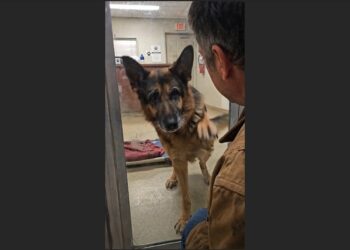
The old Labrador mix had been sleeping beneath the same laundromat awning for almost a week.
People tried to help.
Someone brought food.
Another neighbor left blankets.
A man opened his car door and spent nearly thirty minutes trying to coax Buddy inside.
Nothing worked.
Buddy would eat and drink when hunger or thirst became too strong, but afterward he returned to the same place.
Beside him sat a battered green duffel bag.
Every bus that stopped nearby made his head rise.
Every older man approaching along the sidewalk received his full attention.
Then the person would pass.
Buddy would lower himself beside the bag again.
On the seventh morning, I crouched several feet away and said the words nobody else had been able to say.
“Buddy, I found Frank.”
His head came up immediately.
Then he turned toward the green bag.
I Knew Frank Before I Knew Buddy
My name is Hannah Cole.
At the time, I volunteered with a community meal program in Toledo, Ohio.
That was where I met Frank Dawson.
Frank was sixty-eight and had been living out of an aging van after losing his apartment the previous year.
He rarely volunteered much information about himself.
Ask how he was doing and he would usually say, “Can’t complain.”
Ask about Buddy and you could get twenty minutes.
Buddy was a nine-year-old Labrador mix Frank had found years earlier wandering near an industrial area.
Frank never described the adoption as anything special.
“He needed somewhere to go,” he once told me.
Apparently, that somewhere became wherever Frank happened to be.
The two were rarely apart.
Frank Always Asked About Buddy’s Food First
Every Tuesday and Friday, Frank stopped by the meal program.
He never demanded anything.
He took whatever was available and thanked whoever handed it to him.
Then came the same question.
“Anything plain Buddy can have?”
If we had unseasoned chicken, Buddy received some.
If someone donated blankets, Frank checked whether the dog was warm before using one himself.
During winter, he arranged his limited sleeping space inside the van so Buddy could stretch out.
I once teased him about treating the dog better than himself.
Frank looked down at Buddy.
“He stuck with me,” he said. “So I stick with him.”
That was Frank.
He could talk about losing housing without emotion.
He could shrug about his own discomfort.
But mention Buddy being cold or hungry and his entire face changed.
Then, one Friday, neither of them showed up.
At First, I Assumed They Had Moved On
People living without stable housing sometimes change locations quickly.
Parking becomes a problem.
Vehicles break down.
Police move people along.
Weather changes.
I assumed Frank had relocated the van or found somewhere else to stay.
Two days later, I was driving several blocks from our meal site when I recognized Buddy.
He was beneath the awning of a closed laundromat.
Beside him was Frank’s green duffel bag.
I parked.
“Buddy?”
His eyes followed me.
I expected Frank to appear from around the corner.
He didn’t.
I walked through the parking lot and checked the nearby sidewalk.
“Frank?”
Nothing.
Buddy remained beside the bag.
That was when I started worrying.
Buddy Would Eat, but He Wouldn’t Come With Me
I returned that evening with food and water.
Buddy ate.
He drank.
That reassured me somewhat.
Then I picked up his leash.
Buddy immediately planted all four feet.
I tried one step.
Nothing.
He leaned backward.
I stopped.
There was no reason to turn assistance into a struggle.
So I sat beside him for a while.
Buddy occasionally looked toward me, but most of his attention remained on the laundromat entrance and the sidewalk.
The next morning, he was still there.
By then, nearby business owners had begun comparing what they knew.
Eventually, the story came together.
Frank had not abandoned Buddy.
He had collapsed.
Frank Had Gone Down Inside the Laundromat
Several days earlier, Frank arrived carrying laundry and his green duffel bag.
Buddy followed.
Partway through washing his clothes, Frank became dizzy.
Witnesses said he tried to sit.
Then he collapsed.
Someone called 911.
By the time paramedics arrived, Frank was confused and struggling to communicate clearly.
The sudden activity frightened Buddy.
He backed beneath a bench while strangers crowded around Frank.
As paramedics prepared the stretcher, witnesses remembered Frank gesturing toward the dog.
Someone recalled him saying something like, “Stay there, boy.”
Then the ambulance doors closed.
Buddy remained.
It is tempting to say he understood that as an instruction to wait indefinitely.
We cannot know that.
Dogs can, however, form strong associations with familiar places, objects, people, and routines.
Buddy had just watched Frank disappear from the last place they had been together.
He stayed near it.
The Green Duffel Bag Became Part of the Waiting
Frank’s laundry was eventually removed from the machines.
A local worker gathered the clothes and placed them inside his duffel bag.
Someone moved the bag under the awning so it would not remain inside the laundromat after closing.
Buddy followed it.
That detail stayed with me.
The duffel carried Frank’s clothing.
It undoubtedly carried his scent.
For a dog suddenly separated from his person in a chaotic situation, that familiar scent may have been one of the few recognizable things left.
Buddy settled beside it.
And stayed.
The laundromat owner allowed him to remain under the awning.
She also began asking around.
Nobody knew where Frank had been taken.
That became our next problem.
Finding a Person Without a Phone Was Harder Than It Sounded
Frank did not have a working phone.
We did not know whether he had close relatives nearby.
Nobody in the neighborhood knew enough personal information to identify an emergency contact.
We started calling hospitals.
Privacy rules limited what staff could tell us.
Sometimes we reached the wrong department.
Sometimes we were transferred repeatedly.
Other times there was simply no match under the information we had.
Meanwhile, Buddy kept showing up in the same place.
Or, more accurately, he never really left.
The neighborhood began caring for him collectively.
The laundromat owner slid cardboard beneath the awning so he did not have to sleep directly on cold concrete.
A bakery employee brought scrambled eggs in the morning.
Someone donated an old sleeping bag.
Buddy accepted those comforts.
He did not accept relocation.
Nights Were Becoming Too Cold
Temperatures fell close to freezing.
That worried everyone.
Buddy was older.
His coat offered protection, but sleeping outdoors in cold, damp conditions was not something we wanted to continue.
Several people tried again to get him into a vehicle.
One man sat beside an open car door for almost half an hour.
Buddy approached enough to sniff.
Then he returned to the duffel bag.
Whenever someone attempted to lead him farther away, he resisted.
So people compromised.
Food came to Buddy.
Water came to Buddy.
Blankets came to Buddy.
The neighborhood adjusted around one stubborn old Labrador mix waiting beneath an awning.
By the sixth day, I thought we might have to physically remove him for his own safety.
I hated the idea.
Fortunately, that afternoon, the laundromat owner called.
An Envelope Fell From Frank’s Clothes
The owner had been reorganizing some of Frank’s belongings when she found an envelope.
It carried the name of a local senior outreach organization.
I called immediately.
This time, someone knew him.
“Yes, we know Frank Dawson.”
I nearly cried from relief.
That did not mean they knew where he was.
But it gave us a connection.
Several calls later, information finally came together.
Frank was alive.
He had suffered a serious medical emergency.
After acute hospital treatment, he had been transferred to a rehabilitation facility roughly thirty miles away.
Then came the detail that mattered almost as much.
Frank had been asking about Buddy.
Nobody at the rehabilitation center knew where the dog was.
Now we did.
The Next Morning, Buddy Was Still Lying on the Bag
I returned early.
Buddy’s chin rested across the faded green fabric.
He looked tired.
I crouched several feet away.
No leash in my hand.
No attempt to lure him toward the car.
“Buddy.”
His eyes moved toward me.
“I found Frank.”
He froze.
Maybe it was the name.
Maybe it was my tone.
Dogs can recognize familiar names and words through repeated association.
I said it again.
“Frank.”
Buddy stood.
His ears lifted.
Then he turned toward the duffel.
He pushed his nose through the opening and searched inside.
A moment later, he pulled out an old red baseball cap.
Frank’s cap.
Buddy carried it toward me.
It Was the First Time He Voluntarily Left the Spot
I stood slowly.
Buddy stayed near me.
I walked toward the car.
He followed.
That did not mean he understood that I was taking him to Frank.
He could not know where Frank was or what a rehabilitation center meant.
But something about hearing the familiar name, combined with the cap, my movement, or simply a week of growing familiarity with me, changed his response.
I opened the back door.
Buddy hesitated.
Then he climbed inside.
The red cap remained in his mouth.
I almost cried right there in the parking lot.
Instead, I shut the door carefully.
We had found Frank.
Now we had to figure out how to reunite them.
A Rehabilitation Center Couldn’t Simply Admit an Unknown Dog
The facility had rules.
That was reasonable.
Buddy needed basic veterinary clearance.
His vaccination status had to be documented or updated.
Staff needed to know that bringing him inside would not create a health or safety problem for patients.
So the neighborhood went to work again.
A local veterinary clinic examined him.
Fortunately, Buddy was tired and somewhat underconditioned but otherwise stable.
Records were updated.
One of our volunteers gave him a bath.
The laundromat owner washed Frank’s blanket.
For two days, Buddy stayed with a volunteer.
He was quieter than usual.
But he ate.
He slept indoors.
And every time someone picked up the red cap, he became attentive.
Finally, the rehabilitation center approved a visit.
Buddy Changed the Moment We Entered the Building
At first, he moved cautiously.
The hallway was unfamiliar.
There were wheelchairs, carts, disinfectant smells, voices behind doors, and people moving at different speeds.
Buddy sniffed constantly.
Then his pace changed.
His head lifted.
He began pulling slightly ahead.
I shortened the leash without dragging him back.
Halfway down the hallway, Buddy stopped so abruptly that I nearly bumped into him.
His entire body became still.
From somewhere beyond a partially open door came a weak voice.
“Buddy?”
The red cap fell from his mouth.
Buddy moved.
Fast.
Frank Was Sitting Beside a Window
He looked smaller than I remembered.
Hospitalization had taken weight from him.
He sat in a chair near the window wearing clothes someone from the outreach program had brought.
Buddy crossed the room.
He pressed his body into Frank’s legs so hard that I worried about knocking him over.
His tail moved wildly.
A low whine came from him.
Frank bent forward.
Both arms went around the dog.
“Buddy.”
Again.
“Buddy.”
He kept saying the name.
Buddy kept trying to get closer despite already being pressed against him.
I had seen dogs recognize familiar people before.
Scent, voice, appearance, and movement all provide powerful information.
Whatever combination reached Buddy first, there was no mistaking his response.
Frank was familiar.
Frank was here.
Nobody Needed to Explain Anything to Buddy
Frank cried.
Quietly at first.
Then he stopped trying to hide it.
Buddy alternated between pressing into him and lifting his face toward Frank’s hands.
I stepped back.
So did the rehabilitation staff.
For several minutes, neither Frank nor Buddy seemed particularly interested in the rest of us.
Eventually, Buddy settled with his body against Frank’s feet.
Frank kept one hand resting on his back.
Only then did we begin telling him what had happened.
The laundromat.
The duffel bag.
The awning.
The cardboard.
The eggs.
The blankets.
Nearly seven days in the same place.
Frank lowered his head.
“He stayed?”
“Yes.”
Frank looked at Buddy.
Of course, Buddy did not know why everyone suddenly became emotional again.
He simply leaned harder against Frank’s leg.
Frank Learned How Many People Had Been Watching Over Them
We told him about the laundromat owner who protected his belongings.
The bakery worker who brought Buddy breakfast.
The stranger who left the sleeping bag.
The people who tried to help Buddy into their vehicles.
The veterinary clinic.
The volunteer who gave him a bath.
Frank listened without interrupting.
For someone who had spent months living out of a van, the idea that an entire collection of people had noticed his absence seemed difficult to absorb.
Then he looked at Buddy.
“He always was stubborn.”
I laughed.
That was one word for it.
Buddy had accepted help.
He just had not been willing to abandon the last familiar place associated with Frank until circumstances changed.
We had solved the reunion.
Another problem remained.
Frank Could Not Return to the Van Yet
His recovery would take time.
He was not medically ready to resume living in a vehicle.
The rehabilitation staff worried about stairs, medication storage, follow-up appointments, and basic stability.
Buddy complicated housing options because many temporary programs did not allow pets.
But separating them again immediately after the reunion seemed deeply undesirable if another solution could be found.
This time, people already knew their story.
The outreach organization began making calls.
Housing advocates searched for pet-friendly temporary options.
Someone found a small ground-floor apartment available through a transitional program.
There were forms.
Eligibility reviews.
Phone calls.
Nothing happened overnight.
Still, for once, Frank was not solving everything alone.
The Neighborhood Started Filling an Apartment
When temporary housing was approved, the place was almost empty.
That changed quickly.
Someone donated a table.
Another person found two chairs.
There was a used lamp.
Kitchen supplies.
Bedding.
A small dresser.
The laundromat owner collected Buddy’s things.
Food bowls.
A bed.
Leash.
Dog food.
A few toys Buddy seemed mostly indifferent to.
Frank’s possessions still fit inside remarkably little space.
The green duffel bag remained the most recognizable item.
Several weeks after his medical emergency, Frank and Buddy moved into the apartment.
It was not large.
It did not need to be.
There was heat.
A bathroom.
A kitchen.
A lock on the door.
And, most important to Frank, Buddy was allowed.
I Visited Them Not Long Afterward
The apartment looked lived in already.
Frank’s red baseball cap hung from a hook near the front door.
The green duffel bag was inside a closet.
Buddy was stretched across a rug in a patch of afternoon sunlight.
The contrast caught me immediately.
For nearly a week, that dog had slept outside beside the bag.
Now the bag had become ordinary luggage.
Buddy no longer needed to lie against it.
Frank made coffee.
We talked.
Buddy slept through most of the conversation.
Eventually, I asked the question I had been wondering about.
“Does he still follow you everywhere?”
Frank laughed.
“Pretty much.”
He looked down.
Buddy opened one eye.
Then closed it again.
Frank Never Claimed Buddy Had Understood the Whole Situation
He did not say Buddy knew an ambulance was taking him to a hospital.
He did not claim the dog consciously decided to guard the laundromat until his return.
Frank understood dogs too well for that.
“He knew I wasn’t there,” he said.
That was enough.
Buddy knew Frank’s scent.
His voice.
His belongings.
Their routines.
The last place where those things had existed together was the laundromat.
So Buddy stayed nearby.
For us, those seven days became a story about loyalty.
For Buddy, it may have been simpler.
His person disappeared.
The familiar bag remained.
Then one morning someone said the familiar name.
Housing Changed More Than Where They Slept
Frank’s medical recovery continued.
He still needed appointments.
Some days were better than others.
The apartment did not solve every problem that had led him to living in a van.
Stable housing is rarely that simple.
But it gave him a place from which to recover.
Buddy benefited too.
He had predictable access to water.
Regular meals.
A warm place to sleep.
Veterinary care became easier to coordinate.
Frank no longer had to choose between spending scarce money on fuel for heat or other necessities.
Their daily life became quieter.
Walk outside.
Breakfast.
Medication for Frank.
Nap for Buddy.
Appointments.
Dinner.
Television.
Sleep.
After the chaos of the previous weeks, boring was welcome.
Buddy Still Watched the Door
There was one habit he carried into the apartment.
Whenever Frank left, Buddy noticed.
At first, he sometimes stood near the entrance until Frank returned.
Nobody punished or discouraged him.
The behavior gradually softened as departures became predictable.
Frank left.
Frank came back.
Again.
Again.
Over time, Buddy spent more of those periods sleeping.
A dog does not need to understand housing stability as a concept to learn that a particular door reliably opens again.
That is one of the quiet powers of routine.
The world becomes predictable.
For Buddy, predictability had been missing for seven difficult days.
Now he had it again.
I Kept Thinking About the People Who Stopped
No single person solved everything.
That may be my favorite part of the story.
The laundromat owner did not find Frank.
She protected his belongings.
The bakery worker did not secure housing.
She fed Buddy.
A stranger did not reunite them.
He offered warmth.
The veterinarian did not know Frank personally.
The clinic made Buddy’s visit possible.
The outreach organization connected information.
Neighbors donated furniture.
Each contribution was small when viewed alone.
Together, they changed where Frank and Buddy ended up.
People sometimes assume helping requires solving the entire problem.
It rarely does.
Sometimes it means scrambled eggs.
Sometimes a piece of cardboard under a dog.
Sometimes one phone call.
The Red Cap Still Hung Beside the Door
Frank kept wearing it.
The same faded baseball cap Buddy had pulled from the duffel bag.
I once asked if he knew why Buddy selected that particular item.
Frank smiled.
“Probably smelled terrible.”
That made both of us laugh.
He was probably right.
From a dog’s perspective, an old unwashed cap can carry a tremendous amount of information.
Human sentimentality was unnecessary.
Still, the cap meant something different to me afterward.
Whenever I saw it, I remembered Buddy walking toward me with it in his mouth.
Not because he knew I had solved the mystery.
But because it marked the first moment he willingly stepped away from the place where he had been waiting.
Buddy Didn’t Need to Guard the Bag Anymore
Months later, I visited again.
The green duffel remained in the closet.
Buddy barely noticed it.
That struck me as a good sign.
The bag had once been the closest thing he had to Frank.
Now Frank was in the next room.
Buddy had something better than clothing carrying a familiar scent.
He had the person himself.
He also had a rug.
Sunlight.
Regular meals.
And a door that led into a home both of them could return to.
Frank still called the apartment temporary.
Maybe technically it was.
Buddy did not care about the paperwork.
He slept as though he planned to remain indefinitely.
Frank Had Once Said, “He Stuck With Me”
I remembered that sentence often.
At the meal program, it had sounded like an explanation for giving Buddy the better piece of chicken or the warmest blanket.
After the laundromat, it meant something else.
Still, I try not to turn Buddy’s behavior into something mystical.
Dogs form powerful attachments.
They can respond strongly to separation.
They can remain near locations and objects associated with familiar people.
That is remarkable enough without pretending Buddy understood ambulances, hospitals, or housing insecurity.
For almost seven days, he stayed in the last place where he had experienced Frank’s presence.
Then Frank’s name was spoken.
The pattern changed.
Soon afterward, they were together again.
The Best Part Happened After the Reunion
The dramatic moment was easy to remember.
The hallway.
Frank calling Buddy’s name.
The red cap falling.
Buddy running into the room.
But that is not the part I think about most.
I think about the afternoon I visited their apartment.
Frank sat at the kitchen table.
His cap hung beside the door.
The duffel bag was put away.
Buddy slept in the sun.
Nothing was happening.
That was the victory.
No emergency.
No waiting under an awning.
No ambulance taking one of them somewhere the other could not follow.
Just an old man and an old dog spending an ordinary afternoon inside a place they were allowed to share.
Buddy Finally Had Somewhere Better to Wait
Before I left that day, Frank walked me toward the door.
Buddy raised his head.
“You coming?” Frank asked him.
Buddy considered it.
Then lowered his head again.
Frank laughed.
“See? He’s getting independent.”
I opened the door.
Then I heard Frank add quietly, “He doesn’t have to wait outside for me anymore.”
I looked back.
Buddy had already closed his eyes.
For nearly a week, he had slept beneath a laundromat awning beside a green duffel bag because everything familiar had disappeared except Frank’s belongings.
Now the bag was in a closet.
The red cap hung from a hook.
Frank was home.
Buddy was home.
And after days spent waiting at the last place his person had left him, the old Labrador mix finally had something far better than a patch of concrete to return to.
He had a rug in the afternoon sun.
A familiar voice in the next room.
And a home where, at the end of the day, neither of them had to wait for the other alone.
Editor’s Note: The characters in this story are fictional. Through these stories, we hope to share the intelligence, loyalty, compassion, and loving nature of dogs with people everywhere.