They packed up Mr. Bennett’s house in less than six hours.
The lamps went first.
Then boxes of dishes.
Family photographs disappeared from the walls.
The kitchen table was carried down the front steps, followed by the recliner where Mr. Bennett had spent most afternoons after his stroke.
By evening, the little yellow house on Maple Street looked almost hollow.
One thing remained.
Max.
Thirteen years old, gray around the face, stiff in the back legs, and almost completely confused by the disappearance of the man whose life had been intertwined with his own.
I knew Max well.
For seven years, I had helped care for Mr. Bennett.
I had watched the old Golden Retriever grow slower.
I had watched his muzzle turn white.
And I had watched him follow Mr. Bennett from room to room with such consistency that eventually I stopped noticing it.
Until Mr. Bennett was gone.
Then Max’s waiting became impossible to ignore.
Every Morning, Max Heard Me Before Mr. Bennett Did
My name is Claire.
For years, my weekday routine began at exactly eight in the morning.
I parked in front of Mr. Bennett’s house and walked up the short path.
The doorbell worked only when it felt like it, so I rang twice.
Before the door opened, I could usually hear Max.
His nails clicked across the hardwood.
Then came a deep bark.
Not threatening.
Excited.
From somewhere inside, Mr. Bennett would call out.
“Easy, boy. She’s not going anywhere.”
By the time the door opened, Max was waiting behind him.
In his younger years, he had been a large, handsome Golden Retriever with a full coat and the energy to follow anyone anywhere.
Age changed him gradually.
His face turned almost entirely white.
One eye became cloudy after an old infection.
His hind legs sometimes trembled if he stood too quickly.
By the end, he leaned against people more often than he had before, partly for affection and partly because balance was no longer as effortless as it once had been.
Mr. Bennett Never Described Max as “Just a Dog”
His wife had died years earlier.
One afternoon, while I was organizing medication bottles in the kitchen, Mr. Bennett told me something about those final weeks.
“You know he slept beside her hospital bed for three weeks?”
He nodded toward Max.
“Never wanted to leave her.”
I had no way to know how Max understood that period.
But after Mrs. Bennett died, the dog’s habits changed.
He began sleeping beside Mr. Bennett’s recliner.
That became his place.
If Mr. Bennett went to the bathroom, Max moved into the hallway.
If he showered, Max waited outside the door.
After physical therapy appointments, when Mr. Bennett returned exhausted, Max rested his head against his knee.
At night, the dog sometimes made one slow walk through the hallway before settling near the bedroom.
It would be easy to turn those routines into a story about a dog consciously deciding to become a protector.
I cannot know that.
What I know is simpler.
Max preferred to be near him.
For years, that was where he chose to be.
Their Days Were Built Around Each Other
Mr. Bennett’s stroke had changed what he could do independently.
Some mornings were better than others.
He tired easily.
His balance was unreliable.
There were appointments.
Exercises.
Medication schedules.
Max learned the rhythm without ever needing to understand its medical meaning.
Breakfast happened at the same time.
Then Mr. Bennett gave him a small piece of toast.
They sat near the front window in the afternoon.
When Mr. Bennett dozed in his recliner, Max slept beside it.
Sometimes I entered the room and found one snoring almost as loudly as the other.
Those moments seemed ordinary.
Most of the important parts of a life do while they are happening.
Then came the Thursday when an ambulance was parked outside.
Mr. Bennett Had Gone to the Hospital During the Night
I knew something was wrong before I reached the porch.
A neighbor intercepted me.
“His daughter took him in last night,” she said. “They don’t think he can stay here alone anymore.”
I looked through the storm door.
Max was standing inside.
His tail moved when he heard us.
He came toward the glass.
For several seconds, he looked past me toward the walkway.
It was easy to imagine what he expected.
Mr. Bennett had left before.
He had gone to appointments.
To therapy.
To the hospital.
Then he had returned.
Max had no reason to understand that this departure might be different.
I went inside and stayed with him for a while.
By that afternoon, I learned Mr. Bennett would be moving into a nursing facility.
He would not be returning to Maple Street.
Three Days Later, His Daughter Came Back With Movers
The house changed almost immediately.
Boxes appeared.
Doors stayed open.
People carried furniture outside.
The walls looked unfamiliar once the pictures came down.
Max moved between rooms at first.
Then he settled near the living room.
I stood outside watching the activity and finally asked what had been bothering me from the beginning.
“What’s happening with Max?”
Mr. Bennett’s daughter looked tired.
“We’re figuring it out.”
I wanted something more definite.
There wasn’t one.
The practical demands on her were enormous.
Her father’s care had changed suddenly.
There was the house.
The move.
Paperwork.
Finances.
A new facility.
Still, Max was part of the situation too.
He was old.
He needed medication, stability, and somewhere safe to go.
By evening, most of the house was empty.
Max was still there.
I Was Told Someone Would Come for Him the Next Day
So I went home.
I did not like it, but I assumed arrangements had been made.
The following afternoon, I drove back.
No one had come.
The curtains were gone.
The rooms echoed.
Max lay on the floor where Mr. Bennett’s recliner had been.
He was facing the front door.
There was no food in the kitchen.
A half-filled water bowl remained near the laundry room.
I called Mr. Bennett’s daughter.
No answer.
I left a message.
Then another.
I brought food and fresh water.
Max ate very little.
The absence of furniture seemed to confuse him.
He walked to familiar places, stopped, then changed direction.
The physical house was still there.
Almost everything that had made it familiar had disappeared.
By the Third Day, Max Had Become Very Quiet
That frightened me more than barking would have.
Older dogs sometimes withdraw when stressed.
Appetite can change.
Sleep can change.
Some search.
Some remain near doors or familiar objects.
Max did all of those things to some degree.
I do not believe he had “given up on life.”
That phrase asks too much of an animal.
But he was clearly unsettled.
His routines had vanished.
His person was gone.
The furniture associated with years of daily life had disappeared in hours.
Then rain moved in.
The temperature dropped.
The next morning, I found Max on the covered back porch.
He was curled beside a pair of old gardening boots.
Mr. Bennett’s boots.
I Had No Idea Where the Boots Had Come From
Perhaps the movers overlooked them.
Maybe they had been left near the back door.
Max had somehow dragged them onto the porch.
His head rested across the worn leather.
I crouched several feet away.
He did not rise.
The boots almost certainly still carried familiar scent.
Dogs live in a world shaped heavily by smell, and scent can remain associated with familiar people long after they leave a room.
I did not need to claim Max understood the boots as a memorial.
They smelled like Mr. Bennett.
That alone explained why they might matter.
I called the daughter again.
This time, she answered.
“We Can’t Take Him Where Dad Is”
She explained that the care facility would not allow Max to live there.
I asked what other arrangement had been made.
There was a pause.
Then she said, “He’s old anyway.”
I remember those words because of how much they unsettled me.
Age was exactly why Max needed a plan.
He was not a young dog likely to adapt effortlessly to days alone in an empty house.
His mobility was limited.
He needed routine care.
And after thirteen years with the same person, his world had changed almost overnight.
I told her I could take him temporarily.
She agreed.
I also contacted the person responsible for access to the property so everything was handled properly.
That afternoon, I returned for Max.
He Did Not Come Running When I Opened the Door
That was unusual.
Even at thirteen, he normally responded to me.
This time he lifted his head from the porch.
His tail tapped the floor once.
Then stopped.
I knelt beside him.
“Hey, Max.”
He watched me.
When I slipped my hand beneath his collar and encouraged him to stand, he rose slowly.
Then he leaned into me.
Hard.
For a moment, I had to brace myself against the wall.
Maybe his legs were tired.
Maybe he wanted contact.
Probably both.
I loaded his bed, bowls, medications, the few belongings I could locate, and the old gardening boots into my car.
Then Max came home with me.
My Apartment Did Not Make Sense to Him at First
Everything smelled different.
The rooms were arranged differently.
There was no familiar recliner.
No Maple Street window.
No Mr. Bennett.
Max moved carefully from room to room.
He ignored most of the food I offered that evening.
I kept fresh water available and planned to speak with his veterinarian if the poor appetite continued.
He inspected the bedroom.
The kitchen.
The short hallway.
Finally, he reached my living room.
I had an old recliner.
Max stopped.
He looked at it for several seconds.
Then he lowered himself beside the chair.
That became his place.
For the First Week, Every Hallway Sound Got His Attention
Footsteps.
The elevator bell.
A car door outside.
Voices near my apartment.
Each time, Max raised his head.
Sometimes he stood.
Sometimes he stared toward my door.
Eventually, the sound passed.
He settled again.
I could not know whether he expected Mr. Bennett specifically every time.
The important fact was that departures and arrivals had become uncertain for him.
So I made my routine as predictable as possible.
Breakfast at the same time.
Short walks appropriate for his age.
Medication when needed.
Rest.
Dinner.
Quiet evenings.
Nothing exciting.
Old dogs often do well with boring.
Then I Asked Whether Max Could Visit Mr. Bennett
I did not know if the facility would permit it.
After several calls, we were given permission for a controlled visit.
The staff member I spoke with warned me that Mr. Bennett’s memory had become inconsistent.
Some days he recognized everyone around him.
Other days were more difficult.
I understood.
The first visit was on a Sunday.
I brought Max inside on a leash.
His pace was slow until we reached the room.
Then his entire body changed.
His head lifted.
He pulled forward.
His back legs slipped slightly on the floor, so I slowed him down.
Mr. Bennett was sitting in a wheelchair near the window.
He looked toward us.
“There’s My Boy”
That was what he said.
His face changed before I had time to speak.
Max moved directly to him.
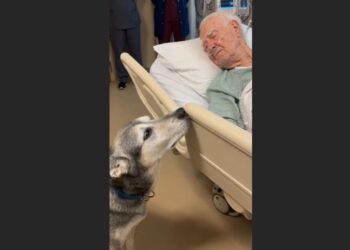
Mr. Bennett lowered both hands.
The dog pressed his head and shoulders against the old man’s chest.
For several minutes, neither moved much.
Max trembled.
Mr. Bennett buried his hands in the dog’s fur.
Then he began crying.
Quietly.
I did too.
It would be easy to say they were both made whole in that instant.
Life is rarely that simple.
Mr. Bennett still needed nursing care.
Max was still an elderly dog whose body was slowing.
They could not go back to living together in the yellow house.
But they were together again for an afternoon.
That mattered.
After That, Sunday Became Max’s Visiting Day
Whenever the facility permitted it, I brought him.
We followed the same routine.
Car.
Short walk inside.
Elevator.
Hallway.
Mr. Bennett’s room.
Some weeks, Mr. Bennett recognized me immediately.
Sometimes he did not.
His awareness varied.
With Max, recognition seemed more consistent.
The dog’s arrival often drew a response even on difficult days.
Perhaps it was scent.
Voice.
Years of repeated experience.
Memory is complicated, especially in cognitive decline.
I would never claim Max could cure or reverse it.
What I observed was that his presence often engaged Mr. Bennett when other things did not.
The staff noticed too.
Max Had His Own Routine at the Facility
He entered slowly.
Sniffed.
Then found Mr. Bennett.
Sometimes he rested beside the wheelchair.
Other times he leaned against the bed.
Mr. Bennett stroked his ears.
Often he talked to him.
The conversations were not always easy to follow.
That did not matter to Max.
The dog responded to tone and touch.
When visiting time ended, leaving could be difficult.
At first, Max looked back several times.
Eventually, even that became part of a new pattern.
We went to see Mr. Bennett.
Then we returned to my apartment.
The following Sunday, we did it again.
Repeated departures no longer meant permanent disappearance.
Months Passed
Max began settling more completely in my home.
The front door stopped commanding his attention every time someone passed outside.
He ate normally.
He learned where sunlight crossed the floor in the afternoon.
He developed an irritating habit of standing in the exact center of my kitchen whenever I was trying to cook.
His mobility continued declining slowly.
We adjusted.
I placed rugs on slippery surfaces.
Walks became shorter.
I helped him into the car.
On difficult mornings, I gave him more time.
Age remained age.
Love did not make his legs young again.
It simply meant someone was there to accommodate what his body could still do.
He Stopped Sleeping Like Someone Was About to Arrive
That was one of the changes I noticed most.
In the beginning, Max rarely seemed fully relaxed.
Even asleep, sounds woke him easily.
Later, he began sleeping deeply beside my recliner.
Sometimes I stepped around him and he barely opened an eye.
The first time that happened, I smiled.
Security can look remarkably unremarkable.
A senior dog sleeping through the elevator bell.
A half-finished bowl of water.
Gray fur on the rug.
No dramatic breakthrough.
Just rest.
Mr. Bennett Always Asked About Him
On days when he could understand more, he asked whether Max was behaving.
“He steal your toast yet?”
“Not yet.”
“He will.”
He was right.
One morning Max lifted a piece directly from the edge of my plate and walked away as if thirteen years of good behavior had earned him the privilege.
I told Mr. Bennett that Sunday.
He laughed.
The sound stayed with me.
Some visits were harder.
There were afternoons when Mr. Bennett seemed far away.
Max still settled beside him.
No demand.
No confusion over whether he was being remembered correctly.
Dogs do not require us to perform our identities for them.
Familiar scent and contact were enough.
Max Lived With Me for Another Fourteen Months
For an old dog, those months contained many ordinary days.
That was what I wanted for him.
He did not spend them waiting in an empty house.
He had meals.
Walks.
Veterinary care.
Sunday visits.
Sunlight.
A place beside my recliner.
Mr. Bennett’s gardening boots stayed in a corner of the bedroom.
Max rarely paid much attention to them after the first few months.
The new apartment had accumulated familiar scents of its own.
That felt like progress.
Not forgetting.
Expansion.
His world contained more than loss again.
One Rainy October Night, Max Went to Sleep
He had been especially tired that day.
We had not visited the facility because his legs were having a difficult week.
I settled him beside my chair.
He ate part of his dinner.
Drank some water.
Then slept.
Sometime during the night, Max died.
Quietly.
There was no dramatic final moment.
No last heroic gesture.
When I found him the next morning, he looked much as he often did in deep sleep.
His body had simply stopped.
He was thirteen.
His last fourteen months had been comfortable.
I tried to let that fact sit beside the grief.
I Buried Him Beneath a Maple Tree
My sister had land outside town.
We chose a place beneath a tree where the ground was quiet and open.
I brought Max there.
I also brought Mr. Bennett’s old gardening boots.
For practical reasons, I did not need them anymore.
Emotionally, I could not imagine throwing them away.
I placed them beside Max before finishing the burial.
I knew the symbolism belonged to me, not to him.
Max did not need boots in death.
He had needed their familiar scent when the person attached to them disappeared.
They had helped mark one difficult transition.
Now they marked another for me.
I Told Mr. Bennett About Max Carefully
There is no perfect way to deliver that news to someone whose memory changes from day to day.
A staff member helped me decide when to speak with him.
For a while, he was quiet.
Then he asked whether Max had been alone.
“No,” I said.
That was the answer I was grateful to give.
He had not been alone.
Not in the empty Maple Street house.
Not during his final year.
Not when he died.
Mr. Bennett nodded.
Then he looked toward the floor where Max usually lay during visits.
We sat together for a while.
I Still Think About the Day the House Was Emptied
For years, I was angry about it.
Sometimes I still am.
But time has made me slightly more careful about the story I tell.
Families facing sudden medical decline often make rushed decisions.
There are facilities to arrange.
Homes to clear.
Bills.
Legal paperwork.
Fear.
Exhaustion.
None of that excuses leaving an elderly dog without a clear plan.
It does explain how people can become so focused on one emergency that another vulnerable life nearly disappears from view.
Max deserved better planning.
Fortunately, he also had people around him who noticed.
He Did Not Need Someone to “Rescue His Broken Heart”
He needed tangible things.
Food.
Water.
Warmth.
Veterinary care.
A stable home.
A familiar person when possible.
Predictable routines.
Those practical acts were how we helped him adjust.
Yes, he searched.
Yes, he waited.
Yes, his behavior changed after Mr. Bennett disappeared.
But Max was not permanently frozen in grief.
Dogs can adapt.
Even senior dogs.
Eventually, he learned my home.
He trusted the new routine.
He slept beside a different recliner.
And because we were able to arrange visits, he did not lose contact with Mr. Bennett entirely.
Sometimes Care Means Returning for What Everyone Else Overlooked
That is the part I remember most clearly.
The house was almost empty.
The truck was loaded.
Furniture had vanished from rooms where it had stood for decades.
And one old Golden Retriever remained.
Max could not ask what was happening.
He could not make a phone call.
He could not explain that his person had been the center of his daily life for thirteen years.
He could only wait.
Beside the front door.
Where the recliner had been.
On the porch with a pair of gardening boots beneath his head.
Someone had to notice what that waiting was telling us.
Max Eventually Stopped Watching Every Door
That became the quiet ending to his story.
Not the burial.
Not even his death.
The ending I choose to remember happened months earlier.
I was sitting in my recliner one evening.
Rain tapped against the windows.
Someone walked down the apartment hallway.
The elevator bell sounded.
Once, Max would have lifted his head immediately.
That night, he did not.
He remained asleep on the rug beside me.
His white muzzle rested across his front paws.
His breathing was slow.
The door could make noise without meaning someone had disappeared.
Footsteps could pass without demanding that he search.
For the first time since the little yellow house had emptied, Max seemed completely certain of where he was supposed to sleep.
Beside someone.
Not waiting for anyone to come back.
Just resting.
Editor’s Note: The characters in this story are fictional. Through these stories, we hope to share the intelligence, loyalty, compassion, and loving nature of dogs with people everywhere.