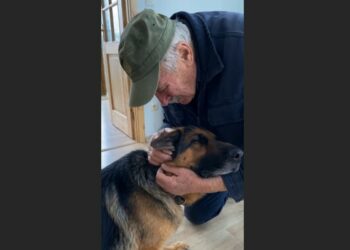
There is a judgment people make quickly when they see someone experiencing homelessness with a dog.
Why have an animal when you cannot afford a home?
Who feeds the dog?
Who pays for veterinary care?
Wouldn’t the animal be better off somewhere else?
In Rio de Janeiro, journalist Glenn Greenwald and his husband, David Miranda, spent years seeing another side of that relationship.
They encountered people living on the streets who had taken in abandoned animals themselves.
People with very little money still found food for dogs.
They slept beside them.
Protected them.
Shared the instability of street life with animals that had often been unwanted before the two found each other.
Greenwald’s reporting on those relationships eventually helped inspire an unusual project.
Instead of treating homeless people and homeless animals as two separate problems, Greenwald and Miranda asked whether the bond between them could become part of a solution.
In 2017, that idea became Abrigo Hope, or Hope Shelter.
The Idea Began Before There Was a Shelter
Years before Hope opened, Greenwald was already involved in animal rescue in Rio.
He and Miranda had taken in numerous abandoned dogs themselves.
A 2017 fundraising campaign for the project said the couple was caring for 23 rescued dogs at home at the time and had fostered or found homes for many others over the years.
Their work repeatedly brought them into contact with people living on Rio’s streets.
What struck them was not simply that homeless people had pets.
It was how many of those relationships had begun.
Some of the dogs had also been living on the streets.
They had been unwanted, injured, hungry, or simply without anyone responsible for them.
Then someone who had very little of their own began caring for them.
The usual story about rescue suddenly became harder to define.
Who was rescuing whom?
Greenwald Began Documenting Those Relationships
In 2015, Greenwald produced reporting and short films about homeless people in Rio and the animals living alongside them.
One of the people featured was known as Birdie, a street vendor whose life included two dogs that had become his companions.
Another project focused on Karollyne and her family, who lived in an abandoned house in the Tijuca Forest area and cared for numerous dogs.
Greenwald’s accompanying reporting examined research into companion animals and homelessness.
The subject has been studied by sociologists, including University of Colorado professor Leslie Irvine, whose work has focused specifically on relationships between unhoused people and their animals.
Those relationships are complicated.
Living without stable housing creates obvious risks for both people and animals.
Access to veterinary care may be difficult.
Extreme heat and rain create danger.
Many shelters and housing programs historically have not accepted pets, forcing people to choose between accommodation and an animal they consider family.
But homelessness by itself does not prove neglect.
That was the assumption Greenwald and Miranda wanted to challenge.
They Saw Attachment Where Others Often Saw Irresponsibility
A person passing on the sidewalk might see a dog sleeping beside someone under a blanket and conclude that the animal should be taken away.
Greenwald and Miranda were seeing something else too.
They saw companionship.
Responsibility.
Routine.
And, in many cases, a person who had taken responsibility for an animal nobody else had wanted.
That did not mean every animal living with a homeless person was automatically receiving adequate care.
No group of owners can be judged that simply.
It meant the circumstances deserved to be understood before conclusions were made.
A dog could be deeply loved and still need veterinary help.
A person could be devoted to that dog and still need housing, identification documents, employment, counseling, or medical care.
Helping one did not have to require separating the two.
That became the foundation of Hope.
The Shelter Was Designed Around an Unusual Employment Model
The 2017 plan was ambitious.
Hope would rescue abandoned animals and prepare them for adoption.
Veterinarians, animal-care workers, and volunteers would provide professional support.
But the shelter’s paid staff would include people who had experienced homelessness and already demonstrated an ability to care for animals.
The project also planned to work with a social-service organization that could provide employees with temporary housing, clothing, help obtaining identification, assistance opening bank accounts, counseling, and support managing their income.
The objective was not merely to hand someone a dog-care job.
It was to use employment as one part of a transition toward greater stability.
Animal rescue on one side.
Human support on the other.
The two systems meeting in the same place.
Then There Was Lucas
Among the first people hired was a 20-year-old named Lucas.
Greenwald and Miranda did not meet him through a conventional job interview.
They noticed him because of a sick puppy.
According to the project’s fundraising account, Lucas had rescued a seriously ill young dog from the street and cared for her for months. That experience was one reason the Hope team wanted him involved.
Later reporting gave more detail.
Lucas and a friend had encountered the puppy suffering on the street.
They sought veterinary help.
The illness proved fatal.
The puppy did not survive long-term, but Lucas continued caring for her through the end of her life.
There was no spectacular rescue ending.
No miraculous recovery.
Just a young man without stable housing deciding that an animal in worse condition than he was should not suffer alone.
Someone noticed.
Lucas Became Hope’s First Hire From the Streets
The project’s own 2017 fundraising page identified Lucas as its first homeless employee.
He would work alongside executive director Francisco David as the shelter developed.
Later coverage reported that his wages helped him obtain an apartment and begin stabilizing his life.
That distinction is important.
A dog did not magically rescue Lucas from homelessness.
Compassion alone did not provide housing.
A real opportunity did.
Paid work.
Income.
Support.
A system designed to recognize a skill he already possessed.
Lucas knew how to care for vulnerable animals because he had been doing it when nobody was paying him.
Hope attempted to turn that capacity into employment.
The Project Was Never Supposed to Depend on Charity Alone
Greenwald and Miranda wanted a shelter that functioned professionally.
Animals would still need vaccinations.
Sterilization.
Food.
Cleaning.
Veterinary treatment.
Behavioral assessment.
Adoption screening.
Employees would need salaries.
The site would need infrastructure.
The founders launched an international fundraising campaign and partnered with a nonprofit structure to receive donations.
The campaign ultimately drew thousands of contributions.
Meanwhile, the team began building and improving facilities.
A 2017 update showed Greenwald, Miranda, staff, volunteers, Karollyne, and Lucas working as construction began on a temporary shelter site.
An idea that had started with street dogs and conversations was acquiring walls, kennels, staff, and responsibilities.
Karollyne Was Another Important Part of the Story
The project did not emerge from observing Lucas alone.
Greenwald described Karollyne as one of Hope’s major inspirations.
She and her family had been caring for dogs while living in precarious conditions in the Tijuca Forest area.
Rather than dismissing her because of where she lived, the Hope project looked at what she was already doing.
Feeding animals.
Taking in dogs.
Maintaining relationships with them despite severe economic hardship.
Hope planned to employ her as well.
This was central to the model.
People experiencing homelessness were not supposed to enter the project merely as recipients of charity.
They could enter as workers with knowledge and experience.
The distinction is substantial.
Stable Housing Changes What People Can Do for Their Animals
One of the cruelest aspects of homelessness with a pet is that solutions for the person and solutions for the animal can conflict.
A shelter bed may not allow dogs.
A temporary room may prohibit pets.
A job may require hours that become difficult without somewhere safe for an animal to remain.
Veterinary appointments can become almost impossible when someone lacks transportation, money, or a fixed address.
So telling someone to “just get help” may conceal a maze of practical barriers.
Hope’s model attempted to address several at once.
Employment mattered.
Temporary housing mattered.
Documentation mattered.
Banking access mattered.
Training mattered.
So did care for the animals.
The founders understood that a paycheck could help, but lasting stability required more than a paycheck.
The Dogs Still Needed Permanent Homes
Hope was not designed to keep every rescued dog forever.
The animal side of its mission remained conventional in one important sense.
Rescue dogs needed medical treatment and preparation for adoption.
Then they needed suitable families.
That required people willing to adopt instead of buy.
It required screening.
Follow-up.
And attention to the individual dog rather than simply moving animals through the shelter as quickly as possible.
Hope’s human employees could participate in that work.
Cleaning kennels might be one task.
Feeding another.
Handling rescued animals, learning routines, assisting with care, and observing changes in behavior were also valuable skills.
For someone rebuilding a working life, those responsibilities had meaning beyond a temporary job.
Other lives depended on them showing up.
The Goal Was Not to Keep Employees Dependent on Hope Forever
Greenwald explained at the time that the employment program was intended as a transition.
If a worker became stable enough to move into another permanent job, that was a success.
It also opened a place for another person experiencing homelessness to enter the program.
That made Hope different from a conventional charitable model built around indefinite assistance.
The shelter wanted turnover for the right reason.
Someone receives support.
Builds income.
Secures housing.
Stabilizes.
Moves forward.
Another person gets the opportunity.
Meanwhile, the animal rescue work continues.
It is not an easy system to operate.
But its logic is straightforward.
Hope Continued Beyond Its Founding Years
David Miranda died in Rio de Janeiro in May 2023 at age 37 after a long hospitalization. Greenwald described him as dying surrounded by family and friends.
The project they helped create did not disappear with him.
Abrigo Hope remains active.
Its current site describes the program as combining animal protection with dignified employment and training for people in vulnerable circumstances.
The David Miranda Institute now includes Hope among the projects associated with Miranda’s legacy.
According to the institute, the shelter has assisted dozens of people and found homes for more than 200 dogs.
Those numbers represent something the original plan hoped to prove.
The model was not only an idea.
It could function in practice.
There Is a Broader Lesson in the Dogs People See on the Street
A dog beside someone who is homeless may indeed need help.
So may the person holding the leash.
But help begins with understanding what is actually happening.
Is the animal underfed?
Is veterinary care needed?
Does the person need pet-friendly temporary housing?
Food?
A leash?
Medication?
Identification?
A place where the dog can stay while the owner works?
Removing the animal may sometimes be necessary when welfare is genuinely at risk.
But separation should not become an automatic response simply because someone is poor or unhoused.
A dog can be loved under a bridge.
A dog can be neglected behind the walls of an expensive home.
Housing status alone does not answer the welfare question.
Companion Animals Can Carry Enormous Meaning During Homelessness
For someone living on the street, a dog may provide routine in a life where almost everything else changes.
The animal needs breakfast.
Water.
Walking.
Rest.
Those requirements continue regardless of whether the human has slept safely the previous night.
Dogs can also provide companionship in circumstances marked by social isolation.
People who feel ignored by passersby may still have another living being responding to their voice and presence.
That bond can become intensely important.
It can also create practical difficulties.
A person may avoid services that require surrendering the dog.
They may turn down accommodation that prohibits animals.
From the outside, such decisions can seem irrational.
From inside the relationship, the dog may be one of the only stable attachments remaining.
Programs that recognize that reality have more options than programs that ignore it.
Hope Turned Observation Into Infrastructure
That may be the most interesting part of Greenwald and Miranda’s idea.
They did not merely say that homeless people love dogs too.
They built a program around the consequences of that statement.
If someone already has animal-care skills, pay them.
If they need housing to stabilize, connect employment with housing support.
If rescued dogs need professional care, provide veterinary expertise.
If those dogs need permanent families, build an adoption program.
If one worker becomes stable enough to move on, create space for another.
The project treated compassion as a starting asset rather than a sentimental quality.
Lucas caring for a dying puppy was not just a touching story.
It demonstrated something about him.
Reliability.
Patience.
Concern for a vulnerable animal.
Hope gave those qualities economic value.
The Puppy Lucas Tried to Save Did Not Survive
That detail should not be softened.
The young dog he cared for was too sick.
Getting her to a veterinarian did not create the ending Lucas would have wanted.
Yet what he did still mattered.
Rescue is not defined only by survival.
An animal can receive food, medical attention, warmth, and company even when treatment cannot reverse the illness.
Lucas apparently stayed involved through that difficult outcome.
Greenwald and Miranda saw his behavior and thought he belonged in animal care.
One dying puppy therefore became part of the chain that led to a job.
The job contributed to greater stability.
Then Lucas could help other animals.
Not because suffering was somehow destined to produce something good.
Because somebody recognized his actions and created an opportunity from them.
That Is Different From “The Dog Rescued the Man”
It makes a beautiful headline.
It is less accurate.
Dogs cannot provide housing applications.
They cannot issue salaries.
They cannot create social programs.
What animals sometimes do is reveal something about people.
A man with almost nothing stops for a sick puppy.
A family living precariously keeps taking in abandoned dogs.
Someone shares food.
Someone stays up with an injured animal.
Those decisions reveal capacity.
Then other humans decide whether that capacity deserves support.
Hope’s contribution was to notice it.
The Shelter Also Challenged an Old Hierarchy of Compassion
Social problems are often placed in competition.
Why help animals when people are homeless?
Why help homeless people when shelters are full of abandoned dogs?
Hope’s founders rejected the premise.
The same program could address both.
A shelter requires workers.
Some people living on the streets already have extensive experience with animals.
Those workers require employment and pathways toward stable housing.
The animals require care.
The needs overlap.
That does not mean one shelter can solve homelessness or Rio’s stray-animal population.
It means one organization can design its work so helping one group strengthens its ability to help another.
More Than 200 Dogs Later, the Original Question Still Matters
Abrigo Hope’s current description remains close to the premise that launched it in 2017.
Care for abandoned animals.
Offer meaningful work and training to people facing severe vulnerability.
Build on a relationship that already exists rather than assuming poverty erases the ability to care.
That is a harder story to fit into a photograph.
A picture of a homeless person hugging a dog is immediate.
Employment records are not.
Neither are housing transitions, identification documents, training, veterinary invoices, adoption screening, or months of work.
Yet those practical pieces are what turn compassion into lasting change.
So Before Judging the Person Beside the Dog, Look Again
The animal may be the reason that person got through the night.
The person may be the reason the animal did.
Perhaps the dog was once abandoned too.
Perhaps the two found each other when neither had a stable place to go.
Perhaps they both need assistance.
None of that can be determined from a glance.
In Rio, Glenn Greenwald and David Miranda looked long enough to see something others often missed.
They saw people in extreme hardship still choosing to care for animals.
Then they asked whether those acts of care could become the foundation for employment, housing support, animal rescue, and a route toward greater stability.
Lucas became one of the first answers.
He was living without stable housing when he stopped for a critically ill puppy.
He could not save her life.
But he cared for her anyway.
Someone noticed.
Hope hired him.
Later reporting said the income helped him obtain housing and begin rebuilding stability.
Years later, the shelter continues operating, and the organization associated with David Miranda’s legacy says more than 200 dogs have found homes through the project.
That may be the lasting lesson of Hope.
Do not assume a person has nothing to give simply because they have very little.
Sometimes the evidence is already lying beside them on the sidewalk, tail resting against the pavement, trusting the person everyone else has learned not to see.