Cooper Was Still Waiting for Jason to Come Home
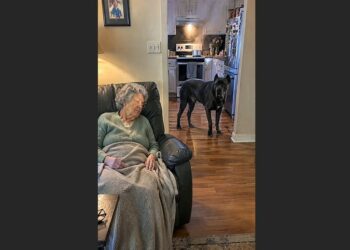
Three days after my brother’s funeral, his black Labrador was still listening for him.
Every time footsteps came down the apartment hallway, Cooper lifted his head.
When the elevator doors opened, he stood.
For a few seconds, his entire body seemed to wait.
Then the footsteps passed our door.
Cooper lowered himself again.
Sometimes he carried one of Jason’s old sweatshirts from room to room. At night, he often slept with his nose pressed into the fabric.
I did not tell myself he understood that Jason was dead.
Dogs do not comprehend death, funerals, or permanent absence the way people do.
What Cooper understood was simpler.
The person around whom most of his adult life had been organized was suddenly gone.
His routines had stopped.
And now, while both of us were still adjusting to that absence, someone knocked on the apartment door.
Richard Arrived With a Folder
It was a cold Wednesday morning.
I remember the building more clearly than I remember many things from that week.
Fresh paint and disinfectant in the hallway.
A maintenance cart rattling downstairs.
The old heating system humming behind the walls.
Inside Jason’s apartment, almost nothing had moved.
His coffee mug was still beside the recliner.
Reading glasses rested on an end table.
A half-finished crossword lay across the kitchen counter.
I had been unable to decide what should be packed first, so I had packed almost nothing.
Cooper lay beside my feet when I opened the door.
The apartment manager stood outside.
His name was Richard.
He carried a leather folder under one arm.
His eyes immediately went to the dog.
“I’m sorry for your loss,” he said.
Then he opened the folder.
“Unfortunately, we have an issue.”
Jason Had Needed Cooper for Nearly Six Years
My brother was forty-seven when he died.
He had served eight years in the Marine Corps.
Like many veterans, he came home carrying difficulties that were not visible to strangers.
I will not reduce his life to a diagnosis.
He was my brother before he was a veteran, and he remained a whole person afterward.
Still, there were days when anxiety and trauma made ordinary life difficult.
Cooper had been individually trained to perform tasks related to Jason’s disability.
He could interrupt escalating episodes.
He responded to particular behavioral cues.
He helped ground Jason during periods of severe distress.
Those were trained behaviors, not some supernatural ability to read a man’s mind.
Cooper learned through repetition, reinforcement, and years of working beside one person.
Eventually, their partnership became part of everyday life.
Then Jason died suddenly.
One Rainy Sunday Changed Everything
There had been no long decline.
No months in which we could prepare ourselves.
Jason suffered a sudden aneurysm on a Sunday evening.
By the following morning, he was gone.
Forty-seven.
Alive one week.
Dead the next.
I spent the days afterward making phone calls I had never expected to make.
Funeral home.
Insurance.
Military paperwork.
Family.
Bills.
People kept asking what they could do.
Most of the time, I had no answer.
Cooper seemed equally unsettled, though in a different way.
His appetite dropped.
He waited near the door.
He carried Jason’s sweatshirt.
At times he walked into another room, paused, and came back as though whatever he expected to find there was missing.
Grief was the human word I used for it.
Behaviorally, what I could see was a dog reacting to sudden separation and a household whose patterns had disappeared.
Then Richard Told Me Cooper Had to Leave
He looked at the paperwork in his folder.
The building had a no-pets policy.
Jason had been permitted to keep Cooper because Cooper was his assistance animal.
Now Jason was dead.
Richard’s position was simple.
The dog could no longer remain.
“He isn’t a pet,” I said.
“He’s a service dog.”
Richard corrected me.
“He was your brother’s service dog.”
That distinction hurt, even though part of it contained a legal reality I did not yet understand.
Cooper’s years of training had not disappeared.
His history with Jason had not been erased.
But service-animal and housing accommodations are generally connected to a person with a disability and that person’s disability-related need for the animal. Those protections do not simply transfer to another person because the original handler dies. HUD
That made the situation more complicated than either Richard or I understood that morning.
Richard treated it as simple anyway.
“You have until Saturday.”
Seventy-Two Hours Felt Impossible
I stared at him.
“Saturday?”
He nodded.
He called the deadline generous.
That word stayed with me.
Generous.
Jason’s funeral flowers had not wilted.
His clothes were still hanging in the closet.
His medications had not been removed from the bathroom.
I was surrounded by probate paperwork, insurance documents, unopened mail, and relatives asking when I planned to clear the apartment.
Now I was supposed to decide the future of a grieving six-year working partnership in three days.
I looked down at Cooper.
He raised his eyes toward me.
He did not understand the argument happening over his head.
He knew only that I was there.
“Please,” I said. “I need some time.”
Richard repeated that his hands were tied.
Then he handed me a written notice and walked away.
Cooper Put His Head on My Knee
I sat down after closing the door.
For several minutes, I did nothing.
Cooper came over.
His head settled across my knee.
It would be easy to say he knew I was upset.
Maybe he noticed my posture, voice, breathing, or stillness.
Dogs are sensitive to changes in familiar people.
But Cooper did not know what a lease was.
He did not know that his housing had just become uncertain.
He certainly did not understand that the person he had worked beside for almost six years could no longer legally speak for him.
I put one hand on his neck.
Then I remembered the organization that had originally helped Jason obtain him.
I found the number.
Someone answered on the second ring.
That call changed the next several days.
“Don’t Move the Dog Until We Understand the Situation”
The nonprofit director listened while I explained everything.
Jason’s death.
The no-pets rule.
Richard’s notice.
My three-day deadline.
When I finished, there was a pause.
Then she told me not to make a rushed placement decision.
She did not promise that federal law automatically gave Cooper the right to remain.
That would have been too simple.
Instead, she said the situation needed proper review.
Who currently had lawful access to the apartment?
What did Jason’s lease say?
What estate procedures were underway?
Would the owner allow temporary occupancy while his affairs were settled?
Could Cooper remain during that period by written permission?
Those were questions for housing professionals and attorneys, not an apartment manager improvising a deadline in a hallway.
The nonprofit began making calls.
For the first time since Richard left, I felt as though seventy-two hours might not be the only clock that mattered.
The Next Forty-Eight Hours Were Mostly Phone Calls
There was nothing cinematic about what followed.
No attorney stormed into the leasing office.
Nobody announced that Richard was going to prison for disliking dogs.
Instead, documents moved.
People asked questions.
The nonprofit contacted advocates familiar with veteran housing issues.
Someone reviewed the lease.
Someone else contacted the property company’s corporate office.
I forwarded copies of the notice.
The company learned that Jason’s estate was still being handled and that I was temporarily occupying the apartment while dealing with his belongings.
Most importantly, the regional staff learned that their manager had given a grieving family member three days to remove a dog without first allowing the company to review the circumstances.
The conversation changed quickly after that.
Not because Cooper magically inherited Jason’s legal accommodation.
Because the company had choices Richard had never bothered to explore.
By Friday, Corporate Management Was Involved
I received a call from someone above Richard.
The tone was entirely different.
She expressed condolences.
Then she asked questions instead of making declarations.
How long would I need to remain in the apartment?
What was happening with Jason’s estate?
Did I intend to take responsibility for Cooper?
Had another placement already been arranged?
I told her the truth.
I did not know yet.
That was precisely why three days had been unreasonable.
Cooper was not a chair I could donate.
He was a living dog who had just lost his handler.
Moving him immediately into another unfamiliar environment might have added another abrupt transition when he was already struggling to eat and settle.
I needed enough time to make a responsible decision.
The company agreed.
On Saturday Morning, the Deadline Disappeared
The regional property director called again.
The removal notice was being withdrawn.
The company would allow Cooper to remain temporarily while Jason’s estate and the apartment arrangements were resolved.
They also agreed to discuss transferring the lease if I decided to stay and could qualify under the property’s ordinary requirements.
I thanked her.
Then I sat down in Jason’s recliner and cried.
Cooper came over.
He placed his chin on the armrest.
Nothing about his behavior suggested he knew a housing dispute had ended.
He simply knew I had stopped moving around the apartment and become available.
I rubbed his ears.
For the first time in several days, I could think about his future without a Saturday deadline hanging over us.
That did not solve the grief.
It created room to deal with it properly.
Richard Was Gone the Following Week
The official explanation was that he had been reassigned.
I never learned every detail behind the company’s decision, and I stopped trying.
Maybe the notice was one problem among several.
Maybe corporate management objected to how he handled the situation.
Perhaps the attention from veteran advocates made the company more cautious.
I did not need a villain punished for the story to end well.
What mattered was that someone higher in the organization recognized that policy did not require needless cruelty.
Rules matter in housing.
So do leases.
So do fair-housing obligations.
But complicated situations deserve to be reviewed accurately before someone starts issuing ultimatums.
Richard had skipped that part.
The people after him did not.
Once the Emergency Passed, I Had to Decide What Cooper Actually Needed
Keeping him in the apartment for a few extra weeks was one question.
Becoming his permanent owner was another.
I had never handled a trained service dog before.
Cooper’s working relationship had been with Jason.
He could not simply become my service dog because I was his brother’s sibling.
Nor did I want to pretend that caring for him was an obligation I automatically understood.
So I talked with the organization.
We discussed his age.
Health.
Exercise.
Temperament.
What retirement from active service might look like.
Whether another handler placement would even be appropriate.
Cooper had spent nearly six years building one highly specific working partnership.
Now that partnership had ended.
Eventually, everyone agreed that a stable retirement home with someone he already knew could be a reasonable outcome.
I began asking myself whether I could provide it.
Cooper Was Still Looking for Jason
During those first weeks, that remained obvious.
He waited near the door less often than before, but he still checked.
Certain hallway sounds brought him upright.
If someone walked with a similar rhythm, Cooper became attentive.
Jason’s sweatshirt remained important.
I never took it away.
There was no reason to.
Familiar scent appeared to comfort him, and the behavior caused no problem.
At mealtimes, I kept things predictable.
Morning walk.
Breakfast.
Rest.
Another walk later.
Same sleeping area.
Same bowl.
Same rooms.
Predictability helped both of us.
I had lost my brother.
Cooper had lost the person around whom his daily life had been organized.
Neither of us needed another abrupt change.
I Eventually Asked to Take Over the Apartment
At first, the idea seemed impossible.
Too many memories.
Jason’s chair.
His kitchen.
The hallway where Cooper still listened for him.
I thought staying would make grief worse.
Leaving, however, began to feel just as difficult.
The apartment was familiar to Cooper.
It was close to my work.
I could afford it if the lease transfer was approved.
And, quietly, I realized I did not want to hand Cooper to someone else simply because I was afraid of living among my brother’s things.
So I applied.
The company approved the transfer.
The apartment became mine.
Cooper stayed.
Not as a service animal assigned to me.
As Cooper.
A trained dog entering retirement after losing his handler.
And now my responsibility.
I Did Not Ask Him to Keep Working
That was important.
Cooper still knew his tasks.
Training does not disappear overnight.
Sometimes he responded automatically to behaviors he associated with Jason.
But I did not turn those habits into a new job.
I was not his disabled handler.
He was not responsible for managing my grief.
If I cried and Cooper came near me, I accepted the companionship.
I did not tell myself he was performing therapy.
He was a familiar dog living with a familiar person in a home both of us associated with Jason.
That was enough.
Over time, Cooper’s days became less about work and more about ordinary dog life.
Walks.
Meals.
Naps.
Sniffing bushes for unreasonable amounts of time.
Learning that toys could be used simply because they were fun.
His Appetite Returned Slowly
There was no single turning point.
One morning, he finished breakfast.
Another week, he began taking treats more eagerly.
Later, he carried a toy into the living room.
The first time he actually played with it, I nearly interrupted him by reacting too enthusiastically.
So I stayed quiet.
Cooper tossed the toy once.
Picked it up.
Walked away.
A few days later, he did it again.
Recovery did not mean forgetting Jason.
It meant Cooper was becoming interested in other parts of life too.
That distinction mattered to me.
I was doing something similar.
There were still terrible mornings.
There were also mornings when I laughed at something and did not immediately feel guilty.
Grief had not vanished.
It had simply stopped occupying every minute.
We Started Walking Every Morning
Jason had walked Cooper regularly.
Continuing that routine made practical sense.
At first, our walks were quiet.
Cooper moved with the polished leash manners of a dog that had spent years working in public.
I had to remind myself that he did not need to be “on duty.”
I let him sniff.
He seemed slightly confused by that freedom at first.
Then he embraced it.
Mailboxes became important.
Trees became extremely important.
Certain patches of grass apparently required prolonged investigation.
I started enjoying the walks too.
We rarely talked to anyone.
We did not need to.
Each morning, we went outside.
Then came home.
That simple pattern helped.
Jason’s Recliner Remained Cooper’s Favorite Place to Sleep Beside
I considered removing it.
I couldn’t.
Eventually, I stopped seeing that as a failure to move forward.
The chair was still useful.
Cooper liked it.
So it stayed.
Most evenings, he lowered himself beside it.
Sometimes he brought the old sweatshirt.
Other nights he slept without it.
I noticed those changes but tried not to assign too much meaning.
There was no timetable for when a dog should stop seeking familiar scent.
There was no reason for me to decide that a particular behavior meant he was “over” Jason’s absence.
Cooper was adapting.
That was enough.
I Stopped Thinking of the Manager’s Deadline as the Worst Part
At first, I was furious.
How could anyone give us three days?
How could someone see Cooper waiting at the door and reduce him to a policy problem?
Months later, my anger became less useful.
Richard had approached a complicated situation with more certainty than knowledge.
That was the failure.
The solution came when other people slowed down.
They reviewed documents.
Asked questions.
Considered options.
Separated what federal assistance-animal law actually covered from what the property owner could voluntarily allow.
Compassion did not require ignoring rules.
It required using judgment inside them.
That lesson stayed with me.
Cooper Did Not Need Anyone to Call Him a Veteran’s Legacy
People sometimes used that phrase.
I understood what they meant.
But Cooper did not exist to symbolize Jason’s service.
He was a dog.
A highly trained one.
An important one.
A dog who had performed meaningful work for one person.
Now he needed a life after that work ended.
Retirement for a service dog can be an adjustment.
The cues change.
Expectations change.
Sometimes the former handler remains present and the dog simply stops working.
Cooper did not have that option.
The person he had worked for was gone.
So we built new routines without demanding that he replace Jason’s purpose with mine.
Months Later, He Still Checks the Door Sometimes
Not every night.
Not for long.
He may hear footsteps.
Lift his head.
Listen.
Then settle again.
The sweatshirt comes out less often now.
His appetite is normal.
His tail moves easily when I reach for the leash.
He has developed an embarrassing enthusiasm for one squeaky toy that Jason probably would have hated.
Sometimes I catch Cooper stretched across the floor in a patch of sunlight.
Deeply asleep.
Those moments affect me more than the dramatic ones.
A dog who spent days monitoring a front door has become comfortable enough to sleep through hallway noise.
That is not proof he has forgotten.
It is evidence that this home has become predictable again.
We Did Not Save Each Other
People like to say that.
Maybe it makes grief easier to package.
The truth is less tidy.
Cooper did not save me from losing my brother.
I could not save Cooper from losing Jason.
We both experienced the loss anyway.
What we did was continue.
Breakfast.
Walk.
Paperwork.
Veterinary visits.
Cleaning out closets.
Putting some things away and leaving others exactly where they were.
One ordinary day followed another.
Gradually, the apartment stopped feeling like a place someone had just left.
It became somewhere two living beings still lived.
Cooper Nearly Lost His Home Because Everyone Was Moving Too Fast
Jason’s death happened quickly.
The funeral happened quickly.
Then came a deadline.
Three more days.
Remove the dog.
Clear the problem.
Move forward.
Grief rarely respects schedules like that.
Neither does responsible animal placement.
Fortunately, someone at the service-dog organization told me not to make an irreversible decision simply because a manager had created an artificial emergency.
Other people stepped in.
The deadline disappeared.
Time returned.
With time, I could make a better decision.
So could the property company.
And Cooper remained in the place he knew.
The Front Door Means Something Different Now
I still notice when Cooper sits near it.
Months ago, he watched that door as though every hallway sound might restore the routine he had lost.
Now he usually settles there because the floor is cool.
Sometimes he listens when the elevator opens.
Then he puts his head back down.
I do not say he understands Jason is never coming home.
I cannot know what conclusion, if any, a dog makes about permanent absence.
I only know Cooper no longer spends hours waiting.
He lives here now.
So do I.
Jason’s photograph sits near the recliner.
The old sweatshirt remains folded in a basket Cooper can reach.
And most evenings, the black Labrador eventually gets up from the door and comes to wherever I am sitting.
He lies down.
I reach toward him.
Sometimes my hand lands on the same spot Jason used to scratch behind his ears.
Neither of us needs to make more of it than that.
Three days after the funeral, someone looked at Cooper and saw a housing-policy problem that needed to disappear by Saturday.
Months later, I look at him and see something much simpler.
An old working partnership ended.
A dog remained.
So did a brother.
We had no idea what came next.
We stayed long enough to find out.
Editor’s Note: The characters in this story are fictional. Through these stories, we hope to share the intelligence, loyalty, compassion, and loving nature of dogs with people everywhere.