At 7:41 on a rainy Thursday evening, a man in a black leather vest stepped into the street and told a stranger to let go of a dog.
The stranger was dragging a young shepherd mix by a rope tied around her neck.
She was trying to keep up, but her legs kept buckling. Every time she fell, the man gave the rope another impatient jerk.
Her nails scraped against the pavement.
People had begun watching from the sidewalk. A woman outside the corner grocery store covered her mouth. Two teenagers stopped walking. A delivery driver slowed his van.
Nobody seemed to know what to do.
Then the biker stepped off the curb.
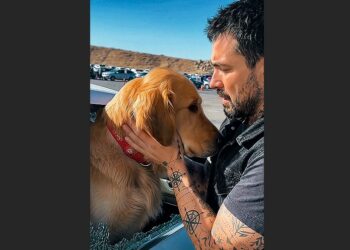
He was a big man, with heavily tattooed arms and a beard streaked with gray. His motorcycle was parked outside the hardware store, and he’d been standing beside it when he heard the dog cry.
“Let her get up,” he said.
The man holding the rope turned.
“Mind your business.”
The biker didn’t raise his voice.
“This is my business now.”
The stranger pulled the rope again.
The dog tried to stand, stumbled, and fell against the curb.
The biker’s expression changed.
“Stop pulling her.”
For a moment, the two men stared at each other.
Then the biker crouched beside the dog.
He held out one hand.
“Hey, sweetheart.”
The animal raised her head.
She was young, perhaps a year old, with a thin tan coat and a black muzzle. Her ears lay flat against her head, and she was trembling so badly that her front paws slipped whenever she tried to move.
The biker touched the side of her neck, careful to avoid the rope.
“It’s all right. Nobody’s going to drag you anywhere.”
The dog took one unsteady step toward him.
Then another.
And before anyone could react, she pressed her face against his chest.
The biker went still.
He hadn’t expected that.
Neither had the woman watching from the grocery store.
Later, she would say that the most surprising thing wasn’t the sight of a rough-looking stranger standing up to an angry man.
It was what happened when the biker gently put his arms around the frightened dog.
She stopped trying to crawl away.
Instead, she leaned her whole weight against him, as though she’d finally found somewhere she could rest.
The Man With the Leather Vest
His name was Caleb Morgan.
He was forty-seven and had spent most of his adult life working as a diesel mechanic.
He lived alone in a small house on the outskirts of town, drove an old pickup during the week, and rode his motorcycle whenever the weather allowed.
Most people knew him by sight.
He was difficult to miss.
Caleb stood well over six feet tall. His arms were covered in tattoos, and his leather vest had patches from years of charity rides and motorcycle rallies.
He wasn’t particularly talkative.
At the diner where he ate breakfast, he usually ordered coffee, eggs, and toast, then read the newspaper while he waited.
He was polite to the waitresses, generous with tips, and careful to thank people who helped him.
But strangers sometimes moved out of his way when he approached.
Caleb had stopped worrying about that years ago.
He knew how he looked.
And he knew what kind of man he was.
There was one thing about him that surprised people who didn’t know him well.
He loved dogs.
His last dog, a black Labrador named Rosie, had died the previous spring at fourteen.
She had been his constant companion for nearly thirteen years.
She followed him around the garage, slept beside his bed, and rode in the passenger seat of his pickup.
When Rosie developed arthritis, Caleb built a small ramp so she wouldn’t have to climb the porch steps.
When she grew too weak for long walks, he drove her to the park and sat with her beneath the trees.
After she died, he put away her bowls and folded her blankets into a box.
He told himself he wasn’t ready for another dog.
Then, on a Thursday evening, he heard the sound of claws scraping against the street.
What the Shop Owner Saw
The woman outside the grocery store was named Linda Parker.
She’d owned the little shop on the corner for twenty-two years, and she wasn’t easily frightened.
She’d dealt with shoplifters, broken windows, and more than a few customers who’d had too much to drink.
But what she saw that evening made her stomach turn.
The man with the dog had come around the corner a few minutes earlier.
Linda noticed him because he was shouting.
The dog was walking behind him, trying to keep pace.
She was thin, with a rope looped around her neck instead of a collar.
At the curb, she hesitated.
The man yanked the rope.
She stumbled.
Linda stepped outside.
“Hey! You’re hurting that dog.”
The man ignored her.
He pulled again.
The dog fell onto her side.
Linda started toward them, then stopped when the man turned and shouted something she couldn’t make out.
She could smell alcohol on his breath from several feet away.
His movements were unsteady, and his face was flushed.
Linda reached for her phone.
She was calling the police when Caleb appeared.
He’d been standing beside his motorcycle, putting his helmet into a storage bag.
He heard Linda shouting.
Then he saw the dog.
He crossed the sidewalk without hesitation.
Linda later remembered how calm he sounded.
He didn’t threaten the man.
He didn’t shove him.
He simply told him to stop pulling the rope.
And when the man refused, Caleb crouched beside the dog.
That was the moment Linda became certain he wasn’t going to walk away.
The Rope Around Her Neck
The dog was breathing rapidly.
Her front legs shook whenever she tried to support herself, and there was a raw patch beneath the rope where it had rubbed against her skin.
Caleb kept one hand near her shoulder while he studied the knot.
It was pulled tight enough that he couldn’t safely slip it over her head.
He didn’t want to make the injury worse by tugging.
“Do you have a knife?” he asked Linda.
She shook her head, then hurried toward the store.
The man holding the rope stepped forward.
“That’s my dog.”
Caleb looked up.
“Then why are you treating her like this?”
“She’s stubborn. Won’t walk.”
Caleb glanced at the animal.
She was trying to stand again, but her hind legs were trembling.
“She can’t walk,” he said.
The man made an impatient sound.
“You don’t know anything about her.”
“Maybe not.”
Caleb looked at the rope.
“But I know she needs help.”
Linda returned with a pair of scissors from behind the counter.
By then, another customer had called the police and was describing the situation to the dispatcher.
Caleb waited while the man loosened his grip on the rope.
Then, with Linda standing nearby and the dog’s movements carefully supported, he cut the loose section and relieved the pressure around her neck.
The dog made a small sound.
Not quite a whine.
More like a tired sigh.
Caleb carefully removed what remained of the rope.
Underneath, the fur was worn away in places.
He looked at Linda.
“She’s been wearing that for a while.”
Linda nodded.
Her eyes were wet.
“I saw him hit her earlier.”
Caleb’s hand stopped moving.
He looked toward the man.
The stranger was arguing with another bystander now, insisting that everyone leave him alone.
Caleb wanted to stand up.
Wanted to demand an explanation.
Instead, he stayed beside the dog.
He knew how easily anger could turn a bad situation into a dangerous one.
And right then, the animal needed him more than his pride did.
The Way She Held On
Once the rope was off, Caleb tried to help the dog stand.
She made an effort.
Her front paws found the pavement, but her back legs gave way almost immediately.
He caught her before she fell.
“Easy, girl.”
He slipped one arm beneath her chest and the other beneath her hindquarters, supporting her body as carefully as he could.
She weighed far less than he expected.
Her ribs were visible beneath her coat, and the bones along her back felt sharp under his fingers.
Caleb lifted her.
At first, she trembled against him.
Then she moved her head beneath his chin.
One front paw hooked gently against the edge of his leather vest.
Her other paw pressed against his chest.
Caleb stopped walking.
The dog was holding on.
Not tightly enough to hurt him.
Just enough that he could feel her paws against his shirt.
He looked down at her.
Her eyes were half-closed.
Her breathing was still quick, but she was no longer struggling.
Caleb swallowed.
“It’s okay, sweetheart.”
He rubbed the back of her neck with his thumb.
“I’ve got you.”
Linda stood beside him, holding a blanket she’d taken from the store’s emergency supplies.
Rain began falling in large, scattered drops.
Caleb stepped beneath the awning while Linda spread the blanket over the dog’s back.
A taxi driver pulled over and offered to help.
Someone brought water.
The stranger who’d been dragging the dog began moving away, but an officer arriving on the scene stopped him to ask questions.
Caleb barely noticed.
He was looking at the little shepherd mix in his arms.
She’d tucked her face against his neck.
And every time he shifted his hold, she pressed closer.
The Questions Nobody Could Answer
The police officer spoke with Linda and several witnesses.
The man who had been holding the rope gave conflicting explanations about how he’d acquired the dog.
At first, he said she belonged to him.
Then he said he’d been watching her for a friend.
He couldn’t provide veterinary records, identification, or any clear information about her history.
The officer documented the witnesses’ accounts and contacted animal control.
The dog needed urgent veterinary care.
Caleb explained that he was willing to help transport her if the authorities approved.
They arranged for the animal to be taken to an emergency clinic.
When it was time to transfer her into the carrier, she lifted her head and looked toward Caleb.
He crouched beside her.
“Hey, girl. You’re going to see a doctor.”
She moved one paw toward him.
He let her sniff his hand.
Then he gently stroked her cheek.
“I’ll check on you.”
Linda watched from beside the store entrance.
The rain was falling harder now.
She later told her husband that she’d never seen a man who looked so intimidating handle an injured animal with such extraordinary care.
“He was furious,” she said. “You could see it in his face.”
Her husband asked whether Caleb had threatened the man.
Linda shook her head.
“No. That’s what surprised me.”
She paused.
“He kept his attention on the dog.”
A Dog With No Name
At the veterinary hospital, the dog underwent a thorough examination.
She was severely underweight and dehydrated.
Her paws were scraped, and the skin around her neck was irritated where the rope had rubbed.
The veterinarian also found bruising and tenderness that raised concern about possible rough handling.
She would need rest, medication, proper nutrition, and careful follow-up.
Her injuries were serious, but the team was cautiously optimistic.
The police and animal control continued investigating.
There was no microchip.
No identification tag.
And no confirmed owner.
The veterinary staff needed a name for her records.
For the time being, they called her Hope.
Caleb wasn’t present when they chose it.
He learned the name the following morning when he called to check on her.
“Hope?” he repeated.
The receptionist confirmed it.
Caleb smiled.
“That’s a good name.”
He asked whether he could visit.
The veterinarian approved a brief, supervised visit later that afternoon.
Caleb arrived wearing clean jeans and a gray work shirt.
He had washed the grease from his hands before leaving the garage.
He didn’t want the little dog smelling motor oil on him.
The technician led him toward the recovery kennels.
Hope was lying on a blanket.
She looked smaller without the chaos of the street around her.
Her ears were folded back, and her eyes followed the technician as the kennel door opened.
Then Caleb spoke.
“Hey, sweetheart.”
Hope lifted her head.
Her tail moved once.
Caleb crouched.
“Well, look at you.”
The technician smiled.
“She seems to remember you.”
Caleb held out his hand.
Hope moved forward slowly and placed her muzzle against his fingers.
Then she rested one paw on his wrist.
Caleb felt the same sudden ache in his chest he’d felt on the street.
He stayed beside her for a long time.
The Dog Who Had Been Waiting in the Garage
Caleb had never told many people how difficult losing Rosie had been.
He’d owned dogs before, but Rosie had been special.
She came into his life during a period when his marriage was ending and his business was struggling.
He’d adopted her from a rescue after a friend suggested he needed something besides work to occupy his evenings.
Rosie was a year-old Labrador mix with endless energy and no understanding of personal space.
She chewed through two pairs of boots.
She stole sandwiches off the workbench.
She once dragged an entire bag of potting soil through the garage and left muddy pawprints all the way to the kitchen.
Caleb had loved every ridiculous minute.
As she grew older, she became quieter.
She still followed him around the shop, but she preferred sleeping near his feet to chasing toys.
When customers came in, she’d lift her head, wag her tail, and wait to see whether anyone had brought a treat.
Caleb kept a jar of dog biscuits on the counter.
He pretended they were for customers’ pets.
Most of them were for Rosie.
When she began slowing down, he made accommodations.
He shortened their walks.
He bought softer bedding.
And when she could no longer jump into his truck, he built a ramp.
He’d cared for her through the final months of her life.
On the day she died, he’d stayed beside her at the veterinary clinic, rubbing her ears and telling her what a good girl she’d been.
Then he went home to a house without her.
For months afterward, he still looked toward the garage door when he arrived in the morning.
He still expected to see her sleeping near the workbench.
When people suggested adopting another dog, he told them he wasn’t ready.
What he didn’t say was that he was afraid of becoming attached again.
Losing Rosie had hurt more than he knew how to explain.
He wasn’t sure he could go through it twice.
A Familiar Feeling He Hadn’t Expected
Now, sitting beside Hope’s kennel, Caleb began to wonder whether he’d been avoiding more than another goodbye.
He’d spent nearly a year coming home to an empty house.
He worked longer hours than necessary.
He ate dinner in front of the television.
On weekends, he rode his motorcycle for miles without any particular destination.
He told himself he liked the freedom.
Sometimes he did.
But he missed having someone waiting when he came through the door.
He missed hearing paws on the kitchen floor.
He missed looking down from his workbench and finding Rosie asleep nearby.
Hope shifted on her blanket.
She looked toward Caleb.
Then she moved her paw closer to his hand.
He smiled.
“You remind me of somebody.”
The little dog blinked.
Caleb rubbed the side of her neck.
“She was a good dog.”
He paused.
“The best.”
The technician came back to check Hope’s medication.
Caleb stood to give her room.
Before he left, he looked at the little shepherd mix one more time.
“I’ll come back tomorrow.”
Hope watched him walk toward the door.
Caleb had no way of knowing what she understood.
But the promise felt important to him.
And he kept it.
The Truth About Where Hope Came From
Over the next several days, animal control learned more about Hope’s past.
A woman contacted the department after seeing a description of the dog in a local report.
She recognized the unusual black marking on Hope’s left ear.
The woman explained that she’d seen the dog living behind a rental property several weeks earlier.
She believed the animal had belonged to a tenant who moved away.
After that, different people in the neighborhood had occasionally fed her.
The man who’d been dragging Hope through the street had apparently taken possession of her recently, although the circumstances remained unclear.
There were still gaps in the story.
No one could establish exactly how long Hope had been neglected or who had been responsible for every injury.
The authorities continued reviewing the evidence.
Caleb listened carefully when the animal control officer explained what they’d learned.
He had hoped someone might come forward and say Hope had simply gotten lost.
Instead, it appeared she’d spent at least part of her young life without consistent care.
He thought about the way she’d collapsed on the pavement.
The rope around her neck.
The way she’d pressed her face against his chest.
He wondered how many people had passed her before someone stopped.
Then he reminded himself that the important thing now was keeping her safe.
He couldn’t change what had happened.
He could only help with what came next.
The First Time She Played
Hope’s recovery was gradual.
She gained weight under veterinary supervision.
The irritation around her neck healed.
Her paws became less tender.
And as she grew stronger, the staff began noticing a playful side that hadn’t been visible during her first days.
She discovered a soft rope toy.
Then a rubber ball.
One afternoon, a technician tossed the ball a short distance across the recovery room.
Hope watched it roll.
For a moment, she seemed uncertain.
Then she walked over, picked it up, and carried it back.
The technician laughed.
“Well, look at that.”
When Caleb arrived later, she told him about it.
He smiled.
“She’s playing?”
“Just a little. But it’s a good sign.”
Caleb watched as Hope investigated the ball.
She picked it up, dropped it, and nudged it with her nose.
Then she looked toward him.
He rolled it gently across the floor.
Hope followed.
She didn’t bring it back.
Instead, she lay down beside it and began chewing one end.
Caleb laughed.
“Fair enough.”
He sat on the floor nearby, resting his back against the wall.
Hope eventually wandered over.
She settled beside his leg and placed one paw across his boot.
Caleb looked down.
“Well, hello again.”
He scratched her ears.
And for the first time since Rosie died, he felt the quiet pleasure of simply sitting beside a dog without thinking about what he might eventually lose.
The Offer Caleb Wasn’t Expecting
The animal control investigation continued while Hope recovered.
When she was medically stable and legally eligible for placement, the rescue organization began discussing foster homes.
Hope needed a calm environment.
She was still nervous around unfamiliar men and sudden movements.
She would benefit from someone patient, experienced, and willing to help her build confidence gradually.
The rescue coordinator mentioned Caleb.
He was surprised.
“Me?”
“You’ve visited almost every day,” she said.
“That’s different.”
“Is it?”
Caleb looked toward Hope’s kennel.
She was sleeping with her head resting on the edge of her blanket.
He thought about his house.
The fenced backyard.
The empty dog bed he’d kept in the garage after Rosie died.
His work schedule was manageable now, and his employees knew how to help with animals.
He had everything a dog might need.
Except, perhaps, the courage to start again.
The coordinator didn’t pressure him.
She simply explained the foster process and told him to think about it.
That evening, Caleb went home and opened the storage box containing Rosie’s belongings.
There was her old collar.
Her favorite tennis ball.
A photograph taken beside his motorcycle, with Rosie sitting proudly in the driveway.
He sat on the edge of the bed and looked at the picture.
He still missed her.
He always would.
But he realized something he’d avoided admitting.
Rosie had given him thirteen wonderful years.
He’d spent nearly a year remembering how painful it was to lose her.
He’d forgotten how much happiness came before that.
Caleb looked toward the empty space beside his bed.
Then he reached for his phone.
Hope Comes Home
The foster placement was approved after the rescue reviewed Caleb’s home and his plan for Hope’s care.
He prepared the house carefully.
He washed Rosie’s old bedding but decided to buy a new bed for Hope.
He put fresh water bowls in the kitchen and living room.
He checked the backyard fence.
And he arranged for one of his employees to look after Hope during the hours he needed to be at the shop.
On the day he brought her home, he drove his pickup.
He’d secured a travel crate in the back seat and placed a soft blanket inside.
Hope was cautious when she entered the house.
She sniffed the floor near the doorway.
Then she examined the kitchen.
She wandered toward the living room, stopping occasionally to look back at Caleb.
He let her explore.
“Take your time, sweetheart.”
Eventually, she found the bed he’d placed near the couch.
She stepped onto it, turned around twice, and lay down.
Caleb sat in his chair.
For nearly an hour, the two of them remained quietly in the living room.
Hope watched him from her bed.
Caleb watched the evening news.
Every so often, he’d glance toward her.
She looked comfortable.
That was enough.
Later, when he stood to go into the kitchen, Hope got up and followed him.
Caleb smiled.
“Well, I guess I’ve got company again.”
The Night She Finally Slept
The first few nights were difficult for Hope.
She was unsettled by unfamiliar sounds and occasionally startled when a car passed outside.
Caleb kept the routine calm.
He didn’t force her to sleep in a particular room.
He left a small lamp on in the hallway and allowed her to choose where she felt comfortable.
On the third night, he woke to the sound of paws moving across the bedroom floor.
He looked toward the doorway.
Hope stood there, watching him.
“Hey, girl.”
She approached slowly.
Caleb reached down.
Hope rested her muzzle against his hand.
He scratched her ears.
Then she lay down on the rug beside his bed.
Caleb watched her settle.
Her breathing became slow and regular.
For a moment, the memory of Rosie sleeping in that same room brought tears to his eyes.
He missed the old Labrador terribly.
But the feeling wasn’t only sadness.
There was gratitude too.
He was glad he’d shared so many years with Rosie.
And he was glad Hope had come into his life.
He turned off the light.
The room was quiet except for the small sounds of a dog sleeping nearby.
Caleb hadn’t realized how much he’d missed that sound.
The Woman Who Watched From the Grocery Store
Linda visited the rescue several weeks later to ask about Hope.
She’d been thinking about the little dog ever since the incident outside her shop.
The image of the animal being dragged across the pavement had troubled her.
So had the sight of Caleb kneeling beside her, trying to stay calm while the crowd gathered.
When the rescue coordinator told Linda that Hope was recovering in a foster home, she looked relieved.
Then she asked who was caring for her.
“Caleb Morgan.”
Linda stared.
“The biker?”
The coordinator nodded.
Linda laughed softly.
“Well, that figures.”
She asked whether she could send a few supplies.
The rescue accepted a donation of food and blankets for other animals in its care.
Linda also sent a small stuffed toy for Hope.
Caleb brought it home.
Hope sniffed the toy carefully.
Then she carried it to her bed.
She slept beside it that night.
The following Saturday, Caleb stopped by Linda’s grocery store.
She came out from behind the counter when she saw him.
“How’s your little girl?”
He smiled.
“Getting better every day.”
Linda looked pleased.
“Good.”
She paused.
“I wanted to thank you for what you did.”
Caleb shrugged.
“Somebody had to help her.”
Linda shook her head.
“A lot of people were standing there. You’re the one who stepped in.”
He looked away, uncomfortable with the praise.
Then he said, “You called for help. That mattered too.”
Linda smiled.
“I suppose it did.”
The Dog Who Started Waiting for Him
Hope’s foster placement became permanent a few months later.
The rescue had completed the necessary procedures, and Caleb had already decided he wanted her to stay.
He signed the adoption paperwork without hesitation.
When the coordinator congratulated him, he smiled.
“Think she already made up her mind.”
By then, Hope had developed a routine.
She ate breakfast while Caleb made coffee.
She enjoyed slow walks around the neighborhood.
She liked lying in the backyard when the sun warmed the grass.
And every evening, she waited near the front window for the sound of his truck.
Caleb’s employees joked that she could tell the difference between his engine and every other vehicle on the street.
Perhaps she could.
Or perhaps she simply recognized the familiar sequence of sounds that meant he was coming home.
Either way, she was usually standing near the door when he walked in.
Her tail wagged.
Her ears lifted.
And she sometimes gave a small, excited whine.
Caleb always greeted her.
“Hey, sweetheart.”
Then he’d crouch and let her press her face against his chest.
It was a habit she’d never entirely outgrown.
He didn’t mind.
The Photograph Beside Rosie’s
On the anniversary of Rosie’s death, Caleb stayed home from the shop.
He’d planned to spend the morning working in the yard.
Instead, he sat on the porch with Hope resting beside him.
He brought out the wooden box containing Rosie’s photographs.
There were pictures of the old Labrador at the lake, in the truck, and sleeping beside the garage door.
He looked through them slowly.
Hope lifted her head when he laughed at one showing Rosie covered in mud.
Caleb smiled.
“You would’ve liked her.”
The little shepherd mix watched him.
“She would’ve bossed you around something fierce.”
He rubbed her ears.
Hope leaned closer.
For a while, Caleb sat quietly with both dogs in his thoughts.
He missed Rosie.
Nothing had changed that.
But he no longer believed that adopting another dog meant leaving her behind.
He had room for both memories.
He kept Rosie’s photograph on the mantel.
A few weeks later, he added a picture of Hope sleeping with her stuffed toy.
The two photographs stood side by side.
Caleb liked seeing them together.
They reminded him of two very different chapters of his life.
Both worth remembering.
The Day They Returned to Main Street
Nearly a year after the rescue, Caleb brought Hope into town for a walk.
The weather was mild, and the streets were busy with the usual Saturday shoppers.
Hope wore a comfortable harness and walked beside him on a proper leash.
She was healthy now, with a soft, glossy coat and a confident stride.
The raw marks around her neck had healed, although a few faint scars remained beneath her fur.
Caleb stopped outside Linda’s grocery store.
She saw them through the window and hurried outside.
“Oh, my goodness.”
Hope looked toward her.
Linda crouched carefully.
“Is this our girl?”
Caleb smiled.
“Sure is.”
Linda let Hope approach at her own pace.
The dog sniffed her hand, then allowed a gentle scratch behind the ears.
Linda looked up at Caleb.
“She looks wonderful.”
He nodded.
“She’s doing pretty well.”
They talked for a few minutes.
Linda asked about his garage and whether Hope enjoyed riding in the truck.
Caleb told her about the stuffed toy she’d sent.
Linda laughed.
“I’m glad she likes it.”
Then she looked toward the street.
For a moment, her expression became serious.
“I still think about that night.”
Caleb followed her gaze.
He could remember exactly where the dog had fallen.
The wet pavement.
The rope.
The frightened animal trying to stand.
He looked down at Hope.
She was sniffing a flowerpot beside the store entrance.
Her tail moved gently.
“Yeah,” he said.
“Me too.”
The Man Who Finally Said Enough
People around town continued telling the story of the biker who stepped between a frightened dog and the man dragging her across the street.
Some remembered Caleb’s tattoos.
Others remembered how angry he’d looked.
A few said he must have been ready to fight.
But Linda, who stood closest to him, remembered something different.
She remembered his shaking hands.
Not because he was afraid of the other man.
Because he was trying to stay calm long enough to help the dog.
She remembered how he knelt beside the animal rather than making the confrontation worse.
How he asked for scissors.
How he carefully lifted her from the pavement.
And how the little shepherd mix pressed her face against his chest, as though she knew she could finally stop struggling.
Linda knew that rescue work wasn’t always dramatic.
Often, it meant arranging veterinary appointments, paying bills, washing blankets, and patiently helping frightened animals feel comfortable.
But sometimes it began with a moment when somebody had to decide whether to intervene.
Caleb had made that decision.
He didn’t do it for attention.
He didn’t know anyone was watching.
He heard an animal in distress, saw what was happening, and refused to ignore it.
That was enough.
The Little Dog Who Never Forgot His Arms
Hope lives with Caleb now.
She sleeps on a soft bed beside his bedroom door and spends much of the day near the window, watching birds move through the backyard.
She still gets nervous around sudden shouting.
She doesn’t like having anything tight around her neck.
And sometimes, when an unfamiliar man approaches too quickly, she steps behind Caleb and waits until she feels comfortable.
He doesn’t rush her.
He lets her decide when she’s ready.
Most evenings, they sit together on the porch.
Caleb drinks coffee.
Hope lies beside his chair.
Sometimes she falls asleep.
Other times, she lifts her head and watches the neighborhood.
When the sun begins to set, Caleb usually reaches down and rubs her ears.
She responds by moving closer.
Then she rests her head against his knee.
Every now and then, she rises, places her front paws gently against his legs, and presses her face into his chest.
The same way she did on the night he found her.
Caleb wraps one arm around her and laughs softly.
“Still doing that, huh?”
Hope’s tail moves.
He scratches the fur behind her ears.
He doesn’t know exactly what she remembers from that evening.
He doesn’t pretend to understand every feeling behind her behavior.
But he knows she’s comfortable with him.
He knows she trusts the routines they’ve built together.
And he knows she no longer has to endure the life she was living when they first met.
For Caleb, that’s what matters.
A Different Kind of Strength
Caleb still rides his motorcycle.
He still wears his leather vest.
His tattoos haven’t changed, and he still looks like the kind of man strangers sometimes cross the street to avoid.
But the people who know him see something else.
They see him carrying a bag of dog food into his house.
They see him kneeling in the grass to help Hope investigate something interesting.
They see him making room on the couch when she decides she’d rather sleep beside him than in her own bed.
And they see how gently he handles the little dog who once clung to his leather vest in the middle of the street.
Caleb never forgot the anger he felt that evening.
He never forgot the sight of the rope tightening around Hope’s neck or the sound of her nails scraping against the pavement.
But when he thinks about the rescue now, those aren’t the images that come to mind first.
He remembers lifting her carefully.
He remembers her paws against his chest.
He remembers the way she tucked her head beneath his chin.
And he remembers realizing that she’d stopped struggling.
She was still frightened.
Still injured.
Still desperately in need of medical care.
But for that moment, she was being held by someone who wanted to help her.
It was a small beginning.
A man kneeling in the street.
A young dog too weak to stand.
A stranger’s voice saying, “I’ve got you.”
Neither of them knew what would come next.
But months later, when Hope lies asleep beside Caleb’s chair, her breathing slow and even, he sometimes looks down and remembers the night they met.
The streetlights.
The rain.
The rope falling loose against the pavement.
And the frightened dog who reached for him.
He reaches down and rests his hand on her back.
“It’s all right, sweetheart.”
Hope doesn’t open her eyes.
She simply settles a little closer.
Caleb smiles.
Then he goes back to his coffee.
The house is quiet.
There is a photograph of Rosie on the mantel, another of Hope beside it, and a well-worn leather vest hanging by the door.
Outside, the last of the daylight fades.
Inside, the little dog who once couldn’t stand is sleeping comfortably beside the man who stopped to help her.
And for Caleb, there is no better place for either of them to be.
Editor’s Note: The characters in this story are fictional. Through these stories, we hope to share the intelligence, loyalty, compassion, and loving nature of dogs with people everywhere.