The water was only a few feet away.
For most dogs, reaching it would have required little more than standing up and walking across the kennel.
But Baxter couldn’t bring himself to move.
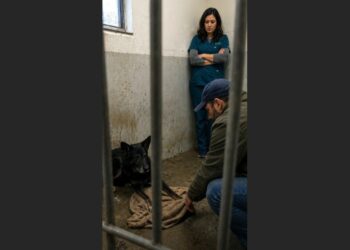
The four-year-old Border Collie had arrived at the animal shelter just two days earlier after being found wandering beside a busy highway.
He was painfully thin, exhausted, and frightened by almost everything around him.
A sudden noise made him flinch.
When someone approached his kennel, he pressed himself against the wall.
Even the ordinary movements of shelter employees seemed to overwhelm him.
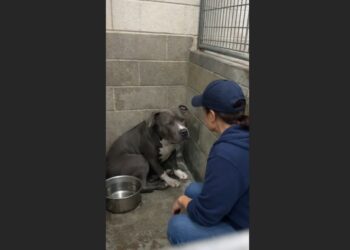
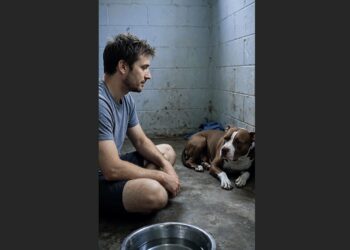
That afternoon, a volunteer noticed Baxter staring at the water bucket.
He had been watching it for nearly twenty minutes.
His tongue was dry, and he appeared desperately thirsty.
But every time he leaned forward as though preparing to stand, he seemed to lose his nerve and withdraw into the corner.
The water remained untouched.
On the other side of the kennel, an elderly Golden Retriever named Rosie watched him.
Rosie had endured her own difficult history. She had been moved between homes for years before arriving at the shelter.
Yet she remained gentle and calm.
She had recently returned from the exercise yard and had reason to be thirsty herself.
When she stood and approached the bucket, the volunteer assumed she was going to drink.
Instead, Rosie lowered her head, took the handle between her teeth, and began pulling.
The metal scraped against the concrete.
Water splashed over the edge.
Slowly, the Golden Retriever dragged the bucket across the floor until it was directly in front of Baxter.
Then she stepped away.
And for the first time that afternoon, the frightened Border Collie lowered his head and drank.
Two Days Earlier, Baxter Had Been Found Beside a Highway
Nobody at the shelter knew exactly how long Baxter had been alone.
The Border Collie was approximately four years old when he was discovered wandering along a busy highway.
Traffic moved nearby, placing him at risk every moment he remained close to the road.
By the time he reached the shelter, he was exhausted.
His body was unusually thin, suggesting that he had not been receiving adequate nutrition.
He appeared frightened and overwhelmed.
The staff had little information about where he came from.
They did not know whether he had escaped from a home, been abandoned, or wandered for an extended period before someone found him.
They also could not determine what experiences had caused his extreme fear.
What they could observe was his behavior.
Baxter startled at ordinary sounds.
He became tense when people approached.
When someone moved toward him, he retreated as far as the kennel allowed.
He did not behave like a dog eager for attention or excited to explore his surroundings.
He seemed to be trying to avoid everything.
The shelter staff understood that his physical condition needed care.
But his fear created another challenge.
He had to become comfortable enough to eat, drink, rest, and interact with the people responsible for him.
Even the simplest activities were proving difficult.
A Kennel That Felt Too Frightening to Explore
For a newly rescued dog, an animal shelter can be an overwhelming environment.
There are unfamiliar voices, footsteps, barking dogs, cleaning equipment, and doors opening and closing.
People enter and leave throughout the day.
Food arrives at scheduled times, but the routine may be completely different from anything the animal has previously known.
Some dogs respond by becoming highly active.
Others remain quiet, cautious, or withdrawn.
Baxter belonged to the latter group.
During his first two days, he spent much of his time in the corner of his kennel.
When someone came near, his body tightened.
He watched every movement.
If a sound startled him, he pressed farther against the wall.
The shelter employees tried to give him space.
They knew that forcing physical contact with a frightened dog could increase his distress.
They wanted him to become familiar with their presence without feeling pursued.
But Baxter’s reluctance to move was beginning to interfere with his basic needs.
He wasn’t simply refusing to greet people.
He appeared afraid to cross the kennel even when water was available.
The volunteers were concerned.
He had already arrived exhausted and underweight.
Maintaining hydration was particularly important for a dog in his condition.
And that afternoon, the staff noticed a problem they could no longer overlook.
The Water Bucket He Couldn’t Reach
Baxter’s water bucket sat within easy walking distance.
It wasn’t outside the kennel.
There were no obstacles blocking his path.
The container was only a few feet from where he rested.
Yet Baxter had been staring at it for nearly twenty minutes.
A volunteer noticed how closely he watched the water.
His dry tongue was visible.
He seemed interested in drinking, but he remained against the wall.
Occasionally, he leaned forward.
His body shifted as though he might stand.
Then he stopped.
He withdrew into the corner again.
The volunteer watched quietly.
Baxter’s behavior was heartbreaking because the distance was so small.
An ordinary dog might have crossed it without hesitation.
For Baxter, that short stretch of concrete appeared overwhelming.
The staff couldn’t know exactly what he was thinking.
His hesitation might have reflected fear of the unfamiliar environment, discomfort, exhaustion, or a combination of factors.
But the observable result was clear.
He was thirsty, and he wasn’t approaching the water.
The shelter needed to make sure he could drink safely.
As the volunteer considered how best to help, another dog in the kennel began paying attention to Baxter.
Her name was Rosie.
Rosie Had a Difficult History of Her Own
Rosie was a senior Golden Retriever who had spent years moving between homes.
Her history was not fully described, but shelter workers knew she had experienced repeated changes in her living arrangements.
For an older dog, that kind of instability can be difficult.
Each move brings unfamiliar surroundings, different routines, and new people.
An animal may have to learn where it will sleep, when it will be fed, and which people it can approach comfortably.
Rosie had experienced several such transitions before reaching the shelter.
Despite them, she remained gentle.
She did not respond to every unfamiliar sound with fear.
She was generally calm around the people caring for her.
And that afternoon, she was sharing kennel space with Baxter.
Rosie had recently returned from the exercise yard.
She was resting on the opposite side of the enclosure while Baxter remained in his corner.
The volunteer initially paid little attention to her.
Rosie seemed comfortable.
Baxter was the one causing concern.
But while the Border Collie watched the water, Rosie appeared to be watching him.
She remained quiet.
She didn’t immediately approach.
She simply observed his movements from across the kennel.
Then she stood.
The Volunteer Thought Rosie Was Going to Drink
Rosie walked toward the bucket.
There was nothing unusual about that.
She had just been outside exercising, and the volunteer assumed she was thirsty.
The water was nearby.
For a moment, it seemed obvious what she intended to do.
But Rosie did not lower her muzzle into the bucket.
Instead, she positioned herself beside it.
She reached toward the handle.
Then she took hold of it with her mouth.
The volunteer watched, surprised.
Rosie began pulling.
At first, the bucket barely moved.
The handle shifted, and the metal container scraped against the concrete.
Rosie adjusted her position.
Then she pulled again.
The bucket slid a short distance.
Water moved inside it and splashed over the edge.
The sound of metal against the floor was soft but unmistakable.
Rosie continued.
She didn’t drag the bucket toward her own resting place.
She pulled it across the kennel toward Baxter.
The volunteer remained outside the enclosure, watching the Golden Retriever repeat the movement.
It was not something anyone had asked her to do.
No employee had pointed toward Baxter or instructed Rosie to move the water.
Yet the bucket was traveling across the floor in the direction of the frightened dog.
A Few Inches at a Time
Dragging a bucket of water was not an especially graceful task.
The container shifted as Rosie pulled.
At times, its base caught slightly against the concrete.
Water splashed onto the floor.
Rosie stopped, adjusted her grip, and continued.
Each movement brought the bucket closer to Baxter.
The Border Collie remained in his corner.
He watched the older dog approach with the container.
The volunteer could see that he was alert to the movement.
But Rosie did not crowd him.
She remained focused on pulling the bucket.
A little closer.
Then another few inches.
Eventually, she stopped directly in front of him.
The bucket was now within easy reach of his muzzle.
Baxter no longer needed to cross the kennel to drink.
Rosie released the handle.
For a moment, she stood near the container.
Then she stepped backward.
She moved several feet away and settled down.
The volunteer watched Baxter.
He looked toward the bucket.
Then toward Rosie.
Then back at the water.
The entire scene had unfolded without a person touching either dog.
Rosie had moved the bucket.
Now Baxter had to decide what to do next.
Baxter Finally Lowered His Head
For a few seconds, Baxter remained uncertain.
The water was directly in front of him.
Rosie had moved away.
The volunteer stayed still outside the kennel.
Baxter glanced toward the Golden Retriever.
She was resting nearby.
Nothing was forcing him to move.
Then the Border Collie slowly lowered his head.
His muzzle reached the bucket.
And he began drinking.
The volunteer watched with relief.
The dog who had spent nearly twenty minutes staring at water from across the kennel was finally able to reach it.
It was an ordinary action.
Dogs drink water throughout the day.
There was nothing remarkable about the movement itself.
What made the moment significant was everything that had happened before it.
Baxter had been too frightened to approach the bucket.
Rosie had moved it closer.
Then she had given him space.
And Baxter had taken the opportunity to drink.
He hadn’t suddenly become confident.
His fear had not disappeared.
But one immediate problem had been eased.
For an exhausted, underweight dog struggling to adjust to a new environment, that mattered.
Nobody Had Taught Rosie to Do It
The volunteer remained outside the kennel, surprised by what she had witnessed.
Rosie had not been trained by the shelter to deliver water to frightened dogs.
There had been no command.
No treat offered as a reward.
No demonstration showing her how to move the bucket toward Baxter.
The older Golden Retriever had approached the container, pulled it across the floor, and stepped away.
The result was that Baxter could drink without leaving the corner where he felt safest.
It was tempting to interpret the behavior as deliberate compassion.
Perhaps Rosie had noticed Baxter’s difficulty and responded.
That was certainly how the moment appeared to the people watching.
But animal behavior is complex.
A single incident cannot reveal a dog’s precise intentions.
Rosie may have been motivated by curiosity, previous experiences with objects, a response to Baxter’s behavior, or some combination of factors.
The shelter workers could not know exactly what she understood.
What they could say was that the action helped.
Rosie had changed the position of the bucket.
Baxter had been reluctant to approach it.
And once the water was brought closer, he drank.
The outcome was simple, but it was meaningful.
Why Baxter’s Fear Mattered So Much
A fearful dog may struggle with more than unfamiliar people.
Fear can interfere with eating, drinking, resting, and exploring.
An animal that remains constantly alert may find ordinary routines difficult.
Every sound or movement can become another reason to retreat.
Baxter had shown those behaviors since arriving at the shelter.
He was already exhausted and painfully thin.
His physical condition made access to food and water especially important.
But offering those resources wasn’t enough if he was too frightened to approach them.
Shelter staff needed to consider how the environment affected him.
They could provide a quieter space, move essential resources closer, avoid sudden movements, and seek veterinary guidance when necessary.
Rosie’s behavior did not replace any of those responsibilities.
A dog who is dehydrated or repeatedly unable to drink needs prompt attention from people trained to care for him.
But the incident highlighted something the volunteer had already begun to understand.
Baxter’s problem wasn’t a lack of available water.
It was his difficulty moving through an environment that frightened him.
By bringing the bucket closer, Rosie had changed that immediate situation.
The small adjustment made drinking possible.
The Gentle Retriever Who Had Been Moved Between Homes
Rosie’s own history made the moment especially affecting for the shelter workers.
She was an elderly dog who had experienced years of instability.
She had been moved from home to home before arriving at the shelter.
Those transitions could have left her cautious or withdrawn.
Instead, she remained gentle in the environment described.
She was comfortable enough to rest in the kennel and move around it.
Her behavior toward Baxter was quiet.
She did not approach him directly or demand interaction.
She brought the bucket closer and moved away.
The volunteer saw an older dog whose own life had not always been stable making a difference for a younger animal in distress.
There was no reason to assume that Rosie’s earlier experiences had taught her empathy in the human sense.
Nor could anyone know whether she consciously understood Baxter’s fear.
But her history made the scene emotionally resonant.
Both dogs had experienced uncertainty.
One had arrived frightened and physically depleted.
The other had lived through repeated changes in caregivers.
For a few minutes, their circumstances intersected around a simple bucket of water.
And the result was something the volunteer would remember.
Small Acts Can Matter Enormously in a Shelter
Animal shelters are places where significant events often happen quietly.
A frightened dog takes its first comfortable steps toward a volunteer.
A neglected animal begins eating regularly.
A senior dog settles into a clean bed after a difficult transition.
A nervous animal accepts gentle attention for the first time.
Those moments rarely attract much attention outside the shelter.
They may not involve dramatic rescues or public celebrations.
But they can represent meaningful progress.
For Baxter, drinking from the bucket was one such moment.
He had been rescued from a dangerous roadside situation.
He had reached a place where staff could provide food, water, and veterinary care.
Yet he remained so fearful that he struggled to approach a basic necessity.
Rosie’s action helped him complete something he had been unable to do.
The volunteer understood the significance.
It wasn’t proof that Baxter was suddenly ready for adoption.
It didn’t mean he would immediately trust unfamiliar people.
But it gave him access to water while he remained close to the corner where he felt safest.
Sometimes an animal’s progress begins with making the environment easier rather than asking the animal to change.
That afternoon offered a striking example.
What We Can Learn From Rosie Without Assuming Too Much
Dogs are highly social animals.
Many develop close relationships with other dogs, and they can be sensitive to changes in body language, vocalizations, and behavior.
Researchers have studied how dogs respond to the emotional cues of people and other animals.
There is evidence that dogs can distinguish certain expressions and signs of distress.
But determining whether a particular action represents empathy, learned behavior, curiosity, or another motivation is not always straightforward.
Rosie’s conduct raised an interesting question.
Did she recognize that Baxter was afraid to approach the bucket?
The volunteer believed she might have.
After all, Rosie had been watching him.
She had seen him lean forward and retreat.
Then she moved the water closer.
But the account does not establish Rosie’s internal reasoning.
It describes what happened.
The Golden Retriever dragged the bucket toward Baxter.
She stepped back.
He drank.
That sequence was remarkable enough without pretending to know precisely what Rosie was thinking.
Her action benefited another dog.
And it reminded the staff how much can happen between animals without a human directing every interaction.
Baxter Still Had a Long Way to Go
After drinking, Baxter was still a frightened rescue dog.
He had been at the shelter only two days.
He was underweight, exhausted, and sensitive to sudden sounds and movement.
The water bucket incident did not erase those concerns.
His recovery would require continued attention to his physical health and emotional well-being.
The shelter staff would need to make sure he was eating and drinking adequately.
They would need to monitor his response to the environment.
And they would need to give him time to become familiar with people without overwhelming him.
Progress might be uneven.
One day, Baxter could seem more comfortable.
The next, an unfamiliar noise might startle him again.
That would not necessarily mean he was failing to improve.
Fearful dogs often need repeated, predictable experiences before their behavior becomes more relaxed.
The most important thing was not to rush.
Baxter had already survived an uncertain period before being rescued.
Now he had people responsible for his care.
He also had Rosie nearby.
The older Golden Retriever could not solve every problem Baxter faced.
But that afternoon, her presence had helped him through one difficult moment.
A Quiet Moment Nobody Expected
The volunteer had been watching Baxter because she was worried.
The Border Collie seemed desperately thirsty but unable to move toward his water.
She hadn’t expected Rosie to become part of the solution.
The senior Golden Retriever had been resting nearby after spending time outside.
There was every reason to assume she would simply drink from the bucket herself.
Instead, she pulled it across the kennel.
The metal scraped against the floor.
Water splashed.
Baxter watched.
Rosie stopped when the bucket was directly in front of him.
Then she moved away.
Nobody was filming.
No crowd had gathered to watch.
There were no cheers when Baxter finally drank.
The volunteer simply stood outside the kennel, taking in what had happened.
It was a small scene in an ordinary shelter afternoon.
But she had seen a dog who was struggling receive help in an unexpected way.
And she had seen another dog behave with a gentleness that was easy to overlook.
For the people responsible for both animals, the moment stayed with them.
Two Dogs With Different Histories
Baxter and Rosie had arrived at the shelter for different reasons.
Baxter had been found wandering beside a highway.
He was young enough to have many years ahead of him, but his immediate condition was serious.
He was painfully thin and intensely fearful.
Rosie was older.
She had experienced repeated changes in her living arrangements and eventually ended up at the shelter.
Yet she remained calm and gentle.
Neither dog could tell the volunteers what had happened in the past.
Baxter couldn’t explain how long he had been alone or why he was frightened.
Rosie couldn’t describe the homes she had lived in or how those experiences had affected her.
The staff had to work with the histories available and the behaviors they could observe.
That afternoon, those two histories met in a shared kennel.
Baxter needed water.
Rosie moved the bucket.
It was a brief interaction, but it showed how differently the two dogs were responding to their circumstances.
One was too frightened to move.
The other was comfortable enough to approach an object, carry out an unusual action, and settle down again.
The contrast made the scene memorable.
The Kind of Kindness That Doesn’t Need an Audience
People often celebrate animals for dramatic acts.
A dog leads rescuers to someone in danger.
A pet alerts a family to smoke.
An animal survives extraordinary circumstances.
Those stories are memorable because the stakes are immediately visible.
But animal welfare also depends on quieter moments.
An exhausted dog finding a comfortable place to sleep.
A frightened animal choosing to approach a familiar caregiver.
Two dogs resting peacefully beside each other.
And sometimes, an elderly Golden Retriever moving a water bucket closer to a companion who cannot bring himself to reach it.
There was no dramatic rescue that afternoon.
Baxter had already been brought into the shelter.
Rosie had not carried him out of danger.
She had simply moved something he needed closer to where he was resting.
The action was modest.
But the result was immediate.
Baxter drank.
For the volunteer watching, that was enough to turn an ordinary afternoon into a memory.
Before Baxter Trusted People, He Had Rosie Nearby
The Border Collie still needed time.
He would need to learn that the shelter staff were there to care for him.
He would need repeated opportunities to experience ordinary sounds and movements without becoming overwhelmed.
He would need food, water, rest, and appropriate medical attention as he recovered from his time alone.
Those changes could not happen in a single afternoon.
But one important thing had happened.
When Baxter was too frightened to approach the water bucket, Rosie moved it closer.
She didn’t crowd him afterward.
She didn’t stand over him while he drank.
She stepped away and allowed him to use the water.
The volunteer could not say with certainty why Rosie did it.
She could not know whether the Golden Retriever recognized Baxter’s distress in the way a person might.
But she had watched the interaction unfold.
And she knew the outcome.
A frightened dog who had been unable to reach water finally drank.
An older dog with a difficult past had done something unexpectedly helpful.
And for a few minutes, the quiet kennel held something other than fear.
A Bucket Moved Across a Concrete Floor
It would have been easy to miss.
A volunteer could have been cleaning another kennel.
An employee could have been answering the telephone.
Someone might have walked past without noticing the old Golden Retriever dragging the bucket.
Nothing about the scene was designed to attract attention.
There was only the scraping sound of metal against concrete.
A little water splashing onto the floor.
An elderly dog moving carefully across the kennel.
And a frightened Border Collie waiting in the corner.
Rosie reached Baxter and stopped.
She released the bucket.
Then she stepped away.
Baxter looked toward her, then at the water.
Finally, he lowered his head and drank.
The moment did not tell the shelter staff everything about either dog.
It did not explain Baxter’s past or reveal exactly what Rosie understood.
But it gave them something they hadn’t expected to witness.
One vulnerable animal had benefited from another’s actions.
And sometimes that is enough to make a small moment unforgettable.
Baxter had arrived at the shelter exhausted, underweight, and terrified.
Rosie had arrived carrying the effects of her own unsettled history.
Neither had a permanent home.
Neither knew what would happen next.
But on that afternoon, when the distance between Baxter and his water felt impossible, Rosie made it smaller.
A few feet of concrete.
A worn metal bucket.
One elderly Golden Retriever who quietly moved it within reach.
And a frightened Border Collie who was finally able to drink.
Sometimes the moments that matter most are not the ones the world sees.
They are the ones that happen quietly, when one animal’s small action makes another animal’s difficult day just a little easier.
Editor’s Note: The characters in this story are fictional. Through these stories, we hope to share the intelligence, loyalty, compassion, and loving nature of dogs with people everywhere.