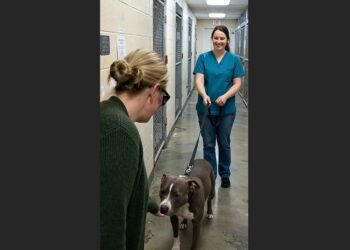
Peggy had been returned to the animal shelter twice.
She was a Pit Bull mix with a gentle disposition, but there was something about being near men that made her visibly uncomfortable.
She didn’t rush toward them.
She didn’t bark or try to attack.
Instead, her body became rigid. She stopped moving, her eyes widened, and sometimes she trembled.
The shelter workers had noticed the pattern.
And when a couple arrived to adopt her, one employee quietly pulled them aside before they left.
“Her name’s Peggy,” she explained. “She’s been returned twice. She’s afraid of men… and it might take a long time—if she ever fully gets past it.”
The couple listened.
They understood that Peggy might never become comfortable around every person she met.
They also understood that bringing her home would require patience.
Still, they wanted her.
During the first evening in her new house, Peggy kept her distance from the husband.
He noticed how closely she watched his movements.
He didn’t attempt to pet her.
He didn’t approach with treats or repeatedly call her name.
Instead, he sat quietly on the floor.
He stayed there without asking anything of her.
The next evening, he did the same.
And on the third night, Peggy approached.
She moved slowly, hesitated, and lowered herself beside him.
Then she gently rested her head against his.
He remained still.
For a dog who had been frightened by the presence of men, that small gesture meant more to the couple than any enthusiastic greeting could have.
Peggy had approached him because she chose to.
And for the first time, she was allowing herself to rest beside him.
A Dog Who Had Already Lost Two Homes
Peggy’s new family knew very little about the experiences that had shaped her fear.
They knew she had been returned to the shelter twice.
They knew staff had observed a strong reaction when men approached her.
But the full details of her earlier life remained uncertain.
There was no confirmed account of what had caused her behavior.
It was possible that she had experienced frightening interactions.
It was also possible that a lack of positive experiences, unfamiliar surroundings, or other factors contributed to her discomfort.
Whatever the explanation, Peggy was struggling.
For a dog who has already experienced multiple changes in living arrangements, another move can be difficult.
Every new home comes with unfamiliar people, scents, rooms, and routines.
Some dogs adjust quickly.
Others need considerable time before they feel comfortable.
Peggy had another challenge.
One of the people in her new household was a man.
Her reaction to men had been noticeable enough that the shelter felt an obligation to warn potential adopters.
The couple could have decided that the situation was more than they were prepared to manage.
Instead, they listened carefully and took Peggy home.
They were not expecting an immediate transformation.
They simply wanted to give her a stable place to live.
The Warning at the Shelter Door
The conversation happened as the couple was preparing to leave with Peggy.
A shelter employee gently approached them.
She spoke quietly, explaining that there was something important they needed to understand about their new dog.
Peggy had already been returned twice.
She was especially uncomfortable around men.
And there was no guarantee that her fear would disappear entirely.
The employee wasn’t trying to discourage the adoption.
She was making sure the couple understood Peggy’s needs.
An animal who is fearful in particular situations may require a different approach from a dog who welcomes every unfamiliar person.
Pushing for contact too soon can make the animal more distressed.
Even seemingly friendly actions, such as reaching toward a dog’s head or leaning over its body, may feel threatening to a dog that is already frightened.
The couple had seen enough of Peggy’s behavior to recognize the concern.
When men came close, her posture changed.
She became still and tense.
Sometimes her body trembled.
She rarely responded with any outward display that people might associate with aggression.
Once, she produced a soft growl.
That sound mattered.
A growl can be a warning that a dog is uncomfortable and wants additional space.
It does not necessarily mean the animal intends to attack.
Peggy was communicating something important through her behavior.
Her new family needed to listen.
What Fear Looked Like for Peggy
Peggy’s fear wasn’t always loud or dramatic.
Much of the time, it appeared as stillness.
When a man approached, she stopped moving.
Her muscles tightened, and she watched him closely.
Sometimes she trembled without making a sound.
This kind of response can be easy to misunderstand.
People often expect a frightened dog to run away, hide, or bark.
But fear can also cause an animal to freeze.
A dog may remain motionless because it is uncertain how to respond or because movement seems risky.
Peggy’s new family noticed that pattern almost immediately.
She wasn’t behaving like a dog who wanted to challenge the people around her.
She appeared uncomfortable and unsure of what would happen next.
The distinction was important.
Her husband didn’t interpret Peggy’s hesitation as stubbornness.
He didn’t insist that she come closer to prove she could trust him.
He recognized that the dog needed space.
Her occasional growl was also treated as information rather than disobedience.
Suppressing a warning sound does not necessarily make an animal feel safer.
Instead, the family wanted to understand what situations caused Peggy distress and avoid overwhelming her.
That meant allowing her to remain at a comfortable distance.
And it meant accepting that progress might happen slowly.
A Quiet Home With No Demands
Before Peggy arrived, the couple had prepared a calm environment.
They provided soft bedding and places where she could rest.
They kept their voices gentle and avoided unnecessary excitement.
They wanted her to have time to become familiar with the household.
But they understood that comfortable bedding alone would not resolve her fear.
Peggy needed to learn that the people around her were predictable.
For dogs who are nervous in unfamiliar environments, consistency can be valuable.
Regular meals, quiet routines, and opportunities to retreat can help reduce uncertainty.
Equally important is the ability to choose whether to approach another person.
Peggy’s new family decided not to force physical contact.
They didn’t expect her to greet visitors.
They didn’t try to make her participate in interactions when she was visibly uncomfortable.
And the husband chose a particularly simple approach.
He would spend time near her without attempting to initiate contact.
He wouldn’t make approaching him into a test.
He wouldn’t reward every movement with an excited reaction.
He would simply be present.
For Peggy, who seemed particularly sensitive to the presence and movement of men, that meant she could observe him without having to respond.
It was a modest beginning.
But the couple believed it was the right one.
The First Night: He Sat on the Floor
On the first evening, the husband settled onto the floor.
He didn’t move toward Peggy.
He didn’t crouch over her or extend his hands in an attempt to persuade her to come closer.
He simply sat down and remained quiet.
Peggy kept her distance.
She watched him carefully.
Her attention seemed fixed on his posture and movements.
The husband understood that she might be deciding whether she needed to move away.
So he gave her no reason to feel pursued.
He didn’t repeatedly call her name.
He didn’t attempt to touch her.
He let her decide where to stand and when to rest.
For a while, nothing happened.
Peggy remained across the room.
The husband continued sitting quietly.
There was no dramatic breakthrough.
No sudden tail wagging.
No affectionate greeting.
But the evening gave Peggy an opportunity to experience something different.
A man was nearby.
He was not approaching or demanding attention.
He was simply sharing the room with her.
That alone did not mean her fear was gone.
But it provided one calm experience that could become part of her developing familiarity with him.
When the evening ended, the husband had asked nothing of her.
And Peggy had been allowed to keep her distance.
The Second Night: A Little Closer
The following evening, the husband returned to the floor.
He followed the same approach.
No sudden movements.
No reaching.
No effort to persuade Peggy to interact.
He wanted the experience to remain predictable.
Peggy watched him again.
But this time, she moved somewhat closer.
She was still cautious.
She stopped before reaching him and appeared ready to retreat if necessary.
Her body language suggested that she wasn’t entirely comfortable.
Yet she had chosen to reduce the distance.
For the couple, that was encouraging.
It was not proof that she had overcome her fear.
A dog can approach something unfamiliar while still feeling uncertain.
Curiosity and caution often exist together.
Peggy might have been investigating the man because he had become part of her environment.
She might have been learning that he did not pursue her when she moved away.
Whatever her motivation, she was beginning to approach on her own terms.
Her husband continued behaving as he had the previous evening.
He did not reach out to take advantage of the moment.
He didn’t treat her movement as an invitation to pet her.
He allowed her to observe him from the distance she had chosen.
Eventually, the evening ended.
Peggy had come a little closer.
That was enough.
The Third Night: Peggy Makes Her Choice
On the third evening, the husband sat on the floor again.
By now, Peggy had experienced two quiet nights with him nearby.
He had not followed her around the room.
He had not forced her to accept attention.
And when she kept her distance, he had allowed it.
This time, Peggy stood watching him for a while.
Then she began to move.
Her steps were slow.
She approached cautiously, pausing as though she were assessing the situation.
The husband remained still.
He didn’t reach toward her.
He didn’t call her closer.
Peggy crossed the remaining distance.
Then she lowered herself beside him.
For a moment, she stayed there.
And gently, almost tentatively, she rested her head against his.
The husband felt her settle next to him.
He knew how unusual the gesture was for this particular dog.
Only days earlier, she had visibly trembled around men.
Now she was choosing to make physical contact with him.
He didn’t want to startle her.
So he stayed exactly where he was.
Peggy remained beside him.
There was no need to ask for anything more.
He Didn’t Move, Even When He Became Uncomfortable
The husband had been sitting on the floor for some time.
His legs were beginning to feel numb.
His neck was becoming uncomfortable.
Under ordinary circumstances, he would have shifted his position.
But Peggy was resting her head against him.
He knew that sudden movement might cause her to withdraw.
So he remained still for a little longer.
The gesture was simple, but it showed how carefully he was paying attention to the dog.
He wasn’t trying to prove that she loved him.
He wasn’t expecting her to remain there indefinitely.
He was allowing her to decide how long the contact would last.
For a dog who had been fearful of men, that freedom was important.
Peggy could move away whenever she wanted.
She wasn’t being restrained.
She wasn’t being held in place.
The husband understood that the moment belonged to her as much as it did to him.
He had offered a calm presence.
She had chosen to approach.
And now they were resting together.
The couple would remember that third night because of how little happened outwardly.
There was no excited celebration.
Just an older fear beginning to give way to a new experience.
A dog rested beside a man.
And he allowed her to remain there in peace.
Trust Doesn’t Always Begin With Affection
People often imagine that gaining a dog’s trust means earning tail wags, kisses, or enthusiastic greetings.
For some animals, those behaviors appear quickly.
For others, trust develops in quieter ways.
A nervous dog may first become comfortable remaining in the same room as an unfamiliar person.
Later, it may begin approaching.
Eventually, it may choose to rest nearby or accept gentle touch.
The process varies from animal to animal.
Peggy’s experience illustrated how meaningful a small change could be.
On her first night, she stayed away from the husband.
On the second, she moved closer.
On the third, she rested her head against him.
Those steps were important because Peggy initiated them.
Her husband had not made physical contact a condition of living in the household.
He had not treated her fear as something she needed to overcome on his schedule.
Instead, he gave her repeated opportunities to observe him behaving calmly.
That consistency appeared to help her become more comfortable.
Still, three evenings would not be enough to guarantee that Peggy’s fear had disappeared completely.
Her new family understood that.
They were celebrating a beginning, not declaring that all her difficulties were over.
Why a Growl Deserves to Be Heard
One detail from Peggy’s early behavior remained important to her family.
She had occasionally growled when she felt uncomfortable.
To someone unfamiliar with canine communication, that sound might seem alarming.
But growling is one way dogs communicate that they want distance or that a situation is troubling them.
The context matters.
A dog who growls while cornered or frightened may be warning that it cannot comfortably tolerate additional pressure.
Punishing the sound without addressing the underlying fear can make the situation more dangerous.
The dog may remain distressed while becoming less likely to give a warning before reacting.
Peggy’s family did not want that outcome.
They wanted her to feel safe enough that she would not need to growl.
That meant respecting her boundaries.
When she stiffened or appeared frightened, the husband allowed additional space.
He did not insist on contact.
He did not interpret her fear as a personal rejection.
His response was not complicated.
He paid attention.
That gave Peggy more control over interactions that had previously caused her distress.
Over time, her behavior around him began changing.
But the change came from repeated experiences, not from forcing a single affectionate moment.
The Importance of Letting a Dog Approach
Peggy’s husband could have tried several more direct ways to gain her affection.
He could have approached with treats.
He could have called her name repeatedly.
He could have attempted to pet her while she was resting.
Instead, he chose to sit quietly and let her approach if she wanted.
That distinction mattered for Peggy.
A fearful dog may find even friendly attention overwhelming if the person moves too close too quickly.
Leaning over a dog, staring directly at it, or reaching suddenly toward its head can increase discomfort.
Allowing the dog to choose the distance can reduce pressure.
The husband made himself available without forcing interaction.
He remained nearby but did not follow Peggy when she moved away.
As a result, she could investigate him gradually.
The family wasn’t attempting to complete a formal behavior modification program in three days.
They were simply establishing a calm routine.
For dogs with persistent fears, qualified veterinary or behavior professionals may be needed to develop a safe, gradual plan.
Peggy’s improvement did not eliminate that possibility.
But her husband’s approach gave her an important early experience in her new home.
She could be near him without being pressured.
And eventually, she chose to be closer.
A Dog Who Had Been Returned Twice Was Staying
The shelter’s warning had stayed with the couple.
Peggy had already been returned twice.
They knew that another failed placement could be especially disruptive for her.
So when they brought her home, they tried not to measure success by how quickly she became affectionate.
They wanted her to feel secure.
That meant accepting that some days might be difficult.
She might remain uncomfortable around unfamiliar men.
She might need more time to adjust to visitors.
She could become frightened by situations the family had not anticipated.
The couple understood that adopting Peggy meant caring for her through those challenges rather than expecting every problem to disappear.
The third-night interaction was encouraging.
But their commitment did not depend on that single moment.
Even if Peggy had continued keeping her distance, they would still have needed to provide a safe environment and appropriate care.
The husband had begun building a relationship through consistency.
Peggy was slowly learning the household.
And for the first time in this account, she was not being asked to move to another home because she was afraid.
Her family intended to keep her.
The Little Changes Continued
After the third night, Peggy’s behavior around the husband continued changing.
She became more willing to approach him.
The distance she had maintained during the first days grew smaller.
She began moving through the house when he did.
If he left one room and entered another, Peggy often followed.
The couple noticed the change gradually.
At first, they had been careful not to approach her too quickly.
Now she was sometimes the one seeking contact.
She appeared increasingly comfortable with his familiar movements and voice.
The husband continued respecting her boundaries.
He did not assume that one affectionate interaction meant every future situation would be easy.
Peggy still needed predictable routines and the freedom to step away when uncomfortable.
But she was developing habits that suggested a growing attachment.
She followed him through the house.
She rested near him.
And the moments of contact became more frequent.
For the couple, those changes were deeply rewarding.
The dog who had once frozen when a man came close was now choosing to remain near one.
They knew how much patience had gone into even that small shift.
The New Evening Routine
Peggy eventually developed a new habit.
At night, when the household became quiet, she settled beside the husband.
Often, she rested her head against him as she fell asleep.
It reminded the couple of the third evening after her adoption.
That was the first time she had approached him and allowed herself to rest with her head touching his.
Now the gesture had become familiar.
Peggy no longer needed the same long period of hesitation before every interaction.
She knew where he liked to sit.
She recognized his movements.
And she was comfortable enough to seek a resting place close to him.
The husband found himself remembering those early evenings on the floor.
The first night when Peggy refused to approach.
The second when she moved a little closer.
And the third when she finally settled beside him.
The family had not asked her to become a different dog.
They had given her opportunities to learn that this particular person could be approached safely.
That familiarity grew into companionship.
The change was not a guarantee that Peggy would never experience fear again.
But it meant that her home now included a man she appeared comfortable being near.
Peggy Was Still the Same Dog
Peggy’s personality had not been erased by her progress.
She was still the same Pit Bull mix who had arrived with a history of fear around men.
She still deserved careful handling, predictable routines, and sensitivity to situations that might make her uncomfortable.
Her family understood that confidence can vary depending on circumstances.
A dog may feel comfortable with one familiar person while remaining fearful of strangers who share some physical characteristic.
That does not make the improvement meaningless.
It simply means trust is often specific to relationships and experiences.
Peggy had learned to approach the husband in her new home.
Other situations might require more time.
The couple was prepared to accept that.
They did not need Peggy to become outgoing with every visitor.
They wanted her to live comfortably and feel secure in the household.
Her behavior had changed because she was beginning to develop a predictable relationship with the people around her.
That was a meaningful accomplishment.
The same dog who once trembled when men approached now sometimes followed her new dad from room to room.
Not because someone demanded it.
Because she appeared to want his company.
What the Couple Learned From Peggy
The family had initially believed that a calm home, soft bedding, and gentle voices would help Peggy settle.
Those things were important.
But her husband discovered that the most useful thing he could offer in the first days was his willingness to wait.
He did not try to win her over through constant attention.
He did not treat every interaction as an opportunity to pet her.
He accepted that she needed to observe him before she was ready for contact.
His patience wasn’t a dramatic act.
It involved sitting quietly on the floor and doing very little.
But that stillness gave Peggy choices.
She could keep her distance.
She could approach.
She could leave.
Over three evenings, she became willing to move closer.
The couple came to understand that helping a fearful dog does not always require immediate affection.
Sometimes the animal first needs the experience of being around someone who respects its boundaries.
Peggy’s progress was not proof that every fearful dog will respond in the same way.
Some dogs need considerably longer.
Some require professional behavioral support.
And some may never become fully comfortable in particular situations.
But Peggy had shown that a frightened dog could still develop a trusting relationship when given appropriate time and space.
The Dog Who Had Been Called Difficult
Before her adoption, Peggy had been returned twice.
That history could easily have shaped how people viewed her.
A dog with repeated unsuccessful placements may be described as difficult, unpredictable, or too much work.
But those labels don’t always explain the behaviors beneath them.
Peggy had not been trying to make life difficult for her caregivers.
She appeared frightened by certain interactions.
Her reactions were part of how she responded to situations she did not yet feel comfortable managing.
Understanding that distinction helped her new family approach her differently.
They did not punish her for trembling.
They didn’t force her to meet men.
They respected the growl that warned she was uncomfortable.
And they allowed her relationship with the husband to develop gradually.
The result was not immediate obedience or an overnight change in temperament.
It was the beginning of trust.
Peggy learned that she could approach the man in her home without being pressured.
And he learned to recognize how much her small choices mattered.
For a couple who had been warned that their new dog might never fully overcome her fear, that was a powerful experience.
Three Nights That Began a New Life
Looking back, the couple often remembered how little the husband had done during those first three evenings.
He had sat on the floor.
He had remained quiet.
He had allowed Peggy to watch him.
The first night, she stayed away.
The second, she came closer.
The third, she rested her head against him.
Those moments formed the beginning of a relationship that continued developing after the initial adjustment period.
Peggy began following him around the house.
She sought his company.
And at night, she rested beside him.
For the family, the transformation was not about making Peggy forget everything that might have frightened her in the past.
They didn’t know her entire history.
They could not explain exactly why men had caused her such distress.
And they couldn’t promise that she would never be frightened again.
What they could provide was a home where her boundaries were respected.
A household with predictable routines.
And people who were willing to give her the time she needed.
Peggy had been returned twice before.
This time, her family wanted her to stay.
A Head Resting Against Someone She Once Feared
The image her family remembers most clearly is still the one from the third night.
The husband sitting on the floor.
Peggy watching from a distance.
The cautious steps that brought her closer.
Then the moment she lowered herself beside him and rested her head against his.
He had been uncomfortable from sitting so long.
His legs were numb, and his neck was beginning to ache.
But he remained still because Peggy had finally chosen to approach.
That first contact did not erase her fear.
It did not prove that she would always feel comfortable around men.
But it was a beginning.
Now Peggy follows him through the house.
When he settles down in the evening, she often comes to rest beside him.
And sometimes she falls asleep with her head against his body, repeating the gesture that meant so much during those first days.
The couple had been warned that she might take a long time to trust.
They listened.
They accepted that possibility.
Then they brought her home and gave her space.
Peggy did not need to prove she was brave.
She did not need to become affectionate on anyone else’s schedule.
She needed people willing to let her feel safe in her own time.
And on the third night, when she finally approached the man who had been sitting quietly nearby, he didn’t reach out to claim the moment.
He simply let her stay.
Editor’s Note: The characters in this story are fictional. Through these stories, we hope to share the intelligence, loyalty, compassion, and loving nature of dogs with people everywhere.