My husband is six-foot-four, rides a Harley, and has tattoos covering most of his arms.
Bruno, our 100-pound German Shepherd, matches him surprisingly well.
Together, they tend to make people give them a little extra room.
Then we walked into a newly renovated veterinary clinic and Bruno saw the floor.
It was spotless.
Bright.
Highly polished.
His front paw touched the tile, and the enormous shepherd immediately froze.
His legs spread wide.
His elbows locked.
His body lowered as though the surface beneath him had suddenly become unsafe.
Within seconds, the dog who patrols our house at night was trembling at the entrance of a waiting room.
My husband did not pull the leash.
He did not laugh at him.
He did not insist that Bruno “get over it.”
He bent down, gathered all 100 pounds of dog against his chest, and carried him across the shiny floor.
Bruno buried his head against his neck.
People in the waiting room began to smile.
My husband looked over and said, “He guards my house at night. Carrying him past a scary floor is the least I can do for him.”
Bruno Looks Like a Dog Who Should Be Afraid of Nothing
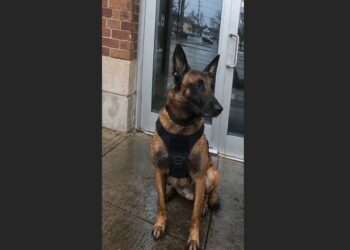
German Shepherds have a reputation.
Alert.
Confident.
Powerful.
They are commonly associated with police work, military roles, protection, and demanding training.
Bruno certainly looks the part.
His chest is broad.
His bark carries through the house.
When someone unfamiliar approaches the yard, he notices before we do.
But appearance tells only part of the story.
Bruno has always had one problem that seems completely inconsistent with the rest of him.
He does not trust glossy floors.
The Fear Started With Certain Surfaces
At home, most of our flooring is easy for him.
Carpet is fine.
Rugs are fine.
Textured outdoor surfaces cause no hesitation.
Highly polished tile is different.
So is some smooth linoleum.
When Bruno encounters a surface that reflects light or offers poor traction, his entire movement changes.
His head drops.
His steps become short.
His toes spread.
Sometimes he refuses to take another step.
The reaction is so immediate that it can look ridiculous until you understand what he may be experiencing.
Dogs Do Not See Floors the Way We Do
We cannot know exactly what Bruno thinks when he sees a polished surface.
He may not literally believe it is ice or a hole.
Still, dogs can become hesitant on slick flooring for very practical reasons.
A smooth surface can reduce traction.
Large dogs may feel particularly unstable if their feet begin sliding apart.
Reflections can also change the way a surface looks, especially when lighting is unfamiliar.
One bad slip can sometimes create a lasting association.
For Bruno, the result is obvious.
Shiny means uncertain.
Uncertain means stop.
The Veterinary Clinic Had Just Been Renovated
We did not know about the new flooring before the appointment.
Bruno walked from the parking lot normally.
He sniffed the grass.
Checked the entrance.
Followed my husband up the walkway without hesitation.
Then the automatic doors opened.
The entire reception area gleamed.
Bruno placed one paw inside.
That was as far as he wanted to go.
His legs widened immediately.
His claws searched for traction.
His body stiffened.
The leash remained loose because my husband stopped moving with him.
Forcing forward would have been easy physically.
It also would have been unnecessary.
Pulling Him Would Have Made the Situation Worse
When a frightened dog refuses to cross a surface, dragging him across may solve the human problem while increasing the dog’s fear.
Bruno was not being stubborn.
He was communicating clearly.
The floor felt unsafe to him.
My husband could have tightened the leash and used his size to make Bruno move.
Instead, he waited a few seconds.
Bruno tried shifting his weight.
His feet slid slightly.
That settled the question.
My husband sighed.
“All right, buddy.”
Then he crouched.
Lifting a 100-Pound Dog Is Not a Casual Decision
Bruno is not small enough to scoop up under one arm.
He is a full-size German Shepherd with a long body, substantial chest, and opinions about being handled.
Fortunately, he trusts my husband.
My husband also knew how to support him rather than lifting awkwardly by the front end.
He positioned himself carefully, supported Bruno’s body, and stood.
Bruno did not struggle.
The moment his feet left the floor, some of the tension came out of him.
Then he tucked his large head against my husband’s neck.
It was an absurdly tender image.
A man who looks as though he belongs beside a motorcycle carrying a German Shepherd through a veterinary waiting room like an oversized child.
The Waiting Room Noticed
People looked up.
A few laughed.
Not cruelly.
The contrast was simply impossible to miss.
Bruno’s ears were partly back.
His face was hidden against my husband’s shoulder.
Four enormous paws hung away from the floor he apparently wanted nothing to do with.
My husband noticed everyone watching.
He could have been embarrassed.
Instead, he adjusted Bruno’s weight and kept walking.
“He guards my house at night,” he said. “Carrying him past a scary floor is the least I can do for him.”
The room laughed again.
This time, my husband smiled too.
The Staff Helped Once They Understood the Problem
Veterinary clinics see all kinds of fears.
Some dogs panic at the scale.
Others dislike examination tables.
Some become distressed by unfamiliar people, barking dogs, doors, or specific surfaces.
Once staff realized Bruno’s issue was the flooring, they did not insist on repeatedly walking him across it for practice during a medical appointment.
A towel or mat can sometimes provide useful traction for a dog worried about slick surfaces.
For long-term management, rugs, runners, nonslip mats, and gradual positive training may help.
That day, however, the immediate goal was simply getting Bruno through his appointment without creating an unnecessary battle in the lobby.
Fear Does Not Cancel Courage
People often speak about dogs as though bravery were one fixed personality trait.
A brave dog should supposedly be brave everywhere.
Real animals are not that simple.
A dog can be confident around strangers and nervous around thunderstorms.
Comfortable in a crowd and afraid of stairs.
Excellent at guarding a property and unwilling to walk across a polished floor.
Bruno’s fear does not make the rest of his behavior fake.
It simply means one specific situation makes him uncomfortable.
Humans are not much different.
My Husband Never Teases Him About It
That may be the part I appreciate most.
It would be easy to turn Bruno’s fear into a running joke.
Our giant tough dog terrified of tile.
We certainly find the contrast funny sometimes.
But amusement is different from deliberately frightening him.
My husband never pushes Bruno onto a slick floor just to prove that nothing bad will happen.
He does not pull him by the collar.
He does not create videos of him scrambling for traction.
If there is an easy way to give Bruno better footing, we use it.
The goal is not to protect him from every uncomfortable surface forever.
It is to avoid making the fear worse while helping him build confidence safely.
At Home, Rugs Became Strategic
Once we understood how strongly Bruno reacted to certain flooring, we paid closer attention around the house.
A rug can change an entire route for him.
Instead of staring at a stretch of polished floor, he sees a series of stable surfaces.
He can walk normally.
His body stays relaxed.
For older or large dogs, traction matters even without a behavioral fear.
Slipping can strain joints and make dogs more reluctant to move.
Bruno is still physically strong, but giving him reliable footing costs us very little.
It also reduces the chance that one frightening slip reinforces the problem further.
Training Has to Move at Bruno’s Speed
If we wanted to work specifically on his floor sensitivity, the useful approach would not begin with dragging him across a large veterinary lobby.
It would start with easier situations.
A short section of mildly smooth flooring.
Good traction nearby.
Rewarding voluntary investigation.
Allowing him to retreat before panic begins.
Gradually increasing difficulty only when his body remains relaxed.
That process can take time.
For some dogs, management may always remain part of the solution.
There is nothing shameful about that.
Success does not require Bruno to become enthusiastic about every glossy surface on earth.
He Was Completely Different Once the Appointment Ended
The exam itself was not the dramatic part of the day.
Bruno cooperated.
He stood where needed.
Accepted handling from familiar staff.
Then came the trip back across the lobby.
He looked at the floor.
Then at my husband.
The expression was almost enough to make all of us laugh again.
My husband did not negotiate.
He bent down.
Bruno allowed himself to be lifted.
And they crossed the waiting room exactly as they had before.
Outside, Bruno’s feet hit textured pavement.
Instantly, he was a German Shepherd again.
Head up.
Stride normal.
Sniffing everything.
The frightening world had apparently returned to acceptable footing.
Ten Minutes Later, He Was Watching the Parking Lot
That is Bruno.
Context changes everything.
On a secure surface, his confidence returns.
At home, he moves through his routines without hesitation.
If someone approaches the house at night, Bruno notices.
If the wind moves something near the fence, he checks.
If my husband gets up, Bruno often gets up too.
The dog who needed to be carried through a lobby is still the same dog who takes his evening watch seriously.
One behavior does not erase the other.
Big Dogs Are Still Allowed to Need Help
People often assume large animals require less reassurance.
Their size creates an illusion of emotional invulnerability.
Bruno weighs around 100 pounds.
That does not mean he experiences uncertainty differently simply because he could physically overpower most obstacles.
Fear is not measured in body weight.
A tiny terrier can march confidently across a surface that freezes a German Shepherd.
A massive dog can seek physical contact when something worries him.
Helping does not undermine confidence.
Sometimes help prevents panic from becoming stronger.
My Husband Understands That Better Than His Appearance Suggests
People occasionally judge him before speaking to him.
The height.
The tattoos.
The Harley.
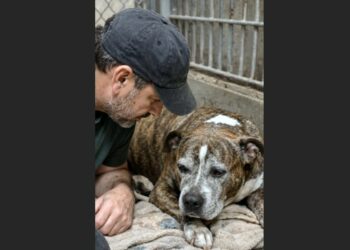
Then they see him sitting on the floor with Bruno’s head in his lap.
Or carrying a frightened shepherd through a clinic.
The contrast makes people smile.
But to me, those things are not contradictory.
Strength is useful when someone smaller or more vulnerable needs it.
In this case, “smaller” happens to weigh 100 pounds.
My husband never treats Bruno’s trust as something to prove.
He protects it.
Bruno Did Not Need a Lecture About Being Tough
He needed four feet off the floor.
That was all.
No lesson.
No confrontation.
No test of obedience.
There may be situations where Bruno needs gradual training because a slick floor cannot always be avoided.
That work can happen when he is calm and below his fear threshold.
A veterinary appointment was not the place to force the issue.
Sometimes the most effective response to a problem is not fixing it immediately.
It is getting through the moment safely and working on the larger issue later.
He Still Avoids Shiny Floors
That part has not magically disappeared.
If Bruno sees a polished surface, he may still stop.
Sometimes a mat is enough.
Sometimes encouragement helps.
Other times he decides absolutely not.
We respect what his body is telling us while continuing to give him safe experiences.
He does not need to become fearless to have a good life.
He needs people who recognize the difference between fear and disobedience.
At Night, None of This Seems Important
Bruno settles into his familiar place.
My husband sits nearby.
The house grows quiet.
If there is a noise outside, Bruno’s ears rise before mine do.
Sometimes he stands and checks the room.
Then he comes back.
There is no polished tile between him and his responsibilities at home.
Only familiar floors.
Familiar people.
A place he understands.
The big dog who hid his face against my husband’s neck at the veterinary clinic is also the dog who watches our house.
Both things are true.
And if another shiny floor appears tomorrow, my husband will probably look down at him, sigh, and make a decision.
Maybe there will be a nonslip mat.
Maybe Bruno will manage a few careful steps.
Or maybe all 100 pounds of him will once again end up in my husband’s arms.
Either way, nobody will ask him to prove how brave he is.
He already gives us enough.
Editor’s Note: The characters in this story are fictional. Through these stories, we hope to share the intelligence, loyalty, compassion, and loving nature of dogs with people everywhere.