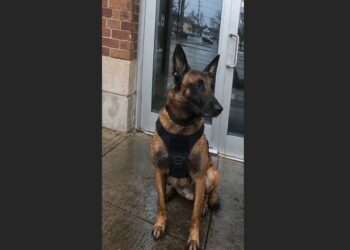
The sound came from the backseat of a Georgia State Patrol cruiser as gunfire struck the vehicle during a pursuit on Interstate 85.
K9 Amor, a police dog riding behind Trooper Christopher Butler, had been hit.
The patrol car’s audio system recorded the injured dog’s cries. Butler was still facing an armed suspect, and the danger had not ended. More shots would be fired before the pursuit came to a stop.
Amor had suffered two gunshot wounds to his right legs.
For the officers involved, the immediate concern was survival. Three Georgia State Patrol troopers had come under fire, and a police dog was injured inside one of their vehicles.
Nearly two years later, on October 15, 2026, the criminal case reached a major conclusion.
Ira Troy Williams, the man responsible for the shooting, pleaded guilty to 16 felony counts, including three counts of attempted murder. He received a sentence of 135 years in prison, followed by 35 years of probation.
But the story had another outcome, one that mattered deeply to the people who knew Amor.
The German Shepherd had survived.
After veterinary treatment and recovery, he returned to the Georgia State Patrol, where he continues serving alongside the officers who depend on him.
A Traffic Stop on Interstate 85
The confrontation began on December 18, 2024, in Coweta County, Georgia.
Trooper Christopher Butler was patrolling Interstate 85 when he stopped a vehicle driven by Ira Troy Williams.
At first, the encounter appeared to be following the basic sequence of a traffic stop.
Williams pulled over and stepped out of his vehicle.
Then the situation changed.
Rather than remaining outside and following the trooper’s directions, Williams climbed back into the driver’s seat and sped away.
Butler began pursuing him.
Inside the patrol vehicle, K9 Amor was riding in the backseat.
Police dogs accompany their handlers in specially equipped vehicles because they may be needed for tasks such as locating suspects, detecting trained odors, or assisting during particular law enforcement operations.
During a pursuit, however, a dog is a passenger.
He cannot control the vehicle or the decisions being made by the fleeing driver.
Amor depended on Butler’s driving, the patrol vehicle’s safety equipment, and the procedures intended to protect both officers and their canine partners.
As the pursuit accelerated along the interstate, the danger to everyone involved increased.
Williams was no longer simply a driver who had refused to remain at a traffic stop.
He was fleeing police at speed through an active highway environment.
A Dangerous Pursuit Through Traffic
As Butler followed, Williams drove aggressively along Interstate 85.
According to the prosecution’s account, Williams repeatedly braked in front of the patrol vehicle, creating dangerous situations for the pursuing trooper.
The behavior forced Butler to respond to sudden changes in speed while attempting to stop the fleeing driver.
Other motorists were also using the interstate.
A high-speed pursuit creates risks far beyond the vehicles directly involved. Drivers nearby may have little warning when a fleeing vehicle changes lanes, brakes suddenly, or makes an unexpected maneuver.
Butler attempted to stop Williams’s vehicle using pursuit intervention techniques.
He made three attempts.
Such maneuvers are intended to bring a fleeing vehicle to a stop under circumstances in which officers determine that intervention is necessary. Their use involves significant risk and depends on training, road conditions, vehicle movement, and the surrounding traffic.
After the third attempt, Williams responded with gunfire.
He opened fire on Butler’s patrol cruiser.
The confrontation had escalated from a dangerous traffic pursuit into an armed attack on a law enforcement officer.
And Amor was directly in the path of that violence.
Gunfire Strikes the Patrol Car
When Williams fired toward Butler’s vehicle, bullets struck the cruiser.
Inside, Amor was wounded.
The patrol car’s recording system captured the dog’s cries after he was hit.
Those sounds would later become one of the most painful details of the case.
A police dog may be highly trained, but training does not make an animal immune to injury or fear.
Amor had no understanding of the criminal case that would eventually follow. He was a working dog traveling with his handler when bullets entered the vehicle.
The gunfire caused two wounds to his right legs.
At the time, Butler still had to respond to an armed suspect who remained a threat.
He could not treat Amor’s injuries while the confrontation continued.
That placed the trooper in a particularly difficult position.
His canine partner needed veterinary attention, but the immediate threat to officers and others on the highway had not been contained.
The incident illustrates a harsh reality of police K9 work.
Although dogs can provide valuable assistance in law enforcement, they may also be exposed to dangerous situations created by human actions.
Amor’s training and relationship with his handler could not prevent the gunfire.
His survival would depend on the severity of his wounds and the medical care he received afterward.
Two More Troopers Join the Pursuit
As the incident continued, two additional Georgia State Patrol members became involved.
Sgt. David Whitehead and Cpl. Anthony Munoz joined the pursuit, bringing the number of troopers directly threatened by Williams to three.
Williams continued firing.
According to the criminal case, he discharged his weapon repeatedly toward the pursuing officers.
The gunfire endangered Butler, Whitehead, and Munoz as they attempted to bring the situation under control.
None of the three troopers was struck.
That outcome was fortunate given the circumstances.
A moving vehicle offers limited protection from gunfire, and officers involved in a pursuit must contend with several hazards at once.
They must monitor the fleeing suspect, surrounding traffic, road conditions, and the actions of other responding units.
When a suspect begins shooting, those dangers become more severe.
The officers could not assume that Williams would stop firing or surrender.
Meanwhile, Amor remained injured inside Butler’s patrol vehicle.
The case would later include three attempted murder charges, reflecting the prosecution’s allegations that Williams had tried to kill the troopers.
Those charges eventually became part of his guilty pleas.
But on the afternoon of December 18, the officers were still dealing with an active threat.
The Pursuit Ends Near Railroad Tracks
The chase eventually reached the area near Grantville, Georgia.
Williams turned off the interstate and onto a dirt road.
He stopped his vehicle near railroad tracks.
The pursuit had left the main highway, but the danger continued.
Williams got out of his vehicle and fired at least four additional shots toward the troopers.
The officers were still under attack.
After firing, Williams fled into nearby woods.
He was no longer driving, but he remained armed and had demonstrated a willingness to shoot at police.
The immediate pursuit had ended without his capture.
For the troopers, that meant the situation was not fully resolved.
An armed suspect was somewhere in the surrounding area, and officers would need to locate him without creating additional danger.
None of the three troopers had been physically injured during the gunfire.
Amor, however, had sustained wounds that required professional treatment.
The dog who had begun the incident riding in the backseat of Butler’s cruiser was now a veterinary patient.
Amor Receives Emergency Veterinary Care
After the shooting, Amor received veterinary attention.
An examination confirmed two gunshot wounds involving his right legs.
The available account does not describe the full medical treatment he received, including whether any surgical intervention was necessary.
What is established is that veterinary professionals assessed and treated his injuries.
He survived and was eventually released from the hospital.
Gunshot injuries in dogs require careful evaluation because the visible entry wound does not always reveal the full extent of tissue damage.
Depending on the bullet’s path, injuries may involve muscle, bone, blood vessels, nerves, or other structures.
Veterinarians must assess the individual patient and determine appropriate treatment based on clinical findings.
In Amor’s case, the confirmed wounds were serious enough to require hospital care, but they were not fatal.
His release was encouraging.
It meant his immediate condition had improved sufficiently for him to leave the veterinary facility under the care arrangements established for his recovery.
Still, being discharged from a hospital is not the same as being ready to return to demanding police work.
A working dog must recover adequately before resuming activities that may involve running, jumping, tracking, or other physically strenuous tasks.
For Amor, the process would involve more than simply surviving the initial injury.
He needed to heal.
A Two-Day Search for the Armed Suspect
While Amor received care, law enforcement continued searching for Williams.
The search lasted approximately two days.
Williams had fled into the woods after firing at the troopers near the railroad tracks.
Because he had already discharged a firearm multiple times toward officers, locating him required caution.
The situation involved an armed suspect whose actions had created a serious threat to public safety.
On December 20, 2024, troopers located Williams inside an old pickup truck.
He was lying in the vehicle with a firearm resting across his chest.
Officers approached and gave commands.
This time, Williams complied.
He was taken into custody without further incident.
The arrest ended the immediate search that had followed the highway shooting.
It also allowed the criminal justice process to move forward.
Investigators and prosecutors could now address the conduct that had endangered three troopers and injured Amor.
For the officers involved, the arrest meant that the man who had fired at them was no longer at large.
For Amor, the most important work was still happening away from the investigation.
He was recovering from his wounds.
The Charges Reflect the Severity of the Attack
The criminal case against Williams involved numerous felony offenses.
The charges addressed his conduct during the traffic stop, pursuit, shooting, and subsequent flight.
Among them were three counts of attempted murder, one relating to each of the troopers he had fired upon.
The case also included aggravated assault charges involving the officers.
Other offenses concerned the harm inflicted on Amor, the use of firearms, fleeing police, and possession of cocaine.
The charges involving the police dog were significant in their own right.
Amor was not simply property damaged during the pursuit.
He was a trained public safety animal performing a law enforcement role, and Georgia law provides specific protections for such animals.
The prosecution included offenses relating to harming a public safety animal and animal cruelty.
Those counts recognized that the gunfire had caused physical injury to a living animal.
The legal case also reflected the broader danger created by Williams’s conduct.
He had fled a traffic stop, driven dangerously, fired repeatedly at pursuing officers, and continued shooting after leaving his vehicle.
The prosecution ultimately pursued accountability for the full sequence of events.
The resolution would not come immediately.
Nearly two years passed between the shooting and Williams’s guilty pleas.
October 15, 2026: Williams Pleads Guilty
On October 15, 2026, Williams entered guilty pleas in the criminal case.
The pleas covered 16 felony counts.
Three were attempted murder charges involving Trooper Christopher Butler, Sgt. David Whitehead, and Cpl. Anthony Munoz.
The remaining counts included aggravated assault, offenses involving the injury to K9 Amor, fleeing police, firearm violations, and cocaine possession.
By pleading guilty, Williams accepted criminal responsibility for the offenses included in the pleas.
The case did not require a jury to reach verdicts on those counts.
The court then imposed a substantial sentence.
Williams received 135 years in prison, followed by 35 years of probation.
The sentence reflected the seriousness of the offenses and the multiple victims involved.
The three troopers had survived the shooting without physical injuries.
Amor had also survived, although he had suffered two gunshot wounds.
The guilty pleas and sentencing brought a major legal conclusion to an incident that had begun as a traffic stop on Interstate 85.
The punishment was severe.
But the court’s decision could not undo what happened inside Butler’s patrol vehicle.
The sound of Amor crying after being shot remained part of the recorded evidence of that afternoon.
What had changed was that the dog had recovered.
The Meaning of a 135-Year Sentence
A sentence of 135 years in prison, followed by 35 years of probation, is an extraordinary legal outcome.
In this case, it followed guilty pleas to numerous serious felonies rather than a single offense.
The charges included attempted murder involving three separate troopers.
The sentence also addressed other criminal conduct during the pursuit, including the harm inflicted on Amor.
For the public, the length of the sentence communicates the seriousness with which the court treated the offenses.
For the officers involved, the case’s conclusion established legal accountability for the attack.
The sentence does not mean that every count carried the same punishment or that all parts of the sentence necessarily operate in the same way. Those details depend on the court’s sentencing order and applicable law.
What the reported outcome establishes is that Williams received a total prison sentence of 135 years, with an additional 35 years of probation.
The legal resolution was one part of the aftermath.
The other involved the people and animal who had been in the line of fire.
The troopers survived.
Amor survived.
And the dog who had been injured during the pursuit eventually returned to the job for which he had been trained.
The Recovery of a Working Police Dog
For a police K9, recovery from an injury involves particular considerations.
A companion dog recovering from a leg wound may need controlled exercise and veterinary monitoring before returning to ordinary household activity.
A working dog may face additional physical demands.
Depending on the dog’s specialty, duties can involve sustained movement, climbing, jumping, scent work, and responding to handler commands in distracting environments.
Those activities require physical comfort, coordination, and sufficient stamina.
An injury affecting the legs can interfere with those abilities even after the immediate wound has healed.
That is why return-to-duty decisions should be guided by veterinary assessment and the dog’s functional recovery.
Amor’s case ended with encouraging news.
He recovered from the shooting and returned to service with the Georgia State Patrol.
The available account does not provide a detailed rehabilitation timeline or identify the specific medical steps that cleared him for duty.
It does establish the outcome.
Amor was able to resume his work.
That return was not evidence that the injuries had been insignificant.
He had been shot twice and required veterinary care.
His recovery was a meaningful development precisely because the shooting had placed his health and future at risk.
The Partnership Behind a Police K9
Police dogs do not work independently of their handlers.
Their effectiveness comes from a combination of training, consistent handling, veterinary care, and support from a larger law enforcement team.
A K9 learns specific behaviors through structured training.
Depending on its assignment, the dog may be taught to locate particular odors, search designated areas, follow scent trails, or perform other tasks under handler direction.
The handler must understand the dog’s behavior and make decisions about when and how to deploy it.
That partnership develops through repeated work.
The dog becomes familiar with the handler’s voice, movements, commands, and daily routines.
The handler, in turn, learns to recognize the dog’s responses and changes in behavior.
For Butler and Amor, their shared work placed them together inside the patrol vehicle on December 18.
Amor was present because he was part of the Georgia State Patrol’s working K9 team.
He was injured because Williams fired into the vehicle.
It would be inaccurate to suggest that Amor consciously chose to sacrifice himself or understood the legal consequences of the attack.
He was a dog exposed to a dangerous situation while accompanying his handler.
His role was real, his injury was real, and the care required afterward was real.
His return to duty also reflected the work of the people responsible for his recovery and continued welfare.
The Sound That Made the Injury Impossible to Ignore
One detail from the case stands apart from the legal charges and pursuit timeline.
The patrol car’s audio system recorded Amor yelping after the gunfire struck him.
The recording made the dog’s suffering part of the documented incident.
For people who work with animals, such sounds are immediately concerning.
A sudden cry following an injury can indicate pain, fear, or distress. It does not reveal the full medical severity of a wound, but it makes clear that the animal has been affected.
In Amor’s case, veterinary treatment later confirmed the physical injuries behind those cries.
He had been struck by gunfire and suffered two wounds to his right legs.
The recording also emphasizes the dog’s vulnerability during the confrontation.
Amor was not directing the pursuit or making decisions about how officers should respond.
He was a passenger in a vehicle being fired upon.
That distinction is important when discussing working animals.
Police dogs may be trained for demanding and sometimes dangerous tasks, but they remain animals whose welfare depends on human decisions.
Their service deserves recognition without turning their injuries into something romantic or inevitable.
Amor’s cries were evidence of an animal in pain.
His later recovery was evidence that he survived that harm.
The Troopers Who Came Under Fire
The case also involved three officers whose lives were directly threatened.
Trooper Christopher Butler initiated the traffic stop and pursuit.
Sgt. David Whitehead and Cpl. Anthony Munoz joined as the situation escalated.
All three became targets of Williams’s gunfire.
According to the criminal case, Williams fired repeatedly toward the troopers during the pursuit and continued shooting after stopping near the railroad tracks.
None of them suffered physical injuries.
That outcome should not obscure the danger they faced.
The officers were dealing with an armed suspect who had demonstrated an intention to use deadly force.
The legal charges reflected that threat.
Each trooper was named in an attempted murder count, and Williams ultimately pleaded guilty.
The officers’ actions took place within a coordinated law enforcement response involving multiple units and a subsequent search.
The eventual arrest on December 20 was completed without further violence after Williams complied with commands.
That sequence is an important part of the story.
The pursuit ended with the suspect escaping temporarily, but the search continued until officers located and arrested him.
The case then moved through the courts to its October 2026 resolution.
Throughout that process, the physical consequences for Amor remained a separate concern requiring veterinary care and recovery.
Amor Returns to the Georgia State Patrol
The most encouraging development in Amor’s story did not take place in a courtroom.
It happened after the veterinary treatment, when the dog recovered sufficiently to return to service.
For a working K9, returning to duty means resuming the trained activities that form part of its regular life.
It also means returning to familiar handlers, routines, equipment, and working environments.
Those familiar patterns can be important for dogs, although each animal responds differently to illness, injury, and changes in activity.
Amor’s return did not erase the shooting.
The injuries were part of his medical history, and his welfare would continue to depend on appropriate care and monitoring.
But the return demonstrated that the gunshot wounds had not permanently ended his working career.
He was still able to serve.
That outcome was especially meaningful given how the incident had begun.
A routine traffic stop had escalated into a dangerous pursuit. A man fleeing police had fired into the patrol vehicle, striking the dog inside.
For a time, the full consequences of those wounds were uncertain.
Now, nearly two years later, the case had reached sentencing, and Amor was still part of the Georgia State Patrol.
His story was no longer only about an injured K9.
It was also about a dog who had received treatment, recovered, and resumed his familiar work.
A Different Ending From the One That Seemed Possible
On December 18, 2024, nobody involved in the pursuit could have known how the story would end.
Williams had fled a traffic stop, driven dangerously, and fired repeatedly at officers.
Three troopers had come under attack.
Inside one of their vehicles, Amor had been wounded.
The gunfire did not kill any of the officers, and the suspect was eventually arrested.
Amor survived his injuries after receiving veterinary treatment.
Then, on October 15, 2026, Williams pleaded guilty to 16 felony counts and received a sentence of 135 years in prison, followed by 35 years of probation.
The criminal case reached its conclusion.
But Amor’s life continued beyond the incident and the courtroom proceedings.
He recovered from the gunshot wounds and returned to the Georgia State Patrol.
There is no need to suggest that he understood the sentence imposed on the man who shot him.
Dogs do not measure justice in prison years or recognize the legal meaning of a guilty plea.
Amor’s world is built around familiar people, learned tasks, physical experiences, and daily routines.
His survival meant he could return to those things.
The dog whose cries were captured inside a patrol cruiser was no longer a patient being treated for gunshot wounds.
He was once again a working member of the Georgia State Patrol.
And nearly two years after the shooting, while the man responsible faced a lengthy prison sentence, Amor was still here, continuing the work he had been trained to do.