For nearly thirteen years, I had opened Dawson’s Travel Center before sunrise.
After that long behind a counter, very little about travelers surprised me.
Phones were forgotten beside coffee machines. Children’s stuffed animals turned up under booths. More than one driver had pulled away with a cup of coffee still balanced on top of a gas pump.
But I had never opened the store and found an elderly dog waiting on a blanket beside the ice dispenser.
I first noticed him a little before 6:30 that morning.
He was a black-and-white English Setter, curled between two concrete bollards near the side of the building. A faded green picnic blanket separated him from the cold pavement.
Beside him sat a metal water bowl and a small zippered bag containing kibble.
His leash was still attached to a worn brown collar.
Nothing about the scene seemed alarming at first.
I assumed whoever owned him was inside buying breakfast.
Then the minutes kept passing.
Every Pickup Made Him Stand
By 7:30, most of the early crowd had finished eating and gone back to the highway.
The dog was still there.
He barely moved unless a pickup entered the lot.
Then his ears lifted.
His tail tapped once or twice against the blanket.
With visible effort, he pushed himself upright and watched the vehicle.
Sometimes he took one step forward.
Mostly he waited.
When the driver walked into the store or headed toward another pump, the dog’s tail gradually stopped.
Then he lowered himself back onto the blanket.
He never barked.
Never wandered through the parking lot.
Never approached strangers for food.
He simply kept watching the driveway.
I Took Him Water Around Ten
By then, I knew something was wrong.
I filled a bowl with clean water and carried it outside.
“Hey there, old fellow.”
He looked at me briefly.
His eyes were cloudy with age, but alert.
Then his attention returned to the road.
I was not the person he was interested in.
That much was obvious.
As I crouched beside him, I noticed something tucked underneath his collar.
It was a folded luggage tag.
Inside, someone had printed two short lines in black ink.
This is Archie.
Truck rides are his favorite.
No phone number.
No address.
No explanation.
Just his name and one small detail about his life.
Whoever Left Him Had Expected Someone to Find Him
That was difficult to ignore.
There was food.
Water.
A blanket.
His name.
Someone had made sure Archie was not left completely without supplies.
But they had also left an elderly dog alone beside a busy travel center.
I did not know why.
So I tried not to build a villain out of information I did not have.
What mattered at that moment was Archie.
I sat on the curb for a while.
He rested his muzzle on his paws.
Then a diesel engine sounded near the entrance.
His head came up again.
Another pickup rolled through.
His tail moved.
The truck continued past him.
Archie lay down.
I Started Imagining the Routine He Might Have Known
That was probably unavoidable.
The luggage tag said he loved truck rides.
His behavior around pickups suggested vehicles were familiar and important to him.
I pictured an open passenger door.
A familiar voice.
Boots hitting pavement.
A dog climbing into a cab he had entered hundreds of times before.
But those were only possibilities.
Archie could not tell me what he remembered or who he expected to see.
What I could see was enough.
Certain vehicles made him alert.
Certain sounds mattered.
And even after hours in the parking lot, he did not appear interested in leaving that small patch of pavement.
I Called the Veterinary Clinic
The clinic was only a couple of miles away.
Dr. Ellis answered.
I explained where I had found Archie and what little information I had.
“Bring him in,” she said. “Let’s check for a chip.”
I expected getting him into my pickup to be difficult.
It wasn’t.
The moment I opened the passenger door, Archie stepped forward.
His stiff legs slowed him, so I helped support his back end.
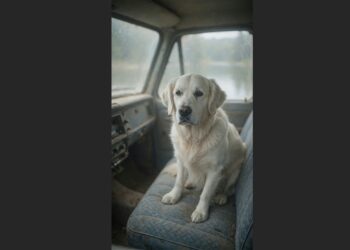
Once inside, he settled into the seat with the ease of a dog who had clearly ridden in vehicles before.
That changed his posture immediately.
He sat upright.
Watched through the windshield.
And every time we stopped near another pickup, his tail gave the same hopeful little movement.
The Clinic Door Got the Same Reaction
Archie sat beside me in the waiting room.
Each time the bell above the entrance rang, he lifted his head.
A woman carrying a cat carrier came in.
Archie watched.
A man with a terrier entered next.
Archie looked.
Then he rested again.
The pattern continued.
The door mattered.
Arrivals mattered.
But nobody arriving seemed to be the person connected to whatever routine Archie knew before that morning.
The staff scanned him.
There was a microchip.
For a few minutes, that felt like the answer.
Then we discovered the registration information had not been updated.
The phone number no longer worked.
Dr. Ellis Estimated Archie Was About Thirteen
His teeth showed significant wear.
His joints were stiff, especially through the hips.
Arthritis had clearly begun limiting his movement.
Still, considering his age, she found him in reasonably good overall condition.
That told us something too.
Archie had not spent his entire life neglected.
Someone had fed him.
Someone had kept him in decent condition.
He knew vehicles.
He accepted handling.
He appeared accustomed to living around people.
“What he needs right now is pretty simple,” Dr. Ellis said.
Soft bedding.
Gentle exercise.
Regular meals.
And somebody dependable.
I smiled.
“He can stay with me while we look.”
At the time, I meant it.
I Told Everyone It Was Temporary
A few days.
Maybe a week.
We would update the chip information if possible, contact shelters, post notices, and ask around.
Someone had to know Archie.
That evening, I brought him home.
I placed a quilt beside the sofa.
Archie walked past it.
He made one slow circuit through the house.
Living room.
Kitchen.
Hallway.
Bedroom doorway.
At every window, he paused.
Then he returned to the front entrance.
That was where he finally lay down.
Face toward the door.
I put the quilt there instead.
The First Night, He Slept Lightly
Sometime after midnight, I heard movement.
I found Archie asleep near the entrance.
His feet twitched.
His tail brushed softly against the quilt.
Every so often, he released a slow breath and settled deeper.
I stood there longer than necessary.
Maybe he was dreaming.
Dogs certainly experience sleep cycles that include twitching and movement.
I could not know what images, if any, passed through his mind.
Still, it was hard not to think about the luggage tag.
Truck rides are his favorite.
Maybe a passenger seat had once been one of the safest places in Archie’s world.
We Spent Three Weeks Looking for His Person
I contacted nearby shelters.
We posted his photograph.
The travel center put up a notice.
Dr. Ellis helped circulate his information.
I checked missing-dog listings.
Nothing matched.
Archie adjusted gradually to my house.
He learned where the water bowl was.
He accepted his medication.
He discovered a warm patch of afternoon sunlight in the living room.
But some habits remained.
A pickup outside could bring his head up immediately.
The sound of an unfamiliar vehicle in the driveway sent him toward the front window.
He did not panic.
He simply checked.
Then returned to whatever he had been doing.
He Was Easy to Live With
That made the possibility of keeping him increasingly tempting.
Archie did not need much exercise.
His walks were short and slow.
He enjoyed sniffing far more than covering distance.
At home, he slept.
A lot.
Sometimes he followed me into the kitchen.
Sometimes he decided the effort was unnecessary.
He did not destroy anything.
He did not bark excessively.
Mostly, he wanted a comfortable place near whatever room I occupied.
By the third week, I had started wondering whether “temporary” was becoming dishonest.
Then one of our regular customers recognized him.
The Man Stared at Archie’s Picture for Several Seconds
He had come into the travel center for coffee.
The notice was still posted near the counter.
He pointed at the photograph.
“I know that dog.”
I stopped what I was doing.
He had seen Archie with an older man from the area.
That lead gave us a name.
Then another phone call led to the man’s daughter.
The story that emerged was not what I had expected.
Archie’s owner had undergone emergency surgery.
Afterward, he could no longer return immediately to his previous home.
He had been moved into assisted living while the family sorted out his care.
During that transition, someone else had been asked to look after Archie.
Somewhere between people, vehicles, assumptions, and hurried arrangements, something had gone badly wrong.
Archie ended up at the travel center.
His Owner Had Not Chosen to Leave Him There
That mattered.
The man’s daughter was horrified when she learned where Archie had been found.
She had believed he was being cared for elsewhere.
By the time she understood the mistake, Archie had already disappeared from the arrangement she had set up.
We did not spend much time assigning blame.
There would be plenty of opportunity for the family to sort through what had happened.
The immediate question was simpler.
Could Archie see his owner?
The answer was yes.
We arranged to meet outside the assisted living residence where the man was recovering.
I loaded Archie into the pickup.
He took his usual place.
He Became Alert Before I Opened the Door
I do not know whether he recognized the location.
It was new to him as far as I knew.
But once we parked, he became more attentive.
I clipped on his leash.
Then I helped him down.
We waited near the entrance.
A staff member appeared first.
Behind her came a man in a wheelchair.
Archie froze.
For perhaps one second.
Then his entire body changed.
His tail started moving so hard that his hips rocked with it.
He pulled forward.
Not recklessly.
His joints would not allow that.
But faster than I had seen him move in three weeks.
Archie Put His Head Across the Man’s Knees
The man leaned forward.
“Archie.”
That was all he said.
The old Setter reached him and immediately began sniffing his hands and clothing.
Then he lifted his head onto the man’s lap.
The man’s hands settled around Archie’s ears.
Neither seemed interested in moving.
People sometimes describe reunion scenes as though animals understand every circumstance that separated them.
We cannot know that.
But recognition was unmistakable.
Voice.
Scent.
Touch.
Movement.
Thousands of familiar cues returning at once.
Archie stayed pressed against him.
His tail continued moving.
I Pretended to Look at My Phone
The staff inside had noticed.
Several stood behind the glass entrance.
Nobody interrupted.
I moved back toward my pickup.
Then I looked down at my phone even though there was nothing on the screen I needed to see.
It gave me somewhere to put my eyes.
After three weeks of watching Archie inspect every arriving truck and every opening door, I finally knew who had been missing.
The man in the wheelchair kept one hand on his head.
Archie closed his eyes.
That was the first time since I had found him that I saw the old dog near an entrance without watching for someone else.
There Was Still a Practical Problem
His owner now lived in assisted care.
That did not automatically mean Archie could stay.
Policies vary.
Some facilities allow pets.
Others do not.
Even when animals are permitted, questions remain.
Who handles veterinary appointments?
Who walks the dog?
What happens if the resident’s condition changes?
Who pays for food and medication?
An emotional reunion does not answer those things.
Fortunately, this facility was willing to discuss them.
Archie was calm.
His exercise requirements were modest.
Family members agreed to help with veterinary care and supplies.
Staff worked through the remaining arrangements.
For once, practicality and emotion pointed in the same direction.
Archie could stay.
I Drove Home Alone
That surprised me.
For three weeks, Archie’s presence had reorganized my house.
His bowl was near the kitchen.
The quilt was by the door.
His medication was on the counter.
I had become accustomed to helping him into the pickup.
Now the passenger seat was empty.
It felt strange.
I missed him.
But I did not regret leaving him.
Archie had never needed me to replace the man he already knew.
He had needed somewhere safe while people figured out how to reconnect them.
For three weeks, my house had been that place.
That was enough.
A Month Later, I Went Back
I wanted to see how he was doing.
I expected to find Archie sleeping beside his owner’s wheelchair.
Instead, I found him walking slowly down a hallway like he had been employed there.
His owner was nearby.
They had established a morning routine.
A short walk through the corridors.
Time outside when weather allowed.
Then rest near one of the common rooms.
Archie had also begun greeting other residents.
He was not a certified therapy dog.
Nobody pretended otherwise.
He was simply friendly.
And because he moved slowly, many residents using walkers or wheelchairs could comfortably keep pace with him.
He Had Become Part of the Building
During my visit, one woman called his name from the sunroom.
Archie’s ears lifted.
He wandered over.
She scratched the side of his neck.
Later, another resident passed in a wheelchair.
Archie walked beside her for several yards before returning to his owner.
By afternoon, he was asleep in a sunny patch near the common area.
The staff laughed when I asked how he was adjusting.
“He thinks he works here,” someone said.
Maybe.
More likely, Archie had simply learned another routine.
Morning walk.
Familiar hallways.
Familiar people.
Then back to the man he had known before any of us entered the story.
His Owner Was Doing Better Too
The man still needed assistance.
That had not changed.
Archie’s return did not cure him.
A dog cannot reverse age, illness, or the reasons someone requires residential care.
What Archie could provide was companionship.
A familiar presence from the life the man had lived before surgery.
Something that had crossed with him into this new stage.
The two still took short walks together with support from staff.
Sometimes Archie rested beside the wheelchair.
Other times he wandered toward the common room and visited someone else.
The man seemed pleased to share him.
I Finally Understood the Travel Center Morning
Archie had been given food.
Water.
A blanket.
He had not been physically wandering the highway.
Whoever left him may have believed they were creating some kind of temporary solution.
But for Archie, the parking lot was full of familiar cues.
Pickups.
Diesel engines.
Passenger seats.
People arriving.
Doors opening.
No wonder each truck drew his attention.
That did not mean he understood abandonment.
It meant he knew patterns.
And the pattern he recognized was incomplete.
Vehicle arrives.
Familiar person gets out.
Except the familiar person never appeared.
Until weeks later.
The Green Blanket Went With Him
I had washed it after bringing Archie home.
It was frayed along one edge and too thin to be especially useful.
Still, I brought it to the residence.
His owner recognized it.
Apparently, Archie had ridden on that blanket in the pickup for years.
That explained why it had been left with him.
At the assisted living center, it eventually ended up near his bed.
Archie still had better bedding.
He still sometimes chose the old blanket.
Familiar objects can matter.
There was no reason to take it away simply because something newer looked nicer.
I Had Thought Archie Needed a New Family
For a while, I was prepared to become that family.
I had already started imagining how winter would work.
Where his bed would stay.
How often Dr. Ellis would want to monitor his arthritis.
Whether I needed a ramp for the pickup.
Then we found his owner.
The problem was not that nobody wanted Archie.
The problem was that a medical emergency and a failed care arrangement had separated two companions who still belonged in each other’s lives.
Once we understood that, the goal changed.
It was no longer about finding Archie a replacement.
It was about seeing whether the old relationship could continue safely.
It could.
The Passenger Seat Still Makes Me Think of Him
Even now.
Archie climbed into that seat without hesitation on the first day.
He watched the road.
Checked every nearby pickup.
Sat like a dog accustomed to traveling beside someone.
Later, I watched him ride the same way to meet his owner.
That was the journey that mattered.
Not the one from the travel center to my house.
The one back to the person he recognized.
Archie No Longer Waits Beside an Ice Machine
He has a bed near his owner’s room.
A green blanket.
Food.
Medication for his joints.
Short daily walks.
And a building full of people who know his name.
Some afternoons, he sleeps in the sunroom.
Sometimes he wanders through the hallway at a pace slow enough for residents to join him.
By evening, he returns to the man whose voice made his entire body move the day they met again.
That is where he settles.
There is no need to romanticize what happened.
A vulnerable senior dog was left in the wrong place because people failed to coordinate his care properly.
He was lucky.
Someone noticed.
A veterinarian checked him.
A community helped circulate his photograph.
One regular customer remembered seeing him before.
And a residential facility found a practical way for an elderly man and his dog to remain together.
That chain of ordinary actions gave Archie what he had been waiting for.
Not a different family.
A route back to the one he already had.
Editor’s Note: The characters in this story are fictional. Through these stories, we hope to share the intelligence, loyalty, compassion, and loving nature of dogs with people everywhere.