The footsteps reached Daisy before the people did.
She had been curled on her blanket inside a shelter kennel, half asleep while the usual sounds moved around her: metal bowls, barking dogs, rolling carts, volunteers opening and closing gates.
Then she heard visitors coming down the aisle.
The little Beagle sprang to her feet.
Her floppy ears lifted. Her tail began sweeping so quickly that her entire back end moved with it.
A mother, father, and young girl stopped only a few feet away.
Daisy pressed herself against the kennel door.
For a moment, everything about her changed.
She stretched her nose through the bars and released a small whine.
The girl smiled.
The father crouched.
Daisy’s tail moved faster.
She could not know why the family was there or what an adoption meant in human terms. But she knew that people had stopped near her, that they were looking toward the kennels, and that sometimes visitors meant attention.
Then a volunteer crossed the aisle.
She did not open Daisy’s gate.
She opened the one opposite her.
Rusty Was the Dog They Had Come to Meet
A shy mixed-breed dog named Rusty stepped cautiously from the kennel.
He had spent much of his shelter stay hanging back from strangers, so the volunteer moved slowly.
The little girl waited.
Her father held the leash while Rusty sniffed the floor.
After a few minutes, his posture loosened.
The family had already spent time learning about him. They had talked with shelter staff, considered whether his temperament fit their household, and returned to complete the adoption process.
Daisy knew none of that.
From her side of the aisle, she could only watch.
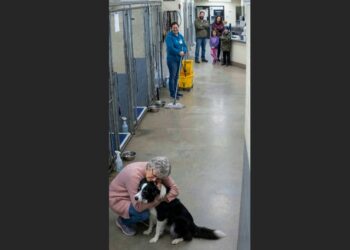
She remained at the gate while the leash was clipped onto Rusty’s harness.
Her nose stayed between the bars.
When the family began walking toward the lobby, Daisy followed as far as her kennel allowed.
Then the gate stopped her.
She Watched Them All the Way to the Door
The little girl glanced back once.
Daisy’s tail moved again.
Perhaps the girl’s face resembled someone Daisy had known. Perhaps any child stopping near the kennel had become exciting after months of shelter life.
There was no way to know.
Still, Daisy watched.
The family continued toward the front entrance.
Rusty walked between them.
Daisy stood upright against the gate until they were nearly out of sight.
The shelter door opened.
Cold air moved briefly through the lobby.
Then the family disappeared outside.
The door closed again.
Daisy remained standing.
For another minute, she looked toward the empty walkway.
Then she lowered herself onto the blanket.
Her tail stopped.
Daisy Had Learned to Watch Visitors Closely
When she first arrived at the shelter, Daisy greeted almost everyone.
A person passing her kennel was enough to bring her forward.
She sniffed fingers through the bars.
She wagged.
She sometimes gave a soft Beagle whine when someone paused.
Over time, the pattern became familiar.
People entered.
They looked.
Some stopped.
Some asked questions.
Then many moved on.
Daisy could not understand the reasons.
She did not know that one family needed a dog comfortable with cats, while another lived in an apartment with weight restrictions.
She did not know that some people wanted a younger dog or that others were concerned about how vocal a Beagle might be.
She simply experienced people approaching and leaving.
So she kept responding to the part she understood.
Footsteps.
Voices.
A face turning toward her.
A hand near the gate.
Shelter Life Is Built Around Repetition
Breakfast arrived at roughly the same time.
Then cleaning.
Outdoor breaks.
Volunteers.
Afternoon visitors.
Dinner.
Quiet hours.
For some dogs, predictability helps.
For others, the constant cycle of people and animals creates its own stress.
Daisy had adapted in the way many dogs do.
She slept more during quieter periods.
She perked up when activity increased.
She learned the sounds that often preceded someone approaching her kennel.
The click of the lobby door.
Shoes against the hallway floor.
A child’s voice.
A volunteer saying, “Would you like to meet her?”
Those cues had become important.
They told Daisy that something might happen.
Most of the time, nothing changed.
Still, she listened.
Rusty Leaving Was Good News
That mattered too.
It would be easy to tell the scene only from Daisy’s side and make Rusty’s adoption feel like another dog’s loss.
It was not.
Rusty needed a home as much as she did.
The family had chosen a dog whose needs they believed matched their own.
Responsible adoption is not about picking the animal who looks saddest through a kennel door.
It is about finding a sustainable match.
That means housing rules.
Work schedules.
Children.
Other pets.
Exercise needs.
Training experience.
Veterinary costs.
Temperament.
Sometimes the dog who goes home is not the one another visitor might have chosen.
That does not make the choice cruel.
But from Daisy’s kennel, none of those practical distinctions existed.
There was only an open gate across the aisle and another dog walking away with people.
Afterward, Daisy Became Very Quiet
She did not bark.
She did not throw herself at the kennel door.
She did not scratch frantically at the floor.
Instead, she lay down.
Her chin rested between her front paws.
The walkway in front of her was empty again.
A volunteer passed a few minutes later and crouched beside her.
Daisy lifted her eyes.
The volunteer slipped a treat through the bars.
She ate it.
Then lowered her head once more.
There was no need to describe her as heartbroken in a human sense.
Dogs do not narrate disappointment the way people do.
But behavior still tells us when arousal falls away.
A dog that had been standing, wagging, watching, and whining was now still.
The contrast was enough.
Tomorrow, Another Family Will Walk Through the Door
That is the difficult hope built into shelter life.
Daisy does not know who will come next.
Neither do the volunteers.
Maybe someone will stop.
Maybe someone will ask about her.
Maybe they will hear that she is affectionate but energetic, that Beagles follow scent with remarkable determination, and that she may need patient work on manners and recall.
Maybe they will decide another dog fits better.
That can happen.
And Daisy may once again watch someone leave.
Shelter workers cannot promise every dog an immediate home.
What they can do is keep giving each animal chances to be seen.
Clean bedding.
Medical care.
Exercise.
Enrichment.
Quiet contact.
Accurate information for adopters.
And another day on the adoption floor.
Daisy Is Not Waiting for Perfection
She does not need a dramatic house with acres of land.
She needs the right household.
Someone prepared for a Beagle’s nose and curiosity.
Someone who understands that scent can become more interesting than a person’s voice.
Someone willing to use secure leashes, patient training, and safe boundaries rather than expecting instant obedience.
A home where she can rest.
Walk.
Sniff.
Eat.
Sleep without the constant noise of neighboring kennels.
A person who intends to remain when the novelty of adoption fades into ordinary responsibility.
That is what a shelter dog truly needs.
Not rescue as a single emotional moment.
A durable home afterward.
The Volunteers Still See Her Tail Move
Despite months in the shelter, Daisy has not stopped responding to people.
That matters.
She may remain on her blanket when the building is quiet, but footsteps can still bring her upright.
A familiar volunteer entering the aisle gets a wag.
A leash often brings more.
Outside, her nose goes immediately to work.
She follows grass, fence posts, old tracks, and whatever invisible information only a Beagle can read.
For those minutes, the kennel is behind her.
She is simply a dog on a walk.
Then the leash turns back toward the building.
Daisy returns.
The gate closes.
Her blanket is still there.
Every Adoption Day Starts the Same Way
People enter not knowing which dog will go home with them.
Some arrive with a breed in mind.
Others change their plans after meeting a particular animal.
Staff answer questions and try to prevent impulsive choices.
Dogs respond in their own ways.
Some jump.
Some bark.
Some retreat.
Daisy usually stands.
She watches.
When someone slows near her kennel, the tail begins.
That is all she can offer through a gate.
A wag.
A sniff.
A little whine.
Perhaps a nose pushed through the bars.
Everything else about her requires time to discover.
The Hardest Part Is Watching Her Settle Again
At the end of the day, the shelter changes.
Visitors leave.
Lights dim.
The barking gradually decreases.
Some kennels are empty because their dogs went home.
Others are occupied by the same animals who woke there that morning.
Daisy circles once on her blanket.
Then lies down.
The hallway outside her kennel becomes still.
She does not understand calendars.
She does not know how many weeks she has been there.
She does not know whether tomorrow is an adoption event or an ordinary Wednesday.
But she has learned that morning brings movement again.
Doors open.
People arrive.
Footsteps return.
So she sleeps.
Somewhere, There May Be a Household That Fits Her
The shelter cannot promise when that person will appear.
That uncertainty is the uncomfortable truth behind stories like Daisy’s.
Some dogs are adopted quickly.
Others wait.
Age, size, breed, color, medical needs, behavior, sheer chance, and the population of a particular shelter can all affect how long that wait becomes.
Daisy’s job is not to make herself more deserving.
She already deserves competent care.
The human responsibility is to make thoughtful decisions and, when possible, give overlooked dogs a genuine look rather than judging them from a few seconds behind a kennel door.
For now, Daisy remains where she is.
That Night, Her Blanket Was in the Same Corner
Rusty’s kennel across the aisle was empty.
His family was beginning something new with him somewhere beyond the shelter walls.
Daisy had no way to know that.
She curled into the same corner where she had slept the night before.
When footsteps sounded near the entrance later, her head lifted.
For a moment, she listened.
Then the sound faded.
Her head lowered again.
There was no new family that evening.
No last-minute adoption.
No surprise person arriving just before closing.
Only Daisy, her blanket, and another quiet night in the shelter.
Tomorrow, the front door will open again.
She will hear voices.
Shoes will cross the floor.
If someone stops near her kennel, Daisy will probably stand.
Her ears will lift.
Her tail will move.
And she will watch to see whether, this time, the gate opening is hers.
Editor’s Note: The characters in this story are fictional. Through these stories, we hope to share the intelligence, loyalty, compassion, and loving nature of dogs with people everywhere.