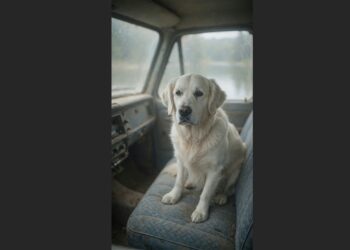
For twelve years, the passenger seat of my truck belonged to Otis.
He rode there when I took my son to school. He rode there when I went to work. In winter, he pushed his nose toward the heater vent. In summer, he rested his head near the open window and let the air pull at his cheeks.
Last Friday, I drove home without him.
I kept reaching across the console out of habit.
My hand found an empty seat every time.
Otis had been a young brindle Boxer when I found him beneath a broken ice machine at a roadside gas station nearly forty miles outside town.
I had planned to keep him for one night.
Instead, he stayed long enough to watch my eight-year-old son become a man, to see me lose one job and build another, and to turn a cramped apartment into the closest thing the three of us had to a complete family.
I Found Him in a November Rainstorm
It was late when I stopped for gas.
Rain swept sideways across the parking lot, and the temperature was dropping quickly.
The station was nearly empty.
That was when I noticed something moving near the back of the building.
A dog was huddled beneath an old ice machine.
He was brindle with a white chest and oversized paws. Even through his wet coat, I could see his ribs.
The cashier said he had been there since morning.
Several customers had left scraps.
Nobody had managed to touch him.
Whenever someone approached, he pressed himself harder against the wall.
I had no business bringing home a dog.
My apartment did not allow pets.
I worked long shifts at a repair shop.
I was raising my eight-year-old son, Noah, largely on my own.
Money was already tight.
Then the cashier said the store was about to close.
I looked outside at the rain.
Then I bought sliced turkey.
It Took Half an Hour for Otis to Take Food From My Hand
I sat on the wet pavement several feet away.
For a long time, the dog did nothing.
I tossed one piece of turkey toward him.
He waited.
Then ate it.
I tossed another slightly closer.
Eventually, he crawled forward.
When I finally held out a piece in my hand, his entire body trembled.
Still, he stretched his neck far enough to take it.
That was when I noticed the rope.
A frayed length was looped around his neck.
No collar.
No tag.
Just rope that appeared to have broken.
I could not tell whether he had escaped, been abandoned, or been wandering for days.
So I told myself something practical.
One night.
Tomorrow I would call a shelter.
Someone with a yard, more money, and more time could take him.
Getting him into the truck took nearly another hour.
Once inside, he curled into a ball on the passenger-side floor.
He made himself as small as he could.
Noah Found Him Before I Could Explain
I set up the bathroom because it was the quietest safe room in the apartment.
Old towels went on the floor.
I filled a mixing bowl with water.
Then I left the door open so the dog would not feel trapped.
By sunrise, he had barely moved.
Noah found him while I was making coffee.
My son sat in the hallway in dinosaur pajamas, staring at the wet, frightened dog.
“Is he ours?” he whispered.
“No,” I said too quickly. “Just until we find his family.”
Noah nodded.
He disappeared into his bedroom.
A few minutes later, he returned carrying his favorite stuffed bear.
The bear was missing one eye.
Noah had slept with it since his mother and I separated.
He placed it outside the bathroom doorway.
“So he won’t be lonely.”
Then he left.
Later that afternoon, I found the bear inside the bathroom.
Otis was asleep with his chin resting on it.
Nobody Came Looking for Him
I called nearby shelters.
I posted notices.
The gas station had my number in case someone returned asking about the dog.
Nothing.
A rescue group eventually offered to place him in foster care, but they needed several days to arrange transportation.
Until then, Otis stayed with us.
The first nights, he remained in the bathroom.
Then he started sleeping in the hallway.
More specifically, outside Noah’s bedroom.
A few days later, I found him lying beside Noah while my son worked on homework.
Noah was reading aloud.
Otis appeared to be asleep.
By the end of the week, the dog had also learned the sound of my truck.
When I came home from work one evening, he was waiting by the apartment door.
Noah’s battered bear hung from his mouth.
His tail was wagging so hard that his entire back end moved.
That was the evening the rescue called.
They had found a foster home.
I looked at Otis.
Then at Noah.
Then I called them back.
“He doesn’t need it anymore.”
Life With Otis Was Not Peaceful
I should not romanticize him.
He destroyed two pairs of work boots.
He chewed the arm of our couch.
Once, while I was at work, he dragged an entire bag of flour through the kitchen.
The apartment looked as though someone had detonated a bakery.
He snored loudly enough to wake me from another room.
Umbrellas terrified him.
Cardboard boxes were suspicious.
Delivery drivers, in Otis’s opinion, were clearly organizing an invasion.
But he settled into our lives with remarkable speed.
Every morning, he came with me when I drove Noah to school.
He sat upright in the passenger seat, staring through the windshield.
Noah said he looked like he was navigating.
Every afternoon, Otis waited by the window for the school bus.
The moment it appeared down the street, he ran between the window and the door.
Noah came inside, dropped his backpack, and hugged him before doing anything else.
For years, that was how our afternoons began.
Eventually, We Got a Yard
I saved enough to move us out of the apartment.
The new place was only a small rental house near the edge of town.
Nothing fancy.
But there was grass behind it.
And a narrow porch.
The first time I opened the back door, Otis stepped outside cautiously.
He sniffed.
Walked several feet.
Then ran.
He tore from one end of the yard to the other, circled an old maple tree, and threw dirt behind him with every turn.
Noah laughed so hard he fell onto the grass.
I stood on the porch watching them.
When I first found Otis, I had worried about how much harder a dog would make an already complicated life.
Standing there, I realized something different.
He had become part of what made that life feel stable.
He Stayed While Everything Else Changed
When I lost my job at the repair shop, Otis was there.
For three months, I worried about rent, utilities, groceries, and whether I had made every possible wrong decision.
Eventually, I rented a small garage and started repairing cars on my own.
I had borrowed tools.
Almost no savings.
Far more optimism than business sense.
Otis slept under the front desk while I worked.
When customers came through the door, he lifted his head.
Sometimes he greeted them.
Sometimes he decided sleep was more important.
The little garage survived.
Then grew.
Noah grew too.
Eventually, he became old enough to learn to drive.
Otis rode in the back during those first lessons.
Every time Noah took a corner too quickly, the dog braced himself.
When the truck stalled, Otis sighed with such perfect timing that Noah accused him of judging his driving.
He probably was not.
But it certainly looked that way.
When My Father Died, Otis Stayed Beside Me
That night, family and friends came and went.
Eventually, the house emptied.
I went outside and sat on the porch.
I did not call Otis.
A few minutes later, he came out.
He lowered himself beside me.
Then leaned his heavy body against my leg.
He did not make grief disappear.
Dogs cannot do that.
He did not understand the complicated loss I was trying to process.
But companionship does not require understanding every detail.
For most of that night, he simply remained there.
I remember the weight of him more clearly than most of the words people said to me that week.
Then Noah Left for College
I should have seen that day coming.
Parents always should.
It still arrived too quickly.
We loaded the final boxes into the truck.
Otis was already older by then.
Gray had spread across his muzzle.
Jumping into the cab required more effort.
Still, when he saw the luggage, he tried.
Noah knelt beside him instead.
He wrapped both arms around Otis’s neck.
“You look after Dad.”
Otis did not understand those words as a promise.
But after Noah left, there were suddenly only two sets of footsteps in the house.
Mine.
And his.
The silence became noticeable again.
Every morning, however, Otis still waited by the door when it was time to go to the garage.
That passenger seat belonged to him.
Some Drives Were Completely Silent
No radio.
No conversation.
Just the engine, tires against pavement, and Otis breathing beside me.
In winter, he leaned toward the heat.
During warmer weather, he liked air from the cracked window.
Sometimes, at a red light, I put one hand on his back.
It became such an ordinary habit that I stopped noticing I was doing it.
That is the strange thing about living with a dog for years.
The important parts do not always feel important while they are happening.
They become mundane.
A bowl filled in the morning.
A dog waiting beside a truck.
Nails across the floor.
A warm back beneath your hand.
Only later do you understand that those small repetitions were the structure of your life.
Age Arrived Quietly
Otis did not suddenly become old.
First, he hesitated before jumping into the truck.
Then one morning, he simply looked at the seat and waited.
So I lifted him.
Later, the porch steps became difficult.
I built a ramp.
His hearing faded.
But he could still recognize the vibration of my truck pulling into the driveway.
His eyes became cloudy.
He never forgot where treats were stored.
He slept more.
Walked less.
Some mornings his joints needed several minutes before they seemed ready to cooperate.
We adjusted.
Shorter walks.
More rugs.
A softer bed.
Veterinary visits became more frequent.
Love did not make him younger.
It simply made adapting to his age part of the household routine.
Whenever Noah Came Home, Otis Changed
The old Boxer could be sound asleep.
Then Noah’s voice came through the door.
His head lifted.
His tail hit the floor.
He pushed himself upright.
Sometimes he even found the old stuffed bear.
By then, it had survived almost as much as Otis.
One arm had been repaired with different fabric.
The missing eye had been replaced by a crooked button.
Yet Otis still carried it when Noah visited.
Whether he associated the bear specifically with Noah’s childhood or simply knew it as a familiar household object, none of us could say.
It did not matter.
Noah would kneel.
Otis would bring the bear.
The years between eight and twenty somehow disappeared for a few minutes.
I Knew We Were Running Out of Time
I simply refused to count it.
As long as Otis ate, wanted to ride in the truck, enjoyed seeing Noah, and moved through his days with reasonable comfort, we kept going.
Then one morning, I picked up my keys.
Otis usually responded before they finished jingling.
That day, he remained on his bed.
I called him.
His eyes opened.
His tail moved once.
He did not stand.
I knelt.
Otis placed his head in my hand.
I remember knowing before the veterinarian told me that something had changed.
The News Was Bad
The examination revealed a large mass near his heart.
At his age and in his condition, surgery was not considered a realistic option.
His body was beginning to struggle.
The veterinarian spoke gently.
We might have days.
Perhaps less.
There are moments when veterinary medicine can offer treatment.
There are other moments when its most important job is helping a family understand that comfort has become the priority.
I called Noah.
He drove home that afternoon.
Otis lifted his head when he arrived.
His tail started moving.
Noah sat on the floor with him for a long time.
Nobody needed to say what all three of us knew.
The Next Morning, Otis Ate Turkey Again
He seemed a little stronger.
Not recovered.
Just having a better morning.
Noah opened the refrigerator and found sliced turkey.
He offered some.
Otis ate it.
I started laughing before I could stop myself.
Twelve years earlier, turkey had been the thing that persuaded a frightened young Boxer to move toward me beneath a broken ice machine.
Now Noah was feeding it to an old dog lying on our living room floor.
We decided to take him for a ride.
Not because Otis understood it would be his last.
We did.
He simply knew the truck.
The seat.
Us.
That was enough.
I Lifted Him Into the Passenger Seat
Noah sat in the back.
We drove past the garage.
Then through the neighborhood where Noah had grown up.
Eventually, we headed toward the lake where we had spent summer Sundays when he was little.
Otis could not walk far.
We carried his blanket to the edge of the water and placed it beneath a cottonwood tree.
The weather was mild.
A breeze moved across the lake.
Otis lay between us.
For a while, nobody spoke.
He watched the water.
Occasionally, he raised his nose toward the wind.
Noah reached into his backpack.
Then he pulled out the stuffed bear.
The Bear Was Nearly as Old as Their Friendship
Noah had repaired it again.
The replacement button eye sat crookedly.
One arm did not match the rest of the body.
He placed it between Otis’s front paws.
Otis lowered his head onto it.
That image nearly undid me.
For a second, I could see the young dog on the bathroom floor.
Skinny.
Unsure.
Resting against a toy an eight-year-old boy had left because he thought a frightened animal should not be lonely.
Except Otis was not that dog anymore.
His muzzle was gray.
His body was tired.
And he was not alone.
I Thanked Him
Not because I believed Otis understood a twelve-year summary of his role in our family.
The words were for me too.
I thanked him for being there while Noah grew up.
For the school mornings.
For the afternoons at the window.
For the porch nights.
For every ride to the garage.
For making an empty apartment feel occupied.
Mostly, I told him he had been a good dog.
Noah kept one hand on his shoulder.
Eventually, Otis closed his eyes.
We stayed until the air began cooling.
Then I lifted him back into the truck.
That Night, None of Us Went to Bed
We spread blankets across the living room floor.
Otis lay between us.
Noah slept for a while.
I don’t think I did.
I listened to Otis breathe.
Sometime before dawn, the pattern changed.
Quieter.
Longer pauses.
I put his head against my chest.
Noah rested a hand along his back.
His death was peaceful.
No struggle.
No panic.
One breath.
Then no next breath.
The house became silent in a way I had been dreading for years.
I stayed where I was for a long time.
So did Noah.
Later That Morning, I Carried Him to the Truck
That was the hardest lift I ever made.
For years, I had helped Otis into the passenger seat when his aging legs could no longer manage it.
This time, he did not shift his weight.
Did not look through the windshield.
Did not turn around before settling.
I placed the stuffed bear beside him.
Then I drove to the veterinary clinic.
The road was familiar.
My body kept following old habits.
At one point, my right hand moved away from the steering wheel.
I reached across the console.
For twelve years, there had almost always been a dog there.
That morning there wasn’t.
The Drive Home Was Worse
The seat was completely empty then.
No Otis.
No bear.
No blanket.
Nothing.
When I reached the house, I turned off the engine.
Then I remained in the driveway.
I knew what would happen when I opened the front door.
Nobody would be waiting behind it.
The water bowl was still inside.
The ramp still led to the porch.
His bed was still beside the wall.
Every object remained in position.
The dog they had been arranged around was gone.
I finally understood why Rosie’s old belongings had once hurt someone else so much.
An empty routine can feel larger than an empty room.
I Had Thought I Was Rescuing Otis
For years, people said that.
“You saved him.”
Maybe.
I got him out of a cold parking lot.
Fed him.
Found him veterinary care.
Eventually gave him a home.
Those things mattered.
But rescue stories often become too simple when we divide everyone into savior and saved.
Otis entered our lives when Noah and I were struggling too.
He gave my son companionship during years of enormous change.
He gave me a reason to come home when work, money, and grief made everything else feel unstable.
He created routine where we badly needed it.
None of that requires pretending he consciously understood our problems.
He was simply there.
Every day.
For twelve years.
Sometimes presence is enough.
The Boy With the Stuffed Bear Became a Man
That may be the measure of Otis’s life I understand best.
Noah was eight when he placed that one-eyed bear outside the bathroom.
He was a college student when he came home because Otis was dying.
Between those two moments were thousands of ordinary days.
School.
Homework.
Arguments.
Birthdays.
Driver’s tests.
Job changes.
Losses.
Moving boxes.
Trips to the lake.
Morning rides.
A little boy became taller than his father.
A frightened young dog became an old one.
Neither transformation happened all at once.
I was lucky enough to witness both.
I Still Reach Toward the Passenger Seat
Not every time.
But often enough.
Habit survives longer than presence.
Sometimes I start the truck and expect to hear Otis shifting beside me.
I still leave more room when I turn a corner.
Once, I caught myself reaching to adjust the heater vent toward him.
Then I remembered.
Grief is strange that way.
The mind knows.
The body keeps repeating what it learned over twelve years.
I no longer think that means something is wrong.
It means the routine had time to become deeply familiar.
Eventually, new habits will form.
I am not in a hurry.
The Passenger Seat Is Empty Now
For twelve years, a brindle Boxer rode there.
First young and nervous.
Then confident enough to behave as though the truck belonged to him.
Eventually gray-faced and too stiff to climb in without help.
His place in our family was never dramatic most of the time.
That is what I miss.
The ordinary version.
Otis asleep beneath the garage desk.
Otis waiting for Noah’s school bus.
Otis leaning into the heater.
Otis carrying a battered stuffed bear.
Otis beside me when neither of us needed anything.
Twelve years ago, I sat on wet pavement outside a gas station and told myself I would keep a frightened dog for one night.
One night became a week.
A week became twelve years.
Long enough for a little boy to become a man.
Long enough for a struggling father to build a business.
Long enough for a temporary dog to become part of nearly every important memory I have from that period of my life.
Last Friday, I drove home alone.
The seat beside me was still.
I kept one hand on the steering wheel.
For several miles, the other rested on the console where it had always been easy to reach across and touch Otis’s back.
There was nothing there.
But I left my hand there anyway.
The passenger seat will probably feel like his for a long time.
And I think I am all right with that.
Editor’s Note: The characters in this story are fictional. Through these stories, we hope to share the intelligence, loyalty, compassion, and loving nature of dogs with people everywhere.