David Mercer had only been away from his pickup for a few minutes.
He had finished lunch beside the county fishing lake, carried his trash toward a nearby bin, and walked slowly back across the gravel lot.
Then he stopped.
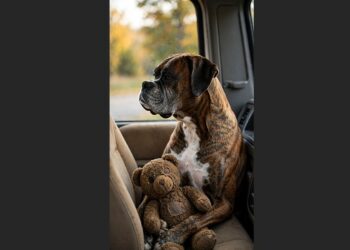
An elderly Golden Retriever was sitting in the passenger seat.
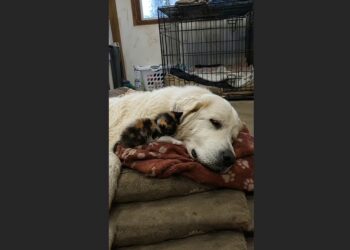
The dog’s coat had faded to a soft cream. His muzzle was almost completely white, and age had clouded his amber eyes.
He was not pawing through the cab or searching for food.
He simply sat there watching David approach.
Of all the places the dog could have chosen, he had settled in the one seat David had struggled to look at since the previous winter.
For thirty-nine years, that seat had belonged to his wife, Ellen.
The Passenger Seat Had Been Empty Since Ellen Died
Ellen had spent decades riding beside David.
On long trips, she kept paper maps folded across her lap even after GPS became common.
She distrusted electronic directions.
“Paper doesn’t lose signal,” she liked to say.
David teased her about it every time.
She would ignore him, adjust the map, and tell him which highway to take anyway.
Those small arguments had become part of marriage.
Then Ellen died.
The farmhouse they had shared became so quiet that David sometimes left the radio playing in rooms he was not using.
There was no singing from the kitchen.
No conversation from the hallway.
No laughter from the living room when he said something ridiculous from another room.
Some mornings, he still got into the truck and reached across the center console because he had thought of something he wanted to tell her.
Then his hand would stop.
The seat was empty.
Ellen’s Denim Jacket Was Still Behind It
David had not deliberately turned the truck into a memorial.
He simply had not moved certain things.
Ellen’s old denim jacket remained folded behind the passenger seat.
A pair of inexpensive sunglasses still rested in the glove compartment.
There were probably receipts she had tucked into the door pocket months before she died.
David knew those objects were there.
He rarely touched them.
Grief had made ordinary belongings difficult.
Moving the jacket felt wrong.
Leaving it there hurt too.
So he did nothing.
That became his strategy for many things during the first months without her.
The Lake Gave Him Somewhere Else to Be
David started driving to the county fishing lake because afternoons at home felt too long.
Sometimes he brought a rod.
Often he did not use it.
He would sit beneath one of the large oak trees with a sandwich and watch ducks moving along the shoreline.
There were regular fishermen who knew each other by name.
Retired men arrived early.
Families came on weekends.
Pickup trucks pulled boats toward the launch.
Nobody expected David to talk.
That was part of why he liked it.
He could spend three hours near other people without having to explain how he was doing.
Then, sometime during those weeks, he noticed the Golden Retriever.
The Old Dog Seemed to Belong to No One
The dog had been appearing around the lake for nearly a month.
Some mornings he slept beneath the wooden pier.
Other days, he rested near the boat launch or walked slowly along the water.
People had begun leaving food.
An older couple brought cooked chicken on Saturdays.
Several fishermen maintained a bowl of clean water near the edge of the parking area.
The park ranger had checked with local animal control but had found no obvious owner.
The dog wore no collar when David first noticed him.
No one could say whether he had been abandoned or simply wandered away from somewhere.
There were stories, of course.
There are always stories when an old dog appears alone.
David tried not to add another one.
What Everyone Noticed Was His Interest in Trucks
Whenever a pickup entered the gravel lot, the Golden Retriever became alert.
His head came up.
He watched the door open.
Then he studied whoever stepped out.
Sometimes he rose and walked several paces closer.
If the person headed toward the lake without acknowledging him, the dog eventually lay down again.
The behavior happened too consistently for the regular fishermen not to notice.
“Waiting on somebody,” one man said.
Perhaps.
Or perhaps trucks had become associated with food, familiar people, or a previous routine.
Nobody could know.
What they could see was that arrivals mattered to him.
Departures did too.
David and the Dog Began Sharing the Same Part of the Shore
At first, they ignored each other.
David sat beneath his oak tree.
The Golden Retriever rested thirty feet away.
Neither crossed the distance.
That suited David.
He was not looking for a dog.
His days already felt uncertain enough.
Still, after several visits, he began bringing extra food.
Nothing elaborate.
A small portion that was safe for a dog.
He placed it several yards away, then returned to his own spot.
The retriever waited.
Only after David moved back toward the truck would he approach.
Over time, that became their routine.
David arrived.
The dog appeared.
Food was left.
Distance remained.
There was something strangely comfortable about it.
No introductions.
No expectations.
Just two living creatures repeatedly occupying the same piece of shoreline.
David Never Tried to Touch Him
He understood enough about frightened animals to know that persistence was not always kindness.
The dog did not need to be cornered because David wanted to feel useful.
So he allowed the retriever to decide how close was comfortable.
After a couple of weeks, the distance shortened.
Thirty feet became twenty.
Then ten.
One afternoon, the dog slept beneath the same oak tree, several yards from David’s chair.
David continued eating his sandwich.
The retriever continued sleeping.
That was progress enough.
Then came the morning David returned to his truck and found the dog already inside.
For a Moment, David Could Not Move
The old Golden sat in Ellen’s passenger seat.
His posture was uncertain.
His ears rested slightly back.
When David approached, the dog’s head lowered.
He did not look comfortable enough to suggest that he considered the truck his.
He looked like an animal unsure whether he had made a mistake.
David stopped several feet away.
He could have called the ranger.
He could have opened the door and encouraged the dog back outside.
Instead, he stood looking at the white muzzle above the seat Ellen had occupied for most of their marriage.
Then he walked closer.
“You picked the right truck,” he said quietly.
The dog watched him.
David swallowed.
“My wife would’ve liked you.”
When David Opened the Door, the Dog Stayed
He approached slowly and gave the retriever room to move away.
The dog did not.
David rested one arm near the open doorway.
After several seconds, the retriever leaned forward.
His nose moved along David’s sleeve.
Then he lowered his chin onto David’s forearm.
The contact lasted only a moment.
It was enough.
David had spent months trying not to look at that passenger seat because every glance reminded him who was missing.
Now there was an elderly dog sitting there.
Not replacing Ellen.
Not fixing anything.
Simply occupying a space David had allowed to remain empty.
David could not bring himself to put him back in the parking lot.
He Still Had to Find Out Whether the Dog Belonged to Someone
Wanting to keep him was not the same as having the right to.
David contacted the local shelter.
The retriever was scanned for a microchip.
None was found.
They checked missing-dog reports and contacted neighboring jurisdictions.
David posted photographs through local channels.
The park ranger asked regular visitors again.
Nobody recognized him as their missing dog.
Meanwhile, a veterinarian examined him.
He appeared to be about eleven years old.
Both hips showed signs of arthritis.
Several teeth were heavily worn.
His hearing was not what it had once been.
Otherwise, he was in reasonable condition for a dog his age.
Someone had probably cared for him at some point.
Exactly what had happened afterward remained unknown.
David Became His Temporary Caregiver
During the holding period, the dog stayed with David under the arrangement worked out with the local shelter.
That first evening at the farmhouse was quiet.
The retriever inspected the kitchen.
Then the living room.
Then the hallway.
He stopped at the bottom of the stairs but did not attempt them.
David placed a bed near the kitchen doorway.
The dog circled it once.
Then lay beside it on the floor.
David laughed for the first time in several days.
“All right. I see what you think of the bed.”
The dog’s tail moved once.
David named him Tucker.
He told himself the name was temporary.
It did not feel temporary for long.
Weeks Passed Without an Owner Coming Forward
David kept expecting a telephone call.
Someone had seen the photograph.
Someone had been searching.
Someone wanted their old dog back.
No call came.
The required steps were completed.
Eventually, Tucker became legally available for adoption.
David did not need time to decide.
He filled out the paperwork.
The old Golden Retriever who had spent weeks watching trucks at the fishing lake now had one of his own to ride in.
For the first time since Ellen’s death, David drove toward the farmhouse with someone sitting beside him.
Tucker Did Not Transform the House Overnight
For the first several days, he slept near the kitchen.
Then he began following David more often.
Not constantly.
At eleven, with arthritic hips, Tucker considered every unnecessary trip across the house before making it.
If David walked outside, though, Tucker usually came.
The dog followed him while he checked fences.
He rested in the grass while David worked.
If David moved too far, Tucker got up and followed again.
David began adjusting without realizing it.
He walked more slowly.
He stopped more often.
He kept water nearby.
When Tucker had enough, they went back to the house.
The farm continued operating.
It simply acquired an old dog.
Evenings Became Different First
David used to dread them.
After Ellen died, dusk seemed to announce the beginning of several hours he had no idea how to fill.
With Tucker, there was a new routine.
David sat on the porch with coffee.
Tucker stretched beside the chair.
They watched the hills darken.
Sometimes David talked.
At first, he felt foolish.
Then he stopped caring.
He told Tucker about a broken section of fencing.
A calf that kept escaping.
A neighbor’s tractor.
The weather.
Occasionally Ellen’s name entered the conversation.
Tucker usually slept through most of it.
That was fine.
David did not need answers.
The Farmhouse Began Making Noise Again
Paws moved across the wooden floor.
A water bowl rattled against the cabinet.
Tucker snored beside the recliner.
At breakfast, his nails clicked toward the kitchen the moment David touched the food container.
Small sounds.
Nothing important by themselves.
Together, they changed the house.
David still missed Ellen.
He still had difficult mornings.
There were evenings when one memory could stop him in the middle of a room.
Tucker did not cure grief.
What he did was add another living routine around it.
Feed the dog.
Open the door.
Take a walk.
Refill water.
Brush the old coat.
Remember joint medication.
Sometimes structure is useful when a person has lost the structure built through decades of marriage.
The Neighbors Noticed Before David Did
He stayed after church longer.
He accepted an invitation for coffee instead of immediately driving home.
When someone stopped by the farm, he no longer seemed eager for them to leave before conversation became personal.
Once, a neighbor heard him laugh and looked surprised enough that David noticed.
That irritated him.
Then it made him laugh again.
Nobody credited Tucker with curing anything.
David had family, neighbors, routines, and years of experience learning how to carry loss.
But the dog had changed one part of the equation.
Going home no longer meant opening a door to complete silence.
Someone usually heard the truck.
Someone waited.
Tucker Claimed the Passenger Seat
Once the arthritis medication began helping and David learned how to support him getting in and out of the truck, Tucker started accompanying him more often.
He rode to the feed store.
To the garage.
Back to the fishing lake.
Sometimes he went nowhere important at all.
He settled into the passenger seat as though it had always been part of his routine.
During summer, David cracked the window enough for fresh air while keeping Tucker safely inside.
On cold mornings, the old dog curled against the seat and slept.
The first few trips were difficult for David.
He kept remembering Ellen.
Then something changed.
The memories did not disappear.
They simply stopped feeling incompatible with Tucker’s presence.
Almost a Year Later, David Moved Ellen’s Jacket
He had been cleaning the truck when he saw the faded denim behind the passenger seat.
For months, Tucker had ridden in front of it.
David picked it up.
The jacket still carried the shape of an old life in ways he could not explain.
For a long time, he stood beside the truck holding it.
Then he carried it into the farmhouse.
He folded it carefully and placed it in a cedar chest with several of Ellen’s other belongings.
He did not throw it away.
He did not donate it.
He simply moved it.
That distinction mattered to him.
Grief had convinced him that changing anything meant leaving Ellen behind.
Nearly a year with Tucker had shown him otherwise.
Making Room Was Not the Same as Forgetting
Ellen had been his wife for thirty-nine years.
Nothing could replace that history.
Tucker did not need to.
The dog had his own unknown past anyway.
David sometimes wondered who had loved him first.
Who had watched that muzzle gradually turn white.
Who had taught him about trucks.
Why had he waited near that lake?
There were no answers.
David eventually stopped trying to invent them.
Whatever life Tucker had known before remained part of him.
Whatever life David had known with Ellen remained part of David.
Neither needed to erase the past to participate in something new.
They Still Returned to the Lake
Tucker’s behavior there changed.
He no longer sat near the parking lot watching every truck.
When David parked, Tucker stayed close.
They walked slowly toward the oak tree.
David sometimes fished.
Tucker slept.
People who remembered the stray Golden asked how he was doing.
“Runs the farm now,” David would say.
That was an exaggeration.
Tucker mostly supervised from horizontal positions.
Still, he had changed from the dog who monitored every arriving vehicle.
Now when a pickup pulled into the gravel lot, he might raise his head.
Usually, he lowered it again.
David’s truck was already there.
Old Age Continued Anyway
Tucker did not become younger because he found a home.
His hips remained arthritic.
Some mornings were slower than others.
David added rugs to slick areas of the farmhouse.
He shortened their walks.
On colder days, Tucker needed more time before moving comfortably.
Veterinary visits became part of life.
David accepted that.
He had not adopted an eleven-year-old Golden Retriever expecting years of energetic companionship.
He had chosen the dog Tucker already was.
An aging animal who liked truck rides, quiet porches, and being close enough to know where David was.
For David, that was plenty.
Sometimes He Still Talked to Ellen While Driving
Especially on long roads.
He told her about the cattle.
About church.
About repairs around the farmhouse.
Sometimes he mentioned Tucker.
“You’d have spoiled him,” he once said aloud.
The old Golden lifted his head.
His tail thumped against the seat.
David smiled.
He did not imagine the dog understood the conversation.
Tucker had responded to a change in voice, movement, or simply hearing his name somewhere in the sentence.
Still, the timing was good enough to make David laugh.
That sound filled the cab.
For a moment, the road did not feel quite so lonely.
David Never Learned Why Tucker Chose His Truck
Perhaps he smelled food.
Perhaps he had once ridden in a similar pickup.
Perhaps the open cab looked like shelter.
Perhaps David had become familiar after weeks of quiet meals beneath the oak tree.
There was no need to turn the moment into destiny.
Tucker had entered a vehicle.
David had chosen not to send him away.
Everything important happened after that.
Veterinary care.
Searching for an owner.
Paperwork.
Medication.
Daily routines.
Thousands of small decisions that turned an encounter into a relationship.
That is how homes are built.
Not in one dramatic moment.
In repetition.
The Passenger Seat Means Something Different Now
For thirty-nine years, it held Ellen.
Then it became empty.
For months, David treated that emptiness almost as though disturbing it would disturb the marriage itself.
Then an elderly Golden Retriever sat there.
At first, the sight hurt.
Later, it became familiar.
These days, Tucker’s gray muzzle rests near the window while the fields move past.
David sometimes reaches across the console.
Now his hand finds fur.
That does not erase the years when it found Ellen’s hand or the sleeve of her jacket.
Both memories can occupy the same place.
That may be one of the things grief eventually asks us to learn.
A space can hold more than one chapter.
Tucker No Longer Watches Every Truck
At the lake, he stays near David.
At home, he listens for David’s pickup coming up the drive.
In the evenings, he sleeps beside the porch chair.
The farmhouse remains quieter than it was when Ellen lived there.
Of course it does.
Some absences cannot be filled.
But quiet is no longer the only thing waiting inside.
There are paws on the floor.
A bowl beside the kitchen wall.
An old Golden asleep near the recliner.
A leash hanging by the door.
And when David turns toward town in the morning, the passenger seat is occupied again.
Not by the woman who rode there for thirty-nine years.
By Tucker.
That difference matters.
So does the fact that David can finally look at the seat without immediately looking away.
One Ordinary Morning Changed Two Routines
For weeks, an old dog had rested beside a fishing lake and watched trucks come and go.
For months, a widower had driven around with an empty passenger seat because home felt too quiet and changing anything felt impossible.
Neither could recover the life that came before.
Tucker could not tell anyone who he had once waited for.
David could not bring Ellen back.
What they could do was move forward without pretending the past had disappeared.
One morning, David returned from a trash bin and found an elderly Golden Retriever sitting in the seat beside him.
He opened the door.
The dog stayed.
David let him.
Nearly a year later, that same dog still rides there.
Sometimes sleeping.
Sometimes watching the road.
Sometimes thumping his tail when David talks aloud.
And whenever they pull back into the farmhouse drive, Tucker lifts his head because he knows where they are.
David used to go to the lake because he was avoiding the silence of home.
Now he goes home because someone is waiting to walk through the door with him.
Editor’s Note: The characters in this story are fictional. Through these stories, we hope to share the intelligence, loyalty, compassion, and loving nature of dogs with people everywhere.