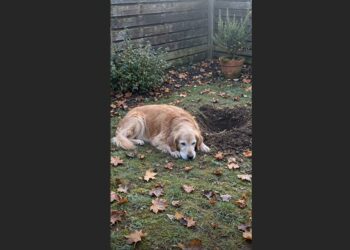
For six winters at a small animal refuge on the Oregon coast, an elderly Great Pyrenees named Willow followed a routine nobody had taught her.
Whenever a frightened kitten arrived without its mother, Willow abandoned her own bed.
She picked up a worn square of red fleece, carried it into the nursery, and settled beside the kitten’s enclosure.
Then she stayed.
Sometimes for an hour.
Sometimes until sunrise.
She rarely touched the kittens.
She simply lay nearby, breathing slowly while the smallest animals in the building adjusted to unfamiliar lights, unfamiliar hands, and a world that had suddenly changed.
The volunteers eventually called her the night nurse.
Visitors loved hearing about her.
Very few wanted to take her home.
Willow was enormous, aging, arthritic, and increasingly weak through her hind legs.
For years, she watched kittens recover and leave with families while she remained behind.
Then a tiny calico named Penny arrived.
And for the first time, one of Willow’s nursery companions decided to stay close to her.
Willow Arrived During a Difficult Week
My name is Daniel Mercer.
I was forty-six and managing overnight operations at Harbor House Animal Refuge in Newport, Oregon.
The refuge occupied a converted dairy barn about a mile from the ocean.
It was not elegant.
On wet mornings, the entire place smelled faintly of salt air, disinfectant, damp wood, and dog bedding.
We had room for twenty-eight dogs, about a dozen cats, and whatever emergency cases local animal control could fit through the door.
Some weeks felt hopeful.
Families arrived carrying new collars.
Children pressed their faces against the cat-room windows.
Dogs left in cars with their heads near open windows, taking in entirely new scents.
Other weeks stayed with you.
Willow arrived during one of those.
A Fisherman Found Her Along Highway 101
It had been raining.
Willow was walking beside the road with several feet of broken rope trailing behind her.
She was soaked through.
Her large frame made her look imposing from a distance.
Up close, the fur concealed how thin she really was.
Our veterinarian estimated she was around nine years old.
There were old marks around her neck.
Her teeth had received little care.
Her joints were already painful.
Her coat was so badly matted that sections had to be clipped away.
We could not determine exactly where she had come from or how she ended up beside the highway.
So we did not invent a history for her.
We treated the dog in front of us.
For Weeks, Willow Tried to Disappear
She never growled at us.
That did not mean she was comfortable.
If someone raised a hand too quickly, Willow flinched.
She ate more reliably when people left the room.
At night, despite having room to stretch out, she pressed her body against the back wall of her enclosure.
The less space she occupied, the more settled she appeared.
We stopped trying to convince her that she should want affection.
Instead, we moved slowly.
Food arrived consistently.
Water remained available.
Her bed stayed in the same place.
Nobody dragged her toward the front of the kennel for visitors.
Over time, Willow began lifting her head when familiar staff approached.
She remained cautious around people.
Other animals were different.
She Watched Everything in the Barn
Not excitedly.
Not with the intensity of a dog trying to chase cats.
Willow simply seemed aware of where everyone was.
If a dog barked sharply from another enclosure, she looked.
If a kitten cried, her ears moved.
If staff carried an animal into the treatment room, Willow followed the movement with her eyes.
Great Pyrenees were developed as livestock guardian dogs, animals selected over generations to remain close to vulnerable animals and monitor their surroundings with considerable independence.
We did not know whether Willow had ever worked around livestock.
Still, her quiet attentiveness fit the temperament people often associate with guardian breeds.
Then the red fleece appeared.
The Fleece Was an Accident
A volunteer had cut an old blanket into smaller pieces for the cat nursery.
One faded red square fell from a laundry cart near Willow’s enclosure.
Before anyone picked it up, Willow did.
She carried it to her bed.
From that night forward, it stayed with her.
She did not shake it.
Did not rip it.
Did not play with it.
She simply slept with part of her body touching it.
Maybe the texture felt comfortable.
Maybe it quickly picked up her own scent and became familiar.
Whatever the reason, Willow began carrying it whenever bedding was moved or changed.
The first time she took it into the nursery happened after a storm.
Three Newborn Kittens Came In That Night
A delivery driver had found them inside a plastic storage bin behind a closed seafood restaurant.
All three were extremely young.
Two were weak but relatively stable after warming and feeding.
The third was a tiny orange kitten who cried almost continuously.
We checked what we could.
Temperature.
Hydration.
Feeding.
Breathing.
He seemed to be improving physically.
Still, whenever human contact stopped, the crying resumed.
Around two in the morning, I heard movement behind me.
Willow stood in the nursery doorway.
The red fleece hung from her mouth.
Dogs were not normally loose in that part of the building.
I started to guide her away.
Before I reached her, Willow walked toward the incubator.
She lowered the fleece beside it.
Then lay down against the clear wall.
The Kitten Eventually Crawled Toward Her
Willow did not paw at the enclosure.
She did not lick the kitten.
She could not physically reach him through the barrier.
She simply remained there.
The kitten continued crying for another minute or two.
Then he moved toward the side nearest Willow.
His tiny body curled against the transparent wall.
Eventually, he slept.
I stayed far longer than the kitten’s condition required.
At the time, I told myself I was monitoring him.
Mostly, I was watching Willow.
Her breathing remained slow.
Her head rested on the red fleece.
Nothing dramatic happened.
That was what made it striking.
A frightened dog who still avoided close human contact had voluntarily positioned herself beside something even smaller and more vulnerable.
The next morning, we returned the fleece to her enclosure.
We assumed the whole episode would never repeat.
It did.
Willow Began Visiting the Kittens Who Struggled Most at Night
Months later, animal control brought in a kitten found inside the engine compartment of a parked truck.
The kitten trembled whenever anyone approached and would not leave the carrier.
That night, Willow brought the fleece into the nursery.
Later came a litter rescued from a flooded crawl space.
A kitten injured near the marina.
Two motherless tabbies left outside our gate in a grocery bag.
Again and again, Willow appeared with the red fleece.
She did not visit every kitten.
Confident kittens interested her much less.
Kittens still nursing normally from their mothers usually received no special attention from her.
The pattern seemed strongest around young animals who vocalized repeatedly or remained distressed during quiet hours.
We could not say Willow “understood loneliness” in the human sense.
What she could certainly detect were behavioral differences.
Crying.
Restlessness.
Movement.
Scent.
The absence of an adult cat nearby.
Something about those cues drew her in.
Eventually, We Gave Her a Bed in the Nursery
There was no point pretending she was not going to keep trying.
So we made the arrangement safer.
A large cushion went near the kitten enclosures.
The door could remain open when supervision and the individual kitten’s medical condition made Willow’s presence appropriate.
Introductions were controlled.
No fragile kitten was simply placed loose with a giant dog because the story sounded sweet.
Willow usually did not need direct contact anyway.
She carried in the red fleece.
Settled.
Stayed.
Some kittens continued crying.
Others calmed.
The presence of a large warm animal nearby may have provided useful sensory cues, but we never treated Willow as a replacement for veterinary care, warmth, feeding, or species-appropriate fostering.
She was simply another quiet presence in the room.
That became her role.
Visitors Called Her the Night Nurse
The nickname spread.
People came specifically asking about her.
They smiled when we told the stories.
Some wanted photographs.
Then they heard the practical details.
Willow was getting older.
Her hind legs were weakening.
She needed joint medication.
Grooming a Great Pyrenees coat required work.
A home with many stairs would be difficult.
Her size alone eliminated many apartments.
Families admired her.
Then they adopted younger dogs.
Willow remained.
For years, kittens recovered beside her and eventually disappeared through the front doors with new people.
Willow did not understand adoption.
She did not know why one animal left and another arrived.
She simply returned to the nursery when another kitten needed monitoring.
Age Slowly Changed What She Could Do
Her muzzle became grayer beneath the white coat.
Standing took longer.
On damp mornings, common along the Oregon coast, her rear legs shook.
The walk across the barn eventually became tiring enough that we began bringing some kitten enclosures closer to where Willow rested.
She still carried the red fleece herself.
That seemed important to her.
If a volunteer tried moving it first, Willow often followed and repositioned it anyway.
So we stopped interfering.
Then, in early February, a mudslide damaged several homes north of town.
During evacuation work, firefighters found a young mother cat hiding beneath part of a collapsed porch.
She had recently given birth.
Only one surviving kitten was located.
That kitten came to us.
Penny Was Barely Strong Enough to Cry
She was a tiny calico.
One ear was mostly black.
A white stripe ran down her face.
She was cold.
Underweight.
Weak enough that even her vocalizations came out thinly.
We named her Penny.
For the first three days, she showed little enthusiasm for food.
Most of her time was spent tucked against the back of a heated enclosure.
Veterinary support, controlled warmth, nutrition, and close monitoring mattered far more than anything Willow could offer.
Still, Willow noticed Penny immediately.
She brought the red fleece into the nursery.
This time, however, she did something we had not seen before.
She dropped it outside Penny’s enclosure.
Then used her nose to push one corner through the bars.
Penny crawled onto it.
Willow lowered her head beside the enclosure.
And stayed.
Over the Next Week, Penny Grew Stronger
She ate more reliably.
Her body temperature stabilized.
Her movements became purposeful.
Eventually, she was healthy enough for carefully supervised time outside the enclosure.
The first time we allowed it, Penny did not explore the room.
She went directly toward Willow.
Then climbed into the thick fur beneath the dog’s neck.
Willow barely moved.
The kitten curled there and fell asleep.
After that, keeping track of Penny usually meant finding Willow first.
Penny followed her around the barn.
She attacked Willow’s tail.
She disappeared beneath her when unfamiliar people entered.
She climbed onto the large dog whenever she wanted to sleep.
Willow tolerated all of it with extraordinary patience.
Then something else changed.
Willow started interacting with us more.
Penny Seemed to Expand Willow’s World
Willow began meeting volunteers closer to the door.
She started eating breakfast while people were still in the room.
Previously, she had often waited until everyone left.
One morning, a volunteer found her pawing at the cabinet where treats were kept.
Nobody had seen her do that before.
Penny also discovered the red fleece.
The kitten would pounce onto an edge.
Willow watched.
Then sometimes placed one enormous paw over the fabric.
Penny pulled.
Willow barely moved.
It became the slowest game of tug-of-war in Oregon.
Those moments stopped people in the middle of chores.
We all understood Willow was old.
That awareness made ordinary play feel especially valuable.
Not because happiness was curing her age.
Because she was still capable of enjoying the day she had.
That Spring, Claire and Owen Visited
Claire came with her sixteen-year-old son, Owen.
They were looking for a quiet cat.
Owen had been recovering from a serious bicycle accident.
Months of physical therapy had helped him walk again, but his mother said he had become more withdrawn since leaving the hospital.
We did not treat an animal adoption as therapy prescribed for a teenager.
They were looking for a pet they could responsibly care for.
Penny’s temperament appeared potentially compatible.
So I took them into the nursery.
Penny saw the strangers.
Then disappeared beneath Willow’s chest.
Owen sat on the floor several feet away.
He did not call the kitten.
Did not reach underneath Willow.
He waited.
That caught the old dog’s attention.
Willow Approached Owen First
It took time.
Eventually, Willow stood.
She crossed the small room with the careful gait we had come to know.
Then she lowered herself beside Owen’s legs.
Penny followed.
The kitten dragged one corner of the red fleece with her.
For nearly an hour, Owen sat there.
He spoke softly to Willow.
Penny eventually climbed into his lap.
Claire watched.
Before they left, she asked a question I had not expected.
“How long has Willow been here?”
“Almost six years.”
Claire looked at the old dog beside her son.
Then at Penny.
“Would separating them be difficult?”
I answered carefully.
They were attached.
Penny could almost certainly form other healthy relationships.
So could Willow.
But yes, moving one while leaving the other would be a significant change.
Claire nodded.
Then she and Owen left.
No application.
They Came Back Two Days Later
I had tried not to be disappointed.
A kitten was one commitment.
An elderly Great Pyrenees with medical needs was another.
Then Claire walked through the door with Owen.
They had spent the previous evening doing homework.
Not emotional homework.
Practical homework.
Ramps.
Orthopedic bedding.
Joint care.
Grooming requirements.
Transportation for a giant senior dog.
Veterinary costs.
The layout of their house.
They had also considered whether they could manage both animals together without expecting Willow to function as an emotional support device for Owen.
Their conclusion was simple.
They did not want to adopt Penny alone.
They wanted Willow too.
We Did Not Approve Them Because the Story Was Beautiful
The rescue still had responsibilities.
We discussed their home.
Their schedule.
The stairs.
Future mobility assistance.
The fact that Willow’s age could mean substantial medical needs sooner rather than later.
We discussed supervised interactions between dog and cat.
Penny’s independence mattered too.
She needed cat-specific enrichment, veterinary care, climbing opportunities, and the ability to retreat from Willow whenever she wanted.
Claire had thought through those things.
Owen had too.
The match began to look workable.
So paperwork moved forward.
After nearly six years at Harbor House, Willow finally had an approved home.
Willow Carried the Red Fleece Out Herself
Penny rode in a secured carrier.
Claire had prepared a thick mattress across the rear cargo area for Willow.
A ramp helped with loading.
Before we left the barn, Willow went back toward the nursery.
She picked up the red fleece.
Then walked toward the door.
I had watched her carry that fabric through the refuge hundreds of times.
That afternoon was different.
She was taking it beyond the building.
Several volunteers stood outside.
Nobody made a speech.
Willow did not understand that people were emotional because she was finally leaving.
She climbed into the car with help.
Penny’s carrier was secured nearby.
The fleece rested between them.
Then the car pulled onto the coastal highway.
I stood in the parking lot longer than I needed to.
Their New Home Was Quieter
Claire’s house overlooked a calm stretch near the Yaquina River.
There was a porch.
Enough room inside for Willow to move without navigating many steps.
Owen built a wooden ramp so she could reach the porch more comfortably.
On warm days, Willow lay outside.
Penny watched birds from the railing.
At night, according to Claire, the kitten often slept curled against Willow’s abdomen.
The red fleece remained in use.
Still faded.
Still too small.
Nobody replaced it.
By then, it had spent years absorbing Willow’s scent and traveling wherever she settled.
There was little reason to remove something so familiar simply because newer bedding looked better.
Owen and Willow Developed Their Own Routine
Some nights, pain from Owen’s injured leg made sleeping difficult.
Claire later told us Willow sometimes settled outside his bedroom door.
She did not climb onto the bed.
Did not paw at him.
Did not somehow understand the medical details of his accident.
She simply chose to remain nearby.
The slow sound of her breathing became part of the nighttime environment.
Owen found it comforting.
That relationship did not replace physical therapy, medical care, family support, or anything else involved in his recovery.
Willow was a dog.
But companionship can still matter.
Sometimes having another living creature nearby makes a difficult night feel less empty.
Penny Became More Independent Too
As she grew, she did not spend every hour beneath Willow.
She explored.
Climbed.
Played elsewhere.
Watched birds.
Developed routines that had nothing to do with the dog.
That was exactly what we wanted.
Their bond did not require Penny to remain dependent on Willow forever.
Likewise, Willow was not merely Penny’s protector.
She ate.
Slept.
Spent time with Claire and Owen.
Rested alone when she wanted to.
Healthy relationships leave room for individuality.
Even unusually close animal pairs need that.
Months Later, an Envelope Arrived at Harbor House
Inside was a photograph.
Owen sat on the porch.
Penny was asleep in his lap.
Willow lay across his feet.
Her head rested on the faded red fleece.
She looked older than the dog I remembered from her first winter with us.
More gray.
Less muscle through the hindquarters.
Still unmistakably Willow.
Claire had written a message on the back.
She said Willow had spent years sitting beside frightened animals until they settled.
Now, she wrote, the old dog often chose to sit near Owen on difficult nights too.
I understood what she meant.
Still, I thought back to Willow’s first months at the refuge.
The dog who ate only when rooms were empty.
The dog who slept pressed against a wall.
The dog who seemed more comfortable giving proximity than receiving it.
We Never Learned Why Willow Started Going to the Nursery
People wanted a reason.
Perhaps she had raised puppies in another life.
Perhaps she had worked with livestock.
Perhaps frightened young animals triggered some guardian behavior.
Perhaps the cries simply caught her attention.
There was no evidence that allowed us to choose among those explanations.
We did not need one.
Willow repeatedly sought proximity to distressed kittens.
She remained calm.
Some of the kittens settled while she was nearby.
Those were observable facts.
Everything beyond them belonged to interpretation.
The red fleece was similar.
Maybe it helped her feel secure.
Maybe it became part of a learned routine.
Maybe she simply liked carrying it.
Its exact meaning stayed hers.
What We Knew Was Simpler
Willow had arrived frightened.
Over time, the refuge became familiar.
Then she began spending nights beside animals smaller and more vulnerable than herself.
Years passed.
Her body aged.
The kittens kept coming.
Willow kept showing up when she could.
Eventually, one of those kittens stayed close enough to alter Willow’s own routine.
Penny played with her.
Slept against her.
Followed her.
And later, when a family came looking for one quiet cat, they saw the old dog attached to her and considered whether their home could accommodate both.
It could.
That is how Willow finally left.
Not because six years of service earned her a reward.
Dogs do not accumulate moral credit toward adoption.
She left because the right household happened to see all of her needs and still had room.
Willow Had Spent Years Beside Departing Animals
That was the part that affected the volunteers most.
Kitten after kitten recovered.
Families came.
Carriers closed.
Doors opened.
The animals disappeared.
Willow remained behind with the red fleece.
Again, she could not know what adoption meant.
But the pattern was part of her environment.
One day there was a kitten.
Later the kitten was gone.
Then another arrived.
That afternoon with Claire and Owen, the pattern changed.
Penny entered a carrier.
Willow did not return to the nursery.
She followed.
The red fleece followed too.
For once, when the frightened younger animal left Harbor House, Willow went with her.
The Photograph Still Hangs in Our Office
Not because Willow belongs to the refuge anymore.
She doesn’t.
Her home is somewhere else now.
We keep the photograph because it reminds us of what long-term rescue care sometimes looks like.
Not every animal leaves quickly.
Some stay months.
Some years.
Some age while waiting.
Good sheltering means caring for the life they are living now, not only preparing them for a hoped-for adoption later.
For Willow, those six years included medicine.
Warm bedding.
Slowly growing trust.
And a ridiculous square of red fleece that moved from kennel to nursery and eventually into a family’s car.
The Last Time Claire Sent an Update, Willow Was Still Sleeping Beside Penny
She was slower.
Owen’s ramp mattered more.
Her joints required careful management.
Nobody pretended love had reversed age.
Penny was nearly grown.
Willow remained old.
That was fine.
A good ending for a senior dog does not require becoming young again.
It requires comfort.
Appropriate medical care.
Predictability.
People willing to adapt as mobility changes.
And enough choice that the dog can decide where she wants to rest.
Most evenings, Willow chose somewhere close to the family.
Sometimes Penny joined her.
Sometimes Owen did.
And underneath Willow’s head was often the same faded red fleece she had first carried into the kitten nursery years earlier.
For six winters, Willow had settled beside frightened animals until their world became a little less unfamiliar.
Then, near the end of her own life, one small calico followed her out the door.
This time, Willow was not the animal staying behind.
She was going home too.
Editor’s Note: The characters in this story are fictional. Through these stories, we hope to share the intelligence, loyalty, compassion, and loving nature of dogs with people everywhere.