Helen had already opened the door when she felt something catch the edge of her cardigan.
She stopped.
Behind her stood Rosie, a seven-year-old Border Collie mix with gray beginning to show around her muzzle. The dog held a small fold of Helen’s sleeve between her teeth.
She was not tugging.
She was not growling or jumping.
She simply stood there, holding the fabric gently while her tail made one uncertain sweep behind her.
Helen had spent less than half an hour with Rosie.
Rosie had spent nearly five months watching visitors leave.
That Thursday morning, for the first time anyone at the shelter could remember, she followed one of them toward the door.
And Helen turned around.
Helen Had Not Come Looking for a Dog
At sixty-eight, Helen had recently entered a stage of life she was still learning how to inhabit.
For forty-one years, she had taught third grade at the same elementary school. Her days had been organized by bells, reading groups, spelling tests, parent conferences, and children who always seemed to need something at exactly the same time.
Retirement had sounded peaceful.
At first, it was.
Helen read books she had postponed for years. She worked in her small garden. She volunteered at the public library and occasionally met former colleagues for lunch.
Still, the hours stretched differently when nobody was waiting for her in a classroom.
Then her older sister died after a brief illness.
The loss changed the shape of Helen’s days again.
Her Sister Had Been Part of Nearly Every Week
The two women lived only a few blocks apart.
They spoke on the phone most afternoons and shared Sunday lunch whenever schedules allowed.
Sometimes they had something important to discuss.
Usually they did not.
They talked about groceries, neighbors, books, weather, and whether one of them had finally remembered to schedule an appointment.
Those ordinary conversations became noticeable only after they stopped.
Helen still had people around her.
Friends invited her to dinner.
Neighbors checked in.
Her church community remained part of her week.
Her daughter, Emily, visited whenever work and family allowed.
Helen was not socially abandoned.
But companionship and constant company are not the same thing.
Evenings were the hardest.
Emily Had Mentioned a Dog More Than Once
Helen had owned dogs years earlier, so her daughter knew she liked them.
“You could think about adopting again,” Emily suggested one afternoon.
Helen shook her head.
“I don’t know if I want that responsibility now.”
It was a reasonable concern.
Dogs require daily care regardless of weather, fatigue, travel plans, or age.
Helen also knew that adopting an energetic dog simply because the house felt lonely would be unfair to both of them.
So she did nothing.
Then she began sorting through belongings that had belonged to her sister’s elderly Labrador.
There were several clean blankets.
Unopened bags of food.
A few other supplies that could still be used.
Helen loaded them into her car.
She planned to donate everything to Maple Ridge Humane Society and go home.
She Almost Left Without Seeing the Kennels
A volunteer accepted the supplies and thanked her.
Then she asked whether Helen wanted to meet any of the dogs.
Helen laughed.
“Oh, I probably shouldn’t.”
The volunteer did not pressure her.
“We can just walk through if you’d like.”
Helen hesitated.
She had nowhere urgent to be.
“Five minutes,” she said.
That was how she met Rosie.
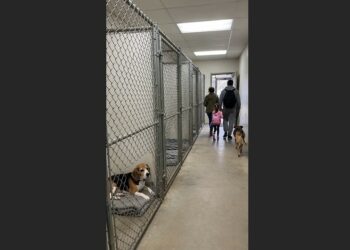
The Border Collie mix was lying near the back of her kennel while other dogs barked around her.
She looked up when Helen stopped but did not immediately approach.
Helen noticed the gray first.
Then the eyes.
Rosie’s expression was alert but cautious, as though she had learned to observe people before deciding whether interaction was worth the effort.
Rosie Had Been There for Almost Five Months
Her previous owner had suffered a severe stroke.
The person who had cared for Rosie for years moved into long-term medical care and could no longer provide for her.
Relatives tried to find another home.
None could offer the combination of time, exercise, and stability Rosie needed.
Eventually, she entered the shelter.
Staff described her as gentle and well mannered.
She did not throw herself against the kennel door when visitors arrived.
She rarely barked for attention.
Her behavior notes summarized her in three short lines:
Exceptionally loyal. Bonds deeply. Takes time to trust.
Helen read them twice.
“Can I sit with her?”
A volunteer led them to a quiet visiting room.
Helen Did Not Ask Rosie to Come Closer
There were two chairs, a rug, and a basket of toys.
Helen chose a chair.
Rosie remained several feet away.
The dog watched her.
Helen had spent four decades working with children, including plenty who became more uncomfortable when adults demanded immediate engagement.
So she did not pat her legs.
She did not call Rosie’s name repeatedly.
She did not reach across the space.
Instead, Helen started talking.
Not because she thought Rosie understood the details.
The sound of a calm human voice was simply something Helen could offer without asking anything in return.
She talked about a novel she had just finished.
Then about tomatoes.
Then about how strange it felt to prepare dinner for one person.
Rosie Moved Closer in Small Steps
At first, she shifted only a few inches.
Later, she stood and crossed part of the room.
Helen kept talking.
Rosie sniffed the rug near her shoes.
Then she lowered herself to the floor.
After a while, her shoulder touched Helen’s shoe.
Helen slowly moved one hand downward.
Rosie watched.
When the dog did not move away, Helen stroked the fur between her ears.
Rosie’s eyes closed.
They stayed that way for close to twenty minutes.
There were no tricks.
No toys thrown across the room.
No dramatic burst of affection.
Just an older woman sitting quietly and a middle-aged dog deciding that being near her felt acceptable.
For Rosie, that was meaningful progress.
Eventually, Helen Looked at the Clock
She had errands to finish.
Staying longer did not seem wise.
That was what she told herself, anyway.
Helen thanked the volunteer and stood.
Rosie lifted her head.
“Goodbye, sweetheart,” Helen said.
The dog remained on the rug while Helen walked into the hallway.
Helen reached the exit from the visiting area.
Then she felt the cardigan catch.
She turned.
Rosie had followed her.
The Border Collie mix stood directly behind her with the fabric held gently between her front teeth.
Nearby volunteers stopped what they were doing.
No One Claimed Rosie Understood Adoption
The gesture was striking, but shelter staff knew better than to turn it into a human sentence.
Rosie could not know that Helen was considering whether to adopt her.
She did not understand applications or ownership.
The dog had spent twenty quiet minutes near a person she appeared comfortable with.
Then that person stood and walked away.
Rosie followed.
When the cardigan moved close enough, she took hold.
That was what the security camera showed.
No frantic struggle.
No desperate attempt to drag Helen backward.
Just several steps down a hallway and a gentle grip on fabric.
Helen looked down.
Rosie’s ears had flattened slightly.
Her tail moved once.
She waited.
Helen Knelt on the Hallway Floor
Her knees objected immediately.
She ignored them.
Helen carefully eased the cardigan from Rosie’s mouth and lowered herself.
Rosie stepped forward.
Then leaned into her.
Helen put both arms around the dog’s shoulders.
Rosie rested her head near Helen’s shoulder and stayed there.
One volunteer turned away for a moment because she was crying.
Another asked whether Helen needed help standing.
Helen laughed through her own tears.
“I came here to donate blankets.”
She looked at Rosie.
“And apparently I made a scheduling mistake.”
The volunteer smiled.
Helen stroked Rosie’s cheek.
“I think I’d better ask some questions before I leave.”
The Shelter Slowed the Moment Down
Emotion alone is not an adoption plan.
The staff did not simply hand Helen a leash because the hallway scene was moving.
Rosie was a Border Collie mix, and even at seven she needed regular mental stimulation and appropriate exercise.
Helen was sixty-eight and lived alone.
They discussed her home.
Her yard.
Her daily routine.
Veterinary costs.
What would happen if Helen became ill.
Whether Emily could help in an emergency.
They talked about Rosie’s previous life and the possibility that sudden changes might make her anxious.
Helen listened carefully.
The more practical the conversation became, the more certain she felt.
She was not choosing a dog because she felt sorry for her.
She was deciding whether the life she could offer matched what Rosie needed.
It appeared that it did.
Helen Called Her Daughter From the Lobby
“I hope you don’t mind coming over tonight,” she said.
Emily asked why.
Helen looked down.
Rosie was sitting beside her chair.
“Because someone new is coming home.”
There was silence on the line.
Then Emily laughed.
“I had a feeling this would happen eventually.”
She arrived before the adoption process was complete.
Rosie greeted her cautiously.
Emily did not crowd her.
Instead, she sat beside Helen and let the dog investigate.
That helped Helen too.
She knew there would be someone else Rosie could learn to trust.
Someone who could step in if Helen ever needed help.
By afternoon, the blankets had been donated.
Rosie left with Helen.
The First Days Were Quieter Than Helen Expected
Rosie did not explore every room immediately.
She chose a few safe places.
Near the armchair.
By the kitchen entrance.
Outside Helen’s bedroom.
Helen kept meals consistent and avoided overwhelming her with visitors.
Walks were predictable.
The yard became available several times a day.
Rosie was not forced to greet neighbors.
If she wanted distance, she got it.
The same patience Helen had shown in the shelter continued at home.
Within several days, Rosie began following her.
Not anxiously every second.
Just enough that Helen became aware of another presence moving through the house.
Soft paws behind her in the hallway.
A dog settling nearby while she read.
A face appearing at the garden door.
The house sounded inhabited again.
Mornings Developed a Routine
Helen woke.
Rosie waited outside the bathroom.
Then they went outside together.
Helen checked her garden while Rosie investigated the yard.
As expected for a Border Collie mix, Rosie needed more than a quick trip outside.
They walked each morning at a pace Helen could comfortably maintain.
Helen also began using food puzzles and simple training games indoors.
Rosie seemed to enjoy having a task.
Afterward, both were ready for a quieter afternoon.
It was not an arrangement built entirely around cuddling.
It was daily care.
That mattered.
Companionship works best when the animal’s needs remain part of the picture.
Rosie Followed Helen Into the Garden
She did not help.
Mostly, she supervised.
Helen would water tomatoes while Rosie stretched in the shade.
If Helen moved to another bed, Rosie sometimes stood and followed.
Other times she remained exactly where she was.
Helen found that reassuring.
A dog comfortable enough not to monitor every movement was beginning to settle.
In the afternoon, Helen often read in her armchair.
Rosie chose the floor nearby.
Sometimes her paws touched Helen’s slippers.
Sometimes she slept several feet away.
Both counted as company.
Helen had not realized how much she missed sharing a room without needing to speak.
Evenings Changed the Most
Before Rosie, Helen often left the television playing simply to create sound.
Now there was dinner to prepare for two species.
A dog needed feeding.
Water bowls needed checking.
There was an evening walk.
Then Rosie usually settled near the kitchen while Helen cleaned up.
Later, she followed her into the living room.
Helen read.
Rosie slept.
No conversation was required.
Helen still missed her sister.
Adopting a dog did not undo bereavement.
Nor did retirement suddenly become easy.
What changed was the rhythm of the house.
There was another living creature participating in the day.
That was different from being cured of loneliness.
It was companionship.
The Shelter Called After the First Week
Follow-up calls were part of their normal process.
A volunteer asked how Rosie was eating.
Whether she was sleeping.
Whether Helen had noticed any anxiety, destructive behavior, or trouble with walks.
Helen answered each question.
Then she looked down.
Rosie was stretched across her feet.
“I thought I was the one taking home a lonely dog,” Helen said.
She paused.
“But I think we were both ready for some company.”
That was closer to the truth than saying Rosie had somehow diagnosed Helen’s loneliness.
The dog did not need supernatural insight.
She had responded to a calm person.
Helen had responded to a dog willing to sit quietly beside her.
Sometimes compatibility begins with something that simple.
The Security Footage Became Special to the Shelter Staff
The camera above the hallway had captured the entire moment.
Helen leaving.
Rosie following.
The mouth reaching gently toward the cardigan.
Helen turning.
Then kneeling.
There was no sound on the clip.
That somehow made it more affecting.
Nothing about the scene looked staged.
No crowd gathered.
Nobody cheered.
The hallway continued operating around them.
A dog simply followed someone she had become comfortable with.
Then the person reconsidered leaving.
For shelter staff who had watched Rosie spend nearly five months keeping her distance from visitors, that small behavior stood out.
Helen Watched the Video Only Once
Emily showed it to her.
Helen smiled.
Then she asked her daughter to put the phone away.
She did not need to watch it repeatedly.
The more important version was currently asleep near her chair.
By then, Rosie had begun leaving toys around the living room.
Helen found dog hair on cardigans that had never encountered dog hair before.
Walks happened even when the weather was inconvenient.
Veterinary appointments had to be scheduled.
The relationship was becoming ordinary.
Helen liked that.
Beautiful moments are pleasant.
Ordinary routines are what make a home.
Rosie Still Had Uncertain Days
There were times she became watchful when Helen put on a coat.
Sometimes a closed door made her restless.
Certain unfamiliar visitors caused her to retreat to another room.
Helen did not know which parts of those behaviors came from losing her previous home and which were simply Rosie’s temperament.
She did not invent explanations.
Instead, she tried to respond consistently.
Departures were calm.
Returns were predictable.
Visitors were asked to give Rosie space.
Her bed remained available as a retreat.
Progress was not measured by whether Rosie became endlessly outgoing.
It was measured by having more choices and feeling safe enough to use them.
Helen Changed Too
She began walking farther than she had before the adoption.
Not because Rosie forced her into a fitness program.
Because twice-daily walks became part of the schedule.
Neighbors who had previously waved from across the street started stopping to talk.
Rosie gave Helen an easy subject.
Soon conversations expanded.
Helen still volunteered at the library.
She still met friends.
She still spent time with Emily.
Rosie did not become her entire social world.
That mattered.
A dog can enrich a person’s life without being asked to replace every human relationship.
Helen’s world became broader, not smaller.
Sometimes Rosie Still Touched Her Cardigan
Not with her teeth.
Usually with her nose.
When Helen sat reading, Rosie occasionally approached and rested her muzzle against the fabric near her knee.
The gesture always reminded Helen of the shelter hallway.
She would put down her book and scratch behind Rosie’s ears.
Then Rosie might stay.
Or she might walk back to her bed.
There was no need to turn every interaction into a symbol.
Still, Helen never wore that cardigan without remembering how close she had come to walking out the door alone.
Rosie Had Watched Visitors Leave for Months
That history did not mean she spent every day consciously hoping for adoption.
Dogs do not understand shelter timelines the way humans do.
But repeated experiences shape behavior.
People approached.
People interacted.
People left.
Rosie had eventually become careful about whom she approached.
Then Helen entered the visiting room and did almost nothing.
She sat.
Talked.
Waited.
Perhaps that low-pressure interaction made following her into the hallway easier.
Perhaps the cardigan was simply the nearest thing Rosie could reach.
No one could know exactly why she took the sleeve.
The meaning came from what happened next.
Helen stopped.
A Small Gesture Changed an Ordinary Thursday
Helen had planned to donate blankets.
She left with a seven-year-old Border Collie mix.
Rosie had begun the morning in the same shelter where she had spent almost five months.
That evening, she slept in a quiet house beside a retired teacher.
Ten days later, the arrangement already had structure.
Garden.
Walk.
Breakfast.
Books.
Afternoon naps.
Dinner.
Another walk.
Evening quiet.
Nothing extraordinary.
That was precisely why it worked.
Neither needed constant excitement.
Both seemed comfortable with companionship that did not require filling every silence.
Helen No Longer Ended the Day in an Empty Room
She still experienced grief.
She still missed her sister.
There were afternoons when she reached for the phone out of habit before remembering there was no call to make.
Those moments did not disappear because Rosie lived there.
But afterward, Helen might feel a nose against her hand.
Or hear paws shifting on the rug.
Or realize it was time for a walk.
Life kept moving.
Not away from the person she had lost.
Forward while carrying the loss with her.
Rosie had experienced a major loss of routine too.
Neither could return to what had existed before.
Together, they could create something different.
And Rosie No Longer Watched From Behind a Shelter Door
She had a garden now.
A bed near Helen’s chair.
A daughter named Emily who arrived with treats but had learned not to overdo them.
A predictable walking route.
A woman who understood that trust did not have to look like constant physical affection.
Sometimes Rosie slept across Helen’s feet.
Sometimes across the room.
Both were allowed.
The cardigan still hung near the front door.
Helen had considered replacing it after Rosie left a tiny tooth mark near one cuff.
She decided not to.
The mark was barely visible.
She liked it there.
Helen Had Gone to Give Something Away
That was the part she found amusing.
She had carried blankets and dog food into the shelter because she wanted someone else to use them.
She believed she was completing a small act of kindness and then returning to the same life she had driven in with.
Instead, she paused beside one kennel.
Sat in one room.
Stayed twenty minutes.
Then walked toward a door.
Rosie followed.
There was nothing magical about what came next.
Helen turned around.
She asked practical questions.
She considered responsibility.
Then she made a choice.
Months later, if someone asked when Rosie became hers, Helen never mentioned the paperwork.
She thought of that hallway.
A cardigan caught gently between a dog’s teeth.
One quiet tail movement.
And the decision to stop walking.
Sometimes a friendship does not announce itself loudly.
Sometimes it begins with someone reaching the door and another living creature giving them a reason to turn around.
Editor’s Note: The characters in this story are fictional. Through these stories, we hope to share the intelligence, loyalty, compassion, and loving nature of dogs with people everywhere.