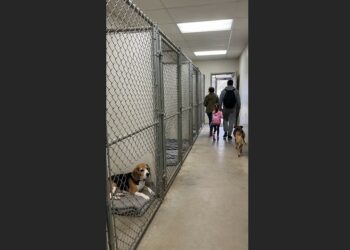
By the time the animal shelter opened its doors that morning, Ian Burke was already waiting outside.
He had not come to browse the kennels.
He already knew which dog he wanted.
Floyd.
The roughly 70-pound dog had once belonged to Ken Meyer, a disabled Vietnam veteran on Ian’s former mail route in Denton, Texas. Meyer used a wheelchair, and Floyd had been his service dog as well as his companion. When Meyer died in May 2025, Floyd was turned over to a local animal shelter.
Ian had not seen the pair regularly for more than a year because his postal route had changed.
Still, he remembered them.
So when a coworker mentioned over Memorial Day weekend that a familiar dog had ended up at the shelter, Ian asked the obvious question.
Was it Floyd?
It was.
And as soon as Floyd became available, the mail carrier who had once stopped briefly at the dog’s home to deliver letters showed up to take him somewhere new.
Their Friendship Began on an Ordinary Delivery Route
Long before anyone imagined Floyd would need another home, Ian knew him simply as one of the dogs along his route.
Their introduction was memorable.
Floyd was still young when he slipped through the doorway and charged toward the letter carrier with all the enthusiasm of an excited puppy.
There was no legendary rivalry between dog and mailman.
Quite the opposite.
Ian liked Floyd almost immediately.
He also came to know Meyer.
For roughly a year and a half, stopping at their home became a familiar part of the workday. Ian delivered the mail and checked in with the veteran and his dog before continuing along the route. The National Association of Letter Carriers later reported that Ian had first met Floyd about three years before the adoption.
Floyd made himself difficult to forget.
Floyd Was More Than a Pet to Meyer
The official USPS account described Meyer as a disabled Vietnam veteran who used a wheelchair and Floyd as his service dog.
Local reporting later offered another glimpse of their household.
Floyd’s full name was Pretty Boy Floyd, after the Depression-era outlaw, and the dog was so thoroughly part of Meyer’s life that he reportedly had his own room in the veteran’s two-bedroom apartment.
For Ian, what stood out was how much Meyer cared for him.
That memory would matter later.
At the time, however, nothing about their routine seemed temporary.
There was mail to deliver.
A man at home.
A dog eager to greet the carrier.
Then Ian’s route changed.
The Mail Route Moved On
After about a year and a half, Ian was assigned elsewhere.
Another carrier took over Meyer’s neighborhood.
That is an ordinary part of postal work.
Routes change.
Employees move.
Schedules shift.
But it meant Ian no longer had a reason to stop at the home where Floyd had once greeted him.
Life continued.
Then, in May 2025, Meyer died.
Floyd suddenly needed somewhere to go.
The Postal Service reported that after Meyer’s death, the dog was turned over to a local animal shelter.
There is no need to imagine what Floyd understood about the disappearance of the person with whom he had shared his daily life.
Dogs recognize familiar people, voices, scents, places, and routines. They notice when those things change.
What we know is simpler.
Floyd’s longtime owner was gone.
And Floyd was now at the shelter.
Ian Heard About Him Almost by Accident
The news reached Ian through another letter carrier.
Over Memorial Day weekend, he heard a coworker discussing a dog that had landed at the shelter.
The description sounded familiar.
Ian interrupted.
Was the dog Floyd?
Yes.
That answer changed his plans.
The shelter’s volunteer coordinator later recalled that once Floyd’s required hold period ended, Ian was at the front door that morning. Reports say he arrived about ten minutes before opening because he wanted to make sure he was first in line.
There was no elaborate campaign.
No long period of deliberation.
Ian knew the dog.
He knew the man who had cared for him.
And he knew he wanted Floyd to come home with him.
This Was Not a Stranger Choosing a Dog From a Kennel
That distinction is what gives the story much of its weight.
Floyd was entering another major transition.
Yet the person waiting for him was not completely new.
Ian already knew his temperament.
He had watched him grow.
Floyd knew the mail carrier’s voice, scent, and presence from repeated encounters at Meyer’s home.
That did not mean adoption would require no adjustment.
A new home is still a new home.
Routines change.
Rooms smell different.
Sleeping places move.
But Floyd would not be starting with someone whose only knowledge of him came from a kennel card.
There was already history between them.
Ian Remembered How Meyer Had Treated Floyd
That history involved more than the dog.
Ian remembered Meyer’s affection for him.
He later explained that taking Floyd felt personal because this was an animal a former customer had deeply cared for.
“I kind of felt responsible to take care of him,” Ian said in later coverage of the adoption.
He also said he believed Meyer would be pleased to know where his dog had ended up.
The thought was grounded in what Ian had seen while delivering mail.
Floyd had mattered enormously to his owner.
Now Ian had an opportunity to make sure the dog still had a stable home after Meyer was gone.
Floyd Went Home With the Mailman
The adoption happened that day.
The dog who had once watched Ian arrive with letters now left the shelter with him.
It was a reversal of their old routine.
For years, Ian had been the visitor.
He arrived.
Stopped briefly.
Then continued down the route.
Floyd remained behind with Meyer.
Now Meyer was gone.
And when Ian walked away, Floyd went with him.
The shelter’s volunteer coordinator celebrated the adoption not only because Floyd had found a home, but because his new owner was already someone connected to his previous life.
Floyd Had Clearly Made an Impression Years Earlier
Ian’s description of him after the adoption was uncomplicated.
Floyd was friendly.
Well behaved.
Social with people.
The Postal Service quoted Ian calling him an “ideal dog” and noted that Floyd seemed to treat almost everyone like a friend.
There was some uncertainty about his breed mix.
Ian suspected German Shepherd and Border Collie ancestry, though there was no definitive breed identification reported.
His behavior provided some amusing evidence for the theory.
Ian said Floyd liked gathering his toys and patrolling around the house.
Whatever breeds went into him, Ian had a simpler conclusion.
Floyd was entirely himself.
His Name Came With a Story Too
Pretty Boy Floyd is not the sort of name people forget.
Meyer had named him after the 1930s outlaw Charles “Pretty Boy” Floyd.
The irony was obvious once Ian began talking about him publicly.
This Floyd had stolen nothing more dangerous than the affection of his mail carrier.
And the relationship between the two men and the dog had formed through something as routine as mail delivery.
That is part of what made the adoption resonate with so many people once local news stations and the Postal Service shared it.
There was no dramatic rescue from a highway.
No dangerous extraction.
No months-long rehabilitation.
The critical act was showing up.
Letter Carriers Often Know More About a Neighborhood Than People Realize
A postal route is built on repetition.
The same streets.
The same porches.
The same names.
The same households changing slowly over time.
Letter carriers notice when someone who usually collects mail every afternoon stops appearing.
They learn which gates stick.
Which houses have dogs.
Which dogs bark from windows and which ones wait for a scratch behind the ears.
Ian’s connection with Floyd grew from those repeated, ordinary encounters.
He was not Meyer’s relative.
He was not initially Floyd’s caretaker.
He was the man who delivered the mail.
Yet repetition can make people part of one another’s lives in small ways.
When Meyer died, that small connection became consequential.
Ian Did Not Describe His Choice as Heroic
The attention surrounding the story surprised him.
USPS later reported that he considered helping Floyd a natural extension of what letter carriers do every day: help people in the communities they serve.
He also hoped the attention might encourage other people to consider adopting shelter dogs.
That framing matters.
The adoption did not require turning Ian into a flawless rescuer or Floyd into a helpless symbol.
A dog needed a home.
Someone who already knew him had the ability and willingness to provide one.
Ian acted.
Sometimes kindness is most durable when it is practical.
Floyd’s Story Also Carries a Harder Reminder
Pets can suddenly lose their caregivers.
Death is one reason.
Serious illness is another.
For older adults, people living alone, and anyone whose animal depends almost entirely on one person, advance planning can make a tremendous difference.
Who would take the dog?
Does that person know?
Do they have access to veterinary records?
Medication information?
Feeding routines?
Emergency contacts?
Housing permission?
Floyd was fortunate because someone from outside Meyer’s immediate household recognized his name and stepped forward.
Not every animal has an Ian waiting outside the shelter.
There Was No Need to Erase Floyd’s Previous Life
Ian did not adopt him by pretending Meyer had never existed.
Quite the opposite.
The connection to Floyd’s former owner was one reason the adoption mattered so much to him.
Meyer had loved the dog.
Ian knew that because he had seen them together.
Taking Floyd home allowed that history to remain part of the story rather than something that needed to be forgotten.
Dogs can form new attachments without erasing old ones.
People can honor someone who has died without freezing everything exactly as it was.
Floyd’s next chapter did not replace his years with Meyer.
It followed them.
A Later USPS Photograph Showed What Came Next
In August 2025, the Postal Service published a photograph of Ian sitting with Pretty Boy Floyd on his lap.
For a 70-pound dog, Floyd appeared to have little concern about whether he technically qualified as a lap dog.
The image was simple.
No shelter kennel.
No adoption counter.
No mailbag.
Just Ian and Floyd at home.
That picture captured the most important part of any adoption story.
The event itself is only the beginning.
The real outcome is what happens afterward.
Meals.
Walks.
Vet visits.
Toys under furniture.
Hair on clothes.
Ordinary evenings.
A dog settling into the place where he will sleep tonight and tomorrow.
Once, Ian Was the Person Who Always Left
That was their original relationship.
He walked toward the house carrying mail.
Floyd greeted him.
Ian talked with Meyer.
Then the carrier continued down the street.
The dog stayed home.
After Meyer’s death, those roles changed.
Floyd was the one whose old routine had ended.
Ian became the person who stayed.
It is tempting to imagine that Floyd somehow understood the full meaning of that reversal.
We cannot know that.
What he could learn was much more concrete.
This person’s house is where I sleep now.
This person fills the bowl.
This person opens the door.
This person comes back.
Home for dogs is built largely from those repeated experiences.
The Story Began With a Mail Route
Ian did not meet Floyd because he was searching for a dog.
He met him because there was mail to deliver to a veteran in Denton.
For a year and a half, those deliveries became brief visits.
Then the route changed and Ian moved on.
Had he not overheard a conversation over Memorial Day weekend, he might never have known what happened afterward.
Instead, one description caught his attention.
One question followed.
“Are you talking about Floyd?”
From there, the decision came quickly.
By the time the shelter opened, Ian was already outside.
Meyer Could No Longer Come Home to Floyd
That is the part of the story that cannot be repaired.
A good adoption does not erase a death.
Floyd’s new home cannot undo the loss of the man who cared for him.
Ian himself never suggested otherwise.
What he could do was make sure the dog Meyer had cherished did not face the next stage of life without someone willing to take responsibility for him.
That responsibility now belonged to a familiar face.
The mailman.
Floyd Did Not Have to Start Completely From Zero
He had lost the person at the center of his old household.
But when the shelter door opened, someone connected to that household was waiting.
Ian knew his name.
Knew some of his habits.
Knew how Meyer had treated him.
And remembered the energetic young dog who had once burst through a doorway to greet the man delivering the mail.
Years later, the setting was different.
There was no delivery to make.
No route to finish before moving on.
Ian had come for Floyd.
He completed the adoption and brought him home.
The story spread because the ending felt unusually fitting.
But underneath the emotion was something very ordinary.
A person remembered.
Then he showed up.
For years, Ian Burke had been the man who stopped at Ken Meyer’s home, delivered the mail, greeted Floyd, and left.
After Meyer died, Floyd needed somebody who would do something different.
This time, Ian came through the door and stayed.
And Floyd went home with him.