The phone rang at 3:47 in the morning.
Only hours earlier, a woman had brought home a gentle Pit Bull named Mochi from a local animal rescue. The arrangement was supposed to be temporary. She would care for the dog for a couple of weeks, perhaps three, while the organization looked for a permanent home.
Mochi had been quiet throughout her first evening.
She had soft, velvety ears and expressive eyes, and she seemed content to remain close to her foster caregiver without demanding much attention.
But when the phone rang, Mochi wasn’t sleeping.
She was lying at the foot of the bed, wide awake, staring toward the bedroom door.
The woman answered.
“I’m sorry for calling this late.”
It was the rescue coordinator.
Her voice sounded exhausted.
She explained that Mochi’s sister, Matcha, had been struggling since the two dogs were separated.
Matcha had been crying for hours.
Staff had tried giving her familiar blankets, toys, and calming wraps. They had even provided bedding carrying Mochi’s scent.
Nothing seemed to help.
The distressed dog had paced inside her kennel until her paws became sore. She had repeatedly tried to get out, eventually breaking a tooth against the kennel.
The coordinator was worried.
Mochi’s foster caregiver looked down at the dog lying near her bed.
Mochi was still staring toward the door.
The woman made her decision.
She got dressed as quickly as she could, grabbed her keys, and headed outside.
By approximately 4 a.m., she was driving back to the shelter in her pajamas.
She had agreed to foster one dog.
But another dog needed her.
And neither sister seemed ready to be without the other.
One Foster Dog, One Temporary Arrangement
The woman had not intended to adopt a dog when she agreed to take Mochi home.
She was helping a rescue organization by providing temporary care.
Foster homes serve an important role in animal rescue.
They provide a place for dogs to live outside a shelter while staff arrange veterinary treatment, evaluate behavior, or search for permanent adopters.
For some dogs, a home environment offers an opportunity to settle away from the activity of crowded kennels.
For others, fostering helps rescuers learn more about their personalities and daily needs.
The woman understood that arrangement.
She would give Mochi a safe place to stay, keep her comfortable, and help prepare her for the next stage of her life.
She expected their time together to be brief.
A couple of weeks seemed manageable.
Three weeks, at most, was what she kept telling herself.
Mochi’s arrival was quiet.
The dog did not rush through the house or demand constant attention.
She remained cautious, observing her new surroundings and the person who had brought her home.
Her foster caregiver noticed her soft ears and gentle expression.
She also noticed how frequently Mochi watched the door.
At first, the behavior seemed understandable.
The dog had just entered an unfamiliar home.
She might simply have been waiting to see what happened next.
The woman had no reason to imagine that another dog, back at the shelter, was experiencing an increasingly serious crisis.
The Sister Who Stayed Behind
Mochi had a sister named Matcha.
The two Pit Bulls had shared a close relationship before the foster placement.
The available account does not describe their entire history.
It does not establish how long they had been in rescue care or what circumstances originally brought them to the shelter.
But it does make clear that the sisters were accustomed to being together.
When Mochi left, Matcha remained behind.
For some dogs, separation from a familiar companion causes relatively little visible distress.
Others struggle considerably.
Dogs can develop strong social attachments through repeated positive experiences, shared routines, and time spent resting or interacting together.
A familiar companion may become an important part of the animal’s daily environment.
When that companion suddenly disappears, the remaining dog may experience uncertainty or distress.
Matcha’s reaction was immediate and intense.
She began vocalizing after Mochi left.
Her cries continued.
The shelter staff tried to help her settle, but she remained agitated.
She paced.
She struggled to rest.
As the hours passed, the employees became increasingly worried.
This was no longer simply a dog protesting a change in routine.
Matcha was showing signs of significant distress, and her attempts to escape the kennel were putting her at risk of physical injury.
The Staff Tried Everything They Could
The rescue workers did not ignore Matcha’s behavior.
They attempted several ways to make her more comfortable.
They offered bedding carrying Mochi’s scent, hoping the familiar smell might provide reassurance.
They provided toys.
They tried calming wraps intended to offer gentle, consistent pressure.
But Matcha continued crying.
She moved repeatedly around her kennel, unable to settle for long.
Her paws became raw from the constant pacing.
Her vocalizations grew hoarse.
Then she injured herself while trying to get out.
She broke a tooth against the kennel.
That injury made the situation more urgent.
A broken tooth can expose sensitive structures and cause significant pain, even when a dog continues behaving normally in other ways.
Veterinary assessment is important because some dental fractures require treatment that cannot be determined simply by looking at the animal.
Matcha now needed attention for both her physical injuries and the distress that appeared to be driving her behavior.
Shelter employees were concerned that another night in the same state could cause additional harm.
They had already tried familiar objects and other calming measures.
Nothing had been sufficient.
Eventually, the rescue coordinator decided to call the woman who had taken Mochi home.
It was an unusually late hour.
But the situation no longer felt like something that should wait until morning.
The Call at 3:47 A.M.
When the foster caregiver answered her phone, she heard the exhaustion in the coordinator’s voice.
The woman listened as the staff member explained what had happened.
Matcha had not stopped crying since Mochi left.
She had become so distressed that she injured her paws and damaged a tooth while attempting to escape.
The coordinator described the blankets, toys, and other measures staff had already tried.
The foster caregiver knew the call wasn’t being made casually.
Rescue workers were asking for help because they were worried about an animal in their care.
She looked toward the foot of her bed.
Mochi was awake.
The Pit Bull’s eyes were open, and she was watching the door.
The woman had noticed her quietness earlier in the evening, but now it felt different.
Was Mochi also unsettled by the separation?
She couldn’t know for certain.
Dogs may remain alert in unfamiliar homes for many reasons, especially during their first night.
Still, the contrast was striking.
One sister was crying and pacing at the shelter.
The other was lying awake in a strange bedroom.
The woman thought about the fact that she had agreed to foster only Mochi.
Then she thought about Matcha’s injuries and the fear described over the phone.
There was no lengthy discussion.
She decided to go back.
A Drive Through the Darkness
By approximately 4 a.m., the woman was on her way to the shelter.
She was still wearing her pajamas.
There had been no time to plan a proper visit or think through every practical detail.
Her immediate concern was reaching Matcha.
Mochi was brought along so the sisters could be reunited under the rescue staff’s supervision.
The roads were quiet at that hour.
Most people were still asleep.
But at the shelter, employees were dealing with a dog who had been unable to settle after losing contact with her familiar companion.
The foster caregiver had agreed to care for one animal temporarily.
Now she was driving through the early morning darkness with the possibility of bringing home two.
She did not yet know whether the reunion would help.
The dogs might respond differently after separation.
Matcha could remain distressed despite Mochi’s presence.
Her injuries would still require attention, regardless of how quickly her behavior changed.
But reuniting the sisters was something the rescue could try while arranging appropriate care.
The woman understood that both dogs might need more support than she had originally expected.
She kept driving.
Matcha Was Barely Able to Settle
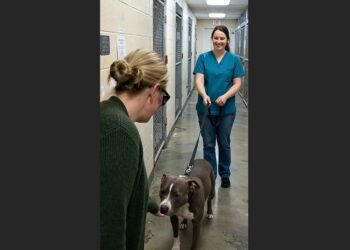
When the woman reached the shelter, she saw how difficult the night had been for Matcha.
The Pit Bull appeared exhausted.
Her voice was nearly gone from prolonged crying.
Her paws were sore from pacing.
She was trembling and having difficulty settling in her kennel.
The foster caregiver had heard the coordinator describe the situation, but seeing Matcha was different.
The animal’s distress was visible.
This was not a dog who had simply become bored because her sister had gone home with someone else.
She had been moving and vocalizing for hours, and she had injured herself in the process.
The rescue workers were trying to keep her safe.
They needed to address the broken tooth and injured paws, but they also hoped that contact with Mochi might help reduce her agitation.
The foster caregiver approached with the same care she would use around any frightened or distressed animal.
She did not assume that Matcha would immediately welcome handling from an unfamiliar person.
Instead, staff arranged for the sisters to encounter one another safely.
Mochi was nearby.
Then Matcha appeared to detect her presence.
The Moment She Caught Mochi’s Scent
Mochi was still in her transport crate when Matcha became aware of her.
The distressed dog moved toward the crate.
She leaned forward, investigating.
Then her movements changed.
The frantic pacing stopped.
For a moment, she became still.
The staff watched closely.
Matcha appeared to settle as she recognized something familiar.
It was a marked contrast with the agitation she had shown throughout the night.
The account describes the change as though she could finally breathe comfortably again.
The visible behavior was simpler: she stopped moving frantically and directed her attention toward Mochi.
Dogs rely heavily on scent to recognize familiar individuals.
A companion’s odor may remain recognizable even after time apart, although scent alone does not guarantee that every distressed dog will become calm.
In Matcha’s case, the encounter appeared to make an immediate difference.
The rescue staff saw the contrast.
One employee quietly described the sisters as bonded.
It was a word that carried practical significance.
The two dogs were not merely animals who happened to be housed in the same shelter.
Their behavior suggested that separation was causing considerable distress, particularly for Matcha.
The foster arrangement needed to be reconsidered.
“Could You Keep Them Together for a Few Days?”
The rescue workers asked the foster caregiver whether she could take Matcha home too.
They weren’t requesting a permanent adoption.
Not yet.
The idea was to keep the sisters together temporarily while the rescue figured out what to do next.
Could she manage both dogs for a few days?
The woman had come expecting to help with an immediate problem.
She had originally planned to foster only Mochi.
Now she was being asked to provide space for two Pit Bulls who appeared strongly attached to one another.
The responsibility would be greater.
There would be twice as many meals to prepare and more daily care to organize.
She would need to observe their interactions, make sure both animals were comfortable, and coordinate with the rescue about Matcha’s injuries.
But she had also seen what happened when Matcha became aware of Mochi.
The distress that had continued through the night seemed to ease.
The woman agreed.
She would take both sisters home.
For a few days.
That was the arrangement.
The rescue could evaluate their needs, and the foster caregiver could provide a stable environment while everyone considered the next step.
Nobody knew yet that the few days would become something much longer.
Two Dogs Arrive at the Same Home
Bringing both sisters home changed the atmosphere.
Mochi was no longer the only dog adjusting to unfamiliar surroundings.
Matcha was beside her.
The two Pit Bulls could share the same rooms, familiar scents, and quiet routines.
Their foster caregiver provided places for them to rest and made sure they had access to food and water.
Matcha’s injured paws and damaged tooth still required appropriate veterinary attention.
The reunion did not erase those physical problems.
But the woman noticed that the sisters appeared more comfortable when they were together.
They frequently chose to rest close to one another.
Their shared presence seemed to help them settle into the new environment.
The foster caregiver began learning their individual behaviors.
Although the dogs were closely attached, they were not identical.
Each had her own preferences and reactions.
Caring for them meant paying attention to both as individuals rather than treating them as a single animal.
The original agreement remained temporary.
The woman had simply agreed to keep the sisters together while the rescue decided what should happen next.
But as the days passed, the household began developing a rhythm around them.
The First Few Days Become a Routine
The foster caregiver soon discovered that Mochi and Matcha preferred staying close.
If one moved into another room, the other often followed or waited for her return.
When they rested, they settled near each other.
Sometimes they curled their bodies together.
The woman had prepared separate resources for them.
That included separate food bowls.
Yet the sisters sometimes chose to approach the same bowl.
Their foster caregiver found the habit amusing, although sharing food was something she needed to monitor to ensure both dogs received enough to eat and neither felt pressured.
The dogs’ close relationship did not mean they had to share everything.
Each still needed access to food, water, rest, and individual attention.
But their behavior made it clear that proximity to one another was important to them.
The woman began arranging daily activities with that in mind.
She watched how they responded when one left the room.
She noticed how easily they settled when they were together.
And she started appreciating the small habits that made the sisters distinctive.
What had begun as a late-night emergency was becoming part of ordinary household life.
A Bond That Couldn’t Be Ignored
As the foster period continued, the woman’s understanding of the sisters changed.
At first, she had thought of Mochi as the dog she had agreed to foster.
Matcha was the dog she had brought home because the shelter needed urgent help.
But the two were closely connected.
Their history together influenced how they behaved in the new home.
Dogs may form strong attachments to companions they have lived with over time.
Those relationships can involve shared play, mutual familiarity, resting together, and preferences for remaining nearby.
Some pairs become distressed when separated.
Others maintain close relationships while tolerating periods apart.
Mochi and Matcha appeared to belong to the first group.
At the shelter, Matcha’s separation-related behavior had become severe enough to cause injuries.
At home, both dogs showed a strong preference for staying together.
The foster caregiver understood why the rescue staff had hesitated to separate them again.
If permanent adoption was eventually considered, placing them together would be an important factor.
Still, their bond did not remove the need to ensure both dogs could remain healthy and comfortable.
Severe separation distress can sometimes require veterinary or behavioral support, particularly when an animal risks injuring itself.
The woman was learning that caring for these sisters involved honoring their relationship while attending to each dog’s individual welfare.
The Weeks Begin to Pass
The temporary arrangement continued.
The woman had originally expected to foster Mochi for two or three weeks.
Then she had agreed to keep Matcha for only a few days.
But the sisters remained together in her home.
The days became weeks.
The weeks gradually became months.
The woman settled into the responsibilities of caring for two dogs.
There were feeding routines and daily outings.
There were veterinary appointments and grooming arrangements.
She learned how the sisters behaved in unfamiliar situations and what helped them remain comfortable.
They often preferred to be together during appointments.
Their caregiver took that preference seriously while following whatever handling arrangements the professionals considered appropriate.
At home, the dogs developed their own routines.
They knew where to rest.
They knew the familiar sounds of the household.
They were no longer spending their days in a kennel awaiting the next placement.
The home that had been intended as a brief stop became the place where their everyday lives unfolded.
The woman hadn’t planned for this.
But she was no longer thinking about the arrangement in quite the same way.
Eight Months Later, They’re Still Together
Eight months passed after the early-morning call.
Mochi and Matcha were still living in the same home.
The woman who had agreed to foster them temporarily had become their permanent caregiver.
There had been no new family waiting at the end of the arrangement.
The sisters had already found the place where they would stay.
Their routines were familiar.
They often slept curled around each other.
Their bodies rested close, sometimes appearing almost like one dog beneath the blankets.
The sight reminded their caregiver of how frightened Matcha had been during that first night apart.
Now she could watch both dogs sleeping peacefully.
They had separate bowls, but sometimes still chose to eat close together.
They preferred attending appointments without being separated unnecessarily.
And when one sister moved out of sight, the other often waited.
Those habits had become part of family life.
The woman knew their personalities and the ways they interacted.
She had not adopted them because she originally intended to bring home two dogs.
She had kept them because, after caring for them together, she could no longer imagine asking either one to begin another unfamiliar transition.
The foster home had become permanent.
The Difference Between Fostering and Staying
The woman’s original decision had been practical.
A rescue organization needed a temporary home for Mochi.
She had room and was willing to help.
She expected the dog to stay for a short time before moving on.
That is often how fostering works.
Someone provides a stable environment while an organization makes longer-term arrangements.
The foster caregiver knows that saying goodbye may eventually be part of the responsibility.
But sometimes a foster relationship develops in an unexpected direction.
The caregiver discovers that the dog fits naturally into the household.
The animal becomes comfortable with familiar routines.
And what began as temporary care gradually becomes a permanent commitment.
In this case, the development involved two dogs rather than one.
Mochi and Matcha had arrived through separate circumstances.
One came through a planned foster placement.
The other arrived after an urgent phone call in the middle of the night.
Their caregiver had not expected either arrangement to last eight months.
But the dogs became part of her everyday life.
She learned what they needed.
And eventually, the distinction between fostering and adopting no longer described what was happening.
They were home.
Why Keeping Bonded Dogs Together Can Matter
Not every pair of dogs who live together must be adopted together.
Some animals are friendly companions but adjust well to separate homes.
Others develop relationships that make separation particularly distressing.
Determining whether two dogs should remain together requires observing their behavior over time and considering their individual welfare.
Mochi and Matcha had shown several signs of a strong attachment.
Most notably, Matcha experienced intense distress after Mochi was taken away.
Her crying, pacing, and attempts to escape had become serious enough to cause injuries.
Later, when the sisters were reunited, Matcha appeared to calm substantially.
In their foster home, they continued showing a strong preference for proximity.
Those observations supported the decision to keep them together.
But a close bond should not be romanticized at the expense of the animals’ health.
A dog who becomes severely distressed whenever a companion is absent may benefit from a professional assessment and a careful plan to improve its ability to cope with ordinary separations.
Veterinary visits, emergencies, and other circumstances can sometimes make brief separations unavoidable.
The goal is to preserve the dogs’ welfare while helping them remain comfortable and secure.
For Mochi and Matcha, the most immediate priority had been ending a separation that was causing visible harm.
Their foster caregiver provided that opportunity.
The Night That Changed Everything
The woman sometimes thinks about the phone call.
She remembers the time on the screen.
3:47 a.m.
She remembers the rescue coordinator apologizing for calling so late.
Then came the explanation.
Matcha had been crying.
The staff had tried everything they could think of.
Her paws were injured, and she had broken a tooth trying to get out of the kennel.
The woman remembers looking down and seeing Mochi awake at the foot of her bed.
She had brought the Pit Bull home only hours earlier.
The dog was supposed to stay temporarily.
There was no reason, at that moment, to imagine an eight-month future with both sisters.
The woman simply knew that another animal needed help.
So she got her keys.
She drove back to the shelter.
And she agreed to keep the dogs together for a few days.
That decision seemed small compared with the responsibilities that eventually followed.
But it was the beginning of everything.
Without it, Matcha might have remained distressed while the rescue searched for another solution.
Mochi might have continued adjusting to a home without her familiar companion.
Instead, the sisters were reunited.
And their temporary caregiver began discovering what life with both of them could be.
Two Sisters, One Familiar Place
Today, Mochi and Matcha have a shared routine.
They rest near one another.
They follow familiar household movements.
They often choose to remain close, whether they are sleeping or simply spending time in the same room.
Their caregiver has learned to expect it.
If she looks for one dog, the other is usually nearby.
Their closeness no longer surprises her.
It is simply part of their household.
The woman also knows that their relationship began long before she met them.
She does not know every experience that shaped their attachment.
She cannot explain precisely why Matcha reacted so strongly to being separated from Mochi.
But she witnessed the distress.
She saw the change when the dogs encountered each other again.
And she has watched them continue living comfortably together.
Her home was originally intended to be a stop along the way.
A safe place before a permanent adopter was found.
Instead, it became the place where both dogs settled.
The temporary arrangement turned into a lasting commitment.
The Foster Home Became Their Final Stop
Eight months after the call, the woman no longer thinks of Mochi and Matcha as guests.
They are her dogs.
They have familiar places to sleep and daily routines built around their needs.
They receive care as individuals, but they remain closely connected.
Their caregiver remembers the exhausted shelter staff who asked whether she could keep the sisters together for just a few days.
She remembers Matcha trembling in the kennel.
She remembers bringing Mochi back and watching the distressed dog grow still as she became aware of her sister.
Those moments were frightening at the time.
But they led to a different future.
The woman had offered temporary care because a rescue needed help.
She had not planned to become the permanent home for two bonded Pit Bulls.
Yet that is what happened.
And now, when she sees the sisters curled together at night, she understands how much their lives have changed since the first separation.
Mochi is no longer a foster dog waiting for another placement.
Matcha is no longer crying in a kennel, trying desperately to reach her companion.
They have a home where both are welcome.
They Didn’t Need Another Goodbye
The story began with one dog arriving at a foster home and another remaining behind.
For Mochi, the new house was unfamiliar.
For Matcha, the sudden separation was overwhelming.
By 3:47 the following morning, shelter staff were worried enough to call for help.
The foster caregiver answered.
She looked at Mochi, awake near her bed.
Then she went back.
It was a decision made without knowing how the story would unfold.
At the time, the rescue only asked whether she could take Matcha for a few days.
The woman agreed because she wanted to help two dogs through a difficult situation.
Eight months later, those same dogs were still together.
They had become familiar with her household.
They had their own routines, their preferred places to rest, and a caregiver who understood how important their relationship was.
There was no need for another adoption announcement or another farewell at the shelter.
The woman who was supposed to help them temporarily had decided they could stay.
And each night, when Mochi and Matcha settle close together, their caregiver is reminded of that first early-morning call.
A frightened dog had been crying for her sister.
Someone had answered the phone.
And two animals who had been separated were given the chance to remain together.
The woman had believed she was offering them a temporary place to stay.
Instead, she became the person who could finally give them both a home.
Editor’s Note: The characters in this story are fictional. Through these stories, we hope to share the intelligence, loyalty, compassion, and loving nature of dogs with people everywhere.