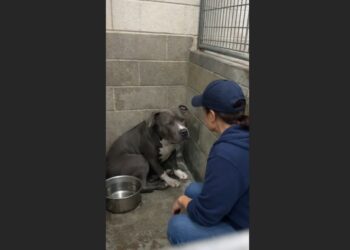
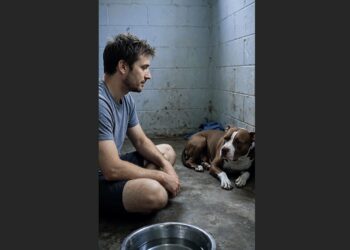
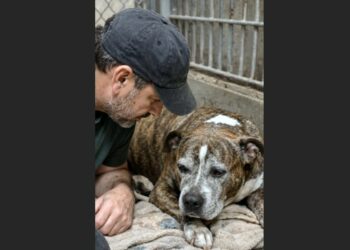
The black shepherd mix lay in the farthest kennel at Pine Creek Animal Shelter, his body curled tightly around an old brown blanket.
He wasn’t barking.
He wasn’t jumping against the gate or trying to attract visitors.
He simply watched the people walking past, shifting his body whenever someone came too close to the blanket beneath him.
His name was Morrow.
He was approximately six or seven years old, with gray beginning to appear around his muzzle.
The blanket was worn thin, and one corner had been repaired by hand with blue thread that didn’t match the original fabric.
To anyone passing his kennel, it probably looked like an ordinary piece of bedding.
But Morrow treated it differently.
He kept one paw pressed against it, and whenever someone approached, he moved his body to cover more of the fabric.
The man standing outside his kennel had come to the shelter looking for an easy dog.
He wanted someone calm, friendly, and uncomplicated.
After losing his father, he had been struggling with the silence of his house. He thought adopting a dog might help him build a new daily routine.
The shelter had already introduced him to a cheerful yellow Labrador mix named Jasper.
Jasper seemed perfect.
But something about Morrow made the visitor stop.
When he asked to meet the shepherd, three shelter employees suddenly looked uncomfortable.
One volunteer explained that Morrow wasn’t a dog they usually recommended.
Then the shelter director approached and revealed something that changed the entire conversation.
Morrow’s previous owner had died.
And the battered blanket beneath him was the last familiar possession he had brought from the home they once shared.
A House That Had Become Too Quiet
The man hadn’t gone to Pine Creek Animal Shelter looking for an emotional challenge.
He was already carrying enough sadness.
His father had died, leaving behind a loss that seemed to affect every ordinary part of the day.
The house felt different now.
There was too much space and not enough activity.
He could go about his responsibilities, prepare meals, and move from one room to another, but the quiet followed him.
Other people sometimes described living alone as freedom.
He understood what they meant.
There was nobody else to consider when making plans, and no one interrupting his routines.
But the freedom didn’t feel particularly comforting when he sat down to dinner.
He missed having another presence in the house.
Eventually, he began thinking about adopting a dog.
He wasn’t expecting an animal to replace his father or make the grief disappear.
He simply wanted companionship.
A reason to get outside regularly.
Someone waiting at home.
A living creature whose needs might bring a little structure back into his days.
He checked his finances and considered what he could manage.
That Thursday, he had $4,800 in his bank account and an adoption form tucked inside his coat.
He had made up his mind about one thing.
He wanted the calmest, easiest dog the shelter had.
He had no idea how much that plan was about to change.
Jasper Seemed Like the Perfect Choice
The shelter was busy when he arrived.
Metal bowls clanged in the kennel area.
Leashes scraped across the floor.
Volunteers moved between animals, answering questions and carrying supplies.
Near the cat area, someone laughed over the surrounding noise.
The air carried the familiar mixture of disinfectant and damp fur.
For the visitor, it was an overwhelming environment, particularly after so many quiet evenings at home.
He explained what he wanted.
A friendly dog.
One who wouldn’t require complicated behavioral work.
An animal who could settle comfortably into a peaceful household.
The staff understood.
They quickly suggested Jasper, a young yellow Labrador mix.
Jasper had an appealing combination of qualities.
He was friendly, already trained, and comfortable approaching people.
His coat was clean, and someone had tied a red bandana around his neck.
When the man stopped to meet him, Jasper’s tail began wagging immediately.
He looked like a dog who would happily walk through a front door and begin making himself at home.
The visitor was impressed.
This was exactly the kind of companion he had imagined.
For a moment, he considered completing the adoption without meeting anyone else.
But before deciding, he wanted to walk through the rest of the kennels.
That was when he noticed the shepherd at the end of the row.
The Dog Who Watched His Hands
Morrow was almost the opposite of Jasper.
He didn’t rush toward the gate.
He didn’t attempt to greet the visitor.
He remained curled around his blanket, quietly watching.
The man stopped.
What caught his attention wasn’t simply the dog’s stillness.
It was where Morrow directed his gaze.
He watched the visitor’s hands.
When someone passed the kennel, Morrow shifted slightly, positioning more of his body over the blanket.
He didn’t bare his teeth.
He didn’t snap at the bars.
He didn’t even growl.
But his movements were deliberate.
Every time someone approached, the shepherd seemed intent on keeping the blanket beneath him.
The visitor remained outside the kennel, observing.
He could see that Morrow was older than some of the dogs nearby.
Gray fur framed his muzzle.
His expression was cautious, and his body stayed close to the ground.
The man had originally wanted a dog who would make adoption easy.
Morrow clearly wasn’t offering that kind of immediate welcome.
Still, he couldn’t bring himself to walk away.
There was something about the way the shepherd held onto that old blanket.
He wanted to understand it.
“He’s Not Really One We Recommend”
A volunteer named Kendra approached from behind.
When she noticed which kennel had caught the visitor’s attention, her expression changed.
“He’s not really one we recommend,” she said.
The man looked toward her.
The wording troubled him.
Kendra hadn’t said Morrow was unavailable.
She hadn’t said he was already adopted.
She simply seemed reluctant to introduce him to a potential owner.
The man asked for his name.
“Morrow.”
Then he asked about the blanket.
Kendra gave a brief, uneasy laugh.
“He came in with it. Gets… strange if anyone touches it.”
The man looked back at Morrow.
The shepherd remained curled around the brown wool, one paw resting firmly against it.
The word strange didn’t explain much.
Was Morrow frightened?
Did he guard the blanket because someone had repeatedly taken it away?
Was he possessive of his bedding, or was there something about this particular object that mattered?
The visitor crouched near the kennel bars.
Morrow lifted his head.
For a moment, the man expected him to move away.
Instead, the dog leaned forward just enough to brush his nose against the man’s hand.
Then he settled back over his blanket.
At the far end of the aisle, a kennel technician paused while mopping the floor.
The visitor noticed the employee watching them.
He asked whether he could meet Morrow properly.
Kendra hesitated.
The Blanket With Blue Stitches
Eventually, Kendra opened the kennel.
The man entered carefully, taking care not to crowd the dog.
Morrow didn’t rise to greet him.
He remained on the floor, his paw resting across the folded brown blanket.
Up close, the fabric looked even older.
It was made of wool, worn thin from years of use.
One corner had torn at some point and been stitched together by hand.
The repair thread was blue, noticeably different from the blanket’s original color.
The visitor found himself wondering who had sewn it.
There was nothing expensive or decorative about the blanket.
It looked like something that had been used for years because someone found it comfortable or familiar.
Morrow kept it close.
When the man shifted nearer, the dog pressed his paw more firmly into the fabric.
The movement was small but unmistakable.
The visitor stopped approaching.
He didn’t try to move the blanket.
He didn’t reach beneath Morrow or attempt to persuade him to leave it.
Then a voice came from the doorway.
“I wouldn’t do that.”
The shelter director was standing there, watching the interaction.
He had noticed the man’s interest in Morrow.
And he understood something about the dog that the visitor hadn’t yet been told.
The Story Behind Morrow’s Blanket
The director explained how Morrow had arrived at the shelter.
His previous owner had died.
After the death, Morrow had been found alone inside the house.
The blanket was with him.
It was the one familiar possession he had brought into the shelter, and staff believed it retained the scent of the person he had lived with.
The director explained that attempts to remove the blanket had caused Morrow considerable distress.
He became withdrawn and difficult to engage.
The staff had eventually learned to leave the fabric where he wanted it.
That explanation changed the way the visitor understood the shepherd’s behavior.
Morrow hadn’t arrived at the shelter as a dog with no history.
He had lived with someone.
He had known a home, a familiar person, and the daily routines they shared.
Then that life had ended.
The dog had been moved into an environment full of unfamiliar people, noises, and smells.
Through the change, he had kept the blanket close.
The visitor looked down at the worn wool.
He thought about his own father’s death.
He knew what it felt like to hold onto familiar possessions after losing someone.
He understood how an ordinary object could become important because of the person associated with it.
Morrow’s experience couldn’t be assumed to match human grief exactly.
But the dog’s attachment to the blanket was visible.
And the man suddenly found it difficult to think of him as an unsuitable adoption candidate.
“I’m Here to Take Both of You”
The man remained beside Morrow.
He didn’t reach for the blanket.
He didn’t attempt to persuade the shepherd to leave it behind.
Instead, he looked toward the shelter director.
“I’m not here to take it,” he said quietly.
Then he looked at the dog.
“I’m here to take both of you.”
The words seemed to surprise the employees.
Only a short time earlier, he had explained that he wanted an easy, uncomplicated companion.
Jasper had appeared to meet every requirement.
Morrow was older, cautious, and deeply attached to an object that staff had learned not to disturb.
There might be difficulties ahead.
The dog could need time to adjust to unfamiliar surroundings.
He might continue guarding the blanket.
He might require careful management if someone approached his belongings.
None of that made him the obvious choice.
But the visitor no longer felt comfortable judging Morrow only by how he behaved inside the kennel.
The shepherd had experienced a significant loss.
And the man was beginning to recognize something familiar in that experience.
He had come looking for companionship after his father’s death.
Morrow had lost the person who once cared for him.
Perhaps they could find comfort in sharing a home.
The decision wasn’t purely practical.
But it wasn’t thoughtless either.
The man understood that bringing Morrow home would require patience.
He was willing to provide it.
Adopting a Dog Who Needed Time
Before the adoption could be completed, the shelter needed to discuss Morrow’s behavior and care.
A dog who protects a valued object may show signs of resource guarding, especially when he feels uncertain about the intentions of nearby people.
That doesn’t automatically mean he is dangerous.
But it does require appropriate handling.
The safest approach is not to challenge the dog repeatedly or forcibly remove the object simply to establish control.
Instead, caregivers should provide space, avoid unnecessary confrontation, and seek professional guidance if the guarding becomes difficult to manage.
The man understood that he would need to respect Morrow’s boundaries while helping him adjust.
He also needed to think about the dog’s age and general care.
At approximately six or seven, Morrow was mature but not necessarily elderly.
He would still need exercise, veterinary attention, appropriate food, and opportunities to engage with his surroundings.
The visitor was prepared to make room for those responsibilities.
He hadn’t expected to adopt a dog with an uncertain adjustment period.
But he could offer a quiet home.
He could establish predictable routines.
And he could let Morrow keep the blanket that seemed so important to him.
The adoption proceeded.
Morrow would be leaving the shelter.
And the brown wool blanket would be leaving with him.
The First Evening in a New House
Bringing Morrow home did not produce an immediate transformation.
The shepherd didn’t race through the rooms or behave as though he understood that his new placement was permanent.
He entered cautiously.
He observed the unfamiliar space.
Then he found a corner of the living room and settled there with his blanket.
The man had prepared a place for him to rest, but he didn’t insist that Morrow use it immediately.
The dog had chosen his own spot.
For now, that was enough.
The first evening was quiet.
Morrow remained close to the folded wool.
He watched the man move around the house.
When someone came near, he appeared especially attentive to the blanket.
His new owner didn’t test the behavior.
He didn’t try to take the fabric away.
Instead, he went about his usual activities.
He prepared dinner.
He moved through the house without expecting Morrow to follow.
And when the evening settled, he sat nearby.
The house was no longer completely empty.
There was a dog resting in the living room.
But the man understood that sharing a room was only the beginning of building a relationship.
Morrow needed time to become familiar with him.
Two Different Kinds of Loss
During the early days, the man sometimes thought about the similarities between their circumstances.
His father had died.
Morrow’s previous owner had died.
Both had experienced the disappearance of someone who had been part of everyday life.
But the man also understood that their experiences were different.
He could remember conversations with his father.
He could talk about the loss and explain what had happened.
Morrow could not.
A dog cannot tell a new caregiver what it remembers about a previous home or how it experiences the absence of a familiar person.
Dogs form attachments through repeated experiences, familiar routines, and interactions with the people who care for them.
When those relationships change, their behavior may change too.
Some become more withdrawn.
Others seek additional attention.
Still others may become attached to familiar objects or places.
It wasn’t possible to know exactly what Morrow understood about his owner’s death.
But the blanket appeared to have special significance for him.
The man didn’t need a complete explanation to respect that.
He knew what it felt like to struggle after a loss.
And he knew that being pushed to move on before he was ready had never helped him.
So he decided not to rush Morrow either.
The Blanket Remained His Safe Place
For the first few weeks, Morrow spent much of his time in the living room.
The brown blanket remained close.
He rested on it, curled around it, and watched the household from his chosen spot.
The man kept the environment calm.
He provided regular meals and opportunities to go outside.
He spoke gently and allowed Morrow to approach when he felt comfortable.
Sometimes the dog watched him from across the room.
At other times, Morrow seemed content to remain on the blanket without interacting.
The man did not interpret that as rejection.
He had learned enough about the shepherd to understand that unfamiliar situations made him cautious.
Forcing contact could make the adjustment more difficult.
Instead, he tried to become a predictable presence.
The dog would see him preparing meals, sitting in the living room, and moving through familiar routines.
Nothing dramatic happened.
There were no sudden breakthroughs.
But gradually, Morrow appeared more settled.
He began paying attention to the man for reasons unrelated to the blanket.
He watched when dinner was being prepared.
He responded to familiar household sounds.
And he became increasingly willing to remain relaxed while his owner moved around the room.
The relationship was developing quietly.
Why Familiar Objects Can Matter After Loss
Morrow’s attachment to the blanket became one of the most important parts of his new owner’s understanding of him.
People sometimes regard a dog’s bedding as interchangeable.
If one blanket becomes dirty or worn, another can be purchased.
But familiar objects may carry sensory information that makes them meaningful to an animal.
Dogs rely heavily on scent when recognizing people, places, and other animals.
A blanket that has remained in a household for years can retain familiar odors.
The shelter director believed Morrow’s blanket still carried the scent of his previous owner.
That was a reasonable possibility, although the exact reason for the dog’s attachment could not be established.
Morrow might also have associated the blanket with rest, safety, or repeated experiences in his former home.
What mattered was his visible response to it.
He became protective when people approached.
He was distressed when staff attempted to remove it.
And in his new home, he continued choosing to remain near it.
The man saw no benefit in taking it away merely because it looked old.
The fabric was worn and imperfect.
But it belonged to Morrow’s history.
The new owner decided that the blanket could remain part of his future as well.
The Evening Morrow Carried It Across the Room
One evening, after several weeks in the house, something changed.
The man was sitting in the living room.
Morrow had been resting in his usual corner, close to the brown blanket.
There was nothing unusual about the evening.
The house was quiet, and the man was occupied with his own thoughts.
Then he noticed movement.
Morrow had stood up.
He was carrying the folded blanket in his mouth.
The man watched as the shepherd crossed the room.
He didn’t call him.
He didn’t reach toward the fabric.
He simply waited.
Morrow approached the chair.
Then he lowered his head and placed the blanket at the man’s feet.
For a moment, he stood there.
The old wool lay between them, its blue-stitched corner visible.
The man remained still, uncertain what Morrow would do next.
Then the shepherd stepped closer.
He lowered his head.
And rested it gently against the man’s knee.
It was the first time Morrow had brought the blanket to him.
For weeks, the dog had kept the object close and protected it from anyone who approached.
Now he had carried it across the room himself.
The man slowly reached down and touched the side of Morrow’s face.
The shepherd stayed.
A Quiet Gesture That Meant Everything
The man didn’t know exactly why Morrow had brought the blanket over.
He couldn’t claim that the dog had consciously decided to share a treasured memory.
Nor could he know whether Morrow understood the emotional significance of the gesture.
But he knew what he had observed.
The dog who previously remained curled protectively around the blanket had voluntarily carried it to him.
Then Morrow had sought physical contact.
That was a meaningful change.
It suggested the shepherd was becoming more comfortable with his new caregiver and less concerned about keeping the blanket away from him.
The man rested his hand against Morrow’s head.
He didn’t try to pick up the wool.
He didn’t need to.
For weeks, he had been careful not to make their relationship depend on the dog surrendering something important.
Now Morrow was approaching him on his own.
The blanket remained exactly where the dog had placed it.
The room was quiet.
And for the first time since the adoption, the man felt that Morrow wasn’t simply tolerating his presence.
He was choosing to be close.
The moment didn’t erase either one’s history.
But it marked the beginning of something new.
Learning to Trust Without Forgetting the Past
After that evening, Morrow continued becoming more comfortable in the house.
The changes were gradual.
He began leaving his favorite corner more often.
Sometimes he followed his owner from one room to another.
At other times, he remained resting in the living room while the man moved elsewhere.
The blanket was still important to him.
He often chose to sleep beside it.
But he no longer seemed to need it within reach every moment.
Occasionally, he left it untouched while exploring another part of the house.
The man noticed these changes without making too much of them.
He understood that confidence can develop slowly, particularly after a dog has experienced major changes in its living circumstances.
A stable home doesn’t erase earlier experiences.
And one affectionate interaction does not guarantee that every behavior concern has disappeared.
Morrow might still become uncomfortable if someone tried to take the blanket abruptly.
His owner continued respecting that possibility.
But the relationship was growing.
They were beginning to share familiar daily routines.
The shepherd knew where he was fed.
He recognized the man’s movements around the house.
And the man was learning Morrow’s preferences.
Neither had expected the other to become part of his life.
Yet they were finding a way to live comfortably together.
The House Began Feeling Different
Months after the adoption, the man noticed something about his home.
It no longer felt quite so large.
The rooms were physically unchanged.
The furniture stood where it always had.
His father’s absence remained part of his life.
But the house had another living presence in it now.
Morrow moved through the rooms with growing confidence.
He rested in familiar places.
Sometimes he followed the man as he went about his day.
Other times, he remained nearby without needing constant attention.
The quiet had changed.
It wasn’t the silence of an empty house anymore.
There were footsteps.
A dog settling onto the floor.
The small sounds of ordinary life with an animal.
For the man, those details mattered.
He had initially imagined adopting a cheerful, uncomplicated dog who might quickly fill the space his father left behind.
Instead, he had brought home a cautious shepherd who needed time before feeling comfortable.
Their relationship had developed through ordinary routines rather than instant affection.
The man still missed his father.
Morrow had not cured that grief.
But caring for the dog gave him companionship and a new rhythm to his days.
They had both arrived in the relationship carrying histories the other could not fully understand.
And gradually, they had made a home together.
The Dog Everyone Hesitated to Recommend
The man sometimes remembered the expressions of the shelter employees when he first asked about Morrow.
Kendra’s hesitation.
The kennel technician stopping to look over.
The director approaching when he moved near the blanket.
They had been concerned for understandable reasons.
Morrow was guarding an object, and that behavior needed to be handled carefully.
The shelter staff had seen him become distressed when people tried to remove it.
They wanted potential adopters to understand the responsibility.
But the man now knew more about the shepherd than he had during that first conversation.
He knew how Morrow liked to rest.
He knew that the dog could approach gently when he felt comfortable.
He knew that his trust developed slowly and that forcing the process would accomplish little.
Most importantly, he had learned that the blanket didn’t need to become a contest between them.
Morrow could keep it.
The man could provide a stable home.
And they could build a relationship without making the dog choose between something familiar and someone new.
What the shelter had described as strange behavior now seemed easier to understand.
Morrow was an animal trying to cope with major changes.
He needed appropriate care, boundaries, and patience.
He also needed somewhere to belong.
He Didn’t Have to Give Up the Blanket to Find a Home
The blanket remained part of Morrow’s life.
Its fabric was still old.
The blue stitches still held the repaired corner together.
It hadn’t become more valuable or attractive with time.
But the man’s feelings about it had changed.
When he first saw the blanket at the shelter, it was the object Morrow appeared determined to protect.
Later, it became part of the dog’s history that his new owner wanted to respect.
Now it was simply a familiar possession in their shared home.
Sometimes Morrow slept beside it.
Sometimes he left it where it was and followed the man into another room.
His owner didn’t demand that he stop caring about it.
He had never needed to.
The gradual change in Morrow’s behavior suggested that the shepherd was becoming more comfortable in his new surroundings.
There were other places to rest.
Other routines to recognize.
And another person who could offer attention and companionship.
The blanket no longer had to be the only familiar thing in his world.
Morrow had a home again.
Two Lives Changed by an Unexpected Choice
The man had arrived at Pine Creek Animal Shelter with a simple plan.
He would adopt the calmest, easiest dog available.
Jasper, the young yellow Labrador mix with the red bandana, had seemed like a perfect choice.
Friendly.
Trained.
Ready to greet him.
There was nothing wrong with Jasper.
He was exactly the sort of dog the man had believed he needed.
But then he walked to the last kennel.
He saw an older black shepherd mix lying protectively over a worn brown blanket.
He noticed the way Morrow watched people’s hands.
He learned about the dog’s previous owner and the death that had brought him to the shelter.
And he recognized something of his own experience in the uncertainty of that loss.
The adoption wasn’t the easiest choice.
But it became the one he wanted to make.
Months later, the house was no longer dominated by silence.
Morrow had settled into a familiar routine.
And the man had discovered that companionship didn’t always arrive in the form he expected.
Sometimes it needed time.
Sometimes it came with difficulties.
Sometimes it began with simply sitting nearby and allowing another living creature to decide when it was ready to come closer.
The Blanket at His Feet
Of all the moments the man shared with Morrow, he kept returning to that evening in the living room.
For weeks, the shepherd had guarded his blanket.
It was the object he had brought from the home where he once lived with someone who had died.
At the shelter, staff had learned that trying to take it away caused him distress.
When the man adopted him, he made a simple promise.
He wouldn’t make Morrow surrender the blanket in order to belong.
He brought both home.
And then he waited.
He gave the dog space to rest and time to learn the new household.
Eventually, one evening, Morrow picked up the blanket and carried it across the room.
He placed it at the man’s feet.
Then he rested his head against his knee.
Nothing about that moment brought back the people they had lost.
The man’s father was still gone.
Morrow’s previous owner was still absent from his life.
But the gesture marked something the man had hardly dared to expect during those early weeks.
They were beginning to trust each other.
Today, Morrow still has his blanket.
Sometimes it remains untouched while he follows his owner through the house.
Other times, he curls up beside it, resting as he has always liked to do.
The man no longer sees the blanket as an obstacle between them.
It is simply one part of Morrow’s past that has been allowed to come along into his future.
He went to the shelter looking for an easy dog.
He came home with one who needed patience.
And in the process of making room for Morrow’s grief and uncertainty, he found that his own house had become a place of companionship again.
Neither had to forget the person he had lost.
Neither had to pretend the past no longer mattered.
They only needed the chance to build something new.
And eventually, they did.
Editor’s Note: The characters in this story are fictional. Through these stories, we hope to share the intelligence, loyalty, compassion, and loving nature of dogs with people everywhere.