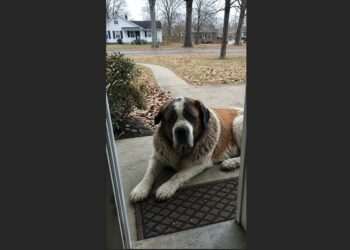
For nearly three weeks, neighbors in rural Kentucky kept seeing the same dog in the same place: the front porch of a house where nobody lived anymore.
Food appeared beside the porch. So did fresh water. People tried to help, and animal control was called more than once. But no matter what anyone did, the dog found his way back to the house. According to the account, on both occasions when officers were called, he had returned to the porch before they had even driven away from the street.
He had somewhere else he was supposed to be. No one in the neighborhood knew where that was.
The house stayed empty. The door did not open. Still, the dog kept choosing that familiar spot, as though leaving it would mean giving up the one place connected to the person he knew.
At the time, the neighbors could only guess why he was so determined to stay. Eventually, a microchip scan would give them an answer. What it revealed was not a case of someone simply forgetting to let a dog inside.
It was a separation neither the man nor his dog had chosen.
The Empty House Had an Owner. So Did the Dog.
The dog had been noticed on the porch for almost three weeks, long enough for the sight to become familiar and troubling. The neighbors’ practical response was to make sure he had something to eat and drink. But a bowl of food could not explain why he was there, and it did not persuade him to stay somewhere else.
When animal control was contacted, the visits did not end his return to the porch. Whatever attempts were made to move him, he kept coming back. It was the consistency that stood out: the same dog, the same empty house, and no one arriving to claim him.
At last, one neighbor arranged to have him checked for a microchip. The information connected the dog to Howard Briggs, a 67-year-old retired teacher.
And then the missing part of the story became clear.
Six weeks earlier, Howard had suffered a stroke. He had been hospitalized and later moved to a memory care facility about forty minutes away. He had no close family living nearby. In the weeks since his hospitalization, his house had stood empty.
The dog had not been waiting for a person who had decided to move away without him. Howard was alive, but he was no longer able to return to the home they had shared.
The timeline left an unanswered question. Neighbors had noticed the dog on the porch for nearly three weeks, while Howard had been away for six. No one knew precisely how long the dog had been returning there before people began paying attention. What mattered now was that the dog had been identified and there was somewhere to direct the search for his person.
There was another question the microchip could not answer: Would Howard recognize him?
Forty Minutes Away, Howard Was Struggling
The neighbor contacted the care facility and explained what had been happening outside Howard’s house. The dog was still there. Neighbors had been looking after him as best they could, but he would not leave the porch behind. Now they knew who he belonged to.
For the people caring for Howard, that information carried particular weight.
Since arriving at the facility, Howard’s condition had worsened. He had stopped speaking and was no longer responding to those around him. Much of his time passed with him looking silently at the wall. The staff had tried different ways of reaching him, but nothing seemed to bring back the engagement they hoped to see.
It is difficult to imagine what the experience was like for Howard. A stroke can change a person’s abilities in ways that are not visible to someone standing nearby, and silence does not tell us exactly what a person is feeling or understanding. The people around him could describe what they observed. They could not know everything going on inside his mind.
What they did know was that a dog had been waiting at Howard’s empty home.
The two parts of the story had developed separately: a man in a care facility who had become withdrawn, and an animal returning again and again to a porch. Until the microchip was checked, no one had connected them.
Once the facility understood the situation, the question became whether a visit could be arranged.
Within an hour of hearing about the dog, the facility director approved it.
The plan was simple. Bring Howard’s dog to see him, let them be together, and see how he responded. There was no promise that the meeting would change his condition. The visit was worth making because the dog was part of Howard’s life, and that relationship had been interrupted without either of them having any say in it.
The Morning the Dog Came Through the Door
The next day, the dog was driven across the county to the care facility. The distance was only about forty minutes from Howard’s home, but it had been enough to keep the two apart for six weeks.
For the dog, the destination was unfamiliar. The room he was about to enter was not the home he had been returning to, and Howard was no longer sitting where his dog had once expected to find him.
Yet when the door to Howard’s room opened, the dog did not hesitate.
He walked directly to Howard and gently rested his head on the man’s knee.
There was nothing complicated about the gesture. The dog did not need anyone to explain the situation or urge him closer. He approached the person he knew and made contact in the way a familiar animal might: quietly, with the weight of his head against a leg.
One Small Movement Changed the Room
Howard looked down at him.
Then, slowly, he raised his hand and placed it on the dog’s head.
For six weeks, Howard had not responded to people around him in the way they hoped. Now the staff were watching him make a purposeful movement toward an animal who had been missing from his daily life.
A nurse standing in the doorway was so affected by what she saw that she stepped outside.
She later described how hard the staff had worked to reach Howard and how little response they had seen from their efforts.
“We had tried everything. Music, photographs, calls from family. Nothing seemed to reach him. That dog came in and connected with him in less than a minute.”
— A nurse who witnessed the reunion, as quoted in the original account
It is important not to turn a single moment into a medical claim. A stroke is a serious condition, and one response to a beloved animal does not mean that a person’s difficulties have suddenly disappeared. The story does not say Howard regained his speech or recovered from the effects of the stroke.
But the moment the nurse witnessed was meaningful on its own. The staff had been looking for any sign of connection. The dog walked into the room, rested his head against Howard, and Howard reached back.
Neither had to do anything more for the visit to matter.
They Found a Way to Keep Them Together
The visit could have ended after a short reunion, followed by another separation. The account, however, describes a different decision: the dog was allowed to stay at the facility permanently.
That changed the arrangement from an occasional visit into something much closer to the companionship the two had known before Howard’s stroke. The dog would not have to return to the empty house, and Howard would not have to wait for someone to bring him his companion.
There was no suggestion that caring for Howard suddenly became easy. The story offers no further medical updates, and it does not describe a dramatic return of speech or independence. Instead, it tells of one consistent change in his everyday life: the dog was there.
At night, he slept at the foot of Howard’s bed.
In the morning, before Howard even opened his eyes, he reached down and rested his hand on the dog’s head.
The gesture was small enough that someone passing the room might not have understood its significance. For the people who had watched Howard withdraw, though, it meant that a familiar part of his life had found its way back to him. And for the dog who had waited on the porch, there was no longer a reason to keep searching the empty house.
A Name They Could Share
One detail of the account is especially unusual. The staff eventually gave the dog the same name as his owner: Howard.
The story does not explain why the dog’s earlier name was not used, or how the staff made their choice. But it leaves a memorable picture: a man and his dog living under the same roof again, with one name now belonging to both of them.
Names were not what brought them back together. A neighbor had paid attention, someone had arranged a microchip check, and a care facility had agreed to let an important relationship continue. Those decisions made the reunion possible.
The Hand That Reached Down Each Morning
What stands out about this story is not a grand rescue or a sudden cure. It is the chain of ordinary decisions that prevented a permanent separation.
Neighbors noticed a dog who would not leave. Instead of assuming he had been abandoned, one of them helped identify him. Someone made the call to Howard’s care facility. A director approved a visit. And when Howard and his dog met again, the people responsible for his care found a way to keep the animal close.
The dog had no way to make a telephone call or explain whom he was waiting for. All he could do was return to the last place where he knew his person belonged. In the end, that persistence helped other people understand what had been missing.
Howard’s life had changed in ways his dog could not fix. But the dog could still be beside him. He could put his head on Howard’s knee and settle at the foot of his bed. He could be present without asking for words or explanations.
And every morning, according to the story, Howard reached down before opening his eyes and found him there.
After weeks apart, they no longer had to wait for each other.