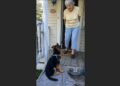
For an entire day and night, the German Shepherd sat outside my upstairs neighbor’s empty apartment, crying for someone who wasn’t coming back.
The neighbor had moved out. His belongings were gone. But he had left his dog in the hallway, right outside the door, as though the animal who had shared his home were one more thing he no longer needed.
At first, I told myself there must be an explanation. Perhaps someone was coming to collect the dog. Maybe the move had happened in a hurry, and a family member or friend would arrive soon. I didn’t know the circumstances, and I wanted to believe no one had deliberately left him there.
But the hours passed. Then the night passed. No one came.
The crying continued. It was a low, distressed sound that carried through the building, and I couldn’t stop thinking about the dog sitting outside a door that would never open for him again. Whatever had happened, he was alone in a hallway, waiting.
Eventually, I opened my own door and approached him slowly. He didn’t rush toward me or try to get away. He simply looked up with tired, searching eyes.
I brought him into my apartment. I thought that once he was somewhere warm and quiet, with food and water nearby, he might begin to settle.
I had no idea how worried I was about to become.
The Dog Who Wouldn’t Leave the Corner
The German Shepherd did not behave like a dog relieved to be indoors. He barely responded when I spoke to him. Food held no interest. Even gentle reassurance seemed unable to draw him out of himself.
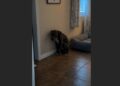
He found an old yellow pillow I had in the room and settled against it. For much of the day, he stayed there, close to the corner, his eyes partly closed. He wasn’t sleeping soundly or resting the way a comfortable dog rests. He seemed exhausted, yet unable to relax.
I couldn’t know what was going through his mind. Dogs don’t explain their losses to us. All I knew was that he had waited outside an empty apartment for more than twenty-four hours, and now, even though he was safe inside mine, he seemed unable to take comfort in anything I offered.
The yellow pillow became his place. I could speak softly and sit nearby, but he seldom looked up. He didn’t seem interested in toys or treats, and he wouldn’t eat the meals I set out for him.
One day without food was unsettling. By the second, I was growing frightened. When the third day passed without him willingly eating, I knew this was no longer something I could simply watch and hope would improve.
I took him to the veterinarian.
A Visit to the Vet—and More Questions Than Answers
I arrived worried that the dog had some hidden physical illness. He looked worn down, and his refusal to eat was beginning to affect his strength. I wanted someone with medical training to examine him and tell me what could be done.
After the examination, the veterinarian did not identify an obvious physical cause that explained everything I was seeing. The vet believed the dog’s emotional distress and separation from his former owner were playing a serious part in his condition.
The words were difficult to hear. I had brought him in hoping there would be a straightforward problem to treat. Instead, I was being told that his withdrawal might be connected to what he had been through—and that recovery could take more than a comfortable room and regular meals.
The veterinarian provided medication intended to help stimulate his appetite. I went home wanting to believe that would be the turning point.
It wasn’t.
He continued turning away from food, treats, and even the medicine I tried to give him. I worked carefully to get small amounts of water and soft food into him, frightened by how little he was taking in. I stayed alert to his condition because I could see he was growing weaker.
Another week passed with barely any progress. He remained withdrawn, and when he tried to stand, his body sometimes trembled. I could tell he was not doing well, even without understanding everything that might be contributing to it.
The veterinarian was concerned about his decline and warned me that the outcome was uncertain. I remember being told to prepare myself for the possibility that he might not recover.
I went home carrying that worry along with everything else. The dog had already lost the person he knew. I couldn’t bear the thought that he might now lose the chance to feel safe with someone new.
The Yellow Pillow Was Still There
At home, he returned to the same place in the corner. The pillow was worn and unremarkable, but for reasons I couldn’t explain, he seemed to find some comfort in being near it.
I began to notice how often I looked toward that corner. I checked whether he had changed position, whether he had looked at the food, whether his breathing seemed calm, whether he had responded when I spoke.
I still did not know where my former neighbor had gone. And by then, finding him was no longer what mattered most to me. The dog was here, in front of me, and he needed care. I could not change the way he had been left behind, but I could decide what happened next.
I Stopped Trying to Hurry Him
I took time away from work so I could stay close to him. I was still concerned about his health, but I also wanted to give him something he had been missing since the day his owner disappeared: a person whose presence became familiar and dependable.
I didn’t try to turn every moment into a test of whether he trusted me. I stopped expecting him to respond just because I had sat beside him or spoken kindly. I knew he might need far more time than I had first imagined.
So I stayed nearby. Sometimes I talked softly. Sometimes I said very little. I let him see me moving through the apartment and returning to sit with him. If he preferred to remain beside his yellow pillow, I let him.
It may not sound like much. There was no special trick that suddenly changed his behavior, no wonderful speech he could somehow understand. Most days, I was simply keeping him company and watching closely for any sign that he was becoming more comfortable.
For a while, I wondered whether anything was changing at all.
Then one afternoon, as I crossed the room, his eyes followed me.
He had looked in my direction before, of course, but this felt different. He seemed interested in where I was going. I didn’t make a fuss or rush toward him. I just noticed, and quietly hoped it meant something.
The next day, when I called to him softly, he raised his head a little.
It was a small response, but it was the first time in days that I felt he was meeting me halfway.
One Gentle Touch
By the fourth day of staying home with him, he did something I had been hoping for without wanting to demand it. He shifted closer from his place by the yellow pillow and gently rested his head against my hand.
I stayed still.
After so many days of seeing him withdrawn and frightened, I didn’t want to startle him or turn that moment into another expectation. I let my hand remain where it was and allowed him to decide how long he wanted to stay.
His gesture was simple. He had moved closer because he chose to. It didn’t mean every fear was gone, and it certainly didn’t mean his health concerns had disappeared. But it suggested that he was beginning to feel comfortable with me.
For the first time, he wasn’t just allowing me to be near him. He was reaching for that closeness himself.
I thought about the dog who had sat outside an empty apartment door, crying for the person who left. Now he was resting his head against the hand of someone who had come into his life simply because that crying had been heard.
I still worried about him. But that afternoon gave me a reason to keep hoping.
The Sixth Day, He Finally Took a Bite
On the sixth day, I offered him food from my fingers. I had done it before, without success, and I was prepared for him to turn away again.
This time, he took a small bite.
I can still remember how relieved I felt. It wasn’t a full meal. It didn’t solve everything. But after watching him refuse food for so long, that one small bite meant he was willing to try.
I cried.
Part of it was exhaustion. Part was fear finally loosening its grip for a moment. I had been watching this dog grow weaker, wondering whether I could help him at all. Now he was accepting something from my hand, and I knew that mattered.
His progress was gradual. There was no overnight transformation from a frightened animal into a carefree companion. But the changes began to add up. He looked toward me more often. He seemed less withdrawn. Eating no longer felt impossible.
The yellow pillow was still there, but it was becoming one comfortable place among others, rather than the only spot where he seemed willing to remain.
The Name I Gave Him
A little more than two weeks after I brought him inside, the German Shepherd was eating on his own. He had begun to settle beside me at night, resting his head close, and I could see a gentleness returning to his expression that had been difficult to find in those first days.
He still had quiet moments. I wouldn’t pretend that one good week could erase everything that had happened to him. Sometimes he looked distant, and I wondered whether he was remembering the person who had left him behind. I couldn’t know. But he no longer spent every hour withdrawn in the corner.
Even the veterinarian, who had once been deeply worried about his condition, began referring to him as a fighter.
I gave him the name Phoenix.
It seemed right for a dog who had come so close to giving up and was slowly finding his way back to ordinary pleasures: eating a meal, lifting his head when someone called, sleeping peacefully near another living creature.
I don’t believe my presence alone cured everything that was wrong. He needed veterinary care, careful attention, and time. Nor can I claim to know exactly what he felt when his former owner disappeared. I only know what I witnessed: a dog who had stopped eating, remained withdrawn for days, and eventually began responding to consistent care.
When I think about the night I first heard him crying in the hallway, I remember how badly I wanted someone else to come and take responsibility. I was afraid of getting involved, afraid I wouldn’t know what to do.
I’m glad I opened my door.
These days, Phoenix can lie beside me at night and rest. Sometimes his head settles close to my hand, much as it did that afternoon beside the yellow pillow. I don’t need to ask him to do it. He comes because he wants to.
The empty apartment upstairs is no longer where his story ends.
He was left outside a door that never opened again. Now, when he looks for someone, there is a person nearby who knows his name.