By the tenth morning, I was waiting for the dog before I even opened my front door. For more than a week, he had been leaving odd little objects on my porch: a crushed soda can, a scrap of cardboard, a spoon. Every time, he placed something near the edge of the steps, backed away, and watched me pick it up.
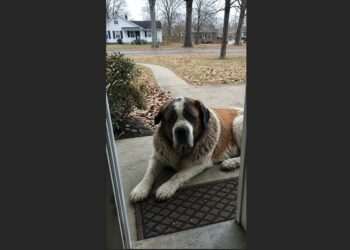
I couldn’t explain why he kept doing it. I wasn’t feeding him, and I hadn’t invited him into the house. Most mornings he stayed across the street, quiet and still, keeping an eye on my front door as if he had decided it was an important place to be.
Then, on the tenth day, he brought an old leather pouch. When I opened it, I found a faded collar tag with a name and an address. Only then did the strange little morning ritual begin to make sense.
But the story really started nine days earlier, when I found a soda can on my porch and thought nothing of it.
The Dog Across the Street
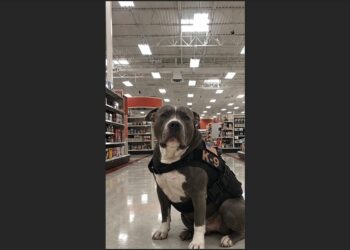
I first noticed him during my ordinary morning trip to the mailbox. He was across the street from my house, sitting in nearly the same spot whenever I looked out. I took him for a stray because there was never anyone with him, and he seemed to be watching the neighborhood on his own.
He didn’t bark or follow me down the sidewalk. He didn’t rush up to ask for attention. When I returned to the porch, he simply watched. I had no reason to think he wanted anything from me.
The next morning, there was a crushed soda can near the edge of my porch. It was an odd place for a piece of litter to end up, but I didn’t dwell on it. I picked it up, dropped it in the trash, and went on with my day.
I might have forgotten the whole thing if I hadn’t seen the dog approach again.
He carried something in his mouth, walked to the same part of the porch, and lowered his head. Then he took a few steps backward and waited for me to notice.
That was the first time I realized he might be the one leaving things there.
I couldn’t tell whether he was playing, looking for food, or simply treating my porch as a convenient place to drop whatever he found.
Still, I had never seen one repeat the same small action so carefully.
A Morning Routine I Didn’t Understand
On the second day, he brought cardboard. On the third, it was a piece of plastic. Another little object appeared the next morning. Nothing was valuable or especially interesting, and I would have thrown each item away without a second thought if I hadn’t been watching the dog.
What caught my attention wasn’t the collection. It was the way he delivered it.
He never tossed an object toward me or ran away with it when I stepped outside. He approached the edge of the porch, put it down, moved back, and stayed where he could see my hands. If I bent to pick it up, his eyes followed the movement.
I started paying more attention to him than to whatever he had brought. He was cautious, but not in a way that seemed aggressive. He gave me room. He never tried to push past me into the house. And although I was close enough for him to approach, he didn’t beg for food or demand that I pet him.
By the fifth morning, I had noticed the timing. He seemed to appear at about the same hour, just as I was going out for the mail. By the sixth, I knew I wasn’t imagining the careful way he set each object down.
I still had no idea what it meant.
A Piece of Cloth, a Lid, and a Spoon
On the seventh day, the dog arrived carrying a folded piece of cloth. I remember looking at that one longer than I had looked at the others. A soda can could have come from the gutter. So could the cardboard and plastic. But the cloth made me wonder where he had been finding these things and why he kept bringing them to my steps.
I looked toward him and spoke aloud, mostly because there was no one else there to hear me.
“Why here?”
He didn’t answer with a bark or even move closer. He shifted slightly when I reached down, then watched me lift the cloth from the porch.
The next morning, he brought a plastic lid.
On the ninth, it was a spoon. It was raining that day, and he stood there soaked while I picked up what he’d left. He didn’t seem interested in coming inside or sheltering near the door. Once again, his attention stayed on what I did with the object.
That night, I found myself thinking about him long after I had gone inside.
I went back through the trash to look at the things I had discarded. They were still ordinary objects, some worn or crumpled, with no obvious connection to one another. Nothing about them explained his behavior. But seeing them together made the pattern harder to ignore.
I was surprised by how much I wanted to understand him.
What He Brought on the Tenth Day
The next morning, I waited near the front door instead of leaving the house at my usual pace. When I heard him approaching, I knew something about his movements was different. The sounds were slower and more deliberate.
I opened the door and found him standing near the steps. In front of him was a small leather pouch, old and worn from use. He had set it down in the same place as all the other objects.
For once, he didn’t back away.
I stood there for a moment, looking from the pouch to the dog. He watched me without moving closer. I bent down and picked it up, then carefully opened it.
Inside was a faded collar tag.
There was a name on it: Buddy. Beneath it was an address.
Suddenly, I had something more useful than a guess. I couldn’t know how the pouch had come into his possession or whether the tag actually belonged to him, but it was a lead worth following. The address was close enough that I could try to find it.
I grabbed my jacket and looked at the dog. After nine mornings of watching him leave small objects behind, I finally had a reason to see where he would go.
“Show me,” I said.
He turned and started walking.
I followed, keeping my eyes on him as we moved away from my house. He didn’t stop to pick anything up this time. He simply went ahead, and I let him set the pace.
A Familiar Name at a Quiet House
A few streets later, Buddy stopped in front of a small house with an overgrown yard. The address matched the one I had found on the tag.
I didn’t know whether the address was still current, but I knocked.
An older man opened the door.
He looked past me and saw the dog. His expression changed immediately.
“Buddy…” he whispered.
That one word told me more than I had learned from all the objects on my porch.
The man recognized him. Buddy had been missing for weeks, he explained, and he had been trying to find his way home. I handed over the pouch with the tag inside. Then the man dropped to his knees and wrapped his arms around the dog.
I stood nearby and let them have that moment.
I hadn’t expected the answer to my ten-day mystery to be waiting a few streets away, behind a door where someone knew the dog’s name.
There were still things I couldn’t explain. If Buddy could lead me to the house, why hadn’t he returned there earlier? Where had the pouch been all that time? Had he carried the other objects because he wanted my attention, or was I reading too much into a habit that had no particular meaning to him?
The reunion didn’t give me answers to those questions. I didn’t need it to.
The Things He Left Behind
Looking back, it would be easy to say Buddy had a plan from the beginning—that every piece of cardboard or plastic was a gift he hoped I’d understand.
But I don’t know what he intended. The can, cloth, lid, and spoon didn’t point me toward his owner. None of them contained a clue that I recognized. It was the pouch and collar tag, followed by Buddy’s walk to the matching address, that finally brought us to his home.
What I do know is that he returned again and again. By the tenth day, we had a routine: he brought something, I picked it up, and neither of us hurried the other.
Perhaps that was why he didn’t run when I opened the door on the morning he brought the pouch. He had seen me come outside nine times before. Whatever his reasons for returning, he had learned that I would be there.
The thought stayed with me after I walked home.
The First Time Buddy Came Back Empty-Handed
A few days later, there was a knock at my door.
The older man stood on the porch, smiling. Beside him was Buddy, his tail wagging. This time there was no battered can, no piece of cloth, and no mysterious object waiting at my feet.
The man told me Buddy had kept trying to return to my house after their reunion.
“Guess he thought you were part of the way home.”
I liked that explanation. It was simple, and it left room for the possibility that Buddy’s strange little ritual had meant something to him, even if nobody could say exactly what.
Buddy still visits from time to time. I recognize him now, and he comes with the reassurance that he has a home to return to. Seeing him beside his owner feels entirely different from watching him sit alone across the street.
And there is one small detail I always notice.
His mouth is empty.
No soda can. No cardboard. No spoon. No leather pouch.
He simply walks up to the porch and looks at me, the same way he did on all those mornings when I was trying to understand him.
I still can’t explain every object he brought or what he thought I might do with them. But I know what happened because I kept watching: a lost dog found someone who paid attention, and an old collar tag helped lead him back to the man who was missing him.
Now, when Buddy visits, I don’t have to search for clues. I can just be glad to see him.