The nurse had barely managed to explain what she had found before the night security guard stepped into the hospital room.
“There’s… something under the bed.”
She wasn’t talking about a misplaced bag or a piece of equipment. Beneath the bed, in a place where an animal had no business being, lay a dog.
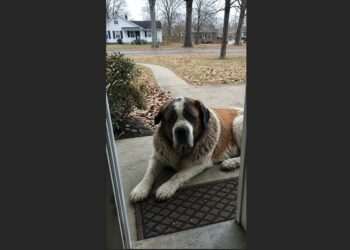
He was thin, with dirty fur and ribs visible beneath his coat. He looked to be about five years old. He didn’t bark when the guard entered, and he made no attempt to run. He remained close to the metal frame of the bed and watched the people standing above him.
The hospital had a clear rule: animals weren’t allowed in patient rooms. The guard had been called into a situation that should have been simple to resolve. Yet nothing about the dog, or the patient sleeping above him, made it feel simple.
A Quiet Discovery on the Night Shift
The room was bright with overhead lights. Disinfectant lingered in the air, and medical equipment made the soft, steady sounds familiar to anyone who has spent time in a hospital. In the bed lay an elderly man, sleeping uneasily. An IV line was taped to his arm, and a worn military cap rested nearby.
The security guard was in his late forties and tired from a long shift. He still carried the smell of coffee. He stopped when he saw the dog, taking in the thin body, the trembling paws, and the way the animal stayed close to the bed instead of seeking an exit.
There was no growling or snapping. The dog wasn’t behaving as though he wanted to challenge anyone. He seemed determined to remain exactly where he was.
It would have been easy to describe him as a stray who had wandered into the wrong building. His dirty coat and visible ribs suggested he had not been living comfortably. But that explanation alone didn’t account for his choice of hiding place. He was not roaming a hallway or looking for food. He was lying beneath one particular patient’s bed.
The elderly man slept on, unaware that the visitors in his room had discovered the animal below him. The dog kept his attention on the guard. No one knew whether he was frightened of being removed, exhausted from finding his way inside, or simply wary of strangers. His paws trembled, but he stayed.
Hospital rules exist for good reasons. Staff must protect vulnerable patients, maintain clean environments, and keep hallways and rooms safe. An unidentified dog inside a patient’s room raised questions that couldn’t be brushed aside. The guard had a responsibility to respond.
Still, neither he nor the nurse immediately reached for a radio. They paused to understand what they were seeing.
That pause mattered. It left room for a question beyond how the dog had entered: Why had he come to this bed?
When the Patient Woke, the Dog Had a Name
The answer began to emerge the following morning.
The elderly man opened his eyes, and his gaze moved toward the floor. When he saw the animal beneath the bed, his expression softened. He did not appear surprised in the way the staff had been. Instead, he recognized him.
“Hey, Rusty…” he whispered.
The dog responded immediately. He lifted his head at the sound of the man’s voice. His tail began to move, only a little, but enough to reveal that the name meant something to him.
Until then, the staff had seen a thin, dirty animal in a prohibited place. Now they were looking at Rusty, a dog who knew the patient and whom the patient knew well enough to greet with tenderness.
As the nurses gathered and the circumstances became clearer, they learned that Rusty had once belonged to the man. The two had shared a life before illness and hospital care separated them. The account gives no detailed history of their years together. It doesn’t say what happened to Rusty after the man became ill, who might have been looking after him, or why his condition had deteriorated.
Those unanswered questions were important. Rusty was thin and dirty, and his welfare deserved attention. But the immediate connection between him and the patient was unmistakable. The old man said his name; Rusty looked up. A relationship that had existed long before this hospital stay was suddenly visible to everyone in the room.
The Mystery of the Nightly Visits
There was another part of Rusty’s story the staff struggled to explain. The dog had apparently found his way into the hospital repeatedly, slipping in without being noticed and making his way back to the same room at night.
No one knew exactly how he was getting inside. The account offers no route through the building, no explanation of which entrance he used, and no reliable count of how many nights he had come. There was also no clear answer to why the patient had not told the staff about him.
What the people in the room understood was that the dog had been returning to someone he knew. He wasn’t attached to the room itself. He wasn’t there because a hospital bed was comfortable or because it was a sensible shelter for a dog. He was there because the man above him mattered to him.
To the staff, that realization changed the nature of the discovery. Rusty was still an animal who had entered a restricted area, and his presence still raised practical concerns. But he was no longer a mystery in the most important sense. He had come back to his person.
An Unexpected Change in the Patient’s Room
Later that morning, a doctor arrived to check on the elderly man. The doctor noticed that something about the patient’s condition seemed different. His vital signs were stronger, calmer, and more stable than they had been in the preceding weeks.
“He’s responding better,” a nurse observed.
It was encouraging news, especially for a patient who had been sleeping restlessly. The story doesn’t identify his medical condition or describe changes to his treatment, so no one could know from this account exactly why his readings had improved. Rusty’s presence may have comforted him, but the improvement could not reasonably be treated as proof that the dog had caused a medical recovery.
What the staff could see was much simpler. The elderly man recognized Rusty. His expression softened when he spoke to him. The dog became attentive at the sound of his voice. Their familiarity was real, and it brought something personal into a room otherwise organized around medical care.
The hospital then faced a decision. Its usual policy did not permit animals in patient rooms, and there were legitimate reasons to take that policy seriously. At the same time, the people responsible for the patient’s care had witnessed how meaningful Rusty’s presence was to him.
They decided to make an exception.
The account doesn’t explain the administrative steps behind that decision or whether any special conditions were established. It simply records the outcome: Rusty would be allowed to stay beside the elderly man’s bed instead of having to hide beneath it.
It was a compassionate choice, but not one that made every concern disappear. Rusty still needed appropriate care, and the hospital still had responsibilities to its patient. The exception mattered precisely because it was made for these particular circumstances, after the staff understood who the dog was and why he kept returning.
The Companion He Had Been Missing
From that day forward, Rusty no longer had to slip into the room unnoticed. He could remain openly beside the bed, near the man whose voice had brought his tail to life that morning.
The change for the patient was described in ordinary, human terms. He smiled again. He spoke more. He began sleeping better. Those details are easy to overlook beside the medical readings, but for someone who has spent a long stretch of time in a hospital, they can be deeply significant.
There is no need to imagine that Rusty knew what an IV line was or understood the man’s medical condition. Dogs don’t need that knowledge to recognize a familiar voice or seek closeness with someone they love. Rusty’s behavior in the room suggested that being near this man was important to him, whatever he understood about the hospital around them.
The dog who had trembled beneath the bed was finally allowed to remain where he had tried so hard to be. The man who had woken to find him waiting could enjoy his company without the immediate threat of another separation.
Neither of them needed an elaborate reunion. There had been no excited running down a hallway or dramatic scene at the door. Their first visible exchange was a whispered name and the smallest movement of a tail.
That was enough for the people watching to understand that they belonged in each other’s lives.
What the Guard Found Under That Bed
At the beginning of the night, the security guard had been called to deal with an animal in a place where animals weren’t permitted. He was tired, the room was quiet, and a nurse had found something she couldn’t readily explain. The most obvious response would have been to remove the dog.
By morning, the staff knew his name. They had learned that he had once lived with the patient and that he had been making his way back to him. They had seen the old man’s face change at the sight of Rusty, and they had heard the gentle way he spoke his name.
The rules hadn’t been written with Rusty in mind. Neither had the room been arranged for an animal companion. Yet the hospital found a way to recognize what the dog meant to its patient.
The story does not tell us how the man’s illness ultimately progressed, or what happened after his stay. It doesn’t explain where Rusty had been living during their separation. Those parts of their lives remain unknown, and they don’t need to be invented to give the reunion its meaning.
What is known within this account is that a thin dog kept returning to an elderly man’s bedside, and that when the two were finally seen together, the staff chose not to separate them again.
The most moving part of the story may be its quietest moment: an old man waking, looking down, and speaking a familiar name. Beneath him, Rusty lifted his head.
For that morning, at least, the distance between them was gone. And this time, Rusty didn’t have to hide.