Claire Bennett Expected an Ordinary Wednesday
By early afternoon, Animal Control Officer Claire Bennett had already handled the kind of calls that filled most workdays in the small community outside Boise, Idaho.
She had checked on a dog left alone in a yard.
Helped get a raccoon out of someone’s garage.
Then spent part of the afternoon dealing with a loose chicken whose opinion of animal control appeared overwhelmingly negative.
Nothing about the shift suggested it would become memorable.
Then dispatch called about a dog near the town’s baseball fields.
A youth game had recently ended, and several families were still packing chairs and sports bags into their vehicles.
Someone had noticed a dog beneath the bleachers.
No owner seemed to be nearby.
Claire headed over expecting a fairly straightforward stray pickup.
The dog had other ideas.
He Was Sitting Beneath the Bleachers Watching the Parking Lot
Claire spotted him almost immediately.
He looked like a golden retriever mix.
Fluffy coat.
Medium-large body.
Golden fur with a distinctive darker patch above his left eye.
More importantly, he did not look like a dog who had been wandering alone for very long.
His coat was reasonably clean.
His body condition looked healthy.
He was alert without appearing frantic.
He was not cowering from people or trying desperately to escape.
Instead, he sat beneath the bleachers and watched cars leaving the parking lot.
Claire approached at an angle with a leash ready.
The dog noticed her.
He stood.
Stretched.
Then walked directly toward her with his tail making slow sweeps behind him.
“Well, hi, sweetheart,” Claire said.
The dog looked up at her.
That was apparently enough of an introduction.
Claire Opened Her Truck Door, and the Dog Made His Own Decision
She wanted a treat.
The treats were inside the animal control vehicle.
So Claire opened the passenger door and reached in.
Before she could turn around, the retriever jumped into the front seat.
Claire froze.
The dog turned once.
Then settled against the passenger seat as though transportation had already been arranged.
Claire laughed.
“Oh, that’s where you’re going?”
He looked through the windshield.
Claire tried coaxing him back out so she could properly secure him.
The dog leaned away from the open door.
She produced a treat.
That worked.
He climbed down.
A few parents nearby were watching by then.
Claire secured him, checked what she safely could for identification, and turned back toward the truck.
The moment he had another opportunity, the dog climbed straight into the passenger side again.
One of the parents laughed.
“Looks like you found yourself a partner.”
Claire had to admit it looked that way.
There Was No Identification on His Collar
The dog wore a collar but no readable tag.
Nobody at the baseball field recognized him.
Claire asked around.
Had anyone seen him arrive?
Did he belong to a family at the game?
Had somebody noticed a person searching for him?
No useful answer emerged.
The dog remained calm.
Friendly, even.
That made Claire more suspicious that he belonged somewhere nearby.
Dogs who are accidentally separated from a family do not necessarily look frightened every minute.
Some wander.
Some search.
Some become highly social with strangers.
Others settle in one place.
This dog seemed particularly comfortable with people and vehicles.
That told Claire something about his experience.
It did not tell her where home was.
So she brought him to the animal services center.
He Rode in the Passenger Seat the Whole Way
Claire secured him appropriately for the drive and let him remain where he appeared comfortable.
The retriever sat upright.
He watched traffic.
Occasionally, he looked at Claire.
Then back through the windshield.
At a stoplight, she glanced at him.
“You’ve done this before, haven’t you?”
He did not answer, obviously.
He just continued watching the road.
Claire could not know whether he had regularly ridden in that exact position with his family.
Still, nothing about the vehicle seemed new to him.
That became the first clue that this was probably not a dog without a home.
Somewhere, Claire suspected, somebody was having a very bad afternoon.
The Shelter Staff Fell for Him Almost Immediately
The dog entered the animal services center as though meeting strangers had been part of his daily schedule.
He greeted employees.
Leaned into scratches.
Rolled over when someone rubbed his chest.
When a staff member stopped petting him, he shifted slightly closer.
“This one isn’t going to last long if nobody claims him,” someone said.
Claire agreed.
But adoption was nowhere near the first step.
A friendly stray could have a family desperately searching for him.
They needed to identify him.
Because of his extraordinary confidence in Claire’s truck, someone jokingly called him “Captain.”
The nickname stuck for the afternoon.
“Captain needs water.”
“Captain’s in intake.”
“Has anybody scanned Captain yet?”
The dog answered to none of it.
That should have been another clue.
The Microchip Scanner Found Nothing
They checked carefully.
No chip.
That made the search more difficult but certainly did not mean the dog was unowned.
Staff looked through local lost-pet reports.
Nothing obvious matched.
They checked recent calls.
No report from the immediate baseball-field area.
Claire examined the collar again.
No writing.
No number tucked inside.
No old tag hidden beneath the fur.
Captain remained unconcerned with the investigation.
He drank water.
Accepted attention.
Then lay down.
Claire began making calls.
Somewhere Eight Miles Away, a Family Was Searching Too
They had been looking since morning.
The dog’s real name was Murphy.
His family had discovered him missing shortly after their eleven-year-old daughter, Lily, left for school.
That morning, Lily had gone into the backyard before getting ready to leave.
When she returned inside, she had not fully latched the gate.
Murphy eventually found the opening.
By the time anyone realized what had happened, the yard was empty.
A simple household mistake had turned into a family emergency.
They checked the street first.
Then nearby yards.
Then the surrounding neighborhood.
Friends joined in.
Murphy’s photograph went online.
Family members drove roads they had already checked.
Nothing.
Lily Blamed Herself
Adults told her it had been an accident.
She understood the words.
They did not make her feel better.
Murphy slept beside her bed every night.
He waited for her after school.
He had never disappeared before.
By afternoon, Lily had started imagining all the things children imagine when a beloved animal is missing.
What if he crossed a busy road?
What if someone took him?
What if he could not find his way home?
What if they never saw him again?
Her mother kept telling her they were not giving up.
They continued calling.
Continued searching.
Eventually, one of those calls reached the animal services center.
Claire Was Preparing for the Possibility That “Captain” Would Spend the Night There
The shelter had already begun the normal stray-hold process.
He had food.
Water.
A secure place to rest.
Claire disliked putting clearly social dogs into kennels when she suspected a family might be searching nearby, but procedure existed for good reasons.
They could not simply hand an unidentified dog to someone without verification.
Nor could they assume the dog had been deliberately abandoned just because nobody had immediately appeared.
Lost dogs can travel farther than people expect.
Eight miles would not be impossible, particularly depending on roads, terrain, and how long the dog had been moving.
Then the phone rang.
A staff member answered.
Claire heard the conversation change.
The Caller Was Looking for a Golden Retriever Mix
Claire came over.
The staff member began asking standard questions.
Sex.
Approximate size.
Collar.
Age.
Any unusual markings.
Claire looked toward the dog resting nearby.
Then took the phone.
“There is one thing I want to ask about,” she said.
She described the golden patch above his left eye.
Silence followed.
Then the woman on the phone began crying.
“That’s him.”
Claire glanced back at Captain.
No.
Murphy.
His family had found him.
Or, more accurately, two separate searches had finally met in the middle.
Claire Didn’t Release Him Based on One Detail
Relief did not eliminate the need for verification.
The family supplied photographs.
Multiple images showed the same dog.
The same facial marking.
The same collar.
They gave other identifying details as well.
Everything matched.
Claire told them where Murphy was.
They were about eight miles away.
The family said they were leaving immediately.
Claire hung up.
Then looked at the retriever.
“Murphy?”
His head lifted.
That got more attention than “Captain” ever had.
One ear shifted.
Claire smiled.
“Well, there you are.”
Less Than an Hour Later, a Girl’s Voice Came From the Lobby
Murphy was farther inside the building when the family arrived.
Lily entered with her mother.
She was already crying.
Then she called his name.
“Murphy!”
The dog reacted before anyone brought him into view.
His head snapped toward the sound.
He stood.
His tail started.
Then his body became increasingly animated.
Claire opened the interior door once the staff had control of the situation.
Murphy moved quickly toward the lobby.
There was no hesitation now.
Lily dropped onto her knees.
Murphy Nearly Knocked Her Over
The retriever pressed against her with enough enthusiasm that Lily had to shift backward to keep her balance.
His tail moved hard enough to sway his hips.
She wrapped both arms around his neck.
Murphy pushed closer.
Lily buried her face into his fur.
Her mother stood nearby crying again.
Nobody needed to say the dog understood the entire day.
Murphy could not know Lily had been blaming herself or that the family had driven miles looking for him.
But the behavioral evidence of familiarity was obvious.
He recognized her voice.
He approached immediately.
He sought close contact.
Whatever adventure he had experienced since leaving the yard, the person in front of him was not a stranger.
“He Sleeps Beside My Bed Every Night”
Once the first excitement settled, Lily began talking.
She told Claire about Murphy’s sleeping place.
His habits.
How he followed her.
How he had never disappeared before.
“I thought I wasn’t going to see him again,” she admitted.
Claire understood why.
Lost-pet calls do not always end this way.
Some animals are recovered within hours.
Others remain missing for days.
Some are never found.
That is why identification matters so much.
Claire gently mentioned the value of microchipping Murphy after the family got him home.
A collar and tag can be lost.
A properly registered microchip provides another way to reconnect a found dog with the people looking for him.
Lily’s mother agreed immediately.
After one day without Murphy, she did not need convincing.
The Open Gate Was Treated as a Mistake, Not a Moral Failure
Lily kept apologizing.
Her mother stopped her.
So did Claire.
An eleven-year-old had forgotten a gate latch.
That mattered because it created a dangerous situation.
It did not require turning the child into the villain of the story.
The useful response was prevention.
Check the latch.
Make sure the gate closes securely.
Consider a second barrier if necessary.
Keep identification current.
Teach everyone in the household the same routine.
Lily listened.
She kept one hand on Murphy the entire time.
The lesson had already landed.
Probably harder than anyone would have wanted.
Murphy’s Mother Mentioned Another Plan They Had for Him
As the family prepared to leave, Lily’s mother said they had been exploring therapy-dog work.
Murphy was unusually comfortable with people.
That much Claire had already noticed.
He was especially gentle around children.
He also adored Lily’s grandfather, who lived at a nearby senior care residence.
The family had wondered whether, with appropriate training and evaluation, Murphy might eventually be suited to structured visits.
Claire liked the idea.
She also knew friendliness alone did not make a therapy dog.
Therapy-Dog Work Requires More Than Loving Attention
A dog visiting care facilities needs reliable behavior around unfamiliar people and environments.
Wheelchairs.
Walkers.
Sudden sounds.
Dropped objects.
Unusual movement.
People who may reach unexpectedly.
Depending on the program and facility, dogs generally need health checks and temperament or skills evaluations, while handlers must learn appropriate visiting practices.
A good therapy dog should also appear comfortable doing the work.
The goal is not to force a friendly animal into constant social interaction.
Murphy’s easy behavior around the shelter was encouraging.
It was not proof.
His family understood that.
They wanted to train properly.
That was exactly what Claire hoped to hear.
Murphy Still Had One More Decision to Make
Before leaving, Claire opened the passenger side of her truck as a joke.
Murphy looked at it.
Lily laughed.
“No.”
She held his leash.
Murphy looked at Claire.
Then the truck.
Then Lily.
He stayed with Lily.
Claire pretended to be offended.
“So that’s how it is?”
Murphy wagged.
The family thanked everyone again.
Then they walked toward their own vehicle.
This time, Murphy climbed into a car belonging to people who knew his real name.
The shelter staff watched them leave.
Someone removed “Captain” from the intake board.
Claire Thought That Was the End of the Story
Most reunions are.
An animal is found.
The family arrives.
Everyone is relieved.
Paperwork is completed.
The animal goes home.
Animal control moves on to the next call.
Claire still had reports to finish.
The loose chicken had generated more paperwork than seemed reasonable.
There were other animals needing attention.
Murphy became one of those cases she remembered fondly but expected never to revisit.
Then a few weeks later, she received a photograph.
Murphy was in a training class.
The Dog Who Had Climbed Into Her Truck Was Learning New Skills
In the picture, Murphy sat beside Lily’s mother.
There were other handlers and dogs nearby.
He looked attentive.
The family wrote that he had begun the program they had mentioned.
Training included the ordinary behaviors that matter enormously in institutional settings.
Walking calmly.
Remaining composed around people.
Responding reliably to the handler.
Settling when asked.
Handling distractions.
Accepting appropriate contact.
Learning that not every person needed to be greeted immediately.
Murphy had been naturally social at the shelter.
Now the family was adding structure to that sociability.
Claire saved the photograph.
Then returned to work.
Months Later, Another Update Arrived
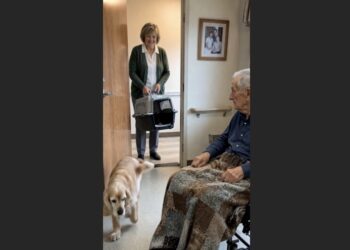
This one showed Murphy inside the senior care home.
His training had progressed enough for him and his handler to begin approved visits through their program.
Lily’s grandfather was there.
Murphy sat near him.
An older resident nearby had one hand on the dog’s back.
Claire studied the image for a while.
The dog looked calm.
Not overwhelmed.
Not being passed around like a toy.
Just present.
That mattered.
Therapy-animal visits are most useful when the welfare of the dog is protected alongside the experience of the people being visited.
Murphy seemed suited to the arrangement.
The family said he had begun making regular visits.
Nobody Claimed Murphy Had “Found His Calling” That Day at the Baseball Field
That would have been a human story imposed backward onto an accidental escape.
Murphy did not leave the yard because he intended to become a therapy dog.
He did not choose Claire’s truck because he had decided on a career in public service.
He was a loose family dog who discovered an open vehicle and apparently considered the passenger seat a perfectly reasonable option.
Everything that followed came from people making choices.
Claire safely contained him.
Shelter staff searched for his family.
His family kept looking.
Then they followed through on training they had already been considering.
The chain was meaningful enough without destiny.
Claire Printed One Particular Photograph for Her Desk
It was not the therapy-dog picture.
Not the reunion.
Not even Murphy beside Lily’s grandfather.
It was the first one.
Murphy sitting in the passenger seat of Claire’s animal control truck.
Front paws braced comfortably.
Head high.
Looking through the windshield as though he belonged there.
Someone at the baseball field had taken it and sent it to her.
Claire printed a copy.
She pinned it above her desk.
Coworkers Started Asking About the Dog in the Truck
New staff members noticed the photograph.
Visitors noticed it.
Eventually someone would point.
“Who’s that?”
Claire had an answer ready.
“That was Captain.”
Then she corrected herself.
“Murphy.”
She would explain how she found him beneath the baseball bleachers.
How he bypassed any reasonable introduction and climbed into the front seat.
How staff spent the afternoon trying to identify him.
Then she got to the part she liked best.
The phone call.
The patch above his eye.
A mother crying.
An eleven-year-old girl entering the lobby and calling his name.
The Reunion Was Important Because So Many Lost-Dog Stories Depend on Small Details
An open gate.
A collar without useful identification.
A distinctive patch of fur.
A phone call made at the right place.
An officer who did not assume a friendly stray had been dumped.
A family that kept searching.
None of those details seems dramatic alone.
Together, they got Murphy home.
Had he been microchipped with current registration information, the reunion might have happened even faster.
The family took that lesson seriously.
They made sure he could be identified more reliably if anything ever went wrong again.
Lily became particularly strict about checking the gate.
No one had to remind her twice.
Murphy Returned to Sleeping Beside Lily’s Bed
The first night home, that was where he went.
No grand adjustment period.
No uncertainty about which room mattered.
Lily got into bed.
Murphy settled nearby.
She reportedly kept reaching down to touch him.
Perhaps to reassure herself he was actually there.
Murphy eventually fell asleep.
The next morning, the gate was latched.
Checked.
Then checked again.
Life resumed.
School.
Meals.
Walks.
Training.
Visits to her grandfather.
The ordinary routine that had disappeared for one frightening day became ordinary again.
Sometimes that is the best ending a lost dog can receive.
His New Visiting Work Became Part of That Routine
Over time, Murphy grew familiar with the care home.
He had to learn its patterns just as residents and staff learned his.
Where he could walk.
When to settle.
Which environments were appropriate.
How long a visit should last before he needed a break.
Not every resident wanted to interact with him.
That was fine.
Not every visit produced a touching conversation.
That was fine too.
Therapy dogs do not need to create dramatic transformations to be useful.
Sometimes a resident simply strokes a dog for several minutes.
Sometimes a dog provides a shared subject for family conversation.
Sometimes the visit breaks the routine of an institutional day.
Those modest experiences have value.
Claire’s Favorite Part Was Still the Front Seat
It made her laugh every time she remembered it.
Most stray pickups required patience.
Some required food.
Others required traps, slip leads, gates, teamwork, or a surprising amount of negotiation.
Murphy had simply walked up.
Claire opened the truck.
He climbed in.
There had been something almost professional about the confidence of it.
“You got transportation?” his behavior seemed to suggest.
“Good. Let’s go.”
Of course, dogs do not narrate events that way.
But humans are allowed to find humor in the ordinary choices dogs make.
Murphy’s choice happened to get him exactly where he needed to be.
Months Later, Claire Saw Him Again
The family brought Murphy by the animal services center after one of his training milestones.
Lily came too.
Murphy entered the building calmly.
He greeted Claire.
His tail moved.
He leaned briefly against her leg.
Then looked toward the hallway where he had once waited.
Claire could not know whether he remembered his afternoon there.
Maybe the scents were familiar.
Maybe her voice was.
Maybe neither mattered very much anymore.
He was comfortable.
That was enough.
Lily proudly explained what he had learned.
Claire listened.
Then Murphy noticed the animal control truck outside.
He looked at it for several seconds.
Everyone laughed.
She Did Not Open the Passenger Door This Time
“You already have a ride,” Claire told him.
Lily held the leash.
Murphy stayed beside her.
A few minutes later, the family left.
Claire watched them cross the parking lot together.
The eleven-year-old girl was still the person Murphy kept orienting toward.
When Lily stopped, he stopped.
When she moved again, he followed.
That seemed fitting.
There was nothing wrong with the passenger seat in Claire’s truck.
It had simply been temporary.
Some Dogs Come Into Animal Control Looking Frightened
Others arrive injured.
Some distrust people.
Some require days before anyone learns much about them.
Murphy’s case had been unusually simple in comparison.
He was healthy.
Friendly.
Apparently delighted with transportation.
And very much loved somewhere else.
That last fact is easy to forget when looking at an unidentified stray.
A dog found alone is not necessarily an unwanted dog.
Somewhere beyond the shelter walls, there may be a child checking the street.
A parent refreshing lost-pet posts.
A family driving the same roads repeatedly.
That was why Claire kept searching even though “Captain” seemed perfectly happy sitting beside her.
The Photograph Above Her Desk Became a Reminder
Not every case ended well.
Animal control work included neglect.
Injuries.
Animals nobody claimed.
Difficult decisions.
Days when Claire drove home thinking about a dog she could not help as much as she wanted.
Then she would look at Murphy.
There he was.
Sitting in the passenger seat.
Looking through the windshield.
A dog who had been missing only hours but already had a family searching eight miles away.
A dog who would eventually return to his nightly place beside a little girl’s bed.
Later, after training, he would accompany his handler into a senior care residence and calmly accept attention from people who enjoyed his visits.
Claire could not have predicted any of that beneath the baseball bleachers.
All She Knew That Wednesday Was That a Dog Needed a Ride
Murphy had no identification anyone could use.
His family had no idea where he had gone.
Claire had a truck.
So she opened the door.
Murphy climbed into the front seat before she could properly invite him.
Hours later, Lily walked into the shelter and called his name.
The rest of his body answered before anyone else needed to.
He moved toward her.
She dropped to her knees.
And the dog Claire had jokingly called Captain became Murphy again.
Whenever someone asked about the photograph above her desk, that was the part Claire always returned to.
Not the training certificate.
Not the care-home visits.
The little girl.
The dog.
And the moment a lost animal heard one familiar voice from across a shelter and knew exactly where to go.
Editor’s Note: The characters in this story are fictional. Through these stories, we hope to share the intelligence, loyalty, compassion, and loving nature of dogs with people everywhere.