At Cedar Ridge, Gene Had Become Known for His Silence
Gene had been living at Cedar Ridge for about four months when one of the staff members described him in a way that stayed with his daughter.
“He lights up for one thing.”
Most days, that light was difficult to find.
Gene spent long stretches in his wheelchair beside the window of his room, looking toward the parking lot below.
He was not necessarily waiting for anyone.
At least, nobody could tell that he was.
Cars arrived.
Visitors walked inside.
Staff changed shifts.
Delivery trucks stopped and left again.
Gene watched.
If someone asked whether he wanted to join an activity, he often declined.
If a nurse stopped to chat, he might answer politely, but rarely at length.
His daughter, Carol, visited every Sunday.
She still brought him updates from home.
Family news.
Photographs.
Stories about people he had known for years.
Sometimes Gene listened.
Sometimes his attention drifted back toward the window.
Carol found the change frightening.
Her father had once been the kind of man who filled a room with conversation.
Now there were afternoons when she could sit beside him for twenty minutes and hear little more than a few words.
Carol Couldn’t Tell What Her Father Was Feeling
That was one of the hardest parts.
Gene had gone quiet.
But quiet did not explain itself.
It could not tell Carol whether he was sad, tired, overwhelmed, grieving, adjusting, or simply uninterested in talking at that moment.
Moving into assisted living had changed almost every part of his daily routine.
Different bedroom.
Different meals.
Different hallway sounds.
Different people.
Different schedule.
His belongings had been reduced to what could fit comfortably in one room.
The house where he had spent years was no longer where he woke each morning.
His yard was somewhere else.
His old chair was somewhere else.
And Rusty was somewhere else too.
That last absence seemed to matter most.
Rusty Had Been Beside Gene for Eleven Years
The cocker spaniel was old now.
Gray showed around his eyes and muzzle.
His hearing was not what it once had been.
Long walks had shortened.
Stairs required more consideration.
But for most of Rusty’s eleven years, he and Gene had been a pair.
Their life together had not been dramatic.
It had been made from the kind of repetition people rarely photograph.
Breakfast.
The back door opening.
Rusty following Gene from room to room.
A leash hanging near the entrance.
The dog sleeping close to Gene’s chair.
Trips outside.
Evenings in front of the television.
The sound of Gene’s voice.
The familiar movement of his hands.
Years of ordinary contact had built a relationship stronger than either one ever needed to announce.
Then Gene moved.
Rusty stayed behind.
Cedar Ridge Didn’t Usually House Residents’ Dogs
When the family arranged Gene’s move, the facility’s usual policy meant Rusty could not simply move into the room with him.
So Carol took the dog home.
It was the practical solution.
Rusty already knew her.
Her house could accommodate him.
She could manage his food, veterinary appointments, and senior care.
The arrangement kept him within the family.
Still, it changed the daily lives of both dog and man.
Rusty had a new house.
Gene had a new residence.
Neither could understand the move in quite the same way as Carol did.
Gene never made a scene about it.
He did not argue.
He did not repeatedly demand that Rusty be brought back.
Instead, according to Carol, something quieter happened.
He stopped asking when he was going home.
That Change Worried His Daughter More Than Complaints Would Have
If Gene had been angry, Carol thought she could have handled that.
If he had protested every Sunday, at least she would have known where he stood.
Instead, he seemed to retreat.
He sat near the window.
Answered questions.
Ate.
Followed the routine.
But some part of his previous engagement with daily life seemed diminished.
Carol was careful not to reduce that entirely to the separation from Rusty.
A major move late in life can be difficult for many reasons.
Health changes, loss of independence, unfamiliar surroundings, grief, fatigue, medication, and many other factors can affect a person’s mood and behavior.
Rusty was not a cure for any of those things.
Still, Carol knew how important the dog had been to her father.
So she began asking whether a visit might be possible.
Permission Took Time
The request was not as simple as carrying Rusty through the front entrance.
Facilities have to consider residents who may be afraid of dogs or allergic to them.
They have to think about sanitation, vaccination status, temperament, mobility equipment, crowded hallways, and whether an animal can remain calm in an unfamiliar setting.
Rusty was elderly and generally quiet.
His veterinary care was current.
Carol was willing to keep him under control throughout the visit.
Eventually, the staff agreed.
The visit would be limited.
Supervised.
Low-key.
Carol said yes immediately.
Then she began worrying.
What If Gene Didn’t Recognize Him?
She had imagined the reunion so many times that she started fearing the real one.
What if her father simply looked at Rusty and saw an unfamiliar dog?
What if Rusty no longer reacted to Gene?
Four months is not an especially long time in human terms, but it was a major interruption in a daily relationship that had lasted eleven years.
Gene had changed physically.
His routine had changed.
The setting would be unfamiliar to Rusty.
Carol reminded herself not to demand a particular response from either of them.
The visit did not need to become a dramatic reunion to be worthwhile.
If Gene enjoyed having a dog nearby for twenty minutes, that would be enough.
If Rusty remained calm and comfortable, that would be enough too.
She tried to believe that.
Carol Brought Rusty Down the Hall in a Carrier
The little cocker spaniel no longer moved through unfamiliar buildings as confidently as he once had.
His legs were older.
The smooth floors could be difficult.
So Carol used a carrier to get him through the busiest part of the building safely.
Rusty shifted inside as they moved down the hallway.
He sniffed.
Listened.
The building was full of unfamiliar information.
Food smells.
Cleaning products.
Shoes.
Wheelchairs.
Voices.
Doors opening.
Televisions playing behind walls.
Carol kept talking to him softly.
“Almost there.”
She did not know whether that meant anything to Rusty.
It helped her.
When they reached Gene’s room, she stopped.
Her father was sitting near the window.
His back was partly turned toward the door.
Rusty Began Whining Before Gene Even Looked Around
Carol opened the carrier.
The reaction was immediate.
Rusty pushed toward the opening.
His old paws scrambled against the bottom.
A soft whine came from him.
Then another.
Carol steadied him.
For an elderly dog, excitement can become physically difficult quickly, so she did not simply let him launch himself out.
She helped him down.
Rusty stood.
His attention was fixed across the room.
Gene heard the sound.
He turned away from the window.
For a moment, he did nothing.
He stared.
Carol held her breath.
Gene Looked as Though He Was Trying to Place What He Saw
Rusty was not the same dog Gene remembered from puppyhood.
His coat had changed with age.
His face had gone gray.
His movements were slower.
But years of familiarity are built from more than appearance.
Dogs and people recognize one another through combinations of voice, scent, movement, touch, and repeated associations.
Gene stared at the cocker spaniel.
Rusty stared back.
Then Gene’s expression shifted.
It happened quickly.
The distant look Carol had seen so often seemed to give way to something more immediate.
Recognition.
Surprise.
Then something close to disbelief.
“Rusty?”
The dog moved.
Rusty Crossed the Room as Fast as His Old Legs Allowed
It was not fast by ordinary standards.
An eleven-year-old cocker spaniel does not need to race anywhere.
But there was purpose in the movement.
Rusty crossed the floor toward Gene’s wheelchair.
His tail moved behind him.
When he reached the chair, he rose and placed his front paws against Gene.
Carol stayed close in case either of them needed help.
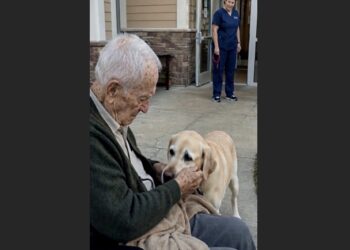
Gene leaned down.
Then his arms closed around the dog.
For several seconds, neither moved much.
Rusty pressed against Gene’s chest.
Gene held him.
Carol looked away because suddenly she was crying.
Then Gene Laughed
It was not a polite chuckle.
Not the small sound he sometimes made when someone tried to cheer him up.
Carol recognized it immediately.
It was her father’s laugh.
The one she remembered from before the move.
The one she had not heard since spring.
Rusty shifted in his arms, and Gene laughed again.
“There you are.”
His voice sounded different too.
More animated.
He touched the dog’s face.
Rubbed the gray ears.
Rusty’s tail kept moving.
Carol stood near the door, afraid that saying anything might somehow break the moment.
Nobody at Cedar Ridge interrupted.
Rusty Settled Onto Gene’s Lap
With Carol’s help, the old cocker spaniel found a comfortable position.
He had done it countless times years earlier.
Now Gene’s wheelchair changed the geometry slightly.
Rusty adjusted.
Then he relaxed.
His body settled against Gene as though the four months apart had not erased the physical familiarity between them.
Gene rested one hand across the dog’s back.
The other remained on Rusty’s gray head.
For the first time that afternoon, he stopped looking toward the window.
He looked only at the dog.
“Good boy,” he said.
Then again.
“Good boy.”
Rusty’s eyes began closing.
Carol Heard Her Father Say the Words She Had Been Afraid He No Longer Could
“I missed you something awful.”
Gene said it quietly.
He was not giving a speech.
There was no need.
His fingers moved through the fur behind Rusty’s ears.
The dog remained settled in his lap.
Carol had spent months wondering what her father missed.
The house?
His independence?
His neighborhood?
The yard?
People sometimes assumed he wanted to return to everything that had existed before Cedar Ridge.
Gene rarely told them.
Now, with Rusty against his chest, he finally named one absence himself.
“I missed you.”
That was enough for Carol.
Nobody Pretended Rusty Had Fixed Anything
That was important.
One good visit did not erase whatever Gene had been experiencing over the previous four months.
It did not reverse age.
It did not restore independence.
It did not resolve medical problems or adjustment difficulties.
A family dog is not a treatment plan.
But comfort does not have to be medicine to matter.
Rusty gave Gene something the building could not manufacture.
A familiar texture beneath his hand.
A scent associated with eleven years of home life.
A living creature connected to thousands of ordinary days.
That kind of familiarity can be powerful even when a person is otherwise withdrawn.
Nobody needed to call it miraculous.
The visible change was enough.
Rusty Didn’t Need Gene to Explain Where He Had Been
Dogs do not understand assisted-living placement in human terms.
Rusty could not know why Gene had stopped coming home.
He did not understand facility policies.
He did not know Carol had spent weeks arranging permission for the visit.
He knew something more immediate.
This person was familiar.
The voice was familiar.
The touch was familiar.
The body beneath him had been part of his world for most of his life.
His behavior suggested those associations remained.
He whined.
Approached.
Made contact.
Then settled.
That was plenty.
Gene Didn’t Need to Explain Himself Either
That may have been part of why the moment worked so well.
Human visits often require conversation.
“How are you?”
“Do you remember?”
“Did you eat?”
“Do you like it here?”
“What did you do today?”
Even loving questions can become tiring.
Rusty asked none.
He did not need Gene to be conversational.
Did not need him to remember Sunday plans.
Did not need an explanation of why the house was gone.
He needed a lap.
A familiar hand.
Maybe a scratch behind one ear.
Gene could provide all three without searching for the right words.
Carol Sat Down Beside Them
After a while, she pulled a chair near her father.
Normally, she would have tried to fill the silence.
That afternoon, she let it happen.
Gene continued speaking to Rusty in short phrases.
“You got gray.”
A pause.
“Look at you.”
Another pause.
“Still a good boy.”
Rusty rested.
Occasionally he lifted his head when Gene’s hand stopped moving.
Then settled again when the petting resumed.
Carol realized that much of what she had wanted from her father during recent visits was reassurance.
She wanted him to talk so she would know he was still emotionally present.
Rusty did not need that reassurance.
He simply responded to what Gene could offer.
Staff Members Quietly Passed the Open Door
News traveled quickly in a place like Cedar Ridge.
The resident who rarely spoke had a dog in his lap.
The dog was apparently his.
Someone walking by slowed.
Another staff member peeked in.
No one entered unless needed.
That restraint mattered.
Reunions can become uncomfortable when observers turn them into performances.
Gene did not need applause.
Carol did not need everyone asking how she felt.
Rusty certainly did not need a room full of strangers approaching him.
So the staff allowed the visit to remain small.
A father.
A daughter.
An old cocker spaniel.
A wheelchair near the window.
Gene Seemed Less Interested in the Parking Lot
For months, Carol had watched him stare outside.
Sometimes she wondered whether the window itself had become a kind of refuge.
The parking lot asked nothing of him.
Cars came.
Cars left.
Nobody required conversation.
Now the chair remained in the same position, but Gene had turned away from the glass.
Rusty occupied his attention.
He traced one finger along the dog’s ear.
Then scratched under his chin.
There was no urgency.
Carol noticed details she had almost forgotten.
The way Gene spoke differently to animals.
The way he repeated praise.
The way his hands seemed to know where Rusty preferred to be scratched.
Eleven years of routine were still visible in those movements.
Memory Is More Complicated Than a Simple On-or-Off Switch
Carol had worried because Gene sometimes seemed distant from familiar people and places.
But recognition does not always operate uniformly.
People may respond differently to old music, familiar smells, voices, photographs, places, or repeated physical routines.
That does not mean one preserved response proves anything specific about a medical condition.
Gene’s family had no need to draw a clinical conclusion from his reaction to Rusty.
They only knew what happened in the room.
He saw the dog.
Called him by name.
Held him.
Laughed.
Spoke to him.
For Carol, each of those moments mattered regardless of what Gene would remember later.
The Dog Had Aged Too
Carol noticed her father examining Rusty’s face.
The gray fur around his eyes was impossible to miss.
Rusty had slowed during the months apart.
Gene had changed too.
There was something tender in the fact that neither seemed to require the other to look as before.
Rusty did not care that Gene now used a wheelchair.
Gene did not seem bothered by the dog’s white muzzle.
Their relationship had been built across years in which both bodies gradually changed.
That afternoon was simply another version of the same relationship.
Older man.
Older dog.
Different room.
Same familiar hands in familiar fur.
The Visit Was Kept Gentle
Carol watched Rusty for signs that he was becoming tired.
At eleven, he needed consideration.
Excitement can hide fatigue for a while.
His joints were older.
His body required rest.
The staff had also learned that Gene tired more quickly than he once had.
Nobody wanted the first visit to become exhausting simply because nobody wanted it to end.
So Carol kept an eye on the clock.
The visit did not need to last all day to matter.
Gene’s hand stayed on Rusty’s head.
Rusty remained comfortable.
For the moment, that was enough.
Gene Asked About Things He Hadn’t Mentioned in Weeks
“Does he still sleep by the kitchen?”
Carol smiled.
“Sometimes.”
“Still beg?”
“Constantly.”
Gene looked down.
Rusty’s eyes were closed.
“You always were terrible.”
His voice carried affection rather than criticism.
Carol laughed.
Gene smiled.
The questions were ordinary.
To Carol, they felt enormous.
Not because they proved her father had returned to some earlier version of himself.
Because he was participating.
Curious.
Connected to a shared history.
For those minutes, conversation came without effort.
Rusty gave them something concrete to talk about.
Carol Had Been Carrying Her Own Guilt
She had done what the family believed was necessary.
Gene needed more support than he could safely receive at home.
Rusty needed daily care.
Cedar Ridge could not house him full time.
Taking the dog herself had been sensible.
Still, logic did not prevent guilt.
Every Sunday, Carol saw her father in one place and Rusty in another.
She wondered whether she had separated the two beings who had made each other’s days easier.
The reunion did not prove she had made a mistake.
Sometimes families have to choose among imperfect options.
Safety and care needs matter.
What the visit did show was that maintaining the relationship, when possible, was worth the effort.
Rusty Eventually Rested His Chin Against Gene’s Arm
The excitement softened.
His breathing slowed.
Gene’s fingers remained near one ear.
Carol sat nearby.
The room became quiet again.
But it was a different kind of quiet from the one she had feared during previous visits.
This silence did not feel like distance.
It felt settled.
Rusty was comfortable enough to rest.
Gene seemed content to hold him without speaking.
Carol no longer felt compelled to fill every empty second.
The three of them stayed that way.
Outside the window, cars continued moving through the parking lot.
Gene did not look.
Nobody Tried to Move Them
A staff member eventually appeared at the doorway.
Carol expected someone to say they needed the room or that the visit had to end immediately.
Instead, the staff member looked at Gene.
Then at Rusty.
She smiled and stepped away.
Another half hour could wait.
A scheduled activity could wait.
There are moments in caregiving when routine matters enormously.
Meals.
Medication.
Appointments.
Safety checks.
Then there are moments when flexibility matters just as much.
Gene had spent four months adapting to everyone else’s schedule.
That afternoon, Cedar Ridge adapted briefly to his.
Carol Watched Her Father’s Hand Stay on the Gray Head
That became the image she remembered most clearly.
Not the first laugh.
Not Rusty scrambling from the carrier.
Not even the moment Gene said his name.
It was the quiet period afterward.
Rusty resting.
Gene sitting.
One hand lying across the dog’s head as naturally as though it had been there the previous evening.
Eleven years of repetition had made the gesture familiar.
The move to Cedar Ridge had interrupted it.
The interruption had lasted four months.
Then, for one afternoon, the old pattern returned.
Rusty Had Not Brought the Old House Back
Gene was still at Cedar Ridge.
His wheelchair remained beneath him.
The room still belonged to the residence.
Carol would still take Rusty home when the visit ended.
Nothing had been reversed.
That was what made the scene feel grounded rather than magical.
They could not restore Gene’s previous life exactly as it had been.
They could bring one familiar part of that life into the room.
Sometimes care means accepting the larger reality while protecting small connections inside it.
Rusty was one of those connections.
Carol Stopped Measuring the Afternoon by What Her Father Might Remember Tomorrow
She could not control that.
Maybe Gene would ask about Rusty again.
Maybe he would remember every detail.
Maybe the specifics would fade.
None of those possibilities changed what was happening in front of her.
Her father was laughing.
Then talking.
Then sitting quietly with his dog asleep against him.
The experience did not need to remain perfectly accessible later to have value while it was happening.
Carol understood that more clearly than she had before.
There are good moments that matter because we remember them.
There are others that matter because we were comfortable while they lasted.
Gene was comfortable.
So was Rusty.
That was enough.
For a While, Nobody Needed Anything From Gene
He did not need to make conversation.
Did not need to explain how he was feeling.
Did not need to participate in an activity.
Did not need to reassure his daughter.
Rusty rested in his lap.
Gene’s hand moved across the dog’s gray head.
Every so often he whispered something.
“Good boy.”
“You’re all right.”
“I missed you.”
Carol sat close enough to hear but did not interrupt.
The window was still there.
The parking lot was still there.
The room had not changed.
Yet Gene was no longer staring through the glass.
For one afternoon, after four months of growing quieter, he had something familiar beneath his hand again.
And nobody at Cedar Ridge was in any hurry to take it away.
Editor’s Note: The characters in this story are fictional. Through these stories, we hope to share the intelligence, loyalty, compassion, and loving nature of dogs with people everywhere.