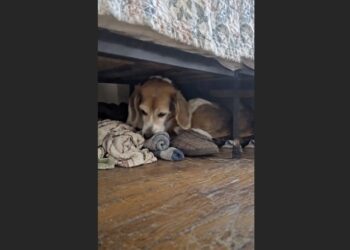
For 63 days, Mabel lived near the back wall of his kennel.
He had a folded blanket there.
A water bowl a few feet away.
Food that he usually ignored until the hallway became quiet.
And enough distance from the gate that visitors could look at him without getting close.
That seemed to be how he preferred it.
Mabel was an older Beagle mix with a whitening muzzle and tan ears that drooped beside his face. He was gentle during necessary handling, but he rarely volunteered for interaction.
When families stopped at his kennel, he watched.
If someone reached through the gate, he turned his head.
If they called to him repeatedly, he lowered himself farther onto the blanket.
If the hallway emptied, he relaxed.
The shelter tried treats.
Toys.
Quiet visits.
Nothing made him rush forward.
Then, one Saturday morning, a nine-year-old boy named Owen arrived carrying a paperback book.
He sat down several feet away.
And instead of asking Mabel to do anything, he began to read.
Owen Had His Own Reason for Being There
His mother had enrolled him in the shelter’s Saturday reading program because reading aloud at school had become difficult.
Owen knew the words.
That was not the problem.
At home, he could read entire chapters.
In class, when the teacher called his name, everything changed.
His voice became smaller.
His hands tightened around the page.
If another student shifted in a chair or whispered nearby, Owen lost his place.
Sometimes he stopped altogether.
His mother did not want reading to become something he feared.
The shelter program seemed different.
Dogs did not correct pronunciation.
They did not laugh.
They did not finish sentences for you.
They did not ask why your voice had gone quiet.
So Owen agreed to try.
He Chose the Dog Who Did Not Bark
The shelter volunteer showed him several kennels.
A young retriever bounced against the gate.
Another dog barked excitedly.
A terrier spun in circles.
Owen liked them.
He also seemed overwhelmed by them.
Then he reached Mabel.
The older dog remained on his blanket.
No barking.
No jumping.
No expectation.
Owen stopped.
“That one.”
The volunteer looked into the kennel.
“Mabel?”
Owen nodded.
“He’s quiet.”
That was enough.
The First Reading Happened From the Hallway
Owen sat in a plastic chair outside the kennel.
His mother remained several feet behind him.
He placed the book across his knees.
The cover was worn.
One corner had already begun curling upward.
Owen opened to the first page.
His first sentence was barely audible.
The volunteer at the desk could not understand what he was saying.
Mabel could hear something.
One tan ear slowly turned.
That was the only visible response.
Owen kept reading.
Mabel Did Not Come Closer
He remained on the blanket for the entire session.
Sometimes his eyes closed.
Sometimes he watched Owen.
When another person passed, his head lowered.
When the hallway settled again, his posture softened slightly.
Owen did not seem disappointed.
The volunteer had explained the rules before they began.
No calling the dog.
No reaching through the gate.
No trying to make him interact.
Just read.
At the end of the session, Owen closed the book.
“Bye, Mabel.”
The dog did not move.
Owen went home.
The Following Saturday, He Brought the Same Book
The shelter staff recognized him.
So did his chair.
Owen took the same seat.
Mabel was still at the back of the kennel.
Owen opened the book.
Instead of beginning where he had stopped the previous week, he went back to page one.
His mother noticed.
“You already read that part.”
“I know.”
“Why are you starting over?”
Owen shrugged.
“Maybe he missed some.”
His mother smiled and said nothing else.
This Time, Owen’s Voice Was Slightly Stronger
Not loud.
Just clearer.
He stumbled over a word.
Stopped.
Started again.
Mabel lifted his head.
Owen continued.
Nothing dramatic happened.
That was becoming part of the value of the program.
Owen could make a mistake and the room simply continued.
No one rushed him.
Mabel did not care whether the sentence came out perfectly.
For a child who had begun associating reading aloud with embarrassment, indifference could be a gift.
The Shelter Changed the Setup Gradually
After several visits, staff decided to move the reading session into a small visiting room.
Mabel could remain at the far end.
Owen would sit near the door.
There would be no forced contact.
The room was quieter than the kennel hallway.
That mattered for both of them.
Mabel entered first.
He went immediately to the wall.
A blanket had been placed there.
Owen sat in a chair on the opposite side.
He opened the book.
Nobody asked Mabel to come over.
By the Fourth Visit, Mabel Ate While Owen Read
The shelter volunteer placed a treat several feet from his blanket.
Normally, Mabel waited until people left before approaching food.
That Saturday, Owen was halfway through a page when the dog stood.
Owen saw the movement.
His voice stopped.
Mabel froze.
The volunteer made a small gesture.
Keep reading.
Owen looked back at the page.
The words started again.
Mabel walked to the treat.
Ate it.
Then returned to the blanket.
For the staff, that small act was encouraging.
Eating in the presence of a person can be difficult for a dog who feels unsafe.
Mabel had not suddenly become confident.
He had simply tolerated one more thing than before.
That was progress.
Owen Was Learning the Same Lesson
His mother noticed that his reading had begun changing too.
At home, he no longer rehearsed every paragraph before school.
He still dreaded being called on in class.
But he recovered from mistakes faster.
The shelter did not “cure” his anxiety.
Mabel was not a therapist.
Owen was simply practicing a difficult skill in an environment with less social pressure.
Week after week, the repetition helped.
Read.
Pause.
Try again.
Nobody laughed.
Mabel stayed.
By the Sixth Visit, the Blanket Was No Longer Mabel’s Only Spot
He still started there.
But after Owen had been reading for several minutes, the dog stood.
He walked toward the water bowl.
Then lay down beside it.
That placed him several feet closer to Owen.
The boy noticed.
He did not say anything.
Did not call the dog.
Did not extend his hand.
He simply turned the page.
That restraint may have mattered as much as anything else.
Approaching Owen did not result in pressure.
Mabel could change the distance without having the decision immediately taken away from him.
Owen Never Tried to “Win Him Over”
Adults sometimes wanted to.
They wanted the moment.
The photograph.
The dog finally taking a treat from a hand.
The frightened animal accepting a hug.
Owen seemed to have no interest in any of that.
Perhaps because he understood what it felt like when people stared at you waiting for you to perform.
He read.
Mabel decided where to lie.
That was the arrangement.
No one had to improve for the other.
The Book Became Familiar
Same cover.
Same smell.
Same pages turning.
Same boy’s voice.
Dogs build associations through repetition.
It would be impossible to know whether Mabel associated the physical book with Owen specifically.
But the overall pattern had become predictable.
Saturday.
Quiet room.
Boy in chair.
Soft voice.
No reaching.
No demands.
Predictability can make difficult environments easier to tolerate.
For Mabel, the reading hour gradually seemed to become one of the least stressful parts of the week.
Then Owen Missed a Saturday
He woke with a fever.
His mother called the shelter.
“He’s devastated,” she said.
The volunteer told her not to worry.
The reading program would continue the following week.
Owen stayed home.
Mabel, of course, could not understand that explanation.
At the usual time, staff noticed something unusual.
He left his blanket.
Walked toward the visiting-room door.
Then lay down beside it.
He Stayed There for Most of the Reading Hour
No one claimed he knew what day of the week it was in a human sense.
Dogs can learn recurring schedules through environmental cues, staff routines, time-of-day patterns, and repeated sequences.
Mabel may have anticipated the usual session because multiple familiar cues had lined up.
The boy did not arrive.
The dog remained near the door.
Later, a volunteer found him still there.
When evening routines began and the hallway lights were switched off, Mabel finally returned toward his kennel area.
Staff mentioned it to Owen’s mother.
She told Owen.
He did not say much.
He just asked when he could go back.
The Next Saturday Was Rainy
Water streaked the shelter windows.
Owen arrived with the same old paperback tucked beneath his jacket.
His hair was wet and refusing, as usual, to lie flat.
Mabel was already in the visiting room.
Owen sat.
Opened the book.
Started reading.
For several minutes, everything looked normal.
Then Mabel stood.
He Crossed the Room Slowly
Owen stopped mid-sentence.
His mother, seated near the wall, watched without moving.
Mabel took several steps.
Paused.
Sniffed the floor.
Continued.
He stopped again.
Nobody called him.
Nobody reached.
The room remained quiet enough that the rain against the window was audible.
Mabel continued toward the blue mat beside Owen’s chair.
Then he lowered himself onto it.
Closer than he had ever chosen to be.
Owen Kept Reading
That was the right thing to do.
So he did.
His voice shook slightly at first.
Then steadied.
Mabel shifted.
His body moved closer to the chair.
Owen was halfway through another paragraph when the dog raised his head.
Slowly, Mabel placed his white muzzle across the bottom edge of the book.
Owen stopped.
For a moment, neither moved.
The paperback bent slightly under the weight of the dog’s chin.
Owen looked toward his mother.
She did not tell him what to do.
Owen Reached With Two Fingers
Not over Mabel’s head.
Not around his neck.
Just two fingers behind one ear.
Mabel stayed.
Owen touched the fur.
The dog’s eyes softened.
Owen found his place on the page again.
Then he started the sentence from the beginning.
Mabel remained where he was.
His muzzle rested partly on the book.
Owen read the rest of the chapter.
Nobody Hugged Him
That detail mattered.
The moment would have looked perfect in a photograph if Owen had wrapped both arms around Mabel.
He did not.
Mabel had chosen proximity.
Owen respected the limit of that choice.
Two fingers became a gentle scratch behind the ear.
Nothing more.
A fearful animal does not become public property the moment he approaches someone.
Trust is not permission for everything.
Owen seemed to understand that instinctively.
Mabel Stayed Until the Chapter Ended
When Owen closed the book, the dog lifted his head.
He remained on the blue mat.
Owen stood slowly.
“Bye.”
Mabel watched him leave.
The boy carried the book home.
One corner was now bent more sharply than before where Mabel’s chin had rested.
Owen refused to straighten it.
His Mother Returned the Next Morning
This time, Owen was not with her.
She carried paperwork.
An adoption application.
Several sections had been completed in careful block letters.
Owen had helped.
His mother had done the adult parts.
Housing.
Veterinary plans.
Schedule.
Costs.
The family had discussed what adopting an older, fearful dog would actually involve.
They understood that one quiet reading-room relationship did not guarantee an easy transition into a home.
Mabel might retreat again.
New sounds could frighten him.
Visitors could be difficult.
Household routines would need to remain predictable.
Owen still wanted him.
So did his mother.
The Shelter Did Not Approve the Adoption Because the Story Was Sweet
That would have been irresponsible.
Staff reviewed the application.
They talked about Mabel’s behavior.
They discussed safe spaces.
Introductions.
Handling.
The importance of not forcing affection.
They explained that Mabel might choose Owen and remain wary of other people.
That would not mean the adoption had failed.
The family listened.
They did not ask whether Mabel would become “normal.”
They asked what would help him feel safe.
That was a better question.
That Afternoon, Mabel Walked Through the Front Door
He wore the same teal collar he had worn during his 63 days at the shelter.
Owen held the leash with his mother’s hand close beside his.
The shelter staff kept the departure quiet.
No cheering crowd.
No loud goodbye.
Mabel stepped outside.
Paused.
Looked around.
Then followed.
The dog did not understand that he had been adopted permanently.
He understood only the immediate sequence.
Door.
Parking lot.
Car.
Owen nearby.
The rest would have to be learned through experience.
The First Days at Home Were Not Perfect
Mabel found a corner.
That was expected.
He ate cautiously.
He followed Owen with his eyes.
He hesitated at doorways.
The family gave him space.
Owen wanted Mabel in his bedroom immediately.
His mother reminded him of the shelter rule.
Let him decide.
So the bedroom door remained open.
A bed was placed nearby.
Nobody carried Mabel inside.
The first night, he slept elsewhere.
The second night too.
Then one evening, Owen began reading in bed.
Mabel Appeared in the Doorway
Owen pretended not to notice.
He read.
Mabel stood there.
Then entered.
A few steps.
Pause.
More steps.
He finally settled near the left side of the bed.
Not touching.
Close.
Owen kept reading.
The same pattern that had worked in the shelter now worked at home.
No invitation was required.
The dog knew what to do.
Saturday Reading Continued
The shelter program had been designed for practice.
At home, it became routine.
Every Saturday, Owen chose a book.
Sometimes the old paperback.
Sometimes something new.
Mabel usually settled near his left knee.
The blue shelter mat was gone.
The position remained.
Owen’s mother occasionally listened from the hallway.
His voice grew stronger over the months.
Not because Mabel corrected him.
Because Mabel never did.
School Improved More Slowly
Owen still struggled when asked to read in front of classmates.
The shelter experience did not magically erase performance anxiety.
But he had accumulated evidence that he could keep going after a mistake.
He had read entire chapters aloud.
He had mispronounced words and recovered.
He had lost his place and found it again.
Those skills transferred gradually.
His teacher noticed.
Owen raised his hand once to volunteer for a paragraph.
Then spent the rest of the day pretending it had not been a big deal.
His mother knew better.
Mabel Changed Gradually Too
Visitors still required patience.
He preferred quieter people.
Sudden reaching made him uncomfortable.
He kept a bed in Owen’s room and another in a more private part of the house.
Both mattered.
He did not become a dog who greeted everyone at the door.
Nobody needed him to.
His life improved without changing his entire personality.
That was important.
A successful adoption does not mean turning a cautious dog into an outgoing one.
It means building a life that works for the dog who actually exists.
Owen Became Good at Explaining Mabel
When friends visited, he gave them instructions.
“Don’t call him.”
“Don’t stare at him.”
“Just sit down.”
“If he comes over, let him sniff first.”
His friends sometimes found the rules strange.
Owen did not.
He remembered how it felt when everyone waited for him to speak before he was ready.
That did not mean he and Mabel experienced fear in the same way.
They were different species with different needs.
Still, Owen had learned something useful.
Pressure rarely helps someone feel less pressured.
The Old Paperback Stayed on His Shelf
Eventually, Owen outgrew the story.
The book itself became too easy.
Still, he kept it.
The cover faded.
Pages loosened.
The corner remained bent.
His mother once tried to flatten it while dusting.
Owen stopped her.
“That’s where Mabel put his head.”
So the corner stayed.
It was an ordinary paperback.
Probably worth very little.
Its value came from one afternoon when an old Beagle mix had voluntarily crossed a room and decided the space beside a nine-year-old boy was safe enough to stay.
Mabel Never Knew He Was Helping Owen
He did not understand school.
He did not understand reading anxiety.
He did not know the boy beside him sometimes froze when classmates listened.
Mabel did not need to know any of that.
His contribution was simpler.
He was there.
Quiet.
Nonjudgmental because dogs do not evaluate reading performance in the human sense.
Owen did the work himself.
Page after page.
Week after week.
Mabel just gave him somewhere comfortable to practice.
Owen Did Not “Save” Mabel Either
Shelter staff had cared for him.
Volunteers had worked patiently.
His family provided the home.
Owen contributed something specific.
He let Mabel approach without turning every approach into a demand.
That mattered.
The dog’s progress came from many safe experiences accumulating over time.
There was no single magical moment that erased five weeks of fear.
Not even the book.
Not even the blue mat.
Not even the first touch behind the ear.
What Changed Was the Pattern
At the shelter, people often approached Mabel.
With Owen, Mabel approached.
That difference gave the dog more control.
At school, adults often waited for Owen to perform.
With Mabel, Owen could read badly, quietly, slowly, and nothing terrible happened.
Both began with less pressure.
That was enough for something new to become possible.
Years Later, the Bent Corner Remained
Owen could pick up the book and know exactly where it happened.
The blue mat was long gone.
The shelter visiting room had probably changed.
Mabel was older.
His muzzle whiter.
His naps longer.
But on Saturday mornings, he still often settled beside Owen’s left leg.
Sometimes Owen read.
Sometimes he used a phone.
Sometimes neither did anything.
The routine no longer required a book.
That was another sign of how far they had come.
The Most Important Step Was Mabel’s
Not because it was brave in some heroic sense.
Not because he conquered fear forever.
Because he chose it.
After 63 days spent near a back wall, Mabel walked toward someone who had never asked him to hurry.
He stopped when he needed to.
Sniffed.
Changed his mind about the distance several times.
Then rested his chin on a book.
Owen responded the same way he had from the beginning.
He stayed quiet.
He moved carefully.
He kept reading.
Trust did not begin because one of them persuaded the other.
It began because both were given enough room to proceed at their own pace.
And sometimes that is all a first step needs.
Not courage.
Not pressure.
Just time, predictability, and the freedom to choose when you are ready to come closer.
Editor’s Note: The characters in this story are fictional. Through these stories, we hope to share the intelligence, loyalty, compassion, and loving nature of dogs with people everywhere.