The Dog Bed Was Ready, but Hazel Walked Past It
The first night Hazel had an entire house available to her, she chose a space barely wider than her body.
Rachel, her foster, had prepared carefully.
A soft dog bed waited in the living room.
Fresh water sat nearby.
The hallway had been cleared so Hazel would not have to navigate around clutter with her weak hind legs.
Rachel expected the older German Shepherd to investigate slowly.
Maybe circle the bed.
Maybe lie near it.
Instead, Hazel walked right past.
She continued toward the laundry area, found the narrow gap between the washing machine and the wall, turned awkwardly, and backed herself inside.
Then she lay down.
Rachel stood several feet away and looked at the expensive bed in the living room.
Hazel had chosen perhaps eight inches of empty floor beside an appliance.
Rachel did not move her.
“You can sleep there tonight,” she said quietly.
And Hazel did.
A Maintenance Worker Had Found Her Behind an Abandoned Motel
Several days earlier, Hazel’s world had been much smaller.
A maintenance worker had arrived at an abandoned roadside motel in southern Missouri to help clear the property before it was placed on the market.
Most of the work was predictable.
Debris.
Old furniture.
Rotting boards.
Trash left behind in rooms that had been empty for some time.
Behind the motel stood a locked storage shed.
When the worker opened it, he heard something scrape across the floor.
He stopped.
The sound came again.
Then he saw the dog.
An older German Shepherd was inside a makeshift enclosure constructed from shipping pallets.
The pen was so tight that turning around required effort.
Empty feed bags were stacked against one side.
A plastic bucket contained a little water.
Hazel was trying to stand.
Nobody Knew How Long She Had Been There
That became one of the questions no one could answer.
The motel had been abandoned.
Records were incomplete.
People who had once been associated with the property were difficult to locate.
There was no reliable account explaining exactly when Hazel had been placed in the shed, who had cared for her, or how long the conditions had existed.
It was tempting to fill in those blanks with the worst possible story.
The people who later cared for Hazel tried not to.
What they could see was serious enough.
She had been confined in an extremely restricted space.
She was underweight.
Her nails were overgrown.
Her hindquarters were weak.
The worker did not need to know every detail of her past to understand that she needed help.
He crouched outside the pallet pen.
Hazel watched him.
He Opened the Pen, and Hazel Stayed Inside
The worker pulled one section aside.
Nothing happened.
Hazel did not rush toward freedom.
She did not leap through the opening.
She stayed exactly where she was.
So he stepped backward.
Still nothing.
Her eyes followed him.
He waited.
Eventually, he brought water and placed the bowl just beyond the opening.
Hazel stretched her neck toward it.
Her front paws remained inside the pen.
He moved the water closer.
She drank.
That was the beginning.
Not a dramatic rescue where the dog immediately understood she was safe.
Just a stranger moving a bowl several inches closer because the dog was not ready to cross an opening.
Sometimes that is what help looks like.
The Veterinary Clinic Did Not Rush Her Either
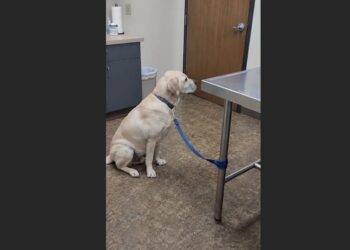
Hazel needed assistance standing when she arrived.
Her rear legs lacked strength.
Her nails had become long enough to interfere with comfortable movement.
Her low body weight raised additional concerns.
The veterinary staff evaluated her carefully.
They provided thick bedding.
Food.
Water.
Medical care.
They also paid attention to what frightened her.
Quick approaches made Hazel press her body toward walls or corners.
If several people entered at once, she became more tense.
She ate better after the room grew quiet.
So the staff adjusted.
They moved slowly.
Kept handling purposeful.
Allowed her time between procedures.
Pain, weakness, unfamiliar surroundings, and a history of confinement could all influence her behavior.
No one pretended to know exactly which factor explained every reaction.
They simply made the environment easier for her to tolerate.
Hazel Seemed More Comfortable With Edges Than Open Space
That pattern became clearer after Rachel brought her home.
Rachel lived in a small bungalow outside town.
Nothing about it was extravagant.
For Hazel, it may as well have been enormous.
There were rooms.
Doorways.
A hallway.
Open floor.
Windows.
A yard beyond the back door.
Rachel had assumed space would feel like relief.
Instead, Hazel repeatedly chose boundaries.
Beside the washing machine.
Under the kitchen table.
Behind an armchair.
Next to the laundry basket.
Places where her body could touch something on one or more sides.
Rachel began to understand that an open living room might not feel comforting simply because humans considered it comfortable.
A dog accustomed to restricted space may initially prefer enclosure and physical boundaries.
Whatever the reason, cramped places appeared easier for Hazel.
So Rachel stopped trying to pull her out of them.
The New Dog Bed Stayed Where It Was
Rachel did not remove it.
She also did not keep placing Hazel on it.
The bed remained in the living room.
Available.
Nothing more.
That became Rachel’s approach to many things.
Offer.
Wait.
Let Hazel make a choice.
She fed her on a predictable schedule.
Kept the water bowl in the same place.
Moved furniture as little as possible.
Avoided sudden visitors.
At night, if Hazel went beside the washing machine, Rachel let her sleep there.
Eventually, the dog began using the area beneath the kitchen table too.
Rachel placed a small mat there.
The goal was not to teach Hazel immediately that the open center of a room was safe.
It was to give her enough stability that she could discover it herself.
Their First Trip Into the Yard Lasted Less Than a Minute
Rachel opened the back door.
Hazel stood behind her.
The yard was fenced.
Quiet.
Nothing threatening was visible.
Still, Hazel hesitated.
Rachel stepped onto the patio.
Hazel followed.
Barely.
She reached the edge where concrete met grass.
Lowered her nose.
Sniffed.
Then turned and hurried back inside.
Rachel closed the door.
That was the entire outing.
She did not pull Hazel back outside.
Did not walk her around the yard on a tight leash to prove nothing bad would happen.
Did not decide they needed to “push through” the fear.
A frightened or uncertain dog does not necessarily become confident by being forced to remain in an overwhelming environment.
So they tried again the next morning.
Rachel Brought Coffee the Second Time
She opened the back door.
Then sat on the bottom step.
Hazel stood inside.
Rachel drank her coffee.
The dog stayed in the doorway.
Nothing happened for several minutes.
That was fine.
Rachel looked toward the yard instead of staring at Hazel.
She finished part of the cup.
Then she felt something near her arm.
A nose.
Hazel had stepped outside.
No celebration.
Rachel did not reach suddenly.
Hazel stood beside her for a moment.
Then sniffed the edge of the step.
That morning, they stayed outside longer.
Not long.
Just longer than the day before.
For Hazel, that counted.
Grass Became Part of the Morning
The next few weeks were built from repetitions like that.
Door opens.
Rachel sits.
Hazel chooses.
At first, she remained on the patio.
Later, one paw touched the grass.
Then two.
Eventually, all four.
Her body remained close to Rachel.
If a sound startled her, she returned toward the house.
Rachel allowed it.
The yard was not a test.
It was simply another place Hazel was learning.
Each morning, the boundaries of her comfort expanded a little.
Sometimes progress seemed to disappear the next day.
That did not worry Rachel as much as it had at first.
Recovery is rarely linear.
Stress, sleep, weather, pain, or unexpected sounds can change what a dog can handle on any particular morning.
Rachel started measuring progress across weeks instead of minutes.
One Morning, Hazel Walked to the Fence
Rachel noticed only after the dog had already moved several yards away.
Hazel was sniffing.
Not scanning.
Not rushing back.
Sniffing.
She reached the fence line.
Investigated a fallen leaf.
Then a flowerpot.
Then followed some invisible scent trail through the grass.
Rachel stayed on the step.
The urge to call Hazel’s name was strong.
She resisted it.
The dog did not need to be interrupted because something wonderful was happening.
Hazel was exploring voluntarily.
For several minutes, she wandered.
Then she returned.
Rachel expected her to go inside.
Instead, Hazel lowered herself onto the grass beside the patio.
Then stretched out fully.
Front legs extended.
Back legs relaxed.
Body long.
Rachel realized she had never seen the Shepherd take up that much space before.
That Was the First Time Hazel Looked Comfortable Being Large
Inside the shed, space had been scarce.
At the clinic, she had pressed toward corners.
In Rachel’s house, she had chosen narrow gaps.
Now she lay in the open yard with nothing touching her sides.
Rachel sat quietly.
She did not photograph the moment.
Did not move closer.
She simply watched.
Hazel closed her eyes.
A breeze moved the fur along her side.
Her hind legs were still weak.
Her body was still thin.
No emotional breakthrough had cured the physical effects of neglect and confinement.
She needed nutrition.
Veterinary follow-up.
Gradual strengthening.
Rest.
Possibly long-term support for age-related stiffness.
But something had changed.
For a few minutes, she was willing to occupy more room.
Her Strength Returned Slowly
Rachel followed the veterinary plan.
Meals were measured.
Exercise increased carefully.
Walks were short enough that Hazel did not become exhausted.
Her nails were managed.
Her skin and coat improved with consistent care.
Her hindquarters strengthened somewhat, though age and whatever physical history she carried meant she was never going to become a young Shepherd again.
That was not the goal.
Comfortable movement mattered more than speed.
Rachel added rugs in areas where smooth flooring made Hazel uncertain.
She kept a bed in the living room.
Another soft resting place appeared closer to the kitchen.
Hazel ignored both at first.
Then, one afternoon, Rachel caught her standing on the edge of the living-room bed.
She sniffed it.
Walked off.
Rachel said nothing.
The Bed Became Interesting in Stages
A few days later, Hazel placed both front paws on it.
Another week passed.
Rachel walked into the room and found her sitting on the bed.
Not lying.
Just sitting.
The moment Rachel appeared, Hazel stood and moved away.
Rachel pretended nothing unusual had happened.
That mattered.
If every brave choice triggered excitement, Hazel might become unsure about making it again.
So the bed stayed ordinary.
A soft rectangle in the middle of the room.
Available when she wanted it.
The next time Rachel saw her there, Hazel remained for several seconds longer.
Then one evening, she lay down.
Curled tightly at first.
Rachel lowered the television volume.
Hazel slept for twenty minutes.
It was progress.
Not completion.
Several Months Later, Elaine Came to Meet Her
By then, Hazel was ready for adoption.
Ready did not mean fearless.
It meant her needs were better understood.
She required a quiet home.
An adopter willing to move slowly.
Someone comfortable with an older dog whose mobility had to be respected.
Someone who would not force affection.
Elaine had applied specifically for a senior dog.
She was a retired school cafeteria cook.
Her home was small.
The backyard was fenced.
She was not looking for a running partner.
She wanted company.
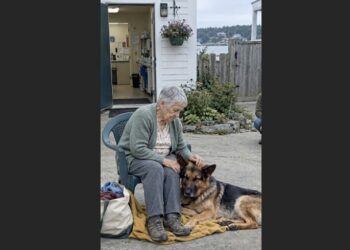
When Elaine arrived, Rachel brought her to the patio.
Hazel wandered nearby.
Elaine did not immediately call her over.
That got Rachel’s attention.
Elaine Sat Down and Started Talking to Rachel
They talked about ordinary things.
The house.
The yard.
Veterinary care.
Medication.
Walks.
Hazel’s preference for quiet spaces.
The possibility that she might always seek sheltered corners when stressed.
Elaine listened.
Hazel moved around them.
At one point, she sniffed Elaine’s shoe.
Elaine did not reach down.
They kept talking.
Several minutes later, Hazel returned.
This time, she stood beside Elaine.
Then lowered herself.
Her shoulder touched the side of Elaine’s shoe.
Elaine looked down.
She did not move her foot.
Minutes passed.
Eventually, she whispered, “I think my toes are asleep.”
Rachel laughed.
Elaine stayed where she was anyway.
Then she asked the question Rachel had hoped to hear.
“When could I bring her home?”
Adoption Still Required More Than a Good First Meeting
Rachel liked Elaine.
Hazel appeared comfortable.
Neither fact was enough by itself.
They talked through the practical details.
Could Elaine manage a large senior Shepherd physically?
Yes, with some planning.
Her home did not have difficult interior stairs.
She could place traction rugs on slick floors.
She had a vehicle Hazel could enter with assistance, and a ramp could be added if necessary.
She understood ongoing veterinary expenses.
She knew walks might remain short.
She had a plan for help if her own health changed.
That mattered.
Senior adoption is often portrayed as simple because older dogs sleep more.
In reality, aging dogs may require medication, mobility support, dental care, veterinary monitoring, and adjustments around the home.
Elaine was prepared for that.
The adoption moved forward.
Hazel Did Not Immediately Claim Elaine’s House
The first night there, she returned to an old strategy.
She found a narrow place beside a chair.
Elaine let her.
The new dog bed waited nearby.
Hazel ignored it.
That did not upset Elaine.
She already knew the pattern.
Meals remained predictable.
Back door in the morning.
Short yard time.
Rest.
Slow walk if Hazel wanted one.
Elaine did not invite a parade of friends over to meet the new dog.
For the first several days, the house stayed quiet.
Hazel learned the kitchen.
The porch.
The path to the garden.
The sound of Elaine moving from one room to another.
New routines began replacing uncertainty.
Their Walks Never Needed to Be Long
Some mornings, Hazel walked to the end of the street.
That was enough.
Other mornings, she explored only the garden.
On stiff days, even that could take time.
Elaine watched her rather than the distance.
If Hazel moved comfortably, they continued.
If she slowed, they turned back.
The objective was not exercise for its own sake.
It was movement, scent, interest, and maintaining mobility without pushing an aging body too far.
Hazel became particularly fond of the covered porch.
She could lie there while remaining near the house.
It offered shelter without enclosure.
That seemed to suit her.
Sometimes she slept there for an hour.
Sometimes she watched birds.
Sometimes she simply breathed the outside air and did nothing.
Elaine considered all three productive.
The Washing-Machine Gap Became a Story Rachel Told Less Often
At first, it was the detail everyone wanted to hear.
The dog who had been confined so long that she chose another cramped place.
It made the story easy to understand.
Over time, Rachel stopped centering Hazel’s past every time she talked about her.
Hazel was more than the shed.
More than the pallet pen.
More than the first night beside the washing machine.
She had preferences unrelated to fear.
She liked certain treats.
Disliked rain.
Enjoyed sniffing flowerpots.
Preferred quiet voices.
Had strong opinions about where Elaine should place blankets.
Learning those details mattered because rescue should not leave an animal forever trapped inside the worst thing that happened to her.
Hazel’s history explained some behavior.
It did not need to define all of her.
The First Time She Used the Living-Room Bed, Elaine Almost Missed It
It was evening.
The television was on quietly.
Elaine was reading.
Hazel had been moving around the room.
Then everything became still.
Elaine looked over.
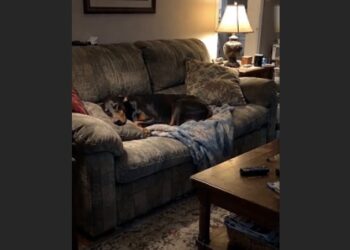
Hazel was on the bed.
Not sitting at the edge.
Not curled into the smallest possible shape.
She was lying on her side.
Her legs stretched out.
Her body covered nearly the entire cushion.
For a moment, Elaine did not move.
She remembered what Rachel had told her.
The narrow gap.
The corners.
The way Hazel once pressed herself behind furniture.
Now there was open floor on every side.
Hazel was asleep anyway.
Elaine reached for the remote.
Turned the volume down.
Then stayed in her chair.
Nobody Could Know What Hazel Thought About Space
That was important.
We cannot say she remembered the storage shed every time she chose a narrow place.
We cannot say the dog bed represented emotional freedom when she finally stretched across it.
Those are human interpretations.
What could be observed was enough.
Early on, Hazel repeatedly selected enclosed spaces.
Over time, as routines became predictable and her physical condition improved, she increasingly rested in more open areas.
She explored farther into yards.
She stretched out.
She slept deeply.
Those behavioral changes suggested increasing comfort.
They did not require a more elaborate explanation.
Dogs tell us plenty through what they do.
We do not always need to write the rest of the sentence for them.
Hazel Still Has Stiff Mornings
Elaine hears her shifting before she stands.
Front legs first.
Then the back.
Sometimes the old Shepherd pauses.
Elaine waits.
There are rugs where Hazel needs traction.
A soft bed waits in the living room.
If her joints are bothering her, the walk becomes shorter.
Veterinary care remains part of the routine.
Nothing about adoption reversed Hazel’s age.
A safe home does not erase arthritis or muscle loss.
Love does not function as medication.
What it can do is make good care consistent.
Hazel gets whatever treatment her veterinarian recommends.
She gets rest.
She gets movement appropriate for her body.
Most importantly, no one asks her to perform youth she no longer has.
Every Morning, Elaine Opens the Back Door
Then she waits.
Hazel decides.
Sometimes she walks into the garden.
Sometimes she stops in the sunny patch beside the steps.
Sometimes she sniffs the air and turns right back around.
Elaine lets her.
Choice became one of the quiet luxuries of Hazel’s later life.
Not unlimited choice.
She still needs veterinary care.
She still needs safe boundaries.
But within those boundaries, small decisions belong to her.
Outside or inside.
Porch or living room.
Grass or bed.
Walk farther or turn home.
For a dog once found in a space barely large enough to turn around, those ordinary options feel especially significant to the humans who know her story.
The Bed Sits in the Middle of the Room Now
It is wide.
Soft.
Easy for Hazel to step onto.
There is no wall pressed against one side.
No appliance on the other.
No pallet boards.
Nothing holds her there.
She can leave whenever she wants.
Most evenings, she chooses to stay.
Elaine occasionally looks over and finds the old German Shepherd stretched so far across the cushion that one paw hangs off the edge.
Her gray muzzle rests against the fabric.
Her breathing deepens.
Sometimes she snores.
Elaine turns down the television.
She stays in her chair a little longer.
There is no need to wake Hazel.
No need to touch her just because the moment feels meaningful.
The dog is sleeping.
That is meaningful enough.
Hazel Finally Learned She Could Take Up Room
Not because someone taught her with a command.
Not because a trainer placed her on the bed.
Not because love erased whatever happened before the maintenance worker opened that shed.
She learned through repetition.
A doorway opened.
Nobody forced her through it.
A yard waited.
Nobody dragged her onto the grass.
A person sat nearby.
Nobody reached before she was ready.
A bed remained available.
Nobody placed her on it.
Day after day, she had choices inside an increasingly predictable world.
Eventually, one evening, an old German Shepherd climbed onto a wide bed in the middle of a living room and stretched her body across nearly all of it.
Elaine noticed.
Then did the kindest thing she could think of.
She let Hazel sleep.
Editor’s Note: The characters in this story are fictional. Through these stories, we hope to share the intelligence, loyalty, compassion, and loving nature of dogs with people everywhere.