“Wait—She’s Scared of Strangers”
The rescue volunteer reached toward the gate, but Willow was already moving.
For three weeks, the German Shepherd had spent most introductions trying to create distance.
A new person entered the room, and Willow slipped beneath a bench.
Someone extended a hand, and she leaned away.
Food interested her, but she often waited until people stepped back before approaching the bowl.
Nobody at the small animal clinic on the coast of Maine considered her aggressive.
She was frightened.
That distinction mattered.
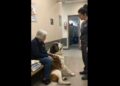
So when Willow unexpectedly slipped into the courtyard one afternoon and started walking toward an elderly woman sitting beside the garden, the volunteer’s first instinct was to stop everyone else from moving.
“Wait,” she said quietly. “She’s scared of strangers. Let her come to you.”
The woman had not come to adopt a dog.
Her name was June.
She was there to give something away.
The Blankets Had Been Sitting in June’s Car
For months, June had kept them folded in the back seat.
They had belonged to her dog.
There was nothing especially valuable about them.
A few old blankets.
Soft from years of washing.
Dog hair stubbornly woven into places even repeated laundering could not completely reach.
One was faded yellow.
June had been meaning to donate them since her dog died.
Meaning to was easier than doing it.
Every time she looked at the blankets, she found a reason to wait another week.
Eventually, she washed them.
Then folded them.
Then folded them again.
She placed them inside a bag and drove to the clinic, which worked with a local rescue group and accepted bedding donations.
When she arrived, June drove around the block once before parking.
Letting go of old dog blankets should have been simple.
It wasn’t.
Grief Had Settled Into the Quiet Parts of Her Day
June had adjusted to the practical changes first.
No food bowls to wash.
No veterinary reminders.
No leash hanging by the door waiting for the next walk.
The harder changes lived in habits that continued after they were no longer needed.
She still woke early.
For years, mornings had meant putting on shoes and going outside with a dog.
Now she sometimes woke at the same hour and lay there listening to the house.
At breakfast, she occasionally caught herself saving the last bite of toast.
Then she would remember.
There was nobody waiting for it.
She had told friends she was doing fine.
Most days, that was true.
Grief does not necessarily mean a person is falling apart.
Sometimes it simply means there are moments in an otherwise ordinary day when your hand reaches automatically for something that is no longer there.
June had been living with those moments for months.
She Had Already Delivered the Blankets
The donation itself took only a few minutes.
A receptionist thanked her.
A volunteer carried some of the bedding inside.
June could have returned to her car.
Instead, she sat in a chair near the courtyard garden.
Perhaps she needed a few minutes before driving home.
Perhaps she simply did not want to walk immediately back to the empty back seat.
Nobody pressed her for an explanation.
She sat with her hands folded in her lap and watched the movement around the clinic.
Then the gate opened.
Willow appeared.
The German Shepherd saw June.
And stopped.
Willow Had Been Keeping Her Distance From Almost Everyone
The rescue knew very little about Willow’s earlier life.
That meant staff refused to invent explanations for her fear.
They did not say she had definitely been beaten.
They did not claim she had been abandoned by a particular kind of person.
Fearful behavior alone cannot provide that history.
Willow might have experienced frightening interactions.
She might also have received inadequate socialization.
Stress from changing environments could be contributing.
There could have been several factors at once.
What staff could observe was enough.
Willow needed space.
She needed predictable routines.
She needed humans who understood that approaching a frightened dog is not always helpful.
During her first three weeks, volunteers concentrated on making daily life manageable rather than forcing social contact.
Meals.
Quiet walks.
Rest.
Low-pressure exposure to people.
Choice whenever possible.
Progress had been slow.
That was expected.
June Did Almost Nothing
Willow stopped several feet away from her chair.
June looked at the dog.
Then at the volunteer.
“Should I move?”
“Just stay where you are.”
So June stayed.
She did not call Willow’s name.
She did not pat her legs.
She did not hold out both hands.
Instead, she turned slightly toward the garden.
Her body was no longer facing the Shepherd directly.
Her hands remained in her lap.
That gave Willow something frightened dogs often need more than encouragement.
Room to make a decision.
Behind them, the courtyard seemed to become unusually still.
A delivery driver lowered the box he was carrying.
The receptionist watched through the doorway.
Nobody wanted to interrupt whatever Willow was doing.
Then the Yellow Blanket Slipped From the Bag
June shifted her feet.
The corner of the faded yellow blanket slid onto the ground beside her chair.
Willow noticed.
Her nose lowered.
She took another step.
Then another.
She reached the blanket and sniffed it carefully.
The fabric may have carried traces of familiar dog scent despite washing.
Or perhaps its softness simply offered an appealing place to settle.
There was no way to know.
What happened next was easier to describe.
Willow turned once.
Then lowered herself onto the blanket.
June stared down at her.
“That was somebody’s favorite,” she said softly.
Her voice broke on the final word.
Willow lifted her head.
For a moment, neither moved.
June Had Not Told Anyone Why the Blankets Were Difficult to Give Away
The volunteer knew only that an older woman had arrived with a donation.
She did not know about the morning walks that had stopped.
Or the toast.
Or the silence in June’s kitchen.
June looked down at Willow.
“I’m a little out of practice,” she murmured.
Then, with a faint smile:
“It’s been a while since anyone wanted to sit with me.”
Willow shifted.
Her shoulder touched June’s ankle.
That contact was small enough that someone passing quickly might not have noticed it.
The volunteer did.
Willow usually arranged herself beyond easy reach.
Now she had chosen to settle beside a stranger.
The volunteer crouched several feet away.
“Would you like to try petting her?”
June hesitated.
Then she lowered one hand.
She Let Willow Close the Final Distance
June did not place her hand on the dog’s head.
She rested it loosely beside her knee.
Willow sniffed her fingers.
Then remained there.
June waited.
A few seconds later, Willow moved her head beneath the hand.
Only then did June touch her.
One slow stroke behind the ear.
Then another.
Willow stayed.
June stopped after a moment.
The Shepherd nudged her hand.
That was when June began to cry.
Not dramatically.
Her mouth trembled.
She wiped one cheek with her other hand and gave the embarrassed little laugh people sometimes use when emotion arrives before they are ready for it.
“I only came to drop off some blankets.”
The volunteer smiled.
“You can stay a little longer.”
So she did.
Willow Slept Beside Her Chair
The afternoon grew cooler.
Someone brought June a cup of tea.
Willow remained on the yellow blanket.
Eventually, the Shepherd stretched onto one side and closed her eyes.
June kept one hand near her but did not constantly touch her.
That mattered.
Willow had approached.
Willow could also disengage.
No one wanted the first successful contact with a stranger to become forty minutes of unwanted petting simply because humans were excited about it.
While Willow rested, June began talking with the volunteer.
She described the walking trail behind her house.
The fenced portion of her yard.
The sunny patch that crossed the kitchen floor every morning.
She mentioned her previous dog.
There were pauses.
Some stories were easier than others.
At no point did the volunteer tell her she needed another dog.
June had not come looking for one.
That decision was too important to make simply because an afternoon felt meaningful.
Before She Left, June Asked One Question
“Could I come back tomorrow?”
The volunteer said yes.
June carefully stood.
Willow raised her head.
She did not panic when June stepped away.
That was encouraging too.
June carried the remaining empty bag to her car.
The yellow blanket stayed behind with Willow.
The next morning, June returned.
Willow did not race toward her.
She did not transform overnight into a confident dog.
Instead, she appeared in the courtyard and stopped at a distance.
June took the same chair.
Waited.
After several minutes, Willow approached.
That was enough.
June Came Back Every Day That Week
Routine began doing what one emotional encounter could not.
Monday became Tuesday.
Then Wednesday.
June arrived around the same time.
She sat.
Willow had choices.
Some days the dog came over quickly.
Other times she took longer.
Once she stayed several yards away before settling.
June did not seem offended.
That pleased the rescue staff.
Fearful dogs do not improve on schedules designed to satisfy human feelings.
A person who can accept “not today” is often easier for such a dog to trust.
June understood that almost instinctively.
Perhaps years with her previous dog had taught her something about patience.
Perhaps grief had made her less interested in demanding that another living creature perform happiness for her.
Either way, she waited well.
Their First Walk Was Very Short
The volunteer suggested trying a leash walk together.
June agreed.
They began on familiar ground.
A staff member stayed nearby.
Willow wore secure equipment appropriate for a frightened dog, and nobody assumed that one week of progress had eliminated the possibility of bolting.
June did not pull her forward.
Willow stopped frequently.
She sniffed.
Listened.
Watched movement in the distance.
When she became uncertain, they paused.
The first walk was not impressive by ordinary standards.
They barely covered much ground.
That was not the objective.
Willow returned without being overwhelmed.
The next outing was slightly longer.
Then another.
Progress was measured by recovery and body language, not distance.
June Began Asking Practical Questions
That was when staff realized her interest might be becoming more serious.
Not:
“Does she love me?”
Not:
“Do you think she chose me?”
June asked about veterinary records.
Food.
Exercise.
How Willow behaved indoors.
What frightened her.
Whether she had shown separation distress.
What type of training the rescue recommended.
How secure her fencing would need to be.
Whether visitors should ignore Willow initially.
Those were adopter questions.
The volunteer finally asked what June was thinking.
June looked toward Willow.
“I think I’m thinking something I did not plan to think.”
The volunteer understood.
But neither of them rushed.
A Frightened German Shepherd Was a Serious Commitment
Willow was not a sentimental cure for loneliness.
She was a large dog with behavioral needs.
June’s age, physical ability, home layout, finances, and support system all mattered.
Could she safely handle a German Shepherd on leash?
What would happen if Willow became frightened by a visitor?
Was there a veterinarian nearby?
Could June afford routine care and unexpected treatment?
Did she have family or friends who could help if illness prevented her from caring for the dog temporarily?
The rescue discussed all of it.
June did not become defensive.
She understood why they asked.
Loving a dog is important.
So is having a plan for Tuesday morning when it is raining, the dog refuses to go outside, and your knee hurts.
Adoption lives in ordinary days.
Willow’s Fear Would Not Disappear Because June Was Kind
The rescue emphasized that too.
Willow’s comfort with June did not mean she suddenly trusted everyone.
A delivery worker could still worry her.
A stranger entering the house might require careful management.
Veterinary visits could be stressful.
Unexpected movements might cause retreat.
There could be setbacks.
June listened.
“I don’t need her to like everybody,” she said.
That was a good start.
The goal would not be to turn Willow into the neighborhood greeter.
It would be to help her feel safe enough to function.
Confidence could grow.
Fear might decrease.
Some sensitivity could remain.
A successful home would accommodate the dog she actually was.
Not demand a different one.
On Friday, June Arrived With a Collar in Her Pocket
She had not bought an elaborate collection of supplies.
Just a collar.
She left it in her coat until the final decision was made.
The rescue completed its normal adoption process.
Home information was reviewed.
Veterinary expectations were discussed.
They talked again about introductions and decompression.
June understood that Willow should not be taken home and immediately presented to every neighbor who wanted to meet her.
The first days would need to be quiet.
Predictable.
Boring, even.
That suited June perfectly.
Her house had been very good at quiet lately.
Now quiet could serve a purpose.
The papers were signed.
June Spread the Yellow Blanket Across the Back Seat
It had returned to her possession in a way she never expected.
The blanket had once belonged to another dog.
June did not pretend that made Willow his replacement.
There was no replacement.
Years of shared routines and memories belonged to that relationship.
Willow would have her own.
June opened the rear door.
The yellow blanket covered the seat.
Willow approached with the volunteer nearby.
She sniffed.
Then climbed in.
No one cheered.
No one wanted to startle her.
June stood beside the open door for a moment.
“We’ll take it slowly,” she said.
“You and me.”
Then she closed the door carefully.
The First Days at Home Were Quieter Than People Expected
June did not invite friends over.
She did not photograph Willow for everyone she knew.
She did not immediately walk her through a busy town.
She established the basics.
Food in one place.
Water in another.
A bed where Willow could rest without being approached.
The yellow blanket nearby.
Short outings.
A secure leash.
Consistent doors.
Consistent language.
Willow explored selectively.
The kitchen interested her.
The hallway required more time.
The sunny patch on the floor became attractive almost immediately.
June noticed that and smiled.
She had mentioned that patch at the clinic before she had any reason to believe a dog would ever use it.
Now one did.
Some Mornings, Willow Still Kept Her Distance
That did not mean the adoption was failing.
A new home is still new even when the adopter is familiar.
Willow sometimes watched June from another room.
Visitors remained difficult.
A dropped object could send her backward.
Once, a delivery at the door left her unsettled long after the truck departed.
June did what the rescue had taught her.
No forcing contact.
No dragging Willow toward whatever scared her.
No scolding her for retreating.
She gave space.
Then routine resumed.
Meal.
Rest.
Walk.
Home.
Fear became something they worked around rather than a drama that controlled the entire day.
June’s Morning Walk Returned
The route behind the house had once belonged to a different chapter of her life.
For months, she had woken at the usual time and remembered there was no reason to put on her walking shoes.
Now she had a reason again.
At first, Willow’s walks were short.
June let her stop.
A lot.
The German Shepherd wanted to inspect smells, listen to distant sounds, and evaluate unfamiliar objects.
June had nowhere urgent to be.
That turned out to be one of her strengths as an adopter.
She did not care about covering two miles.
A successful walk might be twenty minutes and four houses.
Some mornings it was less.
They returned when Willow had had enough.
The route gradually became familiar.
The Last Bite of Toast Changed Too
One morning, June caught herself doing what she had done for months.
She left a small piece on the edge of her plate.
For a moment, grief arrived exactly as it always had.
Then she looked down.
Willow was lying several feet away.
June smiled.
She did not automatically feed her from the table.
New dog, new rules.
Instead, after breakfast, she took a training treat and called Willow gently.
The Shepherd approached.
June rewarded her.
It was such an ordinary interaction that nobody else would have considered it worth remembering.
June did.
Loss had built habits around absence.
Now new habits were beginning to grow beside them.
Willow Did Not Erase the Dog Who Came Before Her
The yellow blanket made that clear.
Sometimes Willow slept on it.
Sometimes she ignored it for a newer bed.
June found both possibilities comforting.
The blanket no longer needed to remain frozen as an object too painful to touch.
It could be useful again.
That did not diminish what it had meant before.
Grief and new attachment are not opposing forces.
A person does not have to stop loving a dog who died before caring about another one.
June discovered that gradually.
She could miss the animal who had once occupied her back seat while adjusting the mirror to check on the German Shepherd now riding there.
One memory did not push the other out.
Willow Learned June’s Movements
Dogs build familiarity through repetition.
June’s footsteps.
The sound of the kitchen cupboard.
Her coat coming off the hook.
The routine before a walk.
The chair where she read in the evening.
These patterns became information Willow could rely on.
Over time, the Shepherd spent less energy watching every movement.
She began sleeping more deeply.
She sometimes remained on her bed when June stood.
That mattered.
Constant following can look affectionate, but for an anxious dog it may also indicate vigilance.
A dog comfortable enough to stay asleep while someone leaves the room is showing another kind of security.
June learned to value that too.
Visitors Still Had Rules
Do not walk straight toward Willow.
Do not reach over her head.
Do not insist she sniff your hand.
Do not corner her.
Ignore her at first.
Let her observe.
If she approaches, allow her to decide how long the interaction lasts.
Some people understood immediately.
Others found it surprisingly difficult.
“But dogs love me,” one visitor said.
June smiled.
“This one gets to decide.”
It sounded very much like what she had said in the courtyard without realizing it.
Willow did not need proof that every stranger was friendly.
She needed repeated evidence that her signals worked.
Distance could be respected.
Approach could be voluntary.
Retreat would be allowed.
Those experiences accumulated.
June Was Changing Too
Before Willow, her days had begun to blur.
She was not incapable of living alone.
She had friends.
Errands.
Books.
A house to maintain.
But caring for a dog gave certain hours shape again.
Morning walk.
Breakfast.
Another outing.
Training practice.
Veterinary appointments.
Cleaning muddy paws.
The responsibility was real.
So was the companionship.
Willow did not cure June’s grief.
A dog cannot replace bereavement support, friendship, family, or whatever else a person may need.
What Willow provided was specific.
A living presence in the house.
Routine.
Movement.
A reason to go outside.
A warm body asleep nearby.
For June, those things mattered.
The Adoption Did Not Begin With Destiny
People who heard the story liked to say Willow had chosen June.
June sometimes said it too.
It was a lovely shorthand.
The literal truth was simpler.
A frightened dog entered a courtyard.
An older woman behaved in a way that did not pressure her.
A familiar-smelling or comfortable blanket became a resting place.
Positive interactions followed.
June returned.
Then returned again.
Willow had repeated opportunities to learn that this particular person was predictable.
June had repeated opportunities to decide whether she could responsibly care for this particular dog.
Eventually, both patterns led to the same car.
That is less magical than destiny.
It may be more meaningful.
The Yellow Blanket Is Still in the House
It no longer lives folded twice in the back seat.
Most days, it lies near Willow’s favorite resting place.
The color is faded.
The fabric is worn.
One corner has developed a small tear.
June could replace it easily.
She has newer blankets.
Better ones, probably.
She keeps the yellow one anyway.
It connects two parts of her life without requiring either to disappear.
A dog she loved used it first.
Then, on an afternoon when June had finally found the courage to give it away, a frightened German Shepherd chose to lie down on it.
That was not a promise.
It was an introduction.
Some Evenings, June Sits in the Same Kind of Quiet She Once Dreaded
The house has not become noisy.
Willow is not that kind of dog.
She may spend an hour sleeping while June reads.
Sometimes neither makes a sound.
But the silence feels different now.
There may be paws stretching across the rug.
A collar shifting when Willow changes position.
A deep exhale from the sunny patch on the kitchen floor.
When June stands, Willow may lift her head.
Or she may stay asleep.
Both make June smile.
Months earlier, she had told a dog she barely knew:
“It’s been a while since anyone wanted to sit with me.”
Now someone often does.
June Had Gone to the Clinic to Close a Chapter
That was how she thought of the blankets.
Wash them.
Fold them.
Donate them.
Drive home.
One more difficult task completed.
Instead, she sat down beside a garden.
Willow walked into the courtyard.
June kept her hands still.
The yellow blanket slipped from the bag.
A frightened dog sniffed it and lay down.
Nothing about what followed was instant.
There were repeat visits.
Careful walks.
Questions.
Screening.
A new collar.
Then a drive home.
The important part was not that two lonely beings magically recognized each other.
It was that neither was rushed.
Willow was allowed to approach at her own pace.
June was allowed to grieve at hers.
Somewhere in the middle, their routines began to fit together.
Now Someone Walks Through the Front Door Beside Her
June still misses the dog whose blankets she carried into the clinic.
She probably always will.
Willow still finds some strangers difficult.
That may improve further.
Some of it may remain.
Neither of them needed a perfect ending.
They needed a workable life.
Morning walks.
A quiet kitchen.
Training treats.
A safe bed.
Time.
The yellow blanket.
And a relationship in which nobody demanded that the other become something different overnight.
On adoption day, June stood beside the car while Willow settled across the old blanket.
“We’ll take it slowly,” she told her.
“You and me.”
That turned out to be exactly what they did.
And for the first time in months, when June pulled into her driveway that afternoon and opened the car door, she did not walk into the house alone.
Editor’s Note: The characters in this story are fictional. Through these stories, we hope to share the intelligence, loyalty, compassion, and loving nature of dogs with people everywhere.