The Shelter Employee Stopped Us Before We Left
A few days ago, my husband and I walked into a shelter intending to meet a German Shepherd named Willow.
By the time we were preparing to take her home, one of the employees asked if she could speak with us privately.
Her voice was gentle.
Her message was not.
“Two families have already returned her,” she said.
Then she glanced toward Willow.
“Men frighten her. Helping her feel comfortable could take months. Some of that fear may never disappear completely.”
There was no sales pitch.
No attempt to convince us that love would fix everything.
The employee wanted us to understand the dog we were taking home, not the dog we might wish she would become.
We appreciated that.
Because by then, we had already seen what she meant.
Willow Did Not Bark When Men Approached
Her fear was quieter than that.
When a man moved toward her, Willow’s muscles tightened.
Her body became rigid.
Her ears shifted back.
Sometimes she trembled.
She did not throw herself against the leash.
She did not lunge.
Most of the time, she barely moved at all.
It was as though becoming still was safer than making the wrong choice.
Once, when a man came closer than she seemed comfortable with, Willow gave a low growl.
Nobody scolded her.
A growl is information.
It can mean discomfort, uncertainty, fear, a request for more space, or several things at once.
Punishing it would not have made Willow feel safer.
It might only have taught her that communicating discomfort brought another unpleasant consequence.
So the shelter listened.
And when we took her home, we intended to do the same.
We Did Not Know What Had Happened to Her
People immediately want an explanation for a dog like Willow.
Someone must have hit her.
A man must have abused her.
She must have been mistreated in some specific way.
Maybe.
Maybe not.
The shelter did not have enough history to say.
Fear of men can develop for many reasons.
A dog may have had frightening experiences with one or more men. She may have lacked appropriate socialization when young. A deeper voice, larger body, facial hair, unfamiliar movement, or other characteristics may have become associated with discomfort.
Pain and chronic stress can make fear worse too.
We did not need to invent a violent story to justify treating Willow gently.
Her behavior told us one useful fact.
She was frightened.
That was enough.
My Husband Decided Not to Win Her Over
That sounds strange until you see what frightened dogs are often asked to tolerate.
People crouch directly in front of them.
Reach out a hand.
Call their names repeatedly.
Offer treats while leaning closer.
Tell them, “It’s okay,” while continuing to invade the space the dog is trying to preserve.
The intention is kind.
To the dog, it may still feel like pressure.
My husband decided to do the opposite.
He did not walk toward Willow.
He did not reach for her.
He did not keep offering food from his hand.
He did not stare at her.
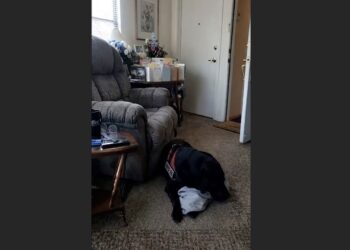
Every evening, he sat on the floor.
That was it.
The First Night, Willow Stayed Across the Room
She watched him carefully.
My husband sat sideways rather than facing her directly.
His hands remained near his lap.
He read for a while.
At another point, he looked at his phone.
He did not call Willow over.
She stood at the opposite side of the room.
Then she lay down.
Then stood again.
If he shifted his legs, her head came up.
If he moved too quickly, her body tensed.
The distance between them remained large.
We let it.
There was no goal for the first evening.
No requirement that Willow take a treat from him.
No photograph we needed to create.
No proof that adoption was already “working.”
She had entered yet another unfamiliar home after two previous placements had ended.
The least we could give her was control over how close she came.
We Kept the House Deliberately Boring
Her bed stayed in one place.
Water stayed in another.
We kept the television low.
Doors closed gently.
Visitors could wait.
We established predictable meal times and short, quiet trips outside.
If Willow chose her bed, nobody bothered her there.
We did not surround her with people eager to meet the new dog.
She had enough to process.
New smells.
New rooms.
New voices.
New floor surfaces.
A new yard.
Another man.
People sometimes assume that a frightened rescue dog needs to be flooded with positive experiences as quickly as possible.
Willow seemed to need something else first.
Less.
Less pressure.
Less novelty.
Less expectation.
The Second Evening, She Came Closer
Not close.
Closer.
There is an important difference.
My husband took his usual place on the floor.
Willow watched from across the room.
After some time, she stood.
Took several steps.
Stopped.
Her weight shifted backward as though she wanted an easy route of retreat.
My husband did not turn toward her.
She moved another little distance.
Then stopped again.
If we had been waiting for a dramatic breakthrough, we might have missed what was happening.
Willow was gathering information.
Nothing bad happened when she approached.
No hand shot toward her head.
Nobody grabbed her collar.
Nobody celebrated so loudly that the moment became overwhelming.
She could come closer.
And she could leave.
That ability to leave was probably as important as the invitation to stay.
She Still Looked Ready to Retreat
Willow’s body remained tense.
Her ears were not completely relaxed.
When my husband adjusted his posture, she noticed immediately.
There was no reason to interpret her approach as complete trust.
She was still uncertain.
That mattered.
People often describe fearful dogs in absolutes.
She trusted him.
She didn’t trust him.
She was healed.
She was traumatized.
Real behavior is usually less tidy.
Willow could want proximity and still be frightened.
She could become curious about my husband while remaining prepared to move away from him.
Those states were not contradictory.
They were part of the same adjustment.
So we continued to let her decide.
On the Third Evening, She Surprised Us
My husband sat on the floor again.
By then, the ritual itself may have been becoming familiar.
Same person.
Same general place.
Same quiet posture.
Nothing demanded from her.
Willow stood several feet away and watched.
Then she started moving.
One step.
Pause.
Another.
She reached his side.
My husband remained still.
Willow lowered herself to the floor.
For a moment, she simply sat beside him.
Then she leaned.
Her head came to rest gently against his.
I stopped what I was doing.
My husband did not.
He Knew Better Than to Turn It Into a Celebration
Every instinct probably told him to hug her.
He didn’t.
He did not wrap both arms around her.
He did not suddenly start rubbing her face.
He did not call me over.
Willow had chosen the contact.
So he let her control it.
He sat there.
One leg went numb.
Then the other.
Later he told me his neck started aching from holding nearly the same position.
He still did not move much.
There was tension in Willow’s body even while she rested against him.
That detail mattered most.
She had not suddenly become fearless.
She was experimenting with closeness while some part of her remained cautious.
My husband understood that the best response was not more affection.
It was predictability.
The Moment Was Smaller Than It Looked
If someone had photographed it, the picture might have suggested a complete transformation.
Frightened rescue dog finally trusts man.
That would have been a better headline than reality.
Reality was more modest.
Willow had tolerated proximity to one man under carefully controlled circumstances.
Then she had initiated physical contact.
That was meaningful.
It was not proof that she would now be comfortable with every man.
It did not mean her fear had disappeared.
It certainly did not mean that whatever had shaped that fear had been erased in three evenings.
Recovery is not a switch.
One good interaction can become useful evidence for a frightened dog.
It is not a cure.
We Had Prepared Everything Except the One Thing She Needed Most
Before Willow came home, we bought a bed.
Food.
Bowls.
A leash.
A harness.
Treats.
We decided where she could retreat if she became overwhelmed.
We talked about routines.
We tried to remove unnecessary chaos from the house.
All of that helped.
But the most useful thing turned out to be something we could not purchase.
Time without demand.
Willow did not need to earn the right to stay by becoming affectionate quickly.
She did not owe my husband cuddling because he behaved gently.
She did not need to prove that adopting her had been the correct choice.
Our responsibility came first.
Trust, if it developed, would come on her schedule.
Being Returned Twice Did Not Make Willow a Failed Dog
That was something else we needed to remember.
Two previous families had returned her.
We did not know enough to judge them.
Living with a fearful dog can be difficult.
A household with frequent visitors, children, male family members, limited space, or little experience with canine fear may not have been a good match.
Recognizing that can be more responsible than keeping a dog in an environment where everyone is overwhelmed.
The returns were part of Willow’s history.
They did not make her disposable.
Nor did they guarantee that our home would succeed automatically.
We still had to build something workable.
Good intentions were only the beginning.
My Husband Started Paying Attention to the Smallest Signals
A softer face.
A body angled toward him instead of away.
Choosing to remain in the room.
Resting rather than constantly watching.
Approaching, sniffing, then leaving.
Those became the measurements that mattered.
He stopped caring whether Willow would accept petting on any particular day.
If she approached, he allowed it.
If she walked away, he let her.
Sometimes he tossed a treat away from himself rather than asking her to come closer for it.
That gave her another choice.
Take the food.
Create distance.
Return if she wanted.
The goal was not to make my husband irresistible.
It was to make him predictable.
Predictability Is Powerful for a Frightened Dog
Humans tend to think safety means kindness.
For many anxious dogs, safety also means knowing what happens next.
This person does not suddenly grab me.
This person does not corner me.
This person listens when I move away.
This door opens again.
Meals arrive.
My bed stays where I left it.
Nobody disturbs me while I sleep.
Those lessons require repetition.
A single gentle evening cannot establish them completely.
Ten may not.
A hundred can matter.
That is why the shelter employee had warned us about months rather than days.
Willow’s third-night gesture gave us hope.
It did not shorten the timetable.
She Began Following My Husband Through the House
In the days that followed, something else changed.
If my husband moved from the living room toward the kitchen, Willow sometimes went with him.
At first, she kept distance.
Then less.
Eventually, she began trailing him between familiar rooms.
We tried not to romanticize that too quickly either.
Following can indicate attachment.
It can also reflect vigilance or uncertainty about where a person is going.
Context matters.
What encouraged us was what happened afterward.
Willow could follow him into a room and eventually lie down.
She did not always remain standing, prepared to retreat.
Her body was beginning to relax around him.
That was different.
We Were Careful Not to Turn Following Into Dependence
There is a temptation, when a fearful dog finally chooses one person, to encourage constant closeness.
We resisted that.
Willow needed to feel safe with my husband.
She also needed to learn that she could rest even when he moved away.
So we did not make every departure dramatic.
He would stand.
Walk into another room.
Return.
Nothing bad happened.
Over time, those ordinary disappearances and returns could become another predictable pattern.
We wanted Willow to have affection without believing she had to monitor someone every second.
That balance takes longer than a few days.
We are still working on it.
Bedtime Became Another Quiet Ritual
Willow began settling closer to my husband at night.
Sometimes she rested her head against him.
The first time, he barely moved.
Now he can shift a little without her immediately becoming tense.
That sounds like a tiny accomplishment.
It is.
Tiny accomplishments are what adjustment often looks like.
She sleeps more deeply too.
Not always.
Certain noises still bring her head up.
An unfamiliar voice can change her posture.
A man she does not know remains much more difficult than my husband.
That is important to say.
Willow has learned something about one person.
She has not generalized that learning to half the human population.
Maybe she will improve with other men over time.
Maybe some discomfort will remain.
Either outcome can be managed.
We Will Not Test Her Fear to See Whether She Is “Over It”
She does not need surprise introductions.
She does not need a room full of male visitors proving they are nice.
She does not need someone insisting, “Dogs love me,” while reaching for her.
Future introductions can be structured.
Distance first.
No direct staring.
No reaching.
Let Willow observe.
Let the new person ignore her if that is easier.
Food can be used thoughtfully if she is comfortable enough to eat, but not as bait that lures her into contact she cannot handle.
If professional behavioral support becomes necessary, we will use it.
Our pride has no place in the process.
The goal is not to prove we can fix her ourselves.
The goal is to help Willow function comfortably.
Her Growl Was Never the Enemy
I keep thinking about that one low growl at the shelter.
How easily someone could have labeled it aggression.
How easily fear could have been punished because the sound made a person uncomfortable.
We see it differently now.
A dog who growls still has options.
She is communicating.
The safer response is to ask what changed.
Did someone get too close?
Did she feel trapped?
Was she in pain?
Was a hand reaching toward her?
Creating more distance can prevent escalation.
Willow’s growl was not something we wanted to provoke.
Nor was it something we wanted to silence without addressing the underlying discomfort.
Communication is useful.
We wanted her to keep trusting that we would listen.
Loving Her Does Not Give Us the Right to Rush Her
That may be the biggest lesson so far.
People often say rescue dogs should know they are safe now.
But how would Willow know?
A new house does not arrive with an explanation.
We cannot sit beside her and say:
“You will live here permanently.”
“No one here intends to hurt you.”
“You never have to worry again.”
Those sentences are meaningful to us.
To Willow, safety has to be demonstrated through experience.
Today was predictable.
Tomorrow was too.
The hand stayed gentle.
The person respected the retreat.
The food arrived.
The bed remained hers.
Then another day.
And another.
We Still Know Very Little About Her Past
Perhaps that is for the best.
Knowing every detail would not necessarily change what Willow needs today.
If we learned a specific person had frightened her, the treatment would still involve safety, gradual exposure where appropriate, choice, and careful behavioral support.
If her fear came partly from inadequate early socialization, patience would still matter.
The unanswered history can tempt people into storytelling.
We try not to do that.
Willow’s current behavior deserves attention without requiring a dramatic origin story.
She is not a mystery we have to solve.
She is a dog we have to care for.
Some Days Will Almost Certainly Be Harder Than Others
We expect setbacks.
An unfamiliar visitor.
A veterinary appointment.
A sudden movement.
A man with a different voice, posture, or gait.
Fear does not improve in a perfectly straight line.
Willow may appear confident one day and cautious the next.
That does not mean the previous progress was fake.
Stress changes thresholds.
Environment matters.
Pain matters.
Fatigue matters.
So does accumulated experience.
We will judge progress over months, not moments.
The third evening was beautiful.
It was still only the third evening.
The Dog Beside My Husband Is Still Willow
She has not become a completely different animal.
She still watches.
Still hesitates.
Still needs choices.
The difference is that she is beginning to gather new information.
This man sits quietly.
This man does not force contact.
This man moves slowly.
If I walk away, he does not follow.
If I come near, nothing bad happens.
If I rest beside him, I am allowed to leave whenever I want.
Those are simple lessons.
Repeated often enough, simple lessons can change behavior.
We are seeing the earliest signs of that.
Last Night, She Rested Her Head Against Him Again
My husband was already in bed.
Willow settled nearby.
Then, after a few minutes, she moved closer and rested her head against him.
He scratched lightly behind one ear after she remained relaxed.
She exhaled.
Her eyes closed.
I watched from across the room.
It would have been easy to look at her sleeping there and decide the fear was gone.
It wasn’t.
That is not what made the moment meaningful.
Willow had entered our home afraid of my husband because he belonged to a category of people she found difficult.
Within a few carefully managed days, she had begun voluntarily approaching one member of that category.
Not because he forced her to confront the fear.
Because he stopped asking her to prove anything.
She Does Not Know Yet That This Home Is Permanent
At least not in the way we understand permanence.
She cannot read adoption papers.
She does not know two families returned her before us.
She does not understand our promise that we intend to keep trying even if progress takes months.
What she can learn is routine.
Tomorrow, the same people are here.
Her bed is here.
Her water is here.
The man on the floor behaves the same way he did yesterday.
Then another morning arrives.
And another.
Perhaps that is how “home” eventually becomes real to a dog.
Not as an idea.
As repetition.
We Are No Longer Waiting for a Breakthrough
The first few days taught us not to look for one.
There probably will not be a single moment when Willow becomes completely comfortable and everything difficult belongs to the past.
There will be dozens of smaller moments.
Choosing to enter the same room.
Remaining relaxed when my husband stands.
Taking food in his presence.
Following him without tension.
Sleeping deeply.
Meeting one unfamiliar man from a safe distance and recovering afterward.
Those are the milestones we care about.
If some fear remains, we will work around it responsibly.
Willow does not have to become fearless to deserve this home.
My Husband Still Sits on the Floor
Not every evening now.
But often.
Sometimes Willow joins him almost immediately.
Sometimes she stays elsewhere.
Both choices are accepted.
When she approaches, he remains calm.
When she leaves, he does not call her back.
There is something almost ordinary about it now.
A large German Shepherd resting beside a man.
Nothing dramatic.
Except I remember the shelter.
The rigid body.
The trembling.
The employee quietly explaining that two previous placements had ended.
Then I look at Willow beside my husband.
She still carries uncertainty.
But she no longer has to carry it alone.
What She Needed Most Was Something We Couldn’t Buy
Not the expensive bed.
Not the treats.
Not a quieter television.
Those things helped.
The most important thing was time without a deadline.
Time to observe.
Time to retreat.
Time to approach again.
Time to discover that one man’s movements could become familiar instead of frightening.
Willow did not owe us affection for adopting her.
She did not owe my husband trust because he was patient for three evenings.
Our responsibility was to provide safety whether or not she ever became the cuddly dog people like to imagine at the end of rescue stories.
Then, on the third night, she crossed the room.
She lay beside him.
And rested her head against his.
He stayed still.
So did she.
That was all.
For Willow, right then, it was enough.
And for us, it was enormous.
Editor’s Note: The characters in this story are fictional. Through these stories, we hope to share the intelligence, loyalty, compassion, and loving nature of dogs with people everywhere.