For Nearly a Year, We Gave Everyone the Same Answer
My husband and I had become very good at saying no.
“No, we’re not adopting again.”
“No, we’re not ready.”
And most often:
“We’re done raising puppies.”
We said it to friends.
We said it to our grown children.
We said it whenever someone sent us a photograph of a dog needing a home.
Eventually, we started saying it mostly to ourselves.
Our Golden Retriever, Charlie, had died in the spring of 2025 after nearly thirteen years with our family.
Thirteen years is long enough for a dog to become woven into the structure of a household.
Charlie had his places.
His routines.
His sounds.
Then suddenly all of them were gone.
The house did not simply become quieter.
It felt incomplete.
Charlie’s Absence Lived in Ordinary Places
I noticed it most in the mornings.
No nails clicking across the hardwood.
No dog waiting near the kitchen while pretending breakfast had been delayed for several days rather than several minutes.
No body stretched across the hallway in exactly the spot where someone needed to walk.
Richard noticed it when he came through the front door.
For years, Charlie had greeted him.
Sometimes enthusiastically.
Sometimes with the slower dignity of an older Golden Retriever who believed people should come to him.
After Charlie died, Richard would open the door and instinctively glance toward the place where the dog usually appeared.
Nothing.
For months, Charlie’s food bowl remained in the pantry.
Neither of us had consciously decided to keep it.
We simply never threw it away.
At 68, We Thought We Knew What Retirement Should Look Like
Richard and I were both sixty-eight.
Our children were grown.
Work had finally loosened its grip on our schedules.
We had imagined retirement as something peaceful.
Slow breakfasts.
Weekend road trips.
Reading without watching the clock.
The freedom to leave for an afternoon without arranging anyone else’s care.
We had already done the puppy years.
House-training.
Chewed furniture.
Interrupted sleep.
Training classes.
Shoes sacrificed for reasons known only to the dog.
We loved Charlie deeply.
That did not mean we wanted to begin again.
When friends suggested adopting an older dog eventually, we were more receptive.
Maybe someday.
A calm senior dog, perhaps.
One who appreciated naps as much as we did.
A six-month-old puppy was absolutely not part of the plan.
Two six-month-old puppies would have sounded ridiculous.
Then our son called in February 2026.
“Just Come Look”
There was an adoption event at a community center.
Our son asked whether we wanted to go with him.
“Just to look,” he said.
I knew that phrase.
People use “just to look” when they want you to enter a building containing animals and temporarily suspend common sense.
“We’re not getting another dog,” I told him.
“I know.”
“I’m serious.”
“I know.”
Richard heard the conversation and shrugged.
We had nothing else planned.
Maybe there would be older dogs.
Maybe we could meet a few without making any decisions.
That was how we ended up driving to the event.
I remember telling Richard on the way there that under no circumstances were we returning with a puppy.
He agreed completely.
That should have made me suspicious.
Most of the Older Dogs Had Already Been Adopted
The community center gymnasium was full of noise.
Kennels lined the walls.
Volunteers answered questions.
Children moved between their parents and the dogs.
Leashes crossed.
Water bowls slid across the floor.
Some dogs barked whenever anyone approached.
Others slept through the commotion.
We asked about senior dogs first.
There was good news for them and inconvenient news for us.
Most had already been adopted.
The remaining dogs were considerably younger.
We walked slowly through the rows anyway.
Then, near the end, a volunteer waved us over.
“I’ve got two I think you should meet.”
I stopped immediately.
“No puppies.”
She smiled.
“Just meet them.”
There was that phrase again.
Daisy and Tucker Were Six Months Old
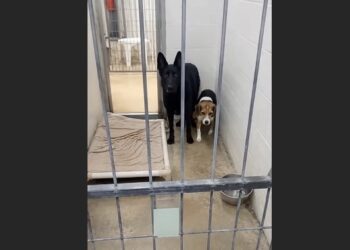
They were Australian Shepherd mixes.
Littermates.
Daisy was the smaller one, black and white with one striking blue eye.
Tucker was a red merle boy with oversized paws and the physical coordination of a dog who had not yet reached an agreement with his own legs.
Both had significant visual impairment.
Neither was completely blind.
According to the rescue, they could see some shapes, movement, contrast, or light, but navigating unfamiliar environments was harder for them than it was for fully sighted puppies.
That had apparently worried potential adopters.
People stopped.
Read the medical information.
Asked questions.
Then moved on.
Some were concerned about future veterinary care.
Others were unsure how difficult training would be.
Those were reasonable concerns.
Special-needs animals can require additional planning, cost, and environmental adjustments.
Richard and I understood that.
Then Tucker attempted to greet us.
Tucker Introduced Himself by Walking Into a Chair
He was excited.
His tail was going.
He moved toward us faster than his visual information could apparently support.
Then he misjudged a folding chair.
Bump.
The volunteer sighed.
“We’ve had a lot of that today.”
Tucker paused for approximately half a second.
Then resumed wagging.
Daisy, meanwhile, was attempting to investigate a tennis ball and had somehow looped part of her leash around Tucker.
Within moments, neither puppy seemed entirely sure who was attached to what.
It should have looked exhausting.
It probably did look exhausting.
Richard laughed.
Not the polite laugh he had been using more often since Charlie died.
A real one.
He bent over, put his hands on his knees, and laughed until Tucker began wagging even harder.
I looked at my husband and knew we were in trouble.
Daisy Came Toward Me More Slowly
She did not charge forward like her brother.
She approached one careful step at a time.
Her head moved slightly as she used what vision she had along with scent and hearing.
When she reached me, she sniffed my shoes.
Then my hand.
I crouched.
She leaned against my leg.
A few minutes later, I was sitting on a folding chair with Daisy partly in my lap.
Then she fell asleep.
No ceremony.
No dramatic “instant connection” that proved she somehow knew I would adopt her.
She was a tired puppy who had spent hours in a noisy gymnasium and found a warm person willing to stay still.
That explanation was enough.
Unfortunately, emotional realism did nothing to make her easier to put down.
I looked over at Richard.
Tucker had settled against his shoe.
My husband was pretending this meant nothing.
Every Argument We Had Made Started Sounding Less Convincing
“We’re too old for puppies,” I said.
Richard nodded.
Tucker yawned against his foot.
“We wanted quiet.”
Another nod.
Daisy shifted more comfortably in my lap.
“Training two dogs would be exhausting.”
“I know.”
“Especially two with vision problems.”
“I know.”
I waited.
Richard looked down at Tucker.
“But look at him.”
That was not an argument.
It was barely a sentence.
Worse, it was effective.
Still, we did not immediately sign adoption papers because two adorable puppies had made us emotional.
We asked questions.
Many questions.
Their Vision Problems Required Planning, Not Pity
The rescue explained what was known about their condition.
Neither puppy was helpless.
They could walk, play, eat, explore, and learn.
But unfamiliar spaces required more caution.
Furniture placement mattered.
Stairs needed management.
Sudden environmental changes could be confusing.
Training would rely heavily on consistent verbal cues, sound, scent, touch, and repeated routes.
We would need veterinary follow-up to understand whether their vision was stable or likely to change.
We also needed to consider whether adopting littermates was sensible.
Two same-age puppies can become heavily dependent on each other if owners do not deliberately build separate confidence, training skills, and relationships.
The rescue encouraged individual training time.
Separate short outings when appropriate.
Independent resting areas.
The ability for each puppy to function without constantly using the other as a guide.
That sounded like work.
Because it was.
We Sat There for More Than an Hour
The volunteer gave us space.
Daisy slept.
Tucker alternated between exploring and leaning against Richard’s shoe.
We talked about money.
Veterinary care.
Food.
Training classes.
Travel.
Our energy.
Our house.
Whether we could physically manage two active adult dogs once six-month-old puppies became forty- or fifty-pound adolescents.
We talked about Charlie too.
That was harder.
Part of me worried that bringing dogs home would feel like replacing him.
Richard said what I had been thinking.
“They wouldn’t be Charlie.”
He was right.
No dog could be.
That was not a reason never to love another one.
Eventually, Richard looked at me.
I looked at him.
We both knew the answer before either of us said it.
We Left With Two Puppies
The adoption process took longer than the emotional decision.
There were forms.
Medical records.
Questions.
Instructions.
Follow-up recommendations.
Then suddenly there were two leashes in our hands.
On the drive home, I kept repeating the same sentence.
“We’ve lost our minds.”
Richard agreed.
Completely.
Daisy and Tucker slept in the back seat.
For two dogs who had just dismantled our retirement plan, they looked remarkably peaceful.
I remember glancing back at them and thinking about Charlie.
Not because they reminded me of him.
They didn’t.
Charlie had been gold.
Steady.
Older.
Deeply familiar.
These two were young, visually impaired Australian Shepherd mixes with no respect for personal schedules.
They were not a continuation of Charlie.
They were something entirely new.
The Peaceful Retirement House Lasted About Twelve Hours
The next morning, our home began changing.
Baby gates appeared.
Furniture placement suddenly mattered.
Dog toys multiplied.
Training treats migrated into every jacket pocket.
Chew toys rolled beneath chairs.
We added textured mats near important locations to give Daisy and Tucker additional environmental cues.
We kept water bowls and furniture in predictable places.
We used consistent words for steps, doors, waiting, and changes in terrain.
Their vision challenges did not prevent learning.
They simply changed how some learning happened.
Both puppies quickly began building mental maps of the house.
That process fascinated us.
They used scent.
Sound.
Memory.
Floor texture.
Repeated routes.
Within weeks, they moved through familiar rooms with enough confidence that visitors sometimes forgot their eyesight was limited.
Tucker Still Collided With Things Occasionally
Especially when excited.
We learned to recognize the particular enthusiasm that usually preceded a poor navigational decision.
“Tucker, easy.”
Sometimes he listened.
Sometimes a chair reminded him for us.
Daisy was more deliberate.
She tended to pause before entering unfamiliar spaces.
She listened.
Then moved.
Neither puppy wanted to be carried everywhere.
That had been one of my early mistakes.
When Daisy hesitated, I wanted to scoop her up and solve the problem.
Our trainer reminded me that constantly removing every challenge would not help her become confident.
Instead, we learned to give information.
A verbal cue.
A stable route.
Time.
Encouragement.
Space to make choices.
She became increasingly capable because we stopped treating hesitation as helplessness.
We Trained Them Together and Apart
This became one of the most important parts of our routine.
Daisy and Tucker clearly enjoyed being together.
They slept close.
Played together.
Investigated the yard side by side.
But we did not want either puppy to believe the other had to be present for the world to feel safe.
So Richard sometimes worked with Tucker while I trained Daisy.
Then we switched.
Short sessions.
Simple behaviors.
Name response.
Recall.
Settling.
Loose-leash walking.
Targeting a hand by scent and touch.
Verbal direction cues.
Each puppy learned to look to humans for information rather than always following the sibling.
That required patience.
It also gave Richard and me something we had not expected in retirement.
Homework.
The House Became Loud Again
Not unpleasantly loud.
Alive loud.
Toys squeaked.
Paws moved through hallways.
Someone always seemed to be drinking water.
Someone else was usually dropping a chew bone on the floor at precisely the moment I wanted quiet.
Tucker developed a theory that every visitor had come specifically to see him.
Daisy claimed the sunny area near the living-room window.
She could not see the view clearly, but she seemed to enjoy the warmth.
Richard started laughing more.
I noticed it before he did.
There were mornings when Tucker misjudged the edge of a dog bed and somehow ended up sleeping halfway out of it.
Richard would start laughing.
Then I would.
For a few minutes, the house sounded like itself again.
Not the old version.
A new one.
Charlie Was Still Missing
That surprised me.
Some foolish part of me had expected that bringing dogs home might make the grief disappear.
It did not.
There were days when Daisy did something and I thought immediately of Charlie.
Sometimes that made me smile.
Other times it hurt.
The puppies did not replace him.
They could not.
Charlie had thirteen years of history with us.
These dogs had weeks.
Then months.
Grief does not work like an empty chair that another animal can simply occupy.
What Daisy and Tucker gave us was not a replacement.
They gave us new routines alongside the old memories.
That was different.
And healthier.
Our Schedule Now Revolves Around Dogs Again
Veterinary appointments.
Training.
Enrichment.
Walks.
Meals.
Individual practice.
More veterinary appointments.
Australian Shepherd mixes are not decorative furniture.
They need physical activity and mental work.
Limited vision does not eliminate those needs.
In some ways, it makes thoughtful enrichment even more important.
We use scent games.
Food puzzles.
Training exercises.
Safe exploration.
Consistent walking routes mixed with carefully introduced new environments.
The puppies have become more confident.
So have we.
There are still moments when I wonder what happened to the quiet retirement we planned.
Usually that thought occurs while I am stepping over three toys and searching for a fourth object Tucker has carried somewhere.
Then I laugh.
Adopting Them at 68 Required Some Humility
Love was not the only consideration.
Richard and I had to be realistic about age.
Daisy and Tucker could easily live well into our late seventies or beyond.
We needed a plan.
Our children know what should happen if our health changes.
We budget for veterinary care.
We pay attention to whether we can safely meet the dogs’ exercise needs.
As the puppies mature, we continue training behaviors that will make them easier to manage later.
No jumping on people.
Waiting at doors.
Walking without pulling.
Cooperating with handling.
Those skills matter in every dog.
They matter even more when owners are older.
Adopting young dogs late in life is not automatically irresponsible.
Doing it without considering the future can be.
We considered it.
Then we committed.
Daisy Knows the House Better Than Some Visitors Do
Watching her move now is one of my favorite things.
She crosses the living room.
Turns before reaching the coffee table.
Finds the hallway.
Locates her bed.
Heads toward the kitchen when she hears food preparation.
Tucker does much the same, though with considerably less elegance.
Blind and visually impaired dogs can build remarkably detailed spatial maps when their environments are consistent.
That does not mean we assume they can navigate everything safely.
New locations require care.
Furniture changes are introduced thoughtfully.
Steps remain managed.
But at home, both dogs have substantial independence.
They are not defined by what they cannot see.
Most days, we think far more about their personalities than their eyesight.
Tucker Believes Hospitality Is His Personal Responsibility
The doorbell rings.
Tucker becomes immediately convinced an admirer has arrived.
We are working on polite greetings.
Progress is mixed.
Daisy is more selective.
She listens first.
Then approaches.
If visitors sit long enough, she often settles nearby.
These ordinary personality differences became clearer as the months passed.
At the adoption event, we had mostly seen “the visually impaired puppies.”
At home, they became individuals.
Daisy is thoughtful.
Persistent.
Very good at finding comfortable sleeping places.
Tucker is enthusiastic.
Clumsy.
Deeply interested in everyone else’s business.
They share genetics.
They share a medical challenge.
They are not interchangeable.
That has been important for us to remember.
The First Thing That Returned Was Laughter
Then came energy.
Then routine.
Then something close to purpose.
After Charlie died, Richard and I had imagined that less responsibility would feel like freedom.
For a while, it did.
Then the freedom became strangely empty.
We did not need puppies to make our retirement meaningful.
But caring for Daisy and Tucker gave shape to days that had become too quiet.
Morning walks mattered.
Training gave us goals.
Veterinary visits gave us information to act on.
The dogs needed consistency, and providing it pulled both of us back into a daily rhythm.
That helped.
Not because grief vanished.
Because life became larger than grief again.
We Still Keep Charlie’s Bowl
It is no longer sitting alone in the pantry for the same reason.
We eventually moved it.
I could not bring myself to throw it away.
Richard did not ask me to.
It belongs to another chapter of the house.
Daisy and Tucker have their own bowls.
Their own beds.
Their own toys.
Their own stories.
That distinction comforts me.
We did not erase Charlie to make room for them.
The heart does not work like a room with limited chairs.
One attachment does not have to be evicted for another to enter.
Charlie remains part of our family history.
Daisy and Tucker are part of what came after.
Both things can be true.
We Sometimes Joke That They Chose Us
People ask why two sixty-eight-year-olds who insisted they were finished raising puppies came home with a visually impaired pair of Australian Shepherd mixes.
I usually give them the short version.
“They chose us.”
Strictly speaking, of course, that is our human interpretation.
Daisy did not assess our retirement plan and deliberately select me as her adopter.
Tucker did not devise a strategy involving Richard’s shoe.
They were puppies responding to people, warmth, smell, movement, and attention.
We were the ones who made the decision.
Still, “they chose us” captures how it felt.
We arrived with a plan.
They made that plan much harder to defend.
Retirement Is Nothing Like What We Imagined
There are baby gates.
Dog hair.
Training treats in pockets.
Veterinary reminders on the calendar.
A tennis ball under almost every piece of furniture.
Some mornings begin earlier than I would prefer.
Some evenings end with both of us tired.
Travel requires more planning.
The house is rarely silent.
It is also full of laughter.
Daisy still prefers the sunny place near the window.
Tucker still assumes visitors have come for him.
Both puppies know the house well enough to race toward the kitchen when they hear a familiar treat container.
And Richard still laughs when Tucker misjudges something harmless and then behaves as though it was the furniture’s mistake.
The Quiet Life Wasn’t Wrong—It Just Wasn’t the Only Life Available
We could have gone home from that adoption event alone.
There would have been nothing wrong with that.
Two special-needs puppies are a serious commitment.
Not everyone has the resources, health, schedule, or desire to take that on.
We did.
Barely, perhaps, if you had asked me during the first week.
But we did.
The puppies did not save us.
They did not cure the grief Charlie left behind.
They did not make us younger.
What they did was bring new life into a house that had become very still.
Then Richard and I chose to build our routines around that life.
Nearly a Year Earlier, We Thought the Dog Chapter Was Over
We were wrong.
Not because fate had secretly chosen two puppies for us.
Because we allowed ourselves to reconsider.
That’s less poetic, but I think it matters more.
People can grieve one dog deeply and still love another.
Older adults can take on new responsibilities if they prepare realistically.
Dogs with visual impairment can live active, confident lives without being treated as fragile.
And a quiet retirement can be wonderful without being the only version worth having.
These days, Daisy may be sleeping in the patch of sunlight while Tucker drops a toy at Richard’s feet for the fifteenth time.
Charlie is still missed.
He always will be.
But the house is no longer defined by the sounds that disappeared when he died.
It has new sounds now.
Paws.
Toys.
Richard laughing.
My own voice telling Tucker for the third time that the chair has not moved since yesterday.
We once believed the best retirement would be peaceful.
The one we have is messy, busy, expensive, occasionally exhausting, and covered in dog hair.
We would not trade it.
Not because Daisy and Tucker replaced the dog we lost.
Because they reminded us that loving Charlie for thirteen years had never used up our ability to love what came next.
Editor’s Note: The characters in this story are fictional. Through these stories, we hope to share the intelligence, loyalty, compassion, and loving nature of dogs with people everywhere.