The Shelter Manager Stopped Me Before Kennel 14
My wife and I had driven nearly two hours to the shelter with what we thought was a sensible plan.
We were adopting one dog.
Not two.
We had recently moved onto a small property outside town, and the place already consumed more money and time than either of us had expected. The fencing needed repairs. An old barn needed work. There were always tools to buy, boards to replace, and bills waiting in the mailbox.
One rescue dog felt responsible.
Then the shelter manager stopped me halfway down the kennel aisle.
“Before you meet the black Shepherd, there’s something you should know.”
I expected a warning about behavior.
Maybe leash reactivity.
Maybe a medical issue.
Instead, she lowered her voice.
“If you take him into the visitation yard, don’t let the little hound lose sight of him.”
I smiled.
“That attached?”
She did not smile back.
“I’m serious. The last time he went out alone, she became so distressed she made herself sick.”
That was when I stopped treating it like a cute story.
At First, Kennel 14 Looked Empty
The shelter was loud in the way most shelters are.
Metal doors.
Barking.
Water bowls shifting across concrete.
Dogs jumping toward visitors and then racing back as someone else approached.
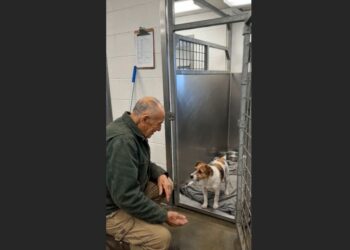
Kennel 14 was strangely quiet.
At first, I thought there was no dog inside.
Then my eyes adjusted.
A large black German Shepherd was lying against the back wall.
Tucked almost underneath his front legs was a much smaller Beagle mix.
Her body fit into the curve of his.
The Shepherd’s chin rested loosely across her back.
Neither barked.
They simply watched us.
The Shepherd’s eyes followed our hands.
The little hound stayed so close to him that, when he shifted one paw, she adjusted with him.
Their shelter names were Shadow and Daisy.
The sight of them together made the manager’s warning suddenly much easier to understand.
Shadow Stood First
A volunteer opened the kennel.
Shadow rose.
He did not lunge.
He did not growl.
He simply moved forward until his body was between us and Daisy.
I would not call that proof he was “protecting” her in the human sense.
It could have been habit.
Positioning.
Caution in an unfamiliar environment.
Whatever the reason, Daisy immediately moved with him.
When he stepped left, she stepped left.
When he paused, she pressed against his leg.
The volunteer gave us time.
No one reached over Shadow’s head.
No one tried to drag Daisy forward for an introduction.
My wife crouched sideways a few feet away and extended one relaxed hand.
Shadow eventually approached to sniff.
Daisy followed almost directly beneath his shoulder.
“They’ve been together a long time,” the volunteer said.
Then she told us what the shelter knew about their past.
Their Owner Had Died Suddenly
According to the information given to the shelter, Shadow and Daisy had belonged to an older retired truck mechanic who lived alone on a rural property.
Neighbors said the dogs went nearly everywhere with him.
Morning chores.
Evening walks.
Trips into town.
Time in the garage while he worked.
Then one winter afternoon, the man suffered a fatal heart attack while working on his property.
He was not discovered immediately.
When family members eventually arrived, they reportedly found both dogs nearby.
The shelter could not know exactly what the dogs understood during those days.
They did not understand death the way his relatives did.
But they had experienced a sudden disruption.
One familiar person stopped responding.
The routines of the household ended.
Strangers arrived.
Then both dogs were removed from the only home they had known.
From that point forward, the one familiar element still present was each other.
The Shelter Learned Quickly That Separation Was Difficult
At first, staff treated Shadow and Daisy like most incoming dogs.
Separate veterinary checks.
Individual walks.
Brief handling sessions.
That was when the problem became obvious.
If Shadow disappeared from Daisy’s view, she became highly distressed.
She vocalized.
Paced.
Scratched at the kennel door.
At times, she struggled to settle even after he returned.
Shadow’s response was different but equally noticeable.
When Daisy was taken elsewhere, he became vigilant.
He stopped engaging with staff.
His attention shifted toward doors and hallways.
He appeared to search for her.
Shelter staff tried housing them in neighboring kennels once because space was tight.
The experiment lasted less than a day.
Both dogs showed more distress apart than they did together.
So the shelter moved them back into the same run.
Their behavior stabilized.
“Bonded” Was a Practical Description, Not a Romantic One
People use the word bonded casually with dogs.
Sometimes two dogs simply enjoy one another.
Other times, their behavior suggests that separation causes significant distress and that each dog functions better when the other is nearby.
Shadow and Daisy appeared closer to the second category.
That did not mean they understood their relationship as friendship, family, or loyalty in the human sense.
It meant their routines had become deeply intertwined.
Daisy relaxed more easily when Shadow was present.
Shadow appeared more settled when he knew where Daisy was.
They slept touching.
They moved through new spaces together.
Each served as a familiar social reference point for the other.
The shelter was trying to honor that without making their dependence worse.
That was not always easy.
They Had Already Been Passed Over Again and Again
The manager told us that several potential adopters had asked about Shadow.
A few had asked about Daisy.
Most changed their minds when told the dogs should ideally be placed together.
The reasons were understandable.
Two dogs meant twice the food.
Two annual veterinary examinations.
Potentially two sets of medications later in life.
More boarding expenses.
More shedding.
More space.
More training.
More difficulty finding rentals or arranging travel.
Most people who walked into a shelter planning for one dog were not prepared to leave with two.
We certainly were not.
That was exactly why we had spent the drive discussing our budget.
“One dog,” I had said.
My wife had agreed.
“Absolutely.”
Standing in front of Kennel 14, that agreement already felt less secure.
The Puppies Down the Hall Drew Bigger Crowds
We watched visitors move through the adoption floor.
Most paused near the young dogs.
Puppies climbed kennel doors and competed for attention.
Teenage dogs bounced at the front of their runs.
Shadow and Daisy remained toward the back.
Adult dogs already face disadvantages in some shelters because many adopters arrive looking for younger animals.
A pair can be harder still.
These two also needed someone willing to understand that moving into a new home might require patience.
They had lost familiar routines.
They were living in a noisy environment.
And their dependence on each other meant a new family would need to help them become comfortable without abruptly taking away their strongest source of familiarity.
One staff member admitted that separating them might make placement easier.
Nobody sounded eager to do it.
Daisy Relaxed the Moment Shadow Lay Down
Shadow eventually returned to the back of the kennel.
He lowered himself onto the bedding.
Daisy followed.
Within seconds, the tension in her posture changed.
Her body softened.
She tucked herself beside him and lowered her head against his shoulder.
I caught myself wanting to say she felt safe.
Perhaps she did.
We could not know precisely what emotion she was experiencing.
What we could observe was that her body became visibly more relaxed when Shadow was close.
That was enough.
I tried to imagine what another major separation might do.
Then I reminded myself that emotion alone did not pay veterinary bills.
Wanting them to stay together did not automatically make my wife and me the right adopters.
We still had to think practically.
My wife, unfortunately, had become very quiet.
I knew that silence.
She Crouched Beside the Kennel
Shadow approached her first.
Slowly.
He sniffed the back of her hand.
She did not reach for him.
Daisy came with him.
The little hound placed one front paw against my wife’s knee.
My wife looked down.
Then she looked at me.
I knew exactly what she was thinking.
The problem was that she knew I knew.
For several seconds, neither of us spoke.
Finally, she smiled.
It was the smile that has historically preceded home repairs, unplanned furniture purchases, and other events requiring revised budgets.
“We’ll figure it out,” she said.
I laughed.
“That’s the entire argument?”
“Yes.”
“Food?”
“We’ll figure it out.”
“Veterinary bills?”
“We’ll figure it out.”
“Two dog beds?”
She looked toward the kennel.
“They seem to be managing with one.”
I hated that this was technically true.
We Did Not Take Them Home That Afternoon
As much as emotion was pushing us toward yes, the shelter did not simply hand over both leashes.
We filled out applications.
Staff asked about our property.
Fencing.
Other animals.
Work schedules.
Veterinary history.
Who would care for the dogs if we traveled.
Whether we understood that a German Shepherd could have substantial exercise and training needs.
Whether Daisy’s separation distress might persist after adoption.
We discussed costs.
The shelter also wanted to know whether we intended to keep them together long term.
We did.
That was the entire reason we were changing our plan.
Then we went home without them.
It was a long drive.
For about twenty minutes, neither of us talked.
Then my wife said, “We’re getting two dogs.”
I told her I was aware.
We Had a Week to Make the House Ready
That gave us time to be practical.
We checked the fences again.
We secured places where a small Beagle mix might squeeze through.
We bought separate bowls even though Daisy had already demonstrated an interest in Shadow’s food.
We set up multiple resting areas.
That was deliberate.
Even closely attached dogs benefit from having enough space and resources that neither needs to compete.
We bought two beds.
My wife reminded me of her argument at the shelter and admitted she had never actually planned to make them share one.
We purchased leashes, identification tags, and food based on the shelter’s recommendations.
A veterinary appointment was scheduled.
The barn remained half renovated.
The fence still needed work.
But the house was ready enough.
A week after meeting Shadow and Daisy, we drove back.
The Ride Home Was Quieter Than Expected
I had imagined chaos.
Instead, Daisy curled close to Shadow in the back of the vehicle.
Shadow remained alert.
New sounds brought his head up.
Daisy watched whatever he watched.
We kept the drive uneventful.
No celebratory stops.
No crowded pet store.
No parade of friends waiting at home.
They had already experienced enough novelty.
When we reached the property, we brought them into a secure area on leash and let them take their time.
Shadow sniffed.
Daisy sniffed wherever Shadow had just sniffed.
They investigated the porch.
The yard.
The doorway.
Inside, they explored room by room.
Always close.
By evening, both were exhausted.
That first night, they slept pressed together.
They Did Not Decide the House Was Theirs on Day Two
At least not literally.
That is how I joked about it later.
The actual adjustment was more gradual.
They learned where the water bowls were.
They learned which door led outside.
They learned the refrigerator was promising.
They learned the vacuum cleaner was unacceptable.
Shadow became interested in the perimeter of the property.
Delivery trucks brought him immediately to attention.
Squirrels ranked high on his list of neighborhood concerns.
Daisy seemed less interested in security and more interested in maintaining visual contact with Shadow.
If he moved, she usually noticed.
If she disappeared into another room, he often checked where she had gone.
Still, both dogs began relaxing.
Their sleeping became deeper.
Their appetites remained good.
New routines formed.
We Learned Not to Reinforce Panic
The shelter had warned us about their separation behavior.
We saw traces of it almost immediately.
Once, a door swung shut between them.
Shadow was on one side.
Daisy was on the other.
Within seconds, both became agitated.
Daisy vocalized.
Shadow scratched once at the door.
We opened it calmly.
No excited reunion.
No dramatic comfort.
Just access restored.
Later, we began working on very small amounts of independence.
One dog in another part of the room.
A few feet apart during meals.
Short moments when each received individual attention while the other remained visible.
We did not force long separations in the name of teaching them a lesson.
Their distress was real.
At the same time, we did not want either dog to become unable to function whenever the other moved ten feet away.
Progress was slow.
That was fine.
Shadow Was Nearly Three Times Daisy’s Size
The size difference made their household negotiations entertaining.
Shadow looked formidable.
Daisy behaved as though that information had never reached her.
She stole his bed.
He often moved.
She picked up toys he had been investigating.
He usually found another one.
She finished her dinner and occasionally approached his bowl.
That was one behavior we did not leave entirely to them.
Meals were supervised.
Each dog had his or her own food and space.
Shadow’s willingness to step away did not mean Daisy should be allowed to overeat or take resources indefinitely.
Still, outside mealtimes, their dynamic was remarkably gentle.
Daisy seemed to have no idea she was the smaller dog.
Shadow appeared uninterested in correcting her misunderstanding.
They Began Building Relationships With Us Separately Too
That became important.
At the shelter, almost every behavior had been described through their relationship with each other.
We wanted them to have relationships with us as individuals as well.
Shadow learned that I often handled morning walks.
Daisy discovered my wife was an excellent source of quiet couch time.
We did short training sessions separately while keeping the other dog comfortable nearby.
Simple cues.
Name recognition.
Leash work.
Settling on a mat.
Coming when called.
Nothing elaborate.
The goal was not to weaken their bond.
It was to expand their world.
Their previous life had already become very small after losing their owner and entering the shelter.
We wanted security to come from more than one place.
Each other.
Us.
The house.
Daily routine.
Familiar walks.
Predictability.
Mornings Became My Favorite Time
I usually wake before my wife.
The dogs do not always agree that this is necessary.
Some mornings, I walk into the living room and find them arranged exactly as they were in Kennel 14.
Daisy tucked against Shadow’s chest.
Shadow stretched around her.
Sometimes his chin rests over her back.
Other times they occupy separate ends of the same rug with only their paws touching.
The first few times I saw it, I stood there longer than necessary.
Not because I thought Shadow was consciously guarding Daisy through the night.
The simpler explanation felt just as meaningful.
This was how they preferred to rest.
It was familiar.
Comfortable.
Normal.
After everything in their environment had changed, they had kept one routine intact.
They Still Prefer to Stay Close
Months later, they are rarely far apart by choice.
If Shadow walks into the yard, Daisy generally follows.
If Daisy settles on the couch, Shadow often lies somewhere nearby.
Closed doors remain unpopular.
But the reaction has softened.
A brief separation no longer automatically causes the same level of distress.
That took time.
Repetition helped.
They learned that a dog leaving the room usually returned.
They learned that people in this house returned too.
Nothing disappeared permanently because a door closed for thirty seconds.
Those lessons cannot be explained verbally to dogs.
They have to be experienced.
Again.
And again.
And again.
Adopting Two Dogs Really Is More Work
I do not pretend otherwise when people ask.
The food bill is larger.
There is considerably more hair.
Veterinary appointments require planning.
Training takes time.
Travel is more complicated.
If both dogs eventually need medication or specialized care, those costs will be real.
Anyone considering a bonded pair should think about those things before saying yes.
Emotion is not enough to sustain responsible ownership.
We were fortunate.
We had the space.
We could adjust the budget.
Our schedules allowed it.
Not every household can.
Declining to adopt a bonded pair because you cannot responsibly care for two animals is not cruel.
It is responsible.
For us, however, two turned out to be manageable.
What They Lost Did Not Disappear When They Came Home
Another misconception is that adoption erases a difficult past.
It does not.
Shadow and Daisy did not forget their former owner because they liked us.
They did not stop relying on each other because the house was comfortable.
Their previous routines had shaped them.
They arrived with strong patterns already in place.
Some were useful.
Some required careful work.
Some we simply accepted.
We never tried to make ourselves replacements for the man they had lived with before.
That relationship belonged to another part of their lives.
Our job was to make this part stable.
Meals.
Veterinary care.
Exercise.
Rest.
Training.
Predictable returns.
A home where both dogs had room to settle.
That was enough.
The Barn Is Still Not Finished
This is the part I like to mention whenever my wife claims everything worked out perfectly.
The barn remains an ongoing project.
There is always another fence board.
Shadow sheds enough hair to construct a smaller Shepherd.
Daisy can detect unattended food from distances that should concern scientists.
Our furniture has aged more quickly since their arrival.
None of that makes adopting them a mistake.
It makes them dogs.
Real adoption is mostly made of ordinary inconveniences.
Mud.
Bills.
Training.
Early mornings.
Veterinary waiting rooms.
Chewed objects.
Hair in places where hair should not exist.
The emotional reward lives alongside all of that.
It does not replace it.
We Went Looking for One Dog and Came Home With a Pair
Sometimes visitors ask whether it felt like taking on an extra burden.
I understand the question.
We had planned carefully for one.
We changed that plan because of what we saw in Kennel 14 and because, after thinking through the practical realities, we believed we could manage two.
I do not think of Daisy as an accessory to Shadow.
I do not think of Shadow as her permanent caretaker.
They are two individual dogs.
Each has separate needs.
Separate veterinary records.
Separate personalities.
Separate relationships with us.
But they also have a relationship with each other that clearly matters.
Preserving that relationship became part of adopting them responsibly.
I Still Remember the Warning in the Hallway
“Don’t let the little hound lose sight of him.”
At the time, it sounded almost unbelievable.
Now I understand why the shelter manager was serious.
Daisy had already lost a home.
Both dogs had lost the person around whom their old life had been organized.
The shelter itself had been another enormous transition.
During all of that, Shadow remained familiar to Daisy.
Daisy remained familiar to Shadow.
It made sense that each one became especially important to the other.
What they needed was not a dramatic rescue.
They needed stability.
And, fortunately, we were able to offer it without taking away the one familiar relationship they still had.
Most Mornings, They Still Sleep the Way We First Found Them
Daisy curled close.
Shadow stretched beside her.
The house quiet.
No kennel doors.
No barking down a concrete hallway.
No strangers deciding whether they can manage two dogs.
Eventually, Daisy wakes.
Shadow follows.
Then both appear in the kitchen because whatever emotional complexity exists in their relationship becomes temporarily less important than breakfast.
I like that about them.
They do not spend their days reenacting what happened before the shelter.
They live in the world in front of them.
Walks.
Food.
Sunlight.
Squirrels.
Beds worth stealing.
People who come home.
And each other.
We went to the shelter believing responsible adoption meant sticking rigidly to our plan.
One dog.
That was what we had budgeted for.
That was what made sense.
Then we met two adult dogs whose lives had already been changed enough.
We went home.
Did the math again.
Made the house ready.
And came back for both.
I would not say we “rescued a friendship.” Shadow and Daisy did not need us to turn their relationship into a human story.
We simply made sure they did not have to lose one more familiar thing.
Some mornings, when I find Daisy asleep against Shadow on the living room rug, that still feels like the best decision we could have made.
Editor’s Note: The characters in this story are fictional. Through these stories, we hope to share the intelligence, loyalty, compassion, and loving nature of dogs with people everywhere.