Buddy Had Been Gone From Walter’s Daily Life for Almost Eight Months
Walter had been living at the senior residence for nearly eight months when his daughter finally asked the staff a question she had been carrying around for weeks.
Could she bring Buddy to visit?
Buddy was Walter’s elderly yellow Labrador.
For years, the dog had been part of the ordinary structure of his father’s life.
Morning meals.
Walks.
Television in the evening.
A dog sleeping somewhere close enough to hear Walter move from one room to another.
Then Walter’s health and memory began changing.
Living alone became increasingly difficult.
Eventually, his family made the decision to move him into a senior residence where staff could provide the help he needed.
Buddy could not come with him.
So Walter’s daughter took the dog home.
Eight months passed.
Nobody knew what would happen when they saw each other again.
Buddy Had Grown Older During the Separation
He had already been a senior dog when Walter moved.
By the time the visit was arranged, Buddy’s age showed more clearly.
His yellow face had turned almost completely gray around the muzzle.
He moved slowly after resting.
His hips needed time to loosen.
Long walks had become short ones.
Stairs were approached carefully.
Walter’s daughter had adjusted his routine accordingly.
He had supportive bedding.
Veterinary care.
Walks based on what his body could manage rather than how far he once liked to go.
Buddy’s world had changed too.
A different house.
Different nighttime sounds.
Different daily patterns.
Walter’s daughter cared for him well, but one familiar person was no longer there.
There was no way to explain why.
The Staff Chose a Quiet Place for the Reunion
Nobody wanted to overwhelm either of them.
Walter had been having increasingly difficult days.
Sometimes he knew exactly where he was.
Other times he became uncertain about the building around him.
Names could be hard.
Recent conversations disappeared.
People he had known for years might seem unfamiliar for a few moments.
The staff had learned not to turn those lapses into tests.
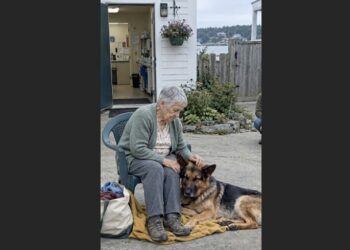
That afternoon, Walter was sitting outside near the main entrance.
A blanket covered his knees.
The weather was mild enough for him to enjoy the air.
He was looking toward the garden.
He did not notice when the glass doors opened behind him.
A staff member stepped outside.
Buddy was walking beside her on a loose leash.
The Labrador Took Two Steps and Stopped
The staff member noticed immediately.
Buddy’s head lifted.
His body became still.
He was looking directly toward Walter.
For several seconds, nothing else happened.
The nurse holding the leash looked down at him, unsure whether he was tired or reluctant to move farther.
Then his tail shifted.
One small movement.
Walter still had not turned around.
Buddy remained focused on him.
Then he started walking.
Slowly at first.
His elderly legs were stiff.
The pavement required careful steps.
Yet his pace became steadier as he crossed the distance between them.
Nobody called Walter’s name.
Nobody said, “Look who’s here.”
They let the dog approach.
Walter Heard the Collar Before He Saw the Dog
There was a faint metallic sound as Buddy moved closer.
Walter turned his head.
At first, his expression remained uncertain.
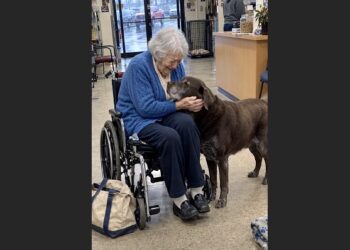
A yellow Labrador was approaching his wheelchair.
The dog’s muzzle was almost white.
His body was older than the one Walter had lived with months before.
Buddy reached him.
Then pushed his nose underneath Walter’s resting hand.
Walter’s fingers moved through the fur.
They reached the faded red collar.
His face changed.
“Buddy?”
The dog pressed closer against his knees.
Walter touched the collar again.
Then his other hand came down around Buddy’s face.
“Buddy,” he said again.
Quieter this time.
Nobody Needed to Say the Dog “Knew Everything”
Buddy did not understand senior housing.
He did not know why Walter had disappeared from the house they once shared.
He could not understand illness, care arrangements, or eight months on a calendar.
What dogs can retain very well are familiar associations.
Scent.
Voice.
Movement.
Body shape.
Touch.
Objects.
Routines tied to particular people.
It was entirely plausible that something about Walter remained deeply familiar to Buddy after months apart.
His behavior certainly suggested recognition.
He had stopped.
Focused.
Approached voluntarily.
Then sought physical contact.
That was meaningful enough without giving him a human understanding of the reunion.
Walter’s Hands Remembered Something Too
One of the nurses watching from nearby later described the change in him.
Walter had been quieter lately.
He sometimes struggled to identify familiar people.
There were mornings when the building around him seemed confusing.
Yet when Buddy placed his head beneath his hand, Walter did not need prompting.
His fingers moved around the dog’s face.
They touched the collar.
Then the familiar spot behind one ear.
Maybe the recognition began with sight.
Maybe the sound of the collar contributed.
Maybe touch completed it.
Memory is not a single system stored in one place.
Familiar experiences can sometimes be triggered by sensory cues even when other kinds of recall have become difficult.
Whatever process was happening inside Walter, the outward result was unmistakable.
He knew Buddy’s name.
Buddy’s Tail Tapped Against the Wheelchair
Not violently.
He was too old for the full-body enthusiasm of his younger years.
But the tail kept moving.
Tap.
Tap.
Tap.
Against the side of the chair.
Walter leaned forward as far as he comfortably could.
Buddy remained close.
For a few minutes, neither seemed particularly interested in anyone else.
Staff members stayed back.
Walter’s daughter watched.
There was no need to make the reunion louder than it already was.
No applause.
No excited voices.
No one repeatedly telling Walter who Buddy was.
The two of them had enough information.
A familiar hand.
A familiar dog.
For that moment, the rest could wait.
Their History Had Been Made Mostly of Ordinary Days
Buddy had not been Walter’s service dog.
He had not performed specialized tasks.
He was a family Labrador.
That meant most of their life together had been unremarkable in the best possible way.
Breakfast.
Walks.
Waiting near the kitchen.
Lying beside Walter’s chair.
Following him into another room.
Watching from the doorway.
Going outside before bed.
Repeating it all the next day.
Humans often underestimate how powerful those repeated routines become for dogs.
The same is true for people.
A relationship built over years does not consist only of major events.
It is mostly repetition.
Perhaps that was why the reunion felt so immediate.
Buddy and Walter had thousands of ordinary moments behind them.
The Visit Lasted Less Than Thirty Minutes
Buddy was old.
Walter could tire easily too.
The family and staff had agreed not to push either one.
So the first visit remained short.
Buddy spent much of it near the wheelchair.
Sometimes Walter stroked him.
Sometimes his hand simply rested against the dog’s back.
They did not need constant interaction.
A successful visit did not require Buddy to stay excited or Walter to remain fully oriented every second.
What mattered was comfort.
Near the end, Buddy lowered himself beside the chair.
Walter’s hand remained near the top of his head.
Then it was time for the dog to leave.
That was the part everyone had worried about.
Walter Asked When Buddy Would Come Back
After the Labrador had gone, Walter mentioned him again.
Then again later.
“When’s Buddy coming?”
His daughter noticed.
The staff noticed too.
Recent information was often difficult for Walter to retain.
Yet something about the visit remained accessible enough for him to ask.
Nobody assumed that meant the dog had somehow reversed his memory problems.
He had not.
The underlying condition remained.
But the family could see that the visit had mattered.
So Walter’s daughter began planning another one.
Sunday seemed manageable.
Then another Sunday.
Soon, Buddy’s visits became part of the weekly routine.
Some Sundays Walter Recognized Him Immediately
Buddy would come through the entrance.
Walter’s face would brighten.
“Buddy.”
Other weeks took longer.
The dog might reach his wheelchair before Walter reacted.
Sometimes Buddy’s muzzle touched his hand first.
Then recognition appeared.
Staff learned not to rush the process.
They did not stand over Walter asking:
“Do you know who’s here?”
They did not turn the visit into a memory examination.
That would have added pressure to something that did not need it.
Instead, they allowed sensory familiarity to do whatever it could.
Buddy approached.
Walter touched him.
The relationship happened in the present.
That was enough.
Buddy Adjusted to the New Routine Too
The senior residence gradually became another familiar destination.
The doors.
The lobby.
The outdoor sitting area.
Certain staff members.
Walter’s wheelchair.
Buddy did not need to understand why they visited every Sunday.
He only needed repetition.
Dogs are very good at learning patterns.
A car ride leads to a building.
A particular hallway leads to Walter.
A visit follows.
Then home.
After several weeks, Buddy sometimes appeared more purposeful when entering.
That did not prove he anticipated the visit in the same narrative way a person might.
It meant he had learned the sequence.
For an old dog, learned routines can be deeply reassuring.
Staff Began Watching Walter Before and After the Visits
Not as a scientific experiment.
Just as part of ordinary care.
On some Sundays, he talked more afterward.
On others, he seemed tired.
Sometimes he repeated Buddy’s name.
Sometimes the visit passed and the details appeared to fade quickly.
Nobody expected consistency.
Memory disorders do not improve in neat lines.
A good day does not mean the condition is reversing.
A difficult day does not erase a meaningful interaction that happened earlier.
What Buddy seemed able to provide was something more modest.
A familiar sensory experience.
Touch.
Scent.
Routine.
Companionship that required little conversation.
Those things can be valuable even when the person cannot later describe the visit accurately.
Buddy Didn’t Care Whether Walter Remembered Yesterday
That may have been one of the most useful things about him.
Human relationships depend heavily on shared memory.
We refer to previous conversations.
Birthdays.
Promises.
Names.
Places.
For someone losing access to those things, social interaction can become exhausting.
A dog does not require that kind of performance.
Buddy did not need Walter to remember what happened last Sunday.
He did not need Walter to explain why they lived apart.
He did not need an apology for eight months of separation.
If Walter touched his head gently, Buddy could respond to that moment.
If Walter forgot the visit later, the dog did not take offense.
The relationship could begin again every time.
Walter’s Daughter Had Worried About Bringing Buddy Back
She had hesitated before arranging the first visit.
What if it upset her father?
What if he did not recognize Buddy at all?
What if Buddy became distressed when he had to leave?
Those were reasonable concerns.
Sometimes reunion stories are treated as automatically beneficial.
They are not.
A visit should be guided by the welfare of both the person and the animal.
In this case, Buddy remained manageable and relaxed.
Walter appeared comforted rather than agitated.
The short duration worked.
So they continued.
Had either one shown persistent distress, the family would have needed to reconsider.
Care meant watching what actually happened, not forcing the reunion to match a sentimental expectation.
Age Made Buddy’s Visits Slower Over Time
His hips became stiffer.
He needed longer to get out of the car.
Walter’s daughter started bringing a small mat so the Labrador did not have to lie directly on a hard floor.
Visits became even quieter.
Buddy would approach Walter.
Receive a few strokes.
Then settle down.
Sometimes Walter talked to him.
Sometimes he said very little.
Buddy did not appear to mind either version.
As both of them aged, the companionship seemed increasingly suited to their pace.
No long walks.
No excitement required.
Just proximity.
The Red Collar Became Part of Walter’s Recognition
It had faded with age.
Once bright, now worn.
Walter’s fingers often found it.
That became one of the small details his daughter noticed.
He might look uncertain at first.
Then touch the collar.
Then say the dog’s name.
No one could know whether the collar itself triggered memory.
Its texture.
Its familiar location beneath Buddy’s fur.
Perhaps it contributed.
Perhaps it was simply something Walter’s hands had touched thousands of times before.
Either way, his daughter never replaced it for cosmetic reasons.
The collar was still safe.
So it stayed.
New was not necessary.
Familiar had value.
The Visits Did Not Give Walter His Old Life Back
That distinction mattered.
Buddy still went home with his daughter.
Walter still lived at the residence.
His memory problems continued.
There were difficult mornings.
Confusing afternoons.
People he sometimes failed to recognize.
The dog did not cure any of that.
Nor did the visits eliminate the grief of watching a parent change.
They gave the family something smaller.
A recurring moment when Walter often seemed connected to something familiar.
That was enough to justify the effort.
Medicine does not have to come from every comforting experience.
Some things are simply comfort.
Dogs Can Remember Familiar People After Long Separations
The final question in Walter’s story does have a grounded answer.
Yes, dogs can retain memories of familiar people for long periods.
Their recognition is not necessarily based on the same kind of autobiographical memory humans use.
Instead, scent can be especially powerful.
So can voice.
Movement.
Touch.
Repeated associations built over years.
A dog may react strongly when those cues return after months or longer apart.
That does not mean every dog will show recognition in the same way.
Some become excited.
Some freeze first.
Some approach cautiously.
An older dog may show recognition with little more than a tail movement and a decision to stay close.
Buddy’s response fit that quieter pattern.
Walter’s Recognition Was More Complicated
Human memory loss can spare some familiar associations while damaging others.
A person may forget a recent conversation yet respond to an old song.
Struggle with a name while recognizing a face.
Fail to recall a date but remember how to perform an old routine.
There is no guarantee which memories remain accessible or when.
That is why Walter’s family stopped measuring the visits by whether he could later report what happened.
The encounter itself had value.
When Buddy placed his muzzle beneath Walter’s hand and Walter said his name, that moment existed whether or not Walter remembered it the following morning.
That idea changed how his daughter thought about visiting too.
Not every good experience has to be stored permanently to matter.
On Sundays, Buddy Still Crossed the Pavement Slowly
The routine became familiar.
Walter near the entrance.
Blanket across his knees.
Buddy approaching on aging legs.
Sometimes the Labrador saw him first.
Sometimes Walter heard the collar.
Then a hand lowered.
A gray muzzle rose.
The tail tapped.
Nobody needed anything more elaborate.
The scene did not recreate their old home.
It could not.
But it preserved one piece of a relationship built through years of ordinary companionship.
Some Memories Don’t Return as Stories
They return as gestures.
A hand finding an old collar.
A dog’s head moving beneath a familiar palm.
A name spoken before anyone supplies it.
Buddy could not understand why Walter had been gone for eight months.
Walter could not always explain where he was or who had visited him yesterday.
But when the old Labrador crossed the pavement and pressed against the wheelchair, neither of them needed an explanation.
For a little while, there was simply Walter.
And Buddy.
A hand resting on a gray head.
A tail tapping softly against the chair.
Then, on the following Sunday, they did it again.
Editor’s Note: The characters in this story are fictional. Through these stories, we hope to share the intelligence, loyalty, compassion, and loving nature of dogs with people everywhere.