Oskar was only three months old when a wildfire took away the only world he had ever known.
By the time the little German Shepherd arrived at our rescue center, his coat was covered in ash, his breathing was labored, and he was barely strong enough to hold up his head.
His mother and littermates had disappeared during the fire. Somehow, Oskar had survived, but the experience had left him physically weak and terribly frightened.
Our veterinarian confirmed that smoke inhalation had seriously affected his lungs. He needed medical attention, careful monitoring, and time to recover.
But there was another problem we couldn’t address quite so easily.
Oskar had withdrawn from everything around him.
For the first two days, he lay almost motionless on a blanket in a quiet corner of his enclosure. He refused food and showed little interest in the people trying to help him.
I had worked at the rescue center for six years. During that time, I had cared for hundreds of animals who had been abandoned, injured, or frightened.
I had seen dogs recover from terrible circumstances.
Still, something about this little puppy stayed with me.
We could treat his lungs and make sure he was physically comfortable. What we couldn’t do was explain to him that the danger had passed.
Then a nine-year-old Rottweiler named Jax entered his life.
And slowly, everything began to change.
A Frightened Puppy Meets an Unlikely Protector
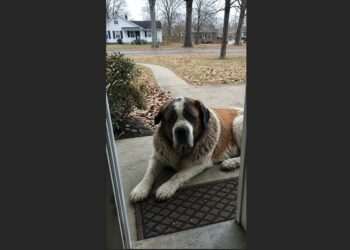
Jax was one of our older dogs.
He had the broad chest, powerful build, and steady manner of a mature Rottweiler. Gray hairs had begun appearing around his muzzle, and his movements were slower than those of the younger dogs.
He was nine years old, with aging joints that sometimes required medication to keep him comfortable.
At first glance, he seemed an unlikely companion for a tiny German Shepherd puppy recovering from a wildfire.
Oskar was young, fragile, and frightened by nearly everything. Jax was large, calm, and well past the energetic stage of life.
But the difference between them would become one of the most remarkable parts of their relationship.
The Morning Jax Lay Down Beside Him
I remember watching Jax approach Oskar for the first time.
The older dog moved slowly, without the excitement or curiosity a younger dog might have shown.
He lowered his head and carefully sniffed the puppy.
Oskar remained where he was.
Jax stayed close for a moment, then lowered his large body onto the floor beside him.
He settled against the puppy, allowing Oskar to rest near the warmth of his thick coat.
What happened next brought tears to my eyes.
For the first time since arriving at our center, Oskar lowered his head against another dog and appeared to relax.
His eyes closed.
And he slept.
It wasn’t the restless, uneasy sleep we had been watching during his first days with us. His small body seemed to settle more comfortably against Jax, who remained beside him.
I stood watching them, reluctant to disturb the moment.
We had spent days trying to make Oskar feel safe.
Jax had simply come close, settled down, and allowed the puppy to decide what he needed.
For Oskar, the presence of another dog seemed to offer a kind of reassurance that human care alone hadn’t yet provided.
From that morning onward, the two were rarely far apart.
Jax Became the Steady Presence Oskar Needed
Oskar’s physical recovery was gradual.
His lungs remained irritated from the smoke, and he still needed time to regain his strength. Although he was receiving appropriate care, his fear did not disappear as quickly as we hoped.
Unexpected noises could send him into a panic.
A door closing too loudly was sometimes enough to make him startle.
When that happened, Jax often responded immediately.
The older Rottweiler would stand and position himself between Oskar and whatever had frightened him.
He wasn’t aggressive toward the people around him. He simply seemed determined to remain close to the puppy whenever something disturbed him.
His broad body became a reassuring presence.
For Oskar, who had lost the familiar company of his mother and littermates, that consistency appeared to matter.
He could rest beside Jax without having to approach unfamiliar people. When something startled him, the older dog was nearby.
And as the days passed, Oskar began showing signs that he was becoming more comfortable in his surroundings.
The First Heavy Rain of Autumn
One of the clearest examples came during the season’s first heavy rainstorm.
Rain began striking the metal roof of the rescue center, filling the building with a loud, unfamiliar drumming.
Oskar panicked.
He hurried toward Jax and squeezed beneath the older dog’s body, seeking shelter from the noise.
Jax responded by curling around him.
The two remained close as the rain continued outside.
Watching them, I was struck by how naturally Jax seemed to adjust to the puppy’s needs.
He didn’t need to understand what Oskar had experienced during the wildfire.
He didn’t need to know why loud sounds frightened him.
He simply stayed with him.
And sometimes, that was exactly what Oskar needed.
I had spent years working with rescued animals, yet I was still learning how much comfort they could offer one another.
Jax wasn’t a trained therapy dog. He was an aging Rottweiler whose own future remained uncertain.
But in the weeks after the fire, he became a dependable companion for a puppy who had lost so much.
Their bond developed through ordinary moments: resting together, staying close during frightening sounds, and gradually learning to move through the day as a pair.
Then, about three weeks after Jax first settled beside Oskar, I witnessed something I hadn’t expected.
The Morning Oskar Finally Wanted to Play
I was making my usual morning rounds when a clear, excited bark caught my attention.
It sounded different from the anxious noises I had grown accustomed to hearing from Oskar.
I walked toward the yard and stopped near the fence.
There he was.
Oskar stood in front of Jax, his front legs bent low in the unmistakable posture of a puppy inviting another dog to play.
His tail was wagging enthusiastically.
He hopped backward, then darted forward again, trying to catch the loose skin around Jax’s neck.
The older Rottweiler responded with surprising gentleness.
He turned slowly, lowered his head, and stepped aside as though allowing Oskar to believe he had won their little game.
Oskar bounced around him, full of energy.
I stood there smiling.
Only weeks earlier, this same puppy had been lying motionless in a corner, too weak and frightened to show much interest in anything.
Now he was playing.
He was initiating contact, moving confidently around the yard, and inviting Jax to join him.
Oskar was beginning to behave like a puppy again.
His recovery was not complete, and we continued to be mindful of his health. But watching him play gave us reason to believe he was making meaningful progress.
Jax seemed comfortable letting the younger dog set the pace.
He never needed to match Oskar’s enthusiasm. His slower movements and patient responses were enough to keep the game going.
For a few minutes, I forgot about the difficult decisions that might eventually lie ahead.
I was simply happy to see Oskar enjoying himself.
Unfortunately, those decisions were approaching faster than I wanted to admit.
The Adoption Decision We Were Afraid to Make
As Oskar grew stronger and more confident, it became clear that he would soon be ready for adoption.
Under ordinary circumstances, that would have been wonderful news.
Young German Shepherds rarely spent long waiting for families at our center. People were often eager to adopt intelligent, energetic puppies they could raise and train.
Oskar was becoming the sort of young dog many families hoped to bring home.
But Jax was nine.
He had gray around his muzzle, a slower gait, and joints that required ongoing attention.
For many prospective adopters, those details made him a more difficult commitment.
A family adopting a puppy could reasonably expect years of activity and companionship. Choosing a senior dog meant accepting the possibility of additional veterinary care and the realities of aging.
I understood why people considered those differences.
Still, I worried about what would happen if Oskar left without Jax.
The two had become deeply attached.
Oskar sought Jax when he was frightened and followed his lead through much of the day. Jax, in turn, seemed attentive to the younger dog’s movements and needs.
Separating them might have been manageable with the right support, but none of us wanted to underestimate the effect it could have on either dog.
I found myself hesitating whenever I thought about completing Oskar’s adoption paperwork.
I knew we couldn’t keep postponing his opportunity to find a permanent home.
Yet I couldn’t stop hoping that someone might be willing to take both dogs.
Then, one Thursday afternoon, the Miller family arrived.
A Family Came Looking for One Dog
The Millers were a family of four.
The parents had brought their two children, a girl of about twelve and her younger brother.
They were hoping to adopt a lively young dog who would enjoy spending time in their spacious backyard.
Oskar seemed like a wonderful possibility.
When the family met him, he approached eagerly, wagging his tail and welcoming their attention.
The little boy was delighted.
Oskar moved happily around the visitors, enjoying the affection that had once seemed so difficult for him to accept.
I watched the interaction with mixed feelings.
On one hand, I was thrilled to see him comfortable with a prospective family.
On the other, I knew Jax was nearby.
The older Rottweiler stood behind the fence, watching the activity without pushing forward for attention.
He seemed content to observe Oskar from a short distance.
Then the Miller family’s daughter noticed him.
The Question That Changed Both Dogs’ Futures
The girl stopped watching the puppy and turned toward Jax.
She looked at the older dog for a moment, then asked about him.
I decided to explain their story.
I told the family about the wildfire, Oskar’s arrival at the rescue center, and the serious effects of smoke inhalation.
I described how frightened he had been during his first days with us, when he barely moved and showed little interest in food.
Then I told them about Jax.
I explained how the older dog had approached Oskar, settled beside him, and become a reassuring presence during his recovery.
I described the rainstorm, the puppy’s fear of sudden noises, and the morning I had finally seen him playing in the yard.
As I spoke, the girl’s mother grew emotional.
Her husband listened quietly.
The little girl moved closer to the fence and knelt near Jax.
Then she asked the question I had been hoping someone would ask.
“Do they need to be together to be happy?”
I considered how best to answer.
I couldn’t promise that two dogs would never adjust to living apart. But after watching Oskar and Jax together, I knew their relationship deserved serious consideration.
I explained that they had become exceptionally close and that keeping them together would be my strongest preference.
The girl looked toward her parents.
Her mother smiled.
Then she said something I will always remember.
“Then I guess we’ll have room for two.”
For a moment, I could hardly believe what I had heard.
The Millers had come looking for one young dog.
Now they were offering a home to both Oskar and the aging Rottweiler who had helped him recover.
One Adoption Day, Two Dogs Going Home
The following Monday, the Miller family returned to complete the adoption.
I remember feeling emotional as I worked through the paperwork.
We reviewed Oskar’s medical history, including his exposure to smoke during the wildfire and the care he had received.
We also discussed Jax’s age, his joint discomfort, and the possibility that he would require additional veterinary support as he grew older.
The family understood what they were taking on.
They weren’t simply adopting an energetic young German Shepherd.
They were welcoming a senior Rottweiler who would need consideration and care during the later years of his life.
The Millers completed the adoption arrangements for both dogs.
When it was time to leave, we brought Oskar and Jax toward the family’s vehicle.
Comfortable bedding had been prepared for them.
Oskar was visibly excited, moving toward the car with the eagerness of a young dog beginning a new adventure.
Jax moved more slowly.
At the back of the vehicle, he paused and turned toward me.
I crouched beside him and wrapped my arms gently around his broad head.
Then I whispered the words I had been wanting to say.
“Thank you for being there when no one else could.”
Jax licked my wrist.
I smiled through my tears and gave him one last gentle touch.
Then he climbed into the vehicle beside Oskar.
For weeks, I had worried that finding Oskar a permanent home would mean leaving Jax behind.
Instead, I was watching them leave together.
The puppy had a family.
And so did the dog who had cared for him.
A New Life for Oskar and a Peaceful Retirement for Jax
The Millers continued sending updates and photographs after the adoption.
Each one reassured me that the two dogs were settling into their new lives.
Oskar grew into a strong, energetic young German Shepherd who loved running through the family’s backyard.
The frightened puppy we had once carried into the rescue center was becoming an active, curious dog.
Jax preferred a quieter pace.
He had comfortable places to rest, including soft bedding near the family’s fireplace.
After years of life and the responsibility he seemed to take on with Oskar, the older Rottweiler was finally enjoying the kind of peaceful home every senior dog deserves.
The two remained close.
One of my favorite updates arrived with a photograph taken near the beginning of winter.
Oskar and Jax were lying together beside a large window.
Outside, the first snowflakes were falling.
Oskar had settled with his head resting against Jax’s side.
The older dog lay comfortably beside him, watching the world beyond the glass.
I looked at the photograph for a long time.
The image brought back the first morning I had seen them together at the shelter.
Back then, Oskar was a tiny, exhausted puppy who had barely survived a wildfire.
Jax had approached him quietly, settled beside him, and offered the simple comfort of his presence.
Now they were in a family home, warm and safe, still choosing to rest together.
That photograph meant more to me than any dramatic account of their recovery could have.
It showed two dogs who had found a place where they could remain together.
The Old Rottweiler Who Helped a Puppy Find His Way Back
I’ve thought about Oskar and Jax many times since their adoption.
At first, I believed the most important part of their story would be Oskar’s recovery from the wildfire.
He was so young when he arrived, and his physical condition was frightening.
Watching him regain his strength and begin playing again was something I will never forget.
But Jax changed the way I understood that recovery.
He couldn’t treat Oskar’s damaged lungs or replace the mother and littermates the puppy had lost.
He couldn’t make the frightening memories disappear.
What he could do was stay close.
When Oskar was afraid, Jax was there.
When the puppy was ready to play, Jax responded.
And when Oskar finally found a permanent home, the family who welcomed him made room for the older dog, too.
I often think about how easily things might have turned out differently.
The Millers could have adopted only the puppy they had originally come to see.
Jax might have remained at the shelter, waiting for someone willing to take home a nine-year-old Rottweiler.
Instead, a thoughtful young girl noticed him standing quietly behind the fence.
She asked one question, and her family listened.
Today, when I look at that winter photograph, I don’t see an elderly dog and a rescued puppy.
I see Jax resting comfortably in the home he deserves, with Oskar still beside him.
And I remember the morning it all began, when a frightened little German Shepherd finally closed his eyes and slept against the warmth of an older dog.
Jax couldn’t give Oskar back the life he had lost in the fire. But he stayed beside him while the puppy learned how to enjoy life again.
In the end, the family that welcomed Oskar understood something equally important.
There was room in their home for the dog who had helped him get there.