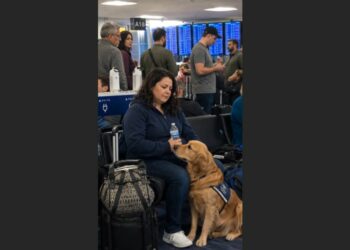
The man at the gate noticed Ranger before he noticed me.
His eyes moved from the scars across Ranger’s shoulder to the working-dog build that aging had softened only slightly.
Then he pulled his carry-on closer.
A few seconds later, he leaned toward an airline employee and spoke quietly enough that he probably thought I could not hear him.
“Are dogs like that really allowed on commercial flights?”
He looked back at Ranger as he asked.
Ranger was lying beside my chair.
His head rested between his front paws.
One ear moved when an announcement echoed through the terminal, but otherwise he barely reacted.
I could have been offended.
Instead, I smiled.
The dog this stranger was watching so nervously had spent much of his working life in environments far more dangerous than an airport gate.
His name was Ranger.
He was a retired Special Operations working dog.
And whatever people thought they saw when they looked at his scars, danger was only one small part of his story.
Ranger Had Been Selected for Work Most Dogs Will Never Do
Ranger was a Belgian Malinois.
The breed is often associated with police and military work because many Malinois possess the drive, athleticism, focus, and responsiveness needed for demanding jobs.
That does not mean every Malinois is suited to such work.
It also does not mean a dog trained for military tasks is automatically dangerous in ordinary life.
Ranger had been selected because of very specific qualities.
He could work intensely for long periods.
He recovered quickly from environmental stress.
He was motivated by toys and handler interaction.
He could search independently while remaining responsive to trained cues.
Most importantly, his handlers learned how to read him.
Military working dogs do not explain what they smell.
Their communication comes through changes in behavior.
A pause.
A shift in breathing.
A change in posture.
A sudden focus on one location.
For teams working around explosives, noticing those changes can matter enormously.
His Job Was Detection Before It Was Anything Else
People sometimes imagine military dogs charging into combat at every opportunity.
The reality is more technical.
Ranger’s most valuable equipment was his nose.
He was trained to detect target odors associated with explosive material and other operational threats.
Handlers reinforced those searches through repetition, conditioning, and carefully managed rewards.
A tennis ball or tug could mean more to Ranger than any human concept of service.
That was part of what made the system work.
He did not need to understand geopolitics.
He did not need to know why a patrol was moving through a particular valley.
He needed to search.
His handler needed to recognize what his behavior meant.
When those two parts worked together, soldiers could receive information before they stepped into a dangerous area.
He Often Worked Ahead of the Team
During deployments, Ranger reportedly accompanied Special Operations personnel through environments where explosive threats were a constant concern.
Before people entered certain structures, he might be sent to search under controlled circumstances.
Before a route was used, Ranger could be tasked with checking areas his handler considered suspicious.
Vehicles.
Walls.
Ground disturbances.
Buildings.
Open spaces.
His job was not to understand what might happen if he found something.
He had been trained to respond to scent.
Humans made the tactical decisions afterward.
That distinction mattered.
Ranger was exceptionally skilled at his work.
He was still a dog performing behaviors shaped through training.
Some Soldiers Credited Him With Finding Things They Had Missed
Over the years, Ranger was said to have alerted on multiple explosive threats and other dangerous materials.
The exact operational record described in his story was not publicly verifiable, which was hardly unusual for a dog associated with sensitive military work.
But the role itself was very real.
Military and Special Operations dogs have long been used for explosive detection, tracking, patrol functions, and other specialized tasks.
Their advantage is not that they possess some supernatural awareness of danger.
It is that a trained canine nose can detect odor information humans cannot perceive directly.
That ability can give a team another layer of warning.
For the people who worked beside Ranger, that layer sometimes felt very personal.
One Patrol Became Part of the Stories Told About Him
The account I heard most often involved a movement through a remote valley shortly before sunrise.
The landscape appeared quiet.
The patrol advanced carefully.
Then Ranger’s behavior changed.
His body stiffened.
His attention fixed ahead.
His handler recognized the change and stopped the movement.
Nobody continued simply because the route looked safe.
A more detailed search followed.
According to the story passed among the men, explosive devices had been concealed along the route ahead.
Had the team continued without investigating Ranger’s alert, the outcome might have been very different.
Ranger did not know that.
He knew only that he had encountered a trained odor and responded as he had been taught.
The humans around him understood the implications.
His Handler Had to Trust What Ranger Was Telling Him
That relationship is easy to romanticize.
In practice, it was built from work.
Repetition.
Mistakes.
Corrections.
Rewards.
Thousands of hours learning the difference between normal canine behavior and operationally meaningful behavior.
A handler cannot simply look at a dog and magically know what the animal senses.
Likewise, a dog cannot perform reliably if the person holding the leash is inconsistent.
The team develops communication through experience.
Ranger’s handler learned the details.
How his breathing changed during a serious search.
How quickly he normally scanned an area.
What his body looked like when he caught odor.
What distraction looked like instead.
Trust came from knowing those differences.
Then Came the Operation That Left the Scars
The most serious incident in Ranger’s story happened during a nighttime operation.
Details were limited.
What remained in the account was confusion.
Gunfire.
Movement.
People trying to find cover.
Commands traveling through darkness.
Ranger and his handler were exposed in part of the compound when an explosion occurred nearby.
Fragments tore through the area.
Ranger was injured.
The damage to his chest, shoulder, and front leg was significant.
Several fragments reportedly penetrated soft tissue.
The wounds required immediate attention.
For those present, the priority became getting both dog and handler out of danger.
Injured Working Dogs Do Not Understand Why the Job Suddenly Stops
Stories about Ranger often said he kept trying to return to work.
That behavior was sometimes described as courage.
There is another way to understand it.
Highly conditioned working dogs develop intense associations around equipment, movement, handlers, search patterns, and rewards.
In the middle of an operation, an injured dog may continue attempting familiar behaviors because the working context has not suddenly acquired the human meaning of “you are badly hurt and need to stop.”
Ranger reportedly tried to rise.
His handler prevented him from continuing.
That restraint was not a failure of Ranger’s determination.
It was responsible handling.
An injured dog does not need to prove anything.
He needs medical care.
The Evacuation Was Only the Beginning
Ranger survived the initial injuries.
After emergency stabilization, he was transferred for more extensive veterinary treatment.
The exact procedures in the source account were not independently documented, so there is no reason to invent surgical details.
What mattered was clear.
His wounds were serious enough to require prolonged treatment.
His front limb had been damaged.
Recovery was measured in months rather than days.
For a dog accustomed to intense physical work, the restrictions were substantial.
Rest.
Controlled movement.
Repeated examinations.
Rehabilitation.
Slow increases in activity.
There were no dramatic shortcuts.
Learning to Move Comfortably Again Took Time
Ranger’s gait changed.
At first, even ordinary movement was difficult.
Rehabilitation focused on what his body could safely tolerate.
Strength.
Range of motion.
Controlled loading.
Gradual return to activity.
Progress varied.
That is normal.
Recovery from significant orthopedic or soft-tissue injury does not move forward at the same rate every day.
Some sessions went well.
Others ended earlier.
The important question was not whether Ranger looked heroic.
It was whether his body was healing without unnecessary pain or reinjury.
Eventually, his movement improved.
He could walk comfortably.
Then run again.
A slight limp remained.
The Limp Was Not a Medal
People liked treating it that way.
They saw Ranger move and immediately attached a story to it.
Sacrifice.
Bravery.
Service.
Those ideas belonged to humans.
For Ranger, the limp was a physical consequence of injury.
Something his family and veterinarians had to monitor.
It could become more noticeable after exertion.
Age would likely make some days harder.
Scar tissue and prior injury do not disappear because people admire them.
His retirement had to account for the body he actually had.
That meant activity appropriate to his condition.
Rest when needed.
Veterinary follow-up.
No expectation that a retired working dog should continue proving how tough he was.
Retirement Took Adjustment Too
Leaving operational work did not transform Ranger into a different animal overnight.
Working dogs are accustomed to structure.
Handlers.
Training sessions.
Predictable cues.
Equipment that signals what comes next.
Retirement removes much of that.
Some dogs adapt easily.
Others benefit from continued structure, enrichment, and carefully managed activities.
Ranger still liked having something to do.
Fortunately, “something to do” did not need to involve explosives.
A search game around the house could hold his attention.
So could obedience work.
A hidden toy.
A tennis ball.
A walk where he was allowed time to investigate smells.
His working life became smaller.
That did not make it empty.
At Home, Ranger Was Surprisingly Ordinary
This was the part strangers rarely imagined.
He loved tennis balls.
Not symbolically.
Not because they represented retirement.
He simply loved tennis balls.
He could become absurdly focused on one.
He slept through long car rides.
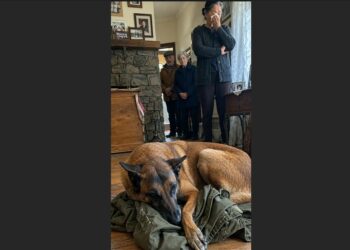
At home, his preferred place was often the living room floor near his family.
He had favorite resting positions.
Favorite routines.
Times of day when he wanted activity.
Times when he wanted to be left alone.
The dog who once operated in dangerous environments also snored.
That fact probably told people more about retirement than any dramatic story could.
Training for Dangerous Work Did Not Mean Constant Aggression
This misconception followed Ranger everywhere.
People saw Belgian Malinois.
They saw scars.
They heard “military.”
Then they imagined an animal waiting for a reason to attack someone.
That was not how Ranger functioned.
Working dogs are trained around specific tasks and cues.
Behavior is shaped and controlled.
A dog used for detection does not spend every waking hour searching for a person to bite.
Ranger’s family never described him as indiscriminately aggressive toward strangers.
That does not mean anyone should approach an unfamiliar retired working dog without permission.
It means his history alone was not evidence that he posed an uncontrolled threat.
Airports Made Those Assumptions More Visible
Travel already makes people tense.
Everyone is carrying something.
Everyone is watching clocks.
People become more alert to anything unfamiliar.
A muscular dog beside a gate attracts attention.
A scarred Belgian Malinois attracts even more.
Some people smiled at Ranger.
Others moved around us.
A few asked respectful questions.
And occasionally someone reacted like the man with the carry-on.
He did not insult me.
He simply looked worried.
I could understand that.
He had no context.
He saw an animal associated in his mind with military and police work.
He did not see Ranger asleep on the living room floor.
Airline Travel Required Planning
Ranger’s background did not automatically exempt him from ordinary travel rules.
His status, transport arrangements, documentation, health, and the specific airline’s policies all mattered.
Responsible travel with any working or retired working dog requires preparation.
I made sure Ranger’s arrangements were handled before arriving at the airport.
There was no improvising at the gate.
That would have been unfair to everyone involved, especially Ranger.
Travel days were already tiring for him.
Long stretches on hard flooring could make the old injury more noticeable.
We gave him breaks.
Water.
Time.
And space.
That Morning, Ranger Was Mostly Interested in Sleeping
While the man spoke with the airline employee, Ranger remained beside me.
An announcement sounded.
His ear moved.
A child dropped something several seats away.
Ranger looked up.
Then lowered his head again.
No dramatic vigilance.
No scanning for enemies.
No tense readiness.
He was retired.
An airport gate was an airport gate.
The environment contained noises, smells, movement, food wrappers, and strangers.
Nothing about it required Ranger to behave like he was back on a deployment.
That separation between past work and present life mattered.
I Did Not Tell the Stranger the Entire Story
There was no reason to corner him with it.
People should be allowed to ask legitimate questions about animals in shared public spaces.
What matters is whether the answer is factual.
The airline employee explained that Ranger’s presence had already been handled through the appropriate process.
The man nodded.
He still looked uncertain.
I scratched Ranger behind the ear.
Eventually, the stranger asked me directly.
“Is he military?”
“Retired,” I said.
He looked at Ranger again.
“That explains the scars?”
“Some of them.”
That was enough to change his expression.
Scars Tell Less Than People Think
A scar shows that tissue healed after injury.
It does not explain the entire event.
It does not tell a stranger how a dog behaves today.
It does not make Ranger noble.
It does not make him dangerous.
Humans are the ones who build stories around visible damage.
Sometimes those stories are generous.
Sometimes fearful.
Both can miss the actual animal.
Ranger was not his scars.
He was also not simply his military record.
He was the dog lying at my feet.
Older now.
A little stiff.
Still obsessed with tennis balls.
People Often Called Him a Hero
I understood why.
The word was used for military working dogs frequently, especially when their actions were credited with protecting service members.
Some of the people who had worked with Ranger used even stronger language.
They remembered alerts that changed routes.
Searches that uncovered danger.
Operational moments when his training contributed directly to keeping people safer.
Those experiences belonged to them.
Ranger himself did not carry a human concept of heroism.
He worked because he had been trained to work.
Because his handler guided him.
Because the tasks and rewards made sense within the world he had learned.
That did not make his contribution less important.
It made it more honest.
He Never Chose War
That is worth remembering with military animals.
Ranger did not volunteer.
He did not understand national policy.
He did not decide which mission was justified.
Humans placed him in a working system and trained him for highly specialized tasks.
That creates a responsibility after service.
Medical care.
Safe retirement.
Understanding his behavioral history.
Respecting the body that work helped wear down.
Not treating him like equipment whose usefulness ended with his career.
Ranger had worked for people.
Retirement meant people owed him care in return.
His Family Learned to Read the Older Version of Him
Age changes even highly driven dogs.
Ranger still became animated by toys.
But the bursts were shorter.
He slept more afterward.
The old leg sometimes looked stiff.
He needed recovery time.
There were days when a long outing was not worth it.
His family stopped measuring a good day by how much he could do.
A good day might mean a walk.
A game.
Dinner.
Then several hours asleep beside the couch.
For a dog who once worked in intense environments, ordinary retirement suited him surprisingly well.
The Man at the Gate Eventually Relaxed
Not immediately.
But enough.
He returned to his seat.
His carry-on stayed beside him instead of clutched against his chest.
Several minutes later, Ranger shifted onto his side.
The movement exposed more of the scar along his shoulder.
The man noticed.
Then he asked another question.
“How old is he?”
I told him.
He nodded.
“He’s been through a lot.”
“Yes.”
This time, he looked at Ranger differently.
Not with pity.
Not exactly admiration either.
More like curiosity.
That was fine.
I Preferred Curiosity to Assumptions
The problem was never that people asked questions.
Ask.
Is he safe to approach?
Should I give him space?
What kind of work did he do?
What do the scars mean?
Those are better questions than deciding from across a room that a breed, body, or past tells you everything.
Ranger could look intimidating.
I understood that.
Belgian Malinois are athletic dogs.
Military associations add another layer.
But responsible handling is about the individual animal in front of you.
History matters.
Training matters.
Current behavior matters.
Context matters.
Ranger Was Allowed to Become Old
That may have been the greatest gift retirement gave him.
He no longer needed to be the first dog through anything.
He did not need to detect another explosive.
He did not need to prove that his injured leg could still keep up with a team.
If he was tired, he slept.
If his body needed a slower day, he got one.
If he wanted to carry a tennis ball around the living room for no useful reason at all, nobody demanded a more productive activity.
His working years had been defined by purpose.
His retirement did not need one.
He was allowed simply to be a dog.
The Scars Became Less Interesting at Home
Visitors noticed them at first.
Family stopped seeing them.
That happens with familiar bodies.
What once stands out becomes part of someone you know.
Instead, people noticed Ranger’s habits.
Where he slept.
How he positioned himself near the refrigerator when food appeared.
Which ball he preferred.
How he sighed when nobody threw it quickly enough.
His scars stopped being a conversation.
That was probably healthier.
An old injury should not have to remain the most interesting thing about a living animal.
The Slight Limp Stayed
Some days it was barely noticeable.
Other days, especially after too much activity, it returned.
We respected it.
There was no reason to describe pain as proof of sacrifice.
If Ranger was uncomfortable, that meant something needed adjusting.
Rest.
Activity.
Veterinary care.
Age-appropriate management.
People sometimes admired working dogs for continuing through injury.
In retirement, the goal was the opposite.
He no longer had to continue through discomfort.
He Still Responded to Certain Cues Instantly
Years of training leave patterns.
A particular tone could bring Ranger’s attention up quickly.
Certain movements made him alert.
Toys remained powerful motivators.
That did not mean he was constantly reliving his operational past.
Learned behaviors simply persist.
Even ordinary pet dogs retain associations built over years.
The difference with Ranger was the intensity and specificity of some of his training.
His family understood that.
They did not deliberately provoke old working behaviors to entertain people.
Retirement was not a demonstration.
Boarding Began
Our flight was called.
People stood.
Bags zipped.
Phones disappeared into pockets.
The gate filled with the familiar disorder of passengers trying to board before the line had actually moved.
Ranger raised his head.
Then stood carefully.
The slight hitch in his front movement was visible for a moment.
The man who had questioned his presence watched.
Ranger did not look at him.
He was focused on me and the movement toward the gate.
Years ago, that attention had been part of far more demanding work.
Now it meant we were going somewhere together.
The Stranger Spoke Before We Left
“Was he really Special Operations?”
I stopped.
“Yes.”
He looked down at Ranger.
“What did he do?”
There was no way to summarize years of work in an airport boarding line.
“Detection work,” I said. “He helped find things before people walked into them.”
The man was quiet.
Then he nodded toward Ranger.
“Well. I guess he’s earned the flight.”
I smiled.
Ranger had not earned the right to exist comfortably in public because of military service.
That wasn’t how I thought about it.
But I understood what the man meant.
Ranger Did Not Need the Stranger’s Approval
Nor did he need mine.
He had already completed the work humans had asked from him.
He had survived an injury.
Recovered as much as his body allowed.
Retired.
Aging had taken care of the rest.
At the gate, none of those facts occupied Ranger.
He was not reflecting on operations.
He was not proud of his scars.
He was not thinking about soldiers who remembered him.
He was following the person he knew through a noisy terminal.
That was enough.
A Working Dog’s Story Does Not End When the Work Does
The dramatic part is easy to tell.
The missions.
The alert.
The explosion.
The evacuation.
People remember those scenes.
Retirement is quieter.
Veterinary appointments.
A sore leg.
A tennis ball.
Sleeping during car rides.
Finding the best place on the floor.
Learning that nobody is putting the working harness back on.
Growing gray.
Those years matter too.
In some ways, they matter more because they belong almost entirely to the dog.
Ranger Walked Toward the Jet Bridge Beside Me
No rushing.
No tactical formation.
No dramatic music.
Just an older Belgian Malinois walking through an airport.
A few people looked at his scars.
Most did not.
The man with the carry-on watched us pass.
This time he didn’t pull his bag closer.
Ranger continued forward.
The slight limp appeared for two steps and disappeared again.
Whatever anyone at that gate imagined when they first saw him, Ranger had already lived a life too complicated to fit inside a first impression.
He had been trained to search for danger.
He had worked beside people in places where mistakes could be fatal.
He had been injured.
Treated.
Rehabilitated.
Retired.
And now, the dog once expected to move toward threats had a much simpler destination.
A seat near his family.
A quiet flight.
And, eventually, a living room floor where an old tennis ball was probably waiting.
That was the part of Ranger’s life I cared about most.
Not proving that the stranger had been wrong to worry.
Not convincing everyone that Ranger was a hero.
Simply making sure the dog who had spent years working for people finally had years in which nobody needed anything from him at all.
Editor’s Note: The characters in this story are fictional. Through these stories, we hope to share the intelligence, loyalty, compassion, and loving nature of dogs with people everywhere.