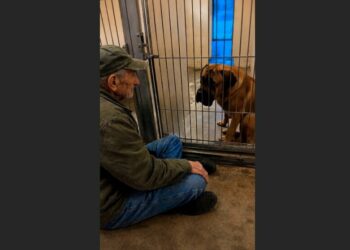
At six o’clock in the morning, I found an elderly Golden Labrador lying beside a wooden post behind our highway gas station.
Someone had left him there with three things.
A bowl of water.
A small amount of dog food.
And an old blanket with blue-and-red checks.
Everything had been placed neatly beside him, almost as though someone intended to return.
But there was nobody around.
The dog’s golden muzzle had turned almost completely white. His hind legs looked stiff, and he seemed reluctant to move.
I approached carefully.
“Hey, old buddy. Where’s your family?”
He looked up at me.
His tail moved once against the ground.
Then he turned his head toward the highway.
A car was approaching.
The Labrador watched it pass.
Then he lowered his head again.
I didn’t know it then, but the person this dog belonged to was three hours away, sitting in a wheelchair at a medical care facility.
The elderly man believed his beloved companion was gone.
And less than two days later, I would stand in that man’s doorway and watch the Labrador slowly walk toward him.
The dog would rest his white muzzle on the man’s knees.
His hands would begin trembling.
And after a long silence, he would whisper two words.
“You came…”
My name isn’t important to this story.
I’m just someone who’s worked at a highway gas station for seventeen years.
But I’ll never forget the old dog I found that morning.
Or the phone call that helped bring him home.
The Dog Behind the Gas Station
I’ve worked at the same highway gas station for seventeen years.
During that time, I’ve seen all kinds of things left behind.
Travelers forget jackets, bags, and other belongings.
Occasionally, animals appear near the property.
Some are wandering strays.
Others seem to have been separated from their owners.
But the Labrador I found that morning was different.
He wasn’t wandering around the parking lot.
He wasn’t approaching customers or looking for food.
He was lying beside a wooden post behind the building.
And someone had clearly left supplies for him.
The bowl of water was positioned within reach.
There was a small amount of dog food nearby.
And the folded blanket looked like something that had belonged to him for a long time.
I stood looking at the arrangement.
It was difficult to understand.
Who would bring an elderly dog to a gas station, leave him with a blanket and some food, and drive away?
I wondered whether his owner had stepped inside or gone somewhere nearby.
Perhaps someone was planning to collect him.
But after checking the area, I couldn’t find anyone who appeared to be looking after him.
The dog remained beside the post.
And whenever a vehicle approached, he raised his head.
The White Muzzle
The Labrador had once been a rich golden color.
I could still see that in his coat.
But his muzzle was almost completely white, the way many dogs’ faces become as they grow older.
He appeared to be a senior dog.
His movements were slow, and his hind legs seemed stiff.
I wondered how long he’d been lying there.
I also wondered whether he was uncomfortable.
I crouched a short distance away and spoke gently.
He turned toward me.
His eyes followed my movement.
Then his tail made one small movement against the ground.
He didn’t get up.
He didn’t try to follow me.
Instead, his attention returned to the road.
Another vehicle was approaching.
The old Labrador lifted his head and watched until it passed.
I couldn’t know what he was thinking.
Perhaps he was responding to familiar traffic sounds.
Perhaps he was watching for the person who had brought him there.
But the behavior was consistent enough that I noticed it throughout the morning.
Every time a vehicle came close, he looked toward it.
Then, when it continued down the highway, he settled again.
Waiting Through the Morning
I checked on him repeatedly while continuing my work.
Each time, he was still beside the wooden post.
The water bowl remained nearby.
The old checked blanket lay beside him.
He showed little interest in leaving the area.
I began feeling increasingly uncomfortable about the situation.
He was an elderly dog.
His legs appeared stiff.
And a highway gas station wasn’t a safe place for him to remain without someone responsible for his care.
I didn’t know whether his owner intended to return.
But I couldn’t assume that would happen.
As the morning progressed, the Labrador continued watching the traffic.
Sometimes he lifted his head when he heard a vehicle approaching.
Other times, he rested quietly.
I kept hoping someone would arrive and recognize him.
Perhaps a driver would pull into the station and ask about a missing dog.
Perhaps the person who’d left him there would return.
But the hours passed without anyone coming for him.
By eleven o’clock, I’d made my decision.
I couldn’t leave him behind the gas station any longer.
The Walk to My Car
I approached the Labrador again.
This time, I was prepared to help him leave.
I moved slowly, knowing that an unfamiliar person could make a frightened or uncomfortable animal uneasy.
The old dog looked toward me.
I offered my hand.
He examined it briefly.
Then, with some effort, he began standing.
I noticed the stiffness in his hind legs more clearly now.
They trembled slightly as he rose.
I waited until he seemed steady enough to move.
Then I gently encouraged him toward my car.
He followed slowly.
There was no excited pulling or hurried movement.
Just an elderly dog walking carefully beside someone he’d only met that morning.
I kept my pace comfortable for him.
When we reached the vehicle, I made sure he was safely positioned for the trip.
I looked at his graying face and wondered how long he’d been living with the stiffness in his legs.
I didn’t know his name.
I didn’t know how old he was.
And I had no way of contacting the person who belonged to him.
But I could get him to a veterinarian.
So that’s what I did.
The Veterinary Examination
The veterinarian examined the old Labrador carefully.
I explained where I’d found him and described his difficulty moving.
I also mentioned how he’d remained beside the post, watching the road.
The examination revealed arthritis that required attention.
That helped explain why his hind legs appeared stiff and why he moved so slowly.
Fortunately, the veterinarian found him otherwise stable.
I felt relieved.
I’d been worried that the dog might be suffering from a more serious condition that wasn’t immediately obvious.
He still needed appropriate treatment and ongoing care for his arthritis.
But he was in a condition where we could begin making practical plans for him.
Then the veterinarian checked for a microchip.
The scanner detected one.
I remember feeling suddenly hopeful.
A microchip could help us identify his registered owner.
Perhaps this would be easier than I’d feared.
Maybe we could make a phone call and arrange for someone to collect him.
But the information we found didn’t lead to an immediate reunion.
The Number That No Longer Worked
The Labrador’s microchip was registered.
There was a telephone number and an address.
But when we tried the number, it was disconnected.
The address was no help either.
The property had been vacant for three years.
I felt my hope fade.
We had information associated with the dog, but it was outdated.
There was no immediate way to reach his family.
I thought about the little collection of belongings beside the wooden post.
The food.
The water.
The blanket.
Someone had apparently cared enough to leave him those things.
Yet nobody had remained to make sure he was safe.
I didn’t know whether the person listed on the microchip was still alive or whether the dog had changed homes since the information was registered.
There were too many unanswered questions.
The veterinarian explained the care the Labrador would need.
I knew I couldn’t simply bring him back to the gas station.
And although a shelter was an option to consider, I found myself reluctant to leave him in another unfamiliar place.
I decided to take him home while trying to find out where he belonged.
The First Night at My House
When I brought the Labrador home, I expected him to explore.
Most dogs I’ve encountered are curious about unfamiliar surroundings, even if they approach them cautiously.
But this old fellow showed very little interest.
He moved slowly through the house.
Then he settled in the hallway, facing the front door.
I placed a soft blanket nearby.
I made sure he had food and water.
I wanted him to be comfortable and have everything he needed while I figured out what to do next.
He remained near the entrance.
Whenever he heard a sound outside, he raised his head.
Sometimes he watched the door for a while before resting again.
I wondered whether he was accustomed to waiting near an entrance at home.
Perhaps that was where he usually greeted someone.
Or perhaps he simply preferred being close to the way out in an unfamiliar house.
There was no way to know.
But I found myself thinking about the morning at the gas station.
He’d spent hours watching vehicles pass.
Now he was lying near another place where people arrived and departed.
I wished I could tell him that he was safe.
And I wished I knew who was missing him.
A House That Didn’t Feel Like His
That evening, I spent time making sure the Labrador was settled.
His arthritis meant I needed to be attentive to his comfort and mobility.
He wasn’t a young dog who could easily move around unfamiliar rooms.
I didn’t want him to struggle unnecessarily.
I made sure he had a comfortable place to rest and access to his basic needs.
But he seemed most interested in the front door.
I watched him lift his head at sounds outside.
Sometimes he’d turn toward me, then settle again.
I thought about what his ordinary life might have looked like before he ended up at the gas station.
Had he lived with one person for many years?
Was he accustomed to spending evenings beside someone’s chair?
Did he have a favorite place to sleep?
The old checked blanket suggested he’d had familiar belongings.
The microchip showed that someone had registered him.
But neither detail told me what had happened.
I couldn’t know whether he was confused, frightened, or simply unsettled by the unfamiliar environment.
I only knew he needed care.
So I let him rest.
And I continued hoping that someone might recognize him.
The Phone Call the Following Afternoon
The following afternoon, the gas station received a phone call.
A woman was asking about the elderly Labrador I’d found.
She had learned that the dog had been discovered beside the highway.
And she believed she knew who he belonged to.
I listened carefully.
She explained that the Labrador’s owner was an elderly man currently receiving medical care at a facility approximately three hours away.
Then she told me something I hadn’t expected.
According to her, a misunderstanding within the man’s family had led his nephew to leave the dog at our gas station.
The nephew apparently assumed someone would take him in.
Meanwhile, the elderly owner believed his companion was gone.
He was devastated.
I looked toward the Labrador resting nearby.
Suddenly, the situation seemed even sadder.
The dog had been left behind at a highway gas station.
And the person who loved him was receiving medical care hours away, believing he’d lost his companion.
I needed to be sure the information was accurate.
But if it was, there might still be a way to bring them together.
Understanding What Had Happened
I asked questions and worked to confirm the woman’s information.
I didn’t want to place the dog with someone based only on an unverified phone call.
The registered microchip information had been outdated, so we needed other reliable details to establish the connection.
Once I was satisfied that the information matched, I began arranging a reunion.
The explanation for the dog’s presence at the gas station was troubling.
A family misunderstanding had led to an elderly animal being left in an unfamiliar place, with no guarantee that someone would take responsibility for him.
The person who’d left him had provided water, food, and a blanket.
But those supplies weren’t a substitute for proper care.
And the dog’s owner hadn’t been given the opportunity to keep his companion with him or arrange an appropriate home.
I tried not to dwell on the nephew’s intentions.
I didn’t know every conversation that had occurred within the family.
What mattered most now was that the Labrador was safe and that we had found a legitimate connection to his owner.
The elderly man was three hours away.
And I wanted to bring his dog to him.
Another Drive With the Old Labrador
A few hours later, I was preparing for another car journey.
This time, I knew where I was going.
The Labrador would be traveling with me to the facility where his owner was receiving care.
I made sure he was comfortable and safely secured for the drive.
Then we set off.
The journey took approximately three hours.
I watched the dog whenever it was safe to check on him.
Sometimes he looked through the window.
Other times, he rested his head.
Then he’d lift it again and watch the passing scenery.
I couldn’t know whether he recognized anything along the route.
It was unlikely that the changing view told him where we were going.
But he remained calm enough for the trip.
As the miles passed, I kept thinking about the elderly man.
I wondered how long they’d been together.
I wondered how the man had reacted when he learned his dog was gone.
And I wondered whether he’d recognize his companion immediately.
I didn’t have answers.
But I was looking forward to finding out.
The Care Facility
When we arrived, the facility staff helped us locate the Labrador’s owner.
I explained the arrangements and made sure the visit could be handled appropriately.
The dog was elderly and had arthritis, so I wanted to avoid unnecessary stress.
The man was also receiving medical care.
It was important that their reunion take place in a way that respected his condition.
Staff guided us toward his room.
As we approached, I felt unexpectedly nervous.
I’d only known the Labrador for a short time.
Yet I’d already become invested in finding the person he belonged to.
I thought about how I’d discovered him behind the gas station.
The neat arrangement of his belongings.
The way he kept watching the traffic.
And the stiff movements he made when I finally helped him toward my car.
Now we were standing outside the room of the man who had apparently spent years caring for him.
I gently guided the Labrador forward.
Then we entered.
The Man Beside the Window
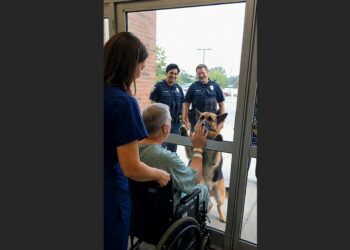
The elderly man was sitting in a wheelchair near a sunlit window.
He looked tired and withdrawn.
I could see that he wasn’t expecting an ordinary visit.
He remained seated as we entered.
Then the Labrador noticed him.
The dog stopped.
For a brief moment, he stood still.
I watched carefully, allowing him time to respond.
Then he began walking toward the wheelchair.
His hind legs were stiff.
His movements were slow.
But he continued across the room.
I didn’t pull him forward.
I let him approach at a comfortable pace.
The elderly man watched.
As the Labrador reached him, the dog lifted his head.
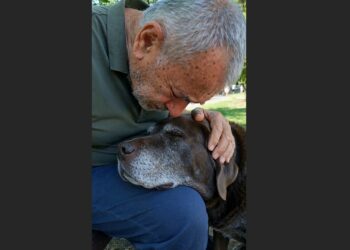
Then he gently rested his white muzzle on the man’s knees.
For a moment, neither moved.
And I knew I was watching something I would remember for the rest of my life.
“You Came…”
The elderly man’s hands began trembling.
He slowly lowered them toward the dog’s head.
His fingers touched the familiar golden fur.
The Labrador remained close.
The man looked down at him.
For a moment, he didn’t speak.
Then he whispered:
“You came…”
The dog’s tail began moving.
The man leaned forward and gently stroked his head.
I stood quietly near the doorway.
There was nothing I needed to say.
I’d wanted to reunite this dog with the person who knew him.
Now they were together.
I couldn’t know exactly what the Labrador understood about the separation.
But his calm approach and familiar physical contact were unmistakable.
He had walked directly toward the man and settled his head against his knees.
The man recognized him.
And the relief on his face was something I won’t forget.
The White Muzzle on His Knees
I looked at the Labrador’s white muzzle resting against the man’s legs.
Only the day before, that same muzzle had been pointed toward the highway.
The dog had spent hours watching passing cars.
He’d been left beside a wooden post with food, water, and a blanket.
And I had no idea where he belonged.
Now he was standing beside the person who had cared for him.
The man’s hands continued moving gently through the dog’s fur.
He appeared overwhelmed.
I thought about how frightening it must have been to believe his companion had disappeared while he was receiving medical care.
I didn’t know every detail of his experience.
But I knew he’d been deeply upset by the separation.
The reunion didn’t change the fact that the dog was elderly or that the man still needed medical attention.
There were practical questions ahead.
We needed to ensure the Labrador would receive appropriate care and that the facility could accommodate him.
But for the moment, I was grateful they could be together.
Finding a Way for Them to Stay Together
The care facility considered the circumstances and eventually granted special permission for the Labrador to remain with his owner.
I was relieved.
The man needed medical care.
The dog needed attention for his arthritis and the ordinary responsibilities of caring for a senior animal.
The arrangement had to work for both.
Fortunately, the facility was willing to accommodate him under the agreed conditions.
The Labrador began settling into his new surroundings.
He had a comfortable place to sleep.
He received the care he needed.
And he could spend time beside his owner throughout the day.
I imagined how much that must have changed the elderly man’s routine.
Instead of wondering where his dog had gone, he could see him resting nearby.
The companion who’d disappeared from his life was once again part of it.
And the Labrador no longer had to spend his days in an unfamiliar place, watching doors and passing vehicles.
He was with someone he knew.
The Dog Beside the Wheelchair
As the Labrador adjusted to life at the facility, he developed a familiar routine.
He often rested beside his owner’s wheelchair.
Sometimes he lay quietly while the man spent time near the window.
Other times, he raised his head when someone approached.
His arthritis meant that movement needed to remain comfortable and appropriately managed.
He was an elderly dog, not an animal expected to run through corridors or engage in demanding activity.
But he could still enjoy companionship.
And he seemed particularly comfortable staying near his owner.
I found that reassuring.
When I’d first brought him into my house, he’d barely explored.
He’d spent much of his time facing the front door.
Now he was in a place where the person he knew was nearby.
The surroundings were different from whatever home they’d shared before.
But their relationship was familiar.
The dog had his owner’s voice, touch, and presence.
And the man had his companion back.
A Gentle Visitor to Other Residents
After the Labrador settled in, the staff noticed something else about him.
He seemed to enjoy gentle visits with other residents.
Sometimes he walked slowly along the hallway, stopping near someone sitting alone.
If the person welcomed him, he would approach.
Then he sometimes rested his head against their knees.
It was the same gesture he’d used when greeting his owner.
I liked hearing about that.
He wasn’t a specially trained therapy dog.
He was simply a senior Labrador who appeared comfortable receiving attention from people who enjoyed his company.
The visits were managed according to the facility’s arrangements and the dog’s needs.
And for some residents, having a calm dog nearby was a welcome part of the day.
I thought about how difficult the Labrador’s situation had looked when I first found him.
He’d been left alone beside a highway.
Now he had a place where he was cared for.
And his gentle manner was bringing comfort to people beyond his own family.
It was a lovely outcome for an animal whose future had seemed so uncertain.
The Blanket With the Blue-and-Red Checks
I still remember the blanket.
Of everything left beside the wooden post, that old checked blanket remains especially clear in my memory.
It wasn’t new.
It looked like something that had already been used many times.
Someone had folded it and placed it near the dog’s food and water.
I wondered whether it had been his usual bedding.
Perhaps he’d slept on it for years.
Perhaps it carried familiar scents from his earlier home.
I couldn’t know.
But I kept thinking about the person who’d arranged those few belongings before leaving.
They had apparently expected another person to take over responsibility for the dog.
And that was a dangerous assumption.
An elderly animal with arthritis needed more than a little food and a blanket beside a highway.
He needed regular care, shelter, and someone accountable for his well-being.
Finding him there reminded me how vulnerable an older dog can become when the people responsible for him make decisions without proper arrangements.
Fortunately, someone noticed him.
And the next day, a phone call revealed where he belonged.
Seventeen Years at the Gas Station
I’ve worked at that highway gas station for seventeen years.
Most days are ordinary.
Cars arrive.
Travelers buy fuel, food, or something for the road.
Then they leave, and another vehicle pulls in.
You become accustomed to seeing people for only a few minutes.
Sometimes you remember a friendly conversation.
Sometimes you recognize a regular customer.
But most encounters are brief.
The Labrador was different.
He stayed in my thoughts long after I left the gas station.
Even when I took him home, I kept wondering what had happened to him.
I remembered how he’d looked toward the road whenever a car approached.
I remembered the way his hind legs trembled when he stood.
And I remembered the brief movement of his tail when I first spoke to him.
At the time, I had no idea I would be taking him on a three-hour journey to reunite him with his owner.
I thought I was simply helping an abandoned dog get veterinary care and somewhere safe to sleep.
That alone would have been worthwhile.
But the phone call gave us the chance to do something more.
The Owner Who Thought He Was Gone
Of all the details I learned, the one that affected me most was that the elderly man believed his dog was gone.
He was receiving medical treatment.
His companion had been taken away because of a family misunderstanding.
And he had been left believing he’d lost the animal who had shared his life.
I didn’t know how long they’d been together.
I didn’t know where the dog usually slept or what their daily routines had been before the man needed medical care.
But I saw the reunion.
I watched the Labrador cross the room.
I saw him place his muzzle against the man’s knees.
And I heard the words the man whispered.
“You came…”
That was enough for me to understand that the relationship mattered deeply to him.
The dog wasn’t an unwanted animal who needed an entirely new family.
He already belonged to someone.
They’d simply been separated under circumstances that should have been handled differently.
Once we understood what had happened, we could begin putting things right.
A Second Chance to Stay Together
Today, the Labrador has a comfortable place to sleep at the care facility.
His arthritis is receiving attention.
He has regular meals and people responsible for his daily needs.
Most importantly, he can spend time with his owner again.
The elderly man no longer has to wonder where his companion has gone.
He can look beside his wheelchair and see the dog resting nearby.
He can reach down and touch the familiar golden fur.
And when the Labrador approaches, he can lower his head onto the man’s knees as he has done so many times before.
I like knowing that the dog also enjoys meeting other residents when it’s appropriate.
His gentle visits have become another part of life at the facility.
But I think his favorite place is still beside his owner.
I can’t know what he remembers about the day he was left at the gas station.
I don’t know whether he associates that experience with the separation.
But I do know that his circumstances have changed.
He is no longer waiting beside a wooden post.
He’s receiving care.
And he’s with the person who missed him.
The Morning I Almost Walked Past Him
Sometimes I think about how easily that morning could have been ordinary.
I might have been too busy to notice the dog immediately.
I might have assumed someone was returning for him.
Or I might have waited longer before deciding to intervene.
But I did notice him.
An elderly Labrador lying beside a wooden post.
A bowl of water.
A small portion of food.
And an old checked blanket.
There was something about the arrangement that made me stop.
At first, I thought perhaps the owner had stepped away briefly.
Then I watched the dog remain there through the morning.
By eleven, I knew I needed to help.
I didn’t make any grand plan.
I simply approached, offered my hand, and helped an elderly dog stand.
Then I drove him to a veterinarian.
The microchip gave us a starting point, although the registered information was outdated.
And eventually, a woman called with the information we needed.
The Labrador had an owner.
And that owner was waiting three hours away.
The Two Words I Won’t Forget
I can still picture the elderly man sitting beside the sunlit window.
The wheelchair.
The tired expression.
And the way he looked up as the Labrador entered the room.
The dog stopped briefly.
Then he walked forward on stiff legs.
He reached the wheelchair and rested his white muzzle on the man’s knees.
The man’s hands trembled as he touched him.
For a moment, the room was quiet.
Then came those two words.
“You came…”
I don’t think I’ll ever forget hearing them.
They weren’t part of a long speech.
The man didn’t need to explain how much he’d missed his dog.
His reaction made that clear.
He’d believed his companion was gone.
Now the dog was standing directly in front of him.
And he could touch him again.
I remained near the doorway, grateful I’d been able to help arrange the reunion.
I’d started the previous morning knowing nothing about the Labrador.
Not his name.
Not his family.
Not even how he’d ended up beside the highway.
Now I knew he’d been missed.
And I knew someone was very happy to have him back.
The Old Labrador Who Came Home
I found him at six in the morning behind a highway gas station.
He was elderly, with a nearly white muzzle and stiff hind legs.
Someone had left him beside a wooden post with water, dog food, and a blue-and-red checked blanket.
He watched the road for hours.
Whenever a vehicle approached, he lifted his head.
Then he watched it pass.
I didn’t know what he was waiting for.
I only knew he needed help.
By eleven, I’d taken him to a veterinarian.
We discovered he had arthritis and an outdated microchip registration.
I brought him home, still unsure where he belonged.
Then the following afternoon, a woman called the gas station.
She explained that the Labrador’s owner was receiving medical care three hours away.
A misunderstanding had separated them.
And the elderly man believed his beloved dog was gone.
I arranged to bring them together.
When we reached the man’s room, the Labrador walked slowly toward his wheelchair.
He placed his muzzle on the man’s knees.
His tail began to move.
And the man whispered, “You came…”
The care facility eventually made it possible for them to remain together.
Now the Labrador rests beside his owner’s wheelchair.
He has the care he needs, a comfortable place to sleep, and familiar companionship.
Sometimes he visits other residents, quietly placing his head on their knees when they welcome him.
And his owner no longer has to wonder where his dog has gone.
When I think about that morning at the gas station, I don’t remember the traffic first.
I remember the old dog lifting his head whenever a car approached.
I remember wondering whether someone would come back for him.
And I remember how carefully he stood when I offered to help.
I thought I was taking a forgotten dog somewhere safe.
I didn’t know I was beginning a journey that would bring him back to the person who loved him.
Seventeen years of working beside that highway have taught me that most travelers are simply passing through.
But every once in a while, someone stops who needs more than a tank of gas or directions.
That morning, it was an elderly Labrador.
He couldn’t tell me where his family was.
He couldn’t explain why he’d been left behind.
But he had a microchip, and someone eventually called with the information we needed.
Together, those things helped us find his way home.
And whenever I remember the moment that white muzzle settled onto the old man’s knees, I think about the two words he whispered.
“You came…”
After everything that had happened, his beloved companion really had come back.
And this time, they were able to stay together.
Editor’s Note: The characters in this story are fictional. Through these stories, we hope to share the intelligence, loyalty, compassion, and loving nature of dogs with people everywhere.