The first time we opened the barn door, the dog moved farther into the darkness.
He was a golden-colored mixed breed, approximately nine years old, with filthy, tangled fur and ribs that showed beneath his thin body.
He stood in the farthest corner, watching us with amber eyes.
He didn’t bark.
He didn’t growl.
He simply pressed himself against the wall, trying to put more distance between himself and the unfamiliar people standing in the doorway.
My name is Rachel Corbett, and I work as an animal control officer in Texas.
I’ve helped rescue animals from difficult circumstances before, but there was something about this dog that I couldn’t forget.
According to what we later learned during our investigation, he had likely been confined inside that deteriorating wooden barn for approximately seven years.
Seven years.
Behind walls with rotting boards, a damaged roof, and an entrance secured by a heavy, rusted chain.
When we finally coaxed him toward the doorway, he stopped just before stepping outside.
The bright November morning stretched before him.
He lifted his head, sniffed the cool air, and looked toward the grass.
Then, cautiously, he stepped forward.
One paw.
Then another.
He stood on the lawn for several moments.
And then something happened that neither my colleague Frank nor I had expected.
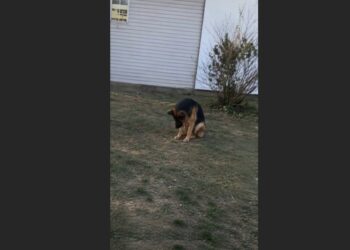
The dog slowly lowered himself onto the grass.
Rolled onto his back.
And lay there with his paws curled toward his chest, his belly facing the open sky.
I stood watching him, unable to speak.
Only minutes earlier, we’d found him huddled inside a dark, abandoned barn.
Now he was lying in the sunlight.
And for the first time since we’d met him, he appeared comfortable enough to stop moving and simply rest.
The Call on a Freezing November Morning
The call came on a cold November morning.
A man named Robert Carter had recently purchased an old farm in Texas.
He had been clearing overgrown brush from the property when he discovered a deteriorating wooden barn.
The building appeared to have been neglected for years.
Part of its roof had collapsed, and the entrance was secured with a heavy chain.
Robert hadn’t expected to find an animal inside.
But something about the building caught his attention.
He approached and looked through a narrow opening between the wooden boards.
At first, he couldn’t see much.
Then he noticed movement in the darkness.
Two eyes were looking back at him.
Robert realized there was a living animal inside the structure.
He couldn’t tell what condition it was in or how long it had been there.
But he knew he needed help.
He contacted animal control.
My colleague Frank and I were assigned to respond.
At that point, all we knew was that someone had discovered what appeared to be an animal inside a chained, abandoned barn.
We had no idea what we were about to find.
The Old Barn at the Edge of the Property
When Frank and I arrived, Robert met us and led us toward the building.
The barn was in poor condition.
Some boards were visibly deteriorating, and part of the roof had given way.
The entrance was secured by an old chain covered in rust.
We stopped to assess the structure before going any farther.
An abandoned building can contain hazards that aren’t immediately visible.
There may be loose boards, unstable materials, or damaged flooring.
We needed to make sure we could enter without putting ourselves or the animal at unnecessary risk.
As we approached, we heard faint movement inside.
I looked toward Frank.
Something was definitely in there.
Robert showed us the narrow opening where he’d seen the eyes.
I tried to look through it.
The interior was dark, and the limited light made it difficult to see.
We couldn’t determine how frightened or injured the animal might be.
But leaving it inside wasn’t an option.
We prepared to open the entrance carefully.
The Rusted Chain
I examined the chain securing the barn door.
It was old and heavily rusted.
Whatever its original purpose, it was now preventing access to a building where a living animal had been discovered.
Frank helped me position ourselves safely.
After assessing the situation, I used the cutting equipment to remove the chain.
The metal finally gave way.
We pulled the heavy wooden door open.
Sunlight entered the barn.
For a moment, I stood at the threshold, allowing my eyes to adjust.
Dust and shadows made it difficult to see everything inside.
Then I noticed a shape against the far wall.
A dog.
He was huddled in the darkest corner of the building.
His body was thin.
His coat was so dirty and matted that it was difficult to see its original condition.
And his eyes followed us cautiously as we entered.
I had expected to find an animal in distress.
I hadn’t expected to see a dog who appeared to have been living under such conditions for so long.
The Dog Who Retreated From the Light
The dog was a golden-colored mixed breed, approximately nine years old.
He looked terribly underweight.
His ribs were visible beneath his coat, and his fur was tangled with dirt.
I watched him closely.
When the door opened, he didn’t rush toward the sunlight.
He didn’t try to escape.
Instead, he moved farther into the shadows.
I stopped.
He appeared frightened by our presence and the sudden change in his environment.
I couldn’t know whether he’d previously had negative experiences with people.
I also couldn’t assume that his reluctance to move meant he didn’t want to leave the barn.
He might simply have been overwhelmed.
The building was familiar to him.
We weren’t.
And the world outside the doorway may have been very different from the environment he’d become accustomed to.
I knew we had to be patient.
He needed veterinary care, but trying to force him toward the entrance could make the situation more dangerous and distressing.
So I decided to give him a little time.
Sitting on the Dusty Floor
I slowly lowered myself onto the barn floor.
The dog remained in the far corner.
Frank stayed nearby while I allowed the animal to observe me.
“Hey, sweetheart,” I whispered. “We’re here to help you.”
I didn’t reach toward him.
I didn’t try to pull him forward.
I kept my movements slow and gave him space.
For several minutes, he simply watched.
His amber eyes followed me.
I wondered how long it had been since he’d experienced gentle, ordinary contact with a person.
There was no way to know.
His history was still largely a mystery.
We hadn’t even determined whether he had ever lived in a home.
But I could see that he was cautious.
And I wanted to avoid giving him another reason to be afraid.
I remained seated.
After a while, the dog shifted.
Then he moved one paw forward.
He stopped.
Sniffed the air.
And looked toward me again.
It was a small movement.
But it was the first sign that he might be willing to approach.
The First Touch
I kept my hand open and still.
The dog moved a little closer.
His steps were cautious, and he stopped several times.
I waited.
There was no need to rush.
Eventually, he came close enough to investigate my hand.
His nose brushed against my palm.
I remained still.
Then, very gently, he leaned his thin body against my side.
I felt an immediate rush of emotion.
Here was a dog who appeared to have spent years confined inside a deteriorating building.
He was underweight, dirty, and visibly cautious.
Yet after a few minutes of quiet observation, he’d become comfortable enough to make contact with someone unfamiliar.
I didn’t interpret that as proof he completely trusted me.
One moment of closeness couldn’t tell me everything about his feelings.
But I was grateful he’d approached voluntarily.
I stayed seated beside him.
For a little while, we simply remained there.
Then Frank and I began preparing to take him outside.
The dog needed medical attention.
And we needed to move him out of the dangerous building safely.
What We Learned About His Seven Years
During the investigation, we gathered information suggesting that the dog had been confined inside the barn for approximately seven years.
It was a disturbing possibility.
Seven years represented most of the life of a dog who appeared to be about nine years old.
We couldn’t reconstruct every day he’d spent in the building.
There were questions we couldn’t answer.
Who had placed him there?
How often had anyone checked on him?
What had he been given to eat?
And how had he survived in a structure that offered so little protection?
We believed he might have managed by drinking rainwater entering through the damaged roof and catching small rodents.
But those were possible explanations, not things we’d directly observed.
We couldn’t establish his complete history.
His physical condition, however, was unmistakable.
He was severely underweight.
His coat had been neglected.
And he was living inside an unsafe structure with very limited access to the outside world.
Whatever had happened during those years, he needed a different environment now.
We were determined to get him the care he required.
The Doorway
Frank and I carefully helped the dog move toward the entrance.
At first, he came with us.
Then, as we approached the open doorway, he stopped.
Outside, the November morning was bright.
The cool air moved through the opening, and grass stretched beyond the barn.
I watched the dog closely.
He lifted his head.
His nose moved as he sniffed.
For several moments, he remained where he was.
I didn’t pull him forward.
I wanted to give him the opportunity to adjust to the new surroundings.
After all, we’d only just met him.
He had no reason to understand what was waiting outside.
The sudden brightness, unfamiliar sounds, and open space might have been overwhelming.
I gave him time to observe.
Frank remained nearby, ready to help if needed.
Then the dog shifted his weight forward.
One paw crossed the threshold.
Then another.
And slowly, he stepped out of the barn.
The First Steps Onto the Grass
I watched his paws touch the grass.
It was an ordinary thing.
Dogs walk on grass every day.
They sniff it, run across it, and lie down on it without anyone paying much attention.
But for this dog, whose history suggested years of confinement, the moment felt significant.
He stood quietly outside the barn.
His head lifted as he investigated the unfamiliar air.
He looked around.
Then he lowered his nose slightly, appearing interested in the ground beneath him.
I didn’t know how much time he’d spent outdoors before he was confined.
And I couldn’t know what he remembered of the world beyond the building.
But I could see him experiencing a very different environment from the one we’d just left.
There was open space.
Natural light.
Fresh air.
And no chained door preventing him from leaving.
He remained still for a while.
Then he began lowering himself toward the lawn.
At first, I thought he simply wanted to rest.
What happened next surprised us.
The Golden Dog Beneath the Open Sky
The dog lay down on the grass.
Then he slowly rolled onto his back.
His paws curled toward his chest.
His belly faced the sky.
And he remained there for a moment.
Frank and I stood nearby, watching.
I couldn’t help thinking about the barn behind us.
The narrow cracks in the walls.
The damaged roof.
The darkness.
And the rusted chain we’d cut only a short time earlier.
Now the dog was lying in an open space with sunlight falling around him.
I didn’t know why he’d chosen to roll onto his back.
Dogs do that for different reasons.
Some enjoy the sensation of grass.
Others use the movement to scratch or stretch.
It wouldn’t be accurate to claim he understood that he’d finally been rescued.
But the change in his behavior was striking.
Only minutes earlier, he’d retreated into the shadows when we opened the door.
Now he was resting on the grass.
I stood quietly, allowing him to have that moment.
It became one of the most memorable scenes of my career.
We Named Him Clancy
We decided to call him Clancy.
He hadn’t arrived with a known name, and we needed something to use as we arranged his treatment and ongoing care.
Clancy seemed to suit him.
The dog we’d found inside the barn was no longer simply an unidentified animal in a difficult rescue case.
He was an individual we were responsible for helping.
But I knew the rescue itself was only the beginning.
Clancy was severely underweight.
His matted coat needed attention.
And his behavior suggested that adjusting to unfamiliar surroundings might take considerable time.
He needed veterinary treatment.
He needed appropriate nutrition.
And he needed a safe place where his physical and behavioral needs could be assessed carefully.
After allowing him a little time outside, we prepared to transport him for medical care.
I looked back toward the barn.
The door was open now.
The rusted chain had been removed.
But I understood that simply opening the building wouldn’t undo the effects of years spent in poor conditions.
Clancy still had a long recovery ahead.
The First Days at the Shelter
At the shelter, Clancy received veterinary attention.
His nutritional needs were assessed, and his meals were managed carefully.
An animal who is severely underweight may require a gradual, monitored approach to feeding.
We didn’t want to overwhelm his body or assume that providing a large quantity of food would immediately solve the problem.
His physical recovery needed professional oversight.
We also had to consider his behavior.
Clancy was cautious around unfamiliar surroundings.
Large, open areas sometimes made him nervous.
Unexpected sounds could cause him to retreat.
And he often seemed more comfortable in small, quiet spaces.
I remembered how he’d moved into the shadows when we first opened the barn.
Now, even though he was somewhere safe, he sometimes responded to new situations with similar caution.
That wasn’t surprising.
The shelter was filled with unfamiliar sights, sounds, and routines.
He needed time to become accustomed to them.
We made sure he had comfortable places to rest.
And we tried to allow him to adjust without constantly demanding interaction.
Learning That He Could Rest
During Clancy’s first days, I paid attention to where he chose to settle.
He often preferred quieter areas.
I didn’t try to force him into large spaces simply because I wanted him to enjoy them.
There would be time for exploration later.
For now, I wanted him to feel comfortable with his immediate environment.
He had regular meals and access to the care he needed.
He no longer had to live in a deteriorating barn.
But he still needed to learn the routines of the shelter.
I spent time near him when my work allowed.
Sometimes I sat quietly while he rested.
Other times, I spoke softly so he could become familiar with my voice.
I wasn’t expecting a dramatic transformation.
He had lived through circumstances that appeared to have lasted years.
It would have been unreasonable to expect him to become confident and outgoing in a matter of days.
So we worked with what he was comfortable doing.
And gradually, his behavior began to change.
The Small Signs of Progress
Over time, Clancy started eating more regularly.
His physical condition improved with treatment and appropriate nutrition.
His coat became healthier.
And he gradually showed greater interest in his surroundings.
At first, the changes were small.
He might look toward something unfamiliar instead of immediately retreating.
He might remain nearby when someone entered.
Or he might approach a familiar caregiver voluntarily.
Those moments were encouraging.
But I was careful not to expect more than he could comfortably manage.
Clancy was still cautious.
He sometimes preferred quiet areas.
And unfamiliar noises continued to make him uneasy.
We respected those needs.
His recovery involved learning how to live in an environment where he had regular care and opportunities to move around.
That was a substantial change from the conditions in which we’d found him.
Each new activity needed to be introduced appropriately.
Eventually, he began showing interest in going outside.
And we started helping him become comfortable with short walks.
Discovering the Outdoors
Clancy’s early walks were gentle.
We didn’t take him into busy, overwhelming environments.
He needed time to become accustomed to the sensation of moving through open spaces.
Sometimes he paused to investigate the ground.
Other times, he watched what was happening around him.
I followed his pace when it was safe to do so.
There was no reason to rush him.
I remembered his first moments outside the barn.
How he’d stopped at the doorway.
How he’d sniffed the cool air.
And how carefully he’d stepped onto the grass.
Now he was beginning to move through outdoor spaces more comfortably.
That was an important change.
His world was no longer limited to a dark building.
He could walk outside under supervision.
He could investigate unfamiliar scents.
And he could rest somewhere comfortable afterward.
I didn’t need him to become an especially energetic dog.
I simply wanted him to have the opportunity to enjoy ordinary activities that were appropriate for his health and temperament.
The Evening He Rested His Head on My Shoulder
One evening, I was sitting beside Clancy.
He had been making steady progress, although he still needed patience and a predictable routine.
I was happy to spend a little quiet time with him.
He moved toward me.
Then he gently rested his head against my shoulder.
I stayed still for a moment.
It reminded me of our first meeting inside the barn.
Back then, he’d approached slowly and leaned his thin body against my side.
Now he was choosing to come close again.
I placed my hand gently against his back.
He remained where he was, breathing quietly.
I found myself remembering everything that had happened since the morning Robert Carter called for help.
The abandoned structure.
The heavy chain.
The frightened dog in the far corner.
And the first time his paws touched the grass.
Now Clancy was resting comfortably beside me.
His physical condition had improved.
And he seemed increasingly familiar with the people caring for him.
It was a small, peaceful moment.
But I knew I’d remember it.
Finding the Right Family
Eventually, Clancy recovered enough for us to begin considering adoption.
We knew he needed a particular kind of home.
His history suggested prolonged confinement.
He had been cautious around unfamiliar spaces and sounds.
And although he’d made encouraging progress, he would still benefit from patient, predictable care.
We didn’t want someone to adopt him expecting an immediately outgoing dog.
We wanted people who understood that his adjustment might take time.
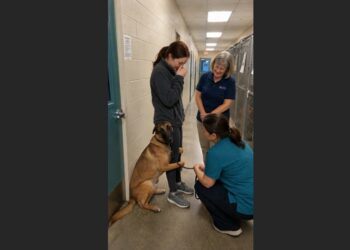
Then Anna and William came into his life.
They were a retired couple with a peaceful home and a large, sunny backyard.
They understood Clancy’s needs.
They knew he might sometimes prefer a quiet place to rest.
They were comfortable giving him time to explore without pressure.
And they were prepared to provide regular meals, veterinary care, and gentle activity appropriate for his condition.
I was encouraged by their approach.
They weren’t simply drawn to the emotional story of his rescue.
They were willing to consider what he would need after coming home.
And that mattered.
A New Home With Anna and William
When Clancy arrived at Anna and William’s house, he began exploring cautiously.
He moved through the rooms, investigating his new surroundings.
The house was unfamiliar, and he needed time to become comfortable.
Anna and William allowed him to proceed at his own pace.
There was no expectation that he would immediately behave like a dog who had lived in a home for years.
He took his time.
Then he reached the open back door.
Beyond it was a lawn.
Clancy stepped outside.
He moved onto the grass.
And then, just as he’d done on the day of his rescue, he slowly lowered himself to the ground.
He rolled onto his back.
His paws curled toward his chest.
And he rested beneath the afternoon sun.
Anna laughed softly.
William watched him settle.
I couldn’t have imagined a more fitting moment for his first day in their home.
The dog we’d found hidden inside a dark barn was now resting comfortably in a private backyard.
And this time, the grass would be there whenever he wanted to enjoy it.
The Life Clancy Has Today
Today, Clancy lives with Anna and William.
He has a comfortable bed.
Regular meals.
Gentle walks.
And a backyard where he can rest in the sunshine.
His routine is quieter than the demanding life some dogs enjoy.
That suits him.
He doesn’t need constant excitement.
He needs dependable care, a familiar environment, and people who understand his preferences.
Anna and William are happy to provide those things.
Clancy has the opportunity to move between the house and the yard as appropriate.
He can explore the grass.
Rest comfortably.
And enjoy the kind of ordinary daily life that seemed impossible when we first discovered him.
I sometimes think about how much his circumstances have changed.
He was approximately nine years old when we found him.
Our investigation suggested he’d spent about seven years confined inside the barn.
That meant much of his life had passed under conditions no animal should have to endure.
We couldn’t give him those years back.
But we could help make the years ahead different.
The Barn I Still Remember
I’ve responded to many animal rescue calls during my work in Texas.
Some animals are found wandering.
Others are discovered in abandoned buildings or places where they haven’t been receiving adequate care.
Every case requires careful attention.
But Clancy’s rescue has stayed with me.
I remember Robert Carter leading Frank and me toward the barn.
The deteriorating walls.
The partially collapsed roof.
And the heavy chain securing the entrance.
I remember cutting through the rusted metal.
Then Frank helping me pull the door open.
Sunlight entered the building.
And in the farthest corner, a golden-colored dog pressed himself against the shadows.
His ribs were visible.
His coat was filthy.
And his amber eyes followed every movement we made.
He didn’t come running.
He didn’t seem excited that the door was open.
He was frightened.
So I sat on the dusty floor.
I spoke gently.
And I waited.
Eventually, he approached and touched his nose to my hand.
Then he leaned against me.
That was how Clancy’s new life began.
The First Time I Saw Him Under the Sky
Of all the moments from that rescue, the one I remember most clearly happened outside the barn.
Frank and I had helped Clancy reach the doorway.
He stopped when he saw the bright November morning.
I gave him time.
He lifted his head and sniffed the air.
Then he stepped forward.
His paws touched the grass.
He stood there, looking around.
And finally, he lowered himself to the ground.
When he rolled onto his back, I felt an unexpected wave of emotion.
His paws curled toward his chest.
His belly faced the sky.
And for a little while, he remained there.
I didn’t need to invent an explanation for his behavior.
I couldn’t know exactly what he felt.
But I could see that he was resting comfortably in an open space after being confined in a dark building.
It was enough to make the moment unforgettable.
Sometimes the changes we hope to see in a rescued animal are small.
A cautious step.
An interest in food.
A willingness to approach someone.
Or the ability to rest in a place that once seemed frightening.
For Clancy, each of those changes mattered.
Seven Years Behind Four Wooden Walls
I still find it difficult to think about how long Clancy may have lived inside that barn.
Approximately seven years.
During that time, the building deteriorated around him.
Its roof was damaged.
The wooden boards were rotting.
And the entrance remained secured by a chain.
We couldn’t determine exactly how he survived.
We believed he may have relied on rainwater and small rodents, but we had no way of reconstructing everything that happened.
What we knew was that he had been found in a severely neglected condition.
He needed medical care.
He needed proper nutrition.
And he needed an environment where he could begin becoming comfortable with the world outside.
His recovery wasn’t immediate.
There were unfamiliar sounds that frightened him.
Open spaces that initially made him nervous.
And days when he preferred to remain somewhere quiet.
But he gradually improved.
He began eating regularly.
His coat became healthier.
He started enjoying short walks.
And eventually, he found a family willing to continue giving him the care and patience he needed.
The Dog Who Finally Had a Choice
When we first found Clancy, he had very little control over his surroundings.
The barn door was chained.
The building was deteriorating.
And he had no way to leave the structure freely.
When we opened the entrance, he was frightened enough to move farther into the shadows.
I think about that sometimes.
We had arrived believing that opening the door was the most important thing we could do.
And physically, it was the first step.
But Clancy needed more than an unlocked entrance.
He needed patient handling.
Veterinary treatment.
Appropriate nutrition.
And time to adjust to a life where he could move around safely.
He also needed people willing to accept that he might never behave like a dog who’d spent his entire life in a comfortable home.
Anna and William understood that.
They didn’t expect him to become a different animal.
They simply gave him somewhere safe to live.
And now he has ordinary choices that weren’t available to him inside the barn.
He can rest on his bed.
Walk outside.
Investigate the yard.
Or lie down in the grass.
Those freedoms might seem small.
But after the conditions in which we found him, they matter enormously.
Nothing Above Him but the Open Sky
Sometimes I picture Clancy in Anna and William’s backyard.
A golden-colored dog resting in the sunshine.
His coat healthier.
His body stronger.
His surroundings quiet and familiar.
He can walk through the open back door and step onto the lawn.
And if he wants to lie down and roll onto his back, he can.
There is no heavy chain across the entrance.
No dark barn confining him.
No broken boards separating him from the world outside.
Just a home where he’s cared for.
When I think about the freezing November morning when Robert called us, I remember how uncertain everything felt.
We didn’t know what was inside the barn.
We didn’t know how the animal would respond.
And we didn’t know whether he would recover from the condition in which we’d found him.
But Robert noticed those two eyes through the wooden boards and contacted us.
Frank and I opened the building.
The veterinary team helped Clancy recover.
And Anna and William gave him a permanent home.
Each part of that process mattered.
I still remember the sound of the rusted chain falling away.
But I don’t think about it first anymore.
I think about the grass.
The cool November air.
And the moment Clancy lowered himself onto the lawn and rolled onto his back.
After spending so much of his life inside a dark, abandoned barn, he was finally outside.
Today, he can enjoy that simple freedom whenever he chooses.
And whenever I remember him lying there beneath the open sky, I’m grateful that Robert Carter looked through a narrow gap in the boards and noticed the eyes staring back.
Because behind that chained door was a dog who still had a chance at a different life.
His name is Clancy.
And now, when he wants to rest in the sunshine, nothing stands between him and the grass.
Editor’s Note: The characters in this story are fictional. Through these stories, we hope to share the intelligence, loyalty, compassion, and loving nature of dogs with people everywhere.