At two o’clock in the morning, I woke to a faint dragging sound coming from the hallway.
My house was otherwise quiet. I lay still for a moment, listening, trying to figure out what could be moving across the hardwood floor at that hour.
Then I remembered Brian.
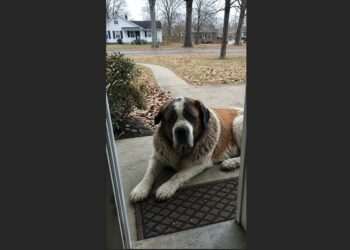
He’s fifteen now, and I’ve had him since he was an eight-week-old puppy. These days, whenever I hear an unfamiliar sound in the middle of the night, my first thought is whether he’s all right.
I reached for my phone, switched on the flashlight, and got out of bed.
What I found in the hallway stopped me.
Brian had apparently lost control of his bladder while sleeping. A small puddle was on the floor.
But he wasn’t resting nearby, waiting for me to discover it.
He was standing over the accident with a bath towel in his mouth, trying to move the fabric across the floor.
He nudged it with his nose and worked at it with his paws, awkwardly dragging it over the spot.
His tail was tucked between his legs, and his body was drawn inward. He was trembling.
I stood there with the flashlight in my hand, looking at the dog I’d loved for almost fifteen years.
And all I wanted to do was hold him.
Fifteen Years With the Same Faithful Companion
Brian came into my life when he was barely old enough to leave his mother.
At eight weeks old, he was still a puppy with everything to learn. Over time, he became an exceptionally well-mannered dog, the kind who seemed to understand the household routine without needing much encouragement.
Once he learned where he was supposed to relieve himself, accidents were never something I had to worry about.
He was reliably house-trained for nearly his entire life.
But there has always been more to Brian than good manners.
He carries himself with a certain quiet dignity. Even as a younger dog, he had a composed way about him that made me think of an old-fashioned gentleman.
He wasn’t the sort of companion I needed to constantly correct or remind.
We learned each other’s habits, and those habits gradually became part of our everyday lives.
After so many years, I can hardly remember what it felt like not to have him around.
Fifteen years is a considerable amount of time to share with any living creature.
People change during those years. Routines change. The things that once seemed important can become less significant, while ordinary moments take on greater meaning.
Through all of it, Brian has been part of my life.
I knew him as a puppy, watched him grow into adulthood, and eventually began noticing the changes that come with old age.
Some were gradual enough that I hardly recognized them at first.
Others were harder to ignore.
When Age Begins to Change the Rules
Anyone who has loved an elderly dog knows that aging doesn’t happen all at once.
There may be a period when your companion still seems much the same as always. Then you begin noticing little differences.
Certain movements take longer. Rest becomes more important. The body that once handled everyday activities without difficulty may start needing additional care.
None of those changes makes a dog less deserving of affection.
But they can be difficult to watch.
I have always known that Brian wouldn’t stay young forever. Knowing that intellectually, however, is different from seeing his body begin to lose some of its former reliability.
He still has the personality I recognize.
He’s still my Brian.
But at fifteen, I understand that his physical needs may be different from those he had five or ten years ago.
And last night was a painful reminder of that.
The Bath Towel in the Hallway
When I first saw Brian standing over the puddle, I noticed the towel before I fully understood what he was doing.
He had it in his mouth and was pushing it around with his nose and paws.
The movements were clumsy, but he seemed focused on the fabric and the spot beneath it.
I couldn’t tell exactly how he’d gotten hold of the towel or how long he’d been working with it.
The sound of it dragging across the hardwood was what had awakened me.
There was something terribly sad about seeing him standing there.
Not because he’d made a mess.
A puddle on the floor is an inconvenience, nothing more. Hardwood can be cleaned, towels can be washed, and accidents happen.
What upset me was Brian’s reaction.
His tail was tucked tightly beneath him. His posture was unusually small and tense, and his body trembled as I approached.
He looked worried.
I couldn’t know whether he understood what had happened or whether he associated the accident with something he’d been taught to avoid.
Dogs don’t experience every emotion in the same way humans do, and I wouldn’t claim to know exactly what was going through his mind.
But I could see that something about the situation had left him distressed.
And the idea that my elderly dog might be frightened because his aging body had failed him was more than I could bear.
For years, he’d been the dog who followed the household rules so reliably.
Now he was fifteen, standing in a hallway at two in the morning, trying to move a towel across a puddle.
He didn’t need to do any of that.
I wished I could make him understand.
The Moment I Put Down My Phone
I stopped worrying about the floor.
I let go of my phone, knelt beside Brian, and wrapped my arms around him.
I drew him against my chest and rested my face in the thick fur around his neck.
For a moment, I just held him.
Then I began speaking softly.
“It’s okay, buddy. I’m not upset. It happens. You’re okay.”
I wanted him to hear the same familiar voice he’d known since he was a puppy.
There was no reason for me to raise it.
No reason to scold him.
No reason to make an already uncomfortable moment any worse.
Brian stayed close as I held him.
Then he lifted his head and gently licked the tears from my face.
Afterward, he let out a long, tired sigh.
I don’t know whether the embrace reassured him in the way I hoped it would. But his body was warm against mine, and he allowed me to hold him.
For that moment, it was enough.
The floor could wait.
The Promise I Made When Brian Was a Puppy
When I brought Brian home almost fifteen years ago, I understood that adopting a dog meant accepting responsibility for another life.
At the time, he was a tiny puppy.
Most of the things I imagined doing for him involved the ordinary responsibilities of raising a young dog: teaching him, feeding him, keeping him safe, and helping him grow into a well-adjusted companion.
It’s easy to make promises when a puppy is young and healthy.
The future feels generous then.
You imagine all the years ahead and the experiences you’ll share.
You don’t spend much time picturing a fifteen-year-old dog struggling with something that used to come naturally.
But growing old is part of the life we agree to share.
And the responsibility doesn’t disappear when the easy years are over.
I made a promise to Brian when he was little.
I would care for him throughout his life.
Not just when he was healthy and independent. Not just when he behaved perfectly or made my days easier.
I would love him through every stage, including the ones that required more patience and care.
Last night, kneeling on the hallway floor with him in my arms, I thought about that promise.
Brian had spent nearly fifteen years being a wonderful companion.
If his aging body now meant that I needed to clean up after him occasionally, that was simply part of taking care of him.
He didn’t owe me an apology.
And he certainly didn’t need to earn my affection by continuing to meet standards his body might no longer be able to maintain.
He Had Nothing to Apologize For
I wish dogs could understand everything we want to tell them.
I wish I could explain to Brian that an accident doesn’t erase fifteen years of good behavior.
That a little puddle on the floor doesn’t matter.
That he doesn’t have to worry about being the same dog he was when he was five.
But I can’t explain those things to him in words he fully understands.
What I can do is respond with patience.
I can keep my voice gentle, make sure he’s comfortable, and remember that changes in an older dog’s bathroom habits may have physical causes that deserve attention.
If accidents begin happening more often, I’ll need to discuss them with his veterinarian rather than assume they’re simply an unavoidable part of aging.
Brian deserves that care.
He also deserves to feel safe in his own home, even when something goes wrong.
I hope that, over all these years, he’s learned that he can trust me.
Last night, I wanted my actions to reinforce that trust.
There was no anger in my voice.
There was no punishment.
Only a familiar embrace and the reassurance that everything was all right.
Loving a Dog Through the Harder Years
Living with a senior dog changes the way you think about time.
When Brian was younger, I didn’t count the days we had together.
There was always another morning, another evening, another ordinary routine waiting ahead.
Now, at fifteen, I’m more aware that our time is not unlimited.
I try not to dwell on that thought.
I don’t want to spend the time we have worrying so much about losing him that I forget to enjoy having him here.
But the awareness is there.
It makes the quieter moments feel important.
It changes how I respond when something takes longer than it used to.
And it reminds me that patience is not an extra kindness we offer an old dog.
It’s part of the care he needs.
I know there may be more difficult nights ahead.
Brian might need additional help as he grows older. His routines may have to change, and there may be practical adjustments I haven’t even considered yet.
I can’t predict exactly what aging will bring for him.
All I can do is pay attention, work with his veterinarian, and make decisions based on his comfort and quality of life.
That may mean cleaning up another accident.
It may mean changing our routine to make things easier for him.
Whatever the situation requires, I want him to know that he’s still welcome beside me.
The dog I loved when he was a puppy is the same dog I love now.
His body has changed.
My responsibility to him hasn’t.
The Floor Can Be Cleaned. These Years Cannot Be Replaced.
After holding Brian in the hallway, I kept thinking about how little the accident actually mattered.
A towel can go into the laundry.
A floor can be washed.
By morning, there may be no visible sign that anything happened there at all.
But the memory of Brian trembling over that puddle will stay with me.
Not because he made a mistake.
Because it reminded me how vulnerable our animals can become as they age.
They depend on us from the beginning, but that dependence can look different at fifteen than it did at eight weeks.
When Brian was a puppy, I was responsible for teaching him how to live in our home.
Now, I may need to help him adjust to things his body can no longer do as reliably.
There is nothing shameful about that.
Old age isn’t misbehavior.
And needing help doesn’t make a beloved companion any less worthy of love.
I don’t know how many more years Brian and I will have together.
I hope there are many comfortable days still ahead of him.
But I also know that what matters most is how he spends the time he has.
I want him to feel secure.
I want him to receive the care he needs.
And I want him to know the familiar comfort of being loved by the person who brought him home all those years ago.
Last night, at two in the morning, Brian was standing in the hallway with a bath towel in his mouth.
He looked frightened, and his aging body had let him down.
I knelt beside him, wrapped my arms around him, and told him he was okay.
It wasn’t a grand moment.
There was no extraordinary rescue, no dramatic turn of events, and no way to make him young again.
There was simply an old dog who needed reassurance and the person who had promised to care for him.
That is what love looks like in this part of our lives.
Not perfect floors or perfectly behaved dogs.
Just patience, tenderness, and the willingness to keep showing up when things become more difficult.
If cleaning the hallway in the middle of the night is part of what it takes to care for Brian now, I’ll do it.
He has spent almost fifteen years beside me.
And as long as he’s comfortable and still enjoying his days, I will be grateful for every bit of time we share.
Because when I look at Brian, I don’t see an old dog who made a mess.
I see the puppy I brought home at eight weeks old, the companion who grew up beside me, and the gentle old gentleman resting his tired head against my chest.
The floor was never the important part.
Brian was.
And he always will be.