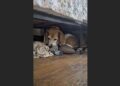
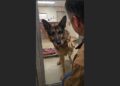
The gray pit bull was lying in the last kennel at the shelter with an old basketball tucked between his front paws.
The ball was almost ruined.
Its surface was cracked and faded. Most of the lettering had worn away, and one side was flattened enough that it could no longer bounce properly.
Yet the dog kept it close.
When he moved, he nudged it with him.
When he lay down, his chin rested against it.
According to the shelter worker, he had been doing that for nearly three years.
Most visitors thought it was simply his favorite toy.
I knew better the moment I saw it.
There was a dark line near one seam where someone had once written a name in black marker.
Most of the ink had faded.
But I could still make out the first few letters.
JUL…
My chest tightened.
I stepped closer to the kennel.
Then I looked at the dog.
Gray coat.
White patch on his chest.
Broad head.
Soft brown eyes.
Older now, heavier through the shoulders, but unmistakable.
“Buster?”
The pit bull’s head came up.
For several seconds, neither of us moved.
Then he stood.
The basketball rolled away from his paws.
And I knew exactly who he was.
Buster had belonged to Julian.
My best friend.
The man I had grown up with.
The man whose death three years earlier had divided my life into everything that came before that phone call and everything that came after.
Julian and I Grew Up With a Basketball Between Us
My name is Alex.
Julian and I met when we were kids in the same neighborhood.
There were only a few houses between ours, which meant that for most of our childhood we existed less like friends and more like an ongoing interruption in each other’s homes.
If I wasn’t at his house, he was at mine.
Our summers revolved around the outdoor basketball court at the end of the block.
The asphalt became almost too hot to touch by noon.
It didn’t matter.
We played until our shirts were soaked through and the evening light faded enough that seeing the rim became difficult.
Julian was better than I was.
Much better.
Even as a kid, he moved differently.
Fast.
Balanced.
Always seeming to know where the ball would go before everyone else did.
But talent wasn’t the reason people liked him.
Julian had the kind of laugh that pulled other people into it.
He could walk into a tense room and somehow make it easier to breathe.
He was generous without making a performance of generosity.
And loyal in a way that made friendship with him feel permanent.
At that age, we assumed permanent meant forever.
Basketball Stayed With Him
As we got older, I stopped playing competitively.
Julian didn’t.
He kept going.
Local leagues became more serious teams.
Eventually he earned a spot with a semi-professional club in the area.
He never became famous.
That wasn’t the point.
He got to play the game he loved in front of people who came specifically to watch him do it.
I went whenever I could.
After games, Julian had a ritual.
No matter whether his team won by twenty points or lost badly, he would look toward the section where I usually sat.
If he still had the ball, he would toss it in my direction.
“Hold this for me, Alex!”
Sometimes security complained.
Sometimes another player wanted the ball.
Julian did it anyway.
It was an old joke between us.
A reminder of neighborhood asphalt and evenings when the only audience had been a few kids sitting on bicycles.
Then Buster Entered His Life
Eight years before I saw that shelter kennel, Julian adopted a young pit bull.
Buster was all muscle, enthusiasm, and poor decisions.
He chewed one of Julian’s shoes during the first week.
A television remote during the second.
He once knocked over a laundry basket and managed to fall asleep inside it.
Julian adored him.
The dog went almost everywhere that made sense.
Walks.
Outdoor practices.
Weekend visits.
Dinner at my house.
Buster learned that basketballs were especially important.
At first, he tried biting them.
Julian discouraged that quickly.
Instead, he taught him to push the ball with his nose and paws.
It became their game.
Julian would roll a ball across the floor.
Buster chased it.
Eventually, he learned to push it back.
Not with perfect accuracy.
But close enough to make Julian laugh every single time.
Buster Became Part of Our Routine
There were Sunday afternoons when Julian came over with Buster and stayed until late.
My son Leo was younger then.
Buster was remarkably patient with him.
Leo would sit on the floor while Buster positioned himself nearby.
Julian watched closely, especially in those early years.
He never assumed that because Buster was affectionate with adults, every interaction with a child required no supervision.
That was another thing about Julian.
He loved his dog without pretending responsibility disappeared because of affection.
Buster grew into a steady, friendly adult.
He followed Julian everywhere.
If Julian stood, Buster usually stood.
If Julian sat outside, Buster settled nearby.
When Julian practiced with a basketball, Buster watched.
Sometimes the old game began.
Push.
Roll.
Return.
Laugh.
It became one of those small routines nobody recognizes as precious while it is still happening.
Three Years Ago, Julian Died
There was no long warning.
No gradual goodbye.
He had finished an ordinary training session.
Later that evening, his heart stopped suddenly.
The medical details never became important to me in the way people expected them to.
There was a cause.
There were explanations.
None changed the fact that Julian was alive one day and gone the next.
He was still young.
Too young.
Everyone said that.
As though there could be an age when losing your best friend suddenly would feel reasonable.
His death dismantled more than I knew how to handle.
And the timing could not have been worse.
My Own Life Was Falling Apart Too
I was going through a difficult divorce.
Money was tight.
I was working two jobs.
Leo and I had moved into a small apartment while I tried to rebuild something resembling stability.
Some weeks, I barely knew what day it was.
Julian’s family was devastated.
They were trying to manage funeral arrangements, paperwork, grief, and all the practical details that arrive immediately after someone dies whether anyone is emotionally prepared for them or not.
Then there was Buster.
I remember someone telling me that Julian’s family could not keep him.
I remember feeling terrible about it.
And then I made an assumption I would regret for years.
Buster was friendly.
Young enough.
House-trained.
Loved people.
I told myself a dog like him would find another home quickly.
Someone good would take him.
I wanted to believe that because I didn’t have the money, the space, or the stability to take him myself.
So I let myself stop asking.
I Told Myself He Was Fine Somewhere
That sentence became convenient.
Buster is probably fine.
Someone adopted him.
He’s in a house.
He has a yard.
He has people who love him.
None of those things were based on information.
They were simply easier to live with than uncertainty.
Time moved.
My divorce was finalized.
I eventually found more stable work.
Leo got older.
We moved into a small house with a yard.
Life became manageable again.
Julian’s absence remained.
But the crisis surrounding it slowly became memory instead of emergency.
Buster rarely crossed my mind.
When he did, I pictured him somewhere else.
Safe.
I was wrong.
I Had Gone to the Shelter for an Entirely Different Reason
There was no plan to find Buster.
I was there because Leo and I had finally started talking seriously about adopting a dog.
We walked through the rows slowly.
Young dogs barked.
One pressed a toy against the gate.
Another stood on his hind legs.
Leo wanted to meet almost all of them.
Then we reached the final kennel.
A gray pit bull lay at the back.
He did not get up immediately.
Between his paws was the basketball.
I noticed the ball before I really looked at his face.
Something about it felt familiar.
Not because basketballs are unusual.
Because that particular one looked old in a familiar way.
The faded marker.
The worn orange surface.
Then the dog raised his head.
“Buster?”
I did not mean to say it loudly.
The name simply came out.
His ears shifted.
He stared at me.
Then he stood.
Slowly.
He was eight years older than the puppy Julian had once brought into my kitchen.
His face had grayed.
His body had thickened.
But when he stepped closer, I saw the white marking on his chest.
The same one.
My hands started shaking.
I turned to the shelter employee.
“How long has he been here?”
Her expression changed.
“Almost three years.”
I don’t remember what I said next.
Maybe nothing.
Three Years
The number landed harder than I expected.
Nearly the entire time I had been telling myself Buster was living with another family, he had been in a shelter.
I asked for his history.
The staff had received him after Julian’s family could no longer care for him.
There had been interest.
Some meetings.
Nothing permanent.
His age increased.
The years passed.
Younger dogs came and went.
Buster stayed.
And through it all, he kept the basketball that had arrived with him.
I Went Into the Kennel
The staff member explained how we should approach.
Buster was generally gentle, but I had not seen him in three years.
Recognition should not be assumed.
Dogs can retain long-term memories of familiar people, scents, and voices, but I did not know what he remembered of me.
So I went slowly.
I crouched.
“Hey, Buster.”
His nose worked.
He came closer.
He sniffed my hands.
My clothes.
Then my face.
For a moment, he just stood there.
I opened my arms slightly.
Not pulling him in.
Giving him the choice.
Buster stepped forward.
His head came against my shoulder.
That was enough.
I Started Crying
There are times when your body reacts before you have decided what you feel.
My knees hit the shelter floor.
I put my arms around Buster.
He remained against me.
His weight was solid.
Real.
This wasn’t a memory.
Not a photograph.
Not another story about Julian.
Buster was alive.
And I had failed to find out what happened to him.
“I’m sorry,” I whispered.
I said it more than once.
Buster could not understand the apology in the human way I meant it.
Still, I needed to say it.
Then another sentence came.
“We’re going home.”
Leo Had Never Seen Me Like That
He stood several feet away.
Quiet.
Normally, Leo filled silence quickly.
Questions.
Jokes.
Comments.
This time, he waited.
Eventually, he came closer.
He crouched beside us and placed one hand gently on Buster’s back.
Buster turned his head to sniff him.
Leo looked at me.
“Dad, this is Julian’s dog?”
I nodded.
“The Julian?”
There was only one Julian in the stories Leo had heard growing up.
“Yes.”
Leo looked toward the old basketball.
Then back at Buster.
“Can we really take him?”
“We’re going to try.”
Adoption Still Required More Than Emotion
I was ready to sign anything immediately.
The shelter was more responsible than that.
They asked questions.
Housing.
Other animals.
Work schedule.
Veterinary planning.
Leo’s age.
Experience with dogs.
Buster’s health.
His history.
They made sure I understood that reunion did not automatically equal compatibility.
Three years changes people.
It changes dogs too.
Buster was older now.
His needs were different.
I listened.
For once, my life was stable enough to answer every practical question.
We completed the adoption.
And the basketball came with him.
There was never any question about that.
Buster Carried the Ball to the Car
The shelter worker offered to place it in a bag.
Buster picked it up before she could.
Leo laughed.
“Guess that’s a no.”
Buster walked beside us with the worn basketball held carefully between his jaws.
At the car, he hesitated.
Then climbed into the back seat with a little help.
Leo sat beside him.
The ball ended up between Buster’s front paws.
For the first several miles, nobody spoke much.
Then Leo began talking.
My Son Told Buster Everything
He told him about the house.
His bedroom.
The yard.
The tree near the back fence.
The neighborhood.
Where they could walk.
He explained which couch Buster probably wasn’t supposed to use.
Then admitted Buster would probably be allowed on it anyway.
I watched them in the rearview mirror.
Buster’s ears shifted when Leo’s voice changed.
He occasionally turned his head toward him.
That did not mean he understood stories about bedrooms and backyard trees.
He was responding to tone.
Attention.
A person beside him.
But watching them together eased something in me.
I had spent years associating Buster entirely with what I had lost.
Now he was sitting beside my son.
That was new.
Buster Stopped at the Front Door
When we reached home, he stood on the mat for several seconds.
New house.
New smells.
New people.
After three years in a shelter, another transition deserved patience.
We did not pull him inside.
He eventually crossed the threshold on his own.
Then he began inspecting everything.
Walls.
Furniture.
Corners.
Doorways.
He moved methodically, nose low.
Leo wanted to show him everything at once.
I reminded him to slow down.
Buster needed a chance to take in the space without being overwhelmed.
Eventually, he reached the living room.
The Basketball Went With Him
Buster walked onto the rug.
Turned twice.
Lowered himself.
Then positioned the old ball between his paws.
His muzzle came down across it.
His eyes closed.
I stood in the doorway.
Leo sat cross-legged several feet away.
Neither of us spoke for a while.
Buster’s breathing gradually became slower.
I do not know what that basketball represented to him.
Familiar smell.
Habit.
Play.
Comfort.
Some association with the life he once knew.
Whatever it was, I had no intention of taking it away.
“Tell Me About Julian”
Leo asked that later.
Buster was still resting nearby.
I sat on the floor.
Then I began.
Not with Julian’s death.
With the basketball court.
That felt important.
I told Leo about summer evenings.
The old hoop.
Julian’s terrible singing.
The way he always claimed fouls that never happened.
The first serious game I watched him play.
The ritual afterward.
“Hold this for me, Alex!”
Leo laughed.
I told him about Buster as a puppy.
The shoes.
The remote.
The laundry basket.
I told him how Julian taught the dog to push a basketball instead of biting it.
For years I had avoided some of those memories because they hurt.
That night, telling them to Leo felt different.
Buster Did Not Need to Understand the Stories
Every time I said Julian’s name, his ears sometimes moved.
Maybe the name was familiar.
It probably was.
Dogs can remember sounds associated with important people.
But I resisted the temptation to turn every sigh or glance into evidence that Buster understood what we were discussing.
The story was for Leo.
And for me.
Buster simply stayed nearby.
That was enough.
The First Weeks Were Quieter Than Leo Expected
Buster did not run through the house celebrating his new life.
He slept.
A lot.
He followed us cautiously.
He sometimes stopped at doors as though waiting for permission.
He carried his basketball from room to room.
At mealtimes, he initially looked toward me before eating.
We gave him space.
No pressure to perform gratitude.
No expectation of instant joy.
After three years in a shelter, stability had to become believable through repetition.
Breakfast today.
Breakfast tomorrow.
The same house.
The same people.
A walk.
Return home.
Sleep.
Repeat.
Then Buster Began Leaving the Ball Behind Sometimes
That was one of the changes I noticed.
At first, it was almost always beside him.
Later, he might walk into the kitchen without it.
Then into the yard.
Once, he fell asleep in Leo’s room while the basketball remained in the living room.
That felt significant to me, though I tried not to overinterpret it.
Maybe he was simply becoming comfortable enough that he didn’t need to keep track of every familiar possession.
The ball was still important.
But the house was becoming familiar too.
He Started Playing Again
Not immediately.
Gradually.
One afternoon, Leo rolled the basketball a short distance across the grass.
Buster watched.
Leo stopped.
He did not keep pushing it toward him.
Then Buster stood.
Walked to the ball.
Put one paw against it.
And pushed.
The ball rolled several feet.
Leo grinned.
“Dad!”
I was already watching.
Buster followed the ball.
Another paw.
Another slow push.
The old basketball did not bounce properly anymore.
That made no difference.
Soon the Yard Had Its Own Game
Buster was no puppy.
He was not running endless circles.
But his energy increased.
Leo rolled the ball.
Buster pushed it.
Sometimes he used his nose.
Sometimes one front paw.
Sometimes the ball rolled in completely the wrong direction.
Leo chased it anyway.
Their game became noisy.
The yard filled with Leo laughing.
Buster occasionally barking.
A battered basketball scraping through the grass.
I stood at the kitchen window one afternoon and realized how long it had been since that sound had made me happy.
Basketballs used to belong only to Julian in my mind.
Now this one belonged to Leo and Buster too.
Memory had gained another chapter.
One Afternoon, Buster Rolled It Toward Leo
Leo came running into the house.
“Dad, come see!”
I followed him outside.
He explained breathlessly.
Buster had pushed the ball toward him, then sat and watched.
“Does that mean he trusts me?”
The source of the question was obvious.
I had told Leo about the game Julian played with Buster.
Years earlier, Julian had encouraged him to return the ball during play.
Leo wanted the gesture to mean something bigger.
I crouched beside him.
“It means he wants to play with you.”
Leo looked slightly disappointed.
I smiled.
“And yes, I’d say being willing to play with you is a pretty good sign that he feels comfortable.”
That answer was less dramatic.
It was also more honest.
Buster did not need a secret symbolic language for the moment to matter.
He had chosen to start a game.
With Leo.
That was enough.
Buster Became More Confident Around the House
His body softened.
He stopped pausing before every doorway.
His appetite became predictable.
He found favorite sleeping places.
One near the living room window.
Another at the foot of Leo’s bed.
He began greeting me when I came home instead of waiting farther back.
Sometimes the basketball stayed untouched for an entire day.
Other days, he carried it everywhere.
Both were fine.
The object no longer looked to me only like evidence of three years in a shelter.
It had become a toy again.
Not completely.
History remained attached to it.
But now play was attached too.
I Stopped Thinking of Buster as Something I Owed Julian
That took longer.
At first, guilt shaped everything.
I should have asked what happened.
I should have found him.
I should have done more three years ago.
Some of that regret was legitimate.
I had made assumptions instead of following up.
But guilt was not a good foundation for caring for Buster now.
He did not need repayment.
He needed food.
Veterinary care.
Walks.
Training.
Consistency.
Affection on terms he was comfortable with.
A family present in the current day.
Eventually, I stopped thinking:
I am taking care of Julian’s dog.
Buster became our dog too.
That Did Not Erase Julian
Nothing could.
His photograph still sits on a shelf.
Leo knows stories about him.
Sometimes Buster sleeps beneath that shelf without any idea of what the arrangement means to me.
I like that.
It keeps memory from becoming theatrical.
Julian mattered.
Buster matters.
Leo matters.
One does not have to replace another.
They simply occupy different parts of the same story.
Grief Had Made Me Think Preserving Memory Meant Keeping It Untouched
For years, memories of Julian existed almost like a sealed room.
I could enter occasionally.
Then leave.
I was afraid that changing anything would somehow weaken them.
Buster taught me something different.
Not intentionally.
He was just living.
An old basketball that had once belonged entirely to Julian’s life could become part of Leo’s childhood without losing its earlier meaning.
The same object could hold both.
That felt healthier than keeping everything frozen.
The Basketball Eventually Needed Repairs
It became softer.
One seam opened slightly.
Leo wanted to replace it.
I said no.
We found a way to stabilize the damaged section enough for gentle play.
We did not try to restore it into something new.
Its wear was part of it.
The faded marker.
The cracks.
The places Buster’s teeth had probably touched years earlier.
We also bought him another basketball.
Bright orange.
Perfect.
Buster liked it.
But he still returned to the old one.
Dogs can have preferences without needing us to turn them into poetry.
He liked that ball.
That was reason enough to keep it.
People Sometimes Ask Whether Buster Recognized Me
I cannot answer with certainty.
His response at the shelter felt powerful.
He reacted to his name.
Approached.
Accepted close contact.
He had known me well years earlier.
Dogs can retain long-term recognition through scent, voice, appearance, and learned associations.
I believe something about me was familiar.
Exactly what Buster remembered is his to know, not mine.
The more important fact is what came afterward.
He adjusted to our home.
Built a relationship with Leo.
Became comfortable with me again.
His future did not have to depend entirely on proving what remained from his past.
Leo Now Knows Julian Through More Than Stories
He knows the old court.
I took him there.
The hoop has been replaced.
The asphalt has new cracks.
Our old neighborhood looks smaller than it did when I was twelve.
I showed Leo where Julian used to stand.
Where we played.
Where he once missed so badly that the ball ended up in someone’s flower bed.
Leo laughed.
Buster came with us.
He walked slowly around the edge of the court, sniffing whatever interested him.
He did not behave as if he had entered a sacred place.
That was appropriate.
For him, it was pavement and smells.
For me, it was history.
For Leo, it became something in between.
Three Years in a Shelter Could Not Be Returned to Him
I think about that sometimes.
There is no way to give Buster those years back.
No way to know what his life would have been if I had checked sooner.
Regret can become selfish if you spend too much time asking an animal to carry it for you.
So I try not to.
Buster lives now.
That is what I can affect.
The rest belongs to the past.
Tonight, He Is Sleeping in Leo’s Room
I can hear both of them from the hallway.
Leo’s breathing.
Buster’s heavier rhythm near the foot of the bed.
The old basketball is beside his paws.
Not clutched tightly.
Just there.
Earlier, they had played with it in the yard.
Leo pushed it.
Buster returned it badly.
They repeated the game until Buster decided he was finished and walked inside without waiting for anyone.
That is our life now.
Not tragic.
Not miraculous.
Ordinary.
And after everything, ordinary feels like a gift.
I No Longer Imagine Julian Somewhere Watching Us
There was a time when grief made me search for signs.
I wanted to believe every coincidence meant something.
Every familiar gesture.
Every moment when Buster responded to Julian’s name.
Now I don’t need to know what exists beyond what I can see.
I know Julian loved this dog.
I know Buster spent years beside him.
I know my son now loves Buster too.
I know stories about Julian continue because Leo asks to hear them.
That is enough continuity for me.
The people we lose can remain present through memory without requiring us to turn that memory into certainty about something we cannot prove.
Buster Is Not Julian’s Ghost
He is a dog.
An aging gray pit bull who likes food, naps, sunshine, Leo, and battered basketballs.
That matters.
I do not need him to carry my best friend’s memory every minute.
Sometimes he sleeps.
Sometimes he snores.
Sometimes he steals socks.
Sometimes he ignores the old basketball entirely because something in the kitchen smells better.
Those moments may be the healthiest part of all.
They allow Buster to belong to the present.
But I Still Remember the Last Kennel
The image returns sometimes.
Buster lying behind the gate.
Gray face.
Old basketball between his paws.
Three years of my own assumptions collapsing in a few seconds.
I wish I had found him sooner.
I always will.
But the most important thing is that eventually I did.
Not because fate arranged it.
Not because Buster had been waiting specifically for me.
Because one afternoon, I walked through the last row of a shelter and looked carefully enough to recognize an old dog and an old basketball.
Then I made a decision I was finally able to keep.
“Come on, Buster.”
We’re going home.
The Ball Means Something Different Now
For Julian, it was part of the game he loved.
For Buster, it became a familiar object carried through an enormous change.
For me, it first represented guilt.
Then memory.
For Leo, it is simply the ball he and Buster play with in the yard.
I think I like his version best.
Objects survive us.
The meanings attached to them change.
The ball did not need to remain a monument to loss.
It could roll again.
Our House Is Quiet Tonight
The curtains move slightly with the evening air.
Leo is asleep.
Buster lies near him.
His old ball rests against one paw.
Tomorrow morning, he will probably wake before either of us.
He will want breakfast.
Then the yard.
Then perhaps another game.
And if Leo rolls that cracked basketball across the grass, Buster may push it back.
Not because he is delivering a message from the past.
Not because he understands the generations of friendship humans have attached to it.
Because it is a game he knows.
Because Leo is someone he now trusts enough to play beside.
Because an object that once belonged to a life that ended can still be part of a life happening now.
I cannot change the three years Buster spent waiting.
I cannot bring Julian back.
But I can make sure Buster never has to wonder where home is again.
And every time that old basketball rolls across our yard, I hear Leo laugh.
For me, that is how the story continues.
Editor’s Note: The characters in this story are fictional. Through these stories, we hope to share the intelligence, loyalty, compassion, and loving nature of dogs with people everywhere.