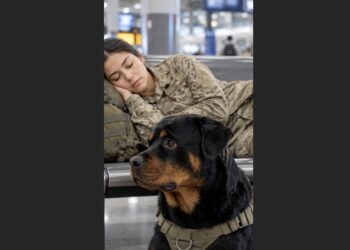
Charlie Had Already Come Back Twice
By the time Margaret Ellis met Charlie, the shelter staff knew exactly what people tended to say about him.
Too clingy.
Too dependent.
Too anxious when left alone.
Charlie was not aggressive.
He did not destroy furniture.
He did not lunge at strangers.
He did not guard food or toys.
His difficulty was quieter.
He wanted to be close to people almost constantly.
If someone crossed the room, Charlie followed.
If they sat down, he leaned against a leg.
If a door closed between him and a person, he became unsettled.
Even something as ordinary as someone stepping into the bathroom could be hard for him.
For two different families, that behavior had become more than they could manage.
So Charlie came back.
Twice.
His First Adoption Lasted Only a Few Days
The first family had liked him immediately.
At the shelter, Charlie had been affectionate and gentle.
He approached easily.
Accepted petting.
Stayed close.
Those qualities seemed charming during a thirty-minute meeting.
Living with them all day was different.
Charlie followed family members from room to room.
If someone stood, he stood.
If they walked upstairs, he went too.
When they tried leaving him alone, he cried.
Crate confinement made him more distressed rather than calmer.
The family tried closing a door between Charlie and themselves for short periods.
Even that was difficult for him.
Within days, they felt overwhelmed.
They returned him.
The Second Family Ran Into Almost the Same Problem
They hoped more time and patience would help.
For about a week, they tried.
Charlie slept close to them.
Leaned against their legs.
Followed them into the kitchen.
Waited outside bathroom doors.
If one person left the room, he sometimes transferred his attention to whoever remained.
When the house emptied, however, his anxiety intensified.
The family realized they were not prepared for a dog who needed gradual separation work and a very predictable routine.
They brought him back too.
The shelter workers were disappointed.
But they did not blame the adopters.
A placement can fail even when everyone involved means well.
Not every household is equipped for every dog.
Charlie Did Not Understand Why He Was Back
The shelter could not explain adoption returns to him.
He could not know that one family felt overwhelmed or that another had decided their routine was not compatible with his needs.
Dogs do not interpret those events through the same moral ideas humans do.
Charlie did not sit in his kennel thinking he had disappointed anyone.
What staff could observe was simpler.
He became quiet after returning.
He watched people pass.
When someone entered his run, he moved close.
When they left, he stayed near the gate.
The pattern was difficult to watch because everyone knew how strongly he seemed to rely on human proximity.
The Shelter Stopped Describing Him as “Just Affectionate”
Affectionate was true.
It was not enough.
Charlie appeared to have significant separation-related distress.
That needed to be disclosed honestly.
A family choosing him needed to understand that he might not tolerate being left alone normally at first.
He could require slow independence training.
Possibly professional behavior support.
Environmental management.
A routine designed around success rather than repeated panic.
The shelter did not want a third family discovering those needs after adoption.
So staff became more direct.
Charlie was loving.
Charlie was gentle.
Charlie was also not an easy dog for someone who expected to leave him alone for long workdays immediately.
The right match would need to want closeness without reinforcing every anxious behavior.
Margaret Ellis Was Looking for Something Almost Opposite
Margaret visited the shelter one afternoon walking slowly behind a wheeled walker.
She had been living alone since her husband died.
The house they had shared felt different now.
Too quiet.
Too still.
She told the adoption counselor she was not searching for a puppy.
She did not want a dog who needed miles of exercise.
She was not interested in a highly independent animal who preferred another room.
“What I really want,” she said, “is company.”
That word changed the conversation.
Margaret wanted a dog nearby when she watched television.
A dog that followed her into the kitchen.
A dog that slept close enough for her to hear breathing in the night.
The staff thought of Charlie.
They Did Not Pretend Charlie’s Anxiety Was Suddenly an Advantage
Compatibility can help.
It does not erase a behavioral problem.
Charlie still needed to learn that brief separations were safe.
Margaret still needed to be able to leave the house occasionally.
A person cannot responsibly promise never to be separated from a dog.
Medical appointments happen.
Groceries happen.
Emergencies happen.
So the shelter explained everything.
The crying.
The difficulty with crates.
The constant following.
The two returns.
Margaret listened carefully.
Then she said something the staff had not heard from previous adopters.
“I don’t mind if he follows me.”
She paused.
“I was hoping he would.”
Their First Meeting Was Quiet
Charlie entered the room.
He noticed Margaret immediately.
He approached without hesitation.
She did not reach over his head.
She let him sniff.
Charlie stood close to her walker, then pressed his shoulder gently against her leg.
Margaret smiled.
“Well, hello.”
Charlie looked up.
Then licked her hand.
Nothing about the interaction proved they were a perfect match.
Still, it was promising.
Margaret was not annoyed by his proximity.
She welcomed it.
When she moved toward a chair, Charlie followed.
The staff watched carefully.
Margaret sat.
Charlie lowered his head into her lap.
Her hand rested behind one ear.
“This Is What I Came Here For”
Margaret said it softly.
The adoption counselor smiled.
Charlie remained against her.
It would have been easy to say he had chosen her.
That is a comforting way humans describe these meetings.
In reality, Charlie was a dog who readily sought physical contact with people.
Margaret happened to want exactly that.
The more meaningful part was not destiny.
It was fit.
A behavior that had been overwhelming in one household was welcome in another.
That did not make the previous homes wrong.
It meant Charlie needed a different kind of daily life.
Margaret appeared able to offer one.
The Shelter Still Asked Hard Questions
Did Margaret own her home?
Yes.
Were pets allowed?
Yes.
Could she physically manage Charlie?
That required discussion.
He was not enormous, but any dog could create a fall risk around a person using a walker.
They needed to consider where he would sleep.
How he would move around the walker.
Whether he pulled on leash.
What would happen if Margaret needed help.
Who could care for Charlie if she was hospitalized?
Margaret had answers.
Her daughter lived nearby.
A neighbor could help with walks.
The house had no difficult interior stairs.
Margaret was willing to use rugs for traction and work on keeping Charlie from crowding directly in front of the walker.
Those practical details mattered.
The First Days at Home Were Predictable
Charlie followed her everywhere.
Kitchen.
Bedroom.
Living room.
Hallway.
Margaret found it comforting.
Still, she did not allow the relationship to become completely unstructured.
The shelter had connected her with a trainer experienced in separation-related problems.
The goal was not to make Charlie independent in the sense of preferring distance.
It was to help him tolerate short periods apart without becoming distressed.
That difference was important.
Margaret could enjoy his closeness and still teach him that closed doors were not emergencies.
They Started With Seconds, Not Hours
Margaret moved behind a baby gate.
Returned before Charlie escalated.
Then repeated.
A few seconds.
Then slightly longer.
Sometimes she gave him a food toy.
Sometimes she simply stepped out of sight and returned calmly.
Progress was slow.
There were setbacks.
Charlie occasionally whined.
If his anxiety rose too high, they reduced the difficulty instead of forcing him through it.
The training was not glamorous.
It looked like dozens of tiny repetitions.
Margaret did not mind.
She had time.
More importantly, she understood that companionship should not require Charlie to panic whenever she disappeared.
Crate Training Was Not Forced
Because the crate had already been associated with distress, they did not treat it as the only acceptable solution.
Charlie was given a safe area instead.
A bed.
Water.
Familiar bedding.
A chew.
Gradually, he learned to settle there for short periods while Margaret moved around the house.
Some dogs can become comfortable with crates through careful conditioning.
Others may do better with a different confinement setup.
The goal was calm, not winning an argument over where a dog should sleep.
Charlie usually preferred the floor beside Margaret’s chair anyway.
Television Became Their Evening Routine
Margaret had always watched the evening news with her husband.
After his death, she sometimes turned the television on simply for sound.
The empty chair beside hers made the room feel larger than it was.
Charlie changed the shape of those evenings.
He curled against the side of her chair.
Sometimes his head rested on her foot.
Other times he stretched along the rug.
Margaret talked to him occasionally.
He did not understand most of the words.
He understood her voice.
The household no longer felt silent.
Not because Charlie replaced her husband.
He could not.
He gave her a different kind of presence.
Grief Did Not Disappear
That mattered.
Margaret still missed her husband.
There were photographs in the hallway.
His jacket remained in the closet for months.
Some mornings were harder than others.
Charlie did not cure bereavement.
He did not erase loneliness completely.
What he did provide was routine.
Breakfast needed serving.
Water needed changing.
A dog needed to go outside.
Someone followed her into the kitchen.
Someone was there when she sat down.
For a person living alone after decades of shared life, those small obligations could give shape to a day.
That is not the same as treatment.
It is companionship.
Sometimes companionship is valuable precisely because it is modest.
Charlie Learned Margaret’s Pace
She moved slowly with the walker.
At first, Charlie occasionally stepped too close.
That created a safety concern.
So they practiced.
Margaret rewarded him for staying beside rather than directly in front of her.
A trainer helped mark a comfortable position.
Charlie learned to pause when Margaret paused.
He began giving the walker more space.
It was not perfect.
Nothing in a real home ever is.
But the pair became easier together.
Margaret learned how Charlie moved.
Charlie learned the rhythm of her steps.
He Still Followed Her
The goal was never to eliminate that.
If Margaret went to the kitchen, Charlie usually came too.
If she moved toward the bedroom, he trailed behind.
If she sat by the window, he settled nearby.
What changed was his urgency.
Over time, he did not need to press against her every second.
Sometimes he chose the other end of the room.
Sometimes Margaret stood and Charlie remained asleep.
The first time that happened, she called her daughter.
“He didn’t follow me.”
Her daughter laughed.
“Is that good?”
“I think so.”
It was.
A dog can remain deeply attached while becoming more secure.
Margaret Also Learned to Leave the House
This part mattered as much as all the cuddling.
She still had appointments.
She needed groceries.
Her daughter occasionally took her out.
Charlie had to learn that her departure did not predict permanent loss.
They built up gradually.
One minute.
Three.
Five.
Then longer.
A camera helped Margaret see what he did after she left.
At first, he stood near the door.
Sometimes he whined.
As training progressed, he began returning to his bed.
That was the behavior everyone wanted.
Not emotional indifference.
Regulation.
The ability to settle.
There Were Bad Days
Progress did not move in a straight line.
One week Charlie managed twenty quiet minutes.
Another day, five seemed difficult.
A delivery truck outside might raise his arousal.
A change in routine could make him more vigilant.
Margaret learned not to treat setbacks as betrayal.
Charlie had a behavioral problem.
Behavior changes under different conditions.
The useful question was not, “Why is he doing this to me?”
It was, “What made today harder?”
That kept frustration from turning into blame.
The Previous Adopters Had Not Failed Him
Margaret made a point of saying that.
She knew people sometimes wanted stories like Charlie’s to have villains.
Families who “gave up.”
People who “didn’t love enough.”
Reality was less simple.
Some households had long workdays.
Some had neighbors sensitive to noise.
Some could not structure life around gradual separation training.
Some discovered they were not equipped for a dog with Charlie’s needs.
Returning a dog responsibly can be kinder than keeping him in a situation where stress and resentment continue growing.
Charlie needed a home suited to him.
Margaret happened to be better suited than the first two.
Charlie Was Not Perfect for Margaret Because He Was Anxious
He was a good match because his natural desire for proximity aligned with the kind of companionship Margaret wanted.
His separation anxiety still required care.
That distinction prevented the story from becoming misleading.
It would have been irresponsible to celebrate panic as devotion.
A dog crying uncontrollably when left alone is not simply “loving too much.”
That distress deserves support.
Margaret could appreciate Charlie’s affectionate nature while helping him feel safer when apart.
Both things could be true.
Nights Became Easier
Charlie slept near Margaret’s bed.
Not on top of her.
Not blocking her path.
They placed his bed where she could reach him but still move safely if she needed to get up.
Most nights, Charlie curled near her feet.
Margaret could hear him breathing.
Sometimes he snored.
She found the sound comforting.
The house that had felt impossibly quiet now had small noises again.
Tags shifting.
Paws across the hallway.
Water from the bowl.
A sigh from the rug.
Nothing dramatic.
Just evidence that someone else lived there.
Margaret’s Daughter Noticed the Difference
Her mother talked more about daily things.
Charlie had stolen a dish towel.
Charlie had learned to wait beside the walker.
Charlie had refused to go outside in the rain.
Charlie had slept through a thunderstorm.
The stories were ordinary.
That was the point.
Grief had made Margaret’s world feel narrower.
Caring for Charlie added another set of concerns and routines.
Not all of them were easy.
Still, the house contained movement again.
Charlie Eventually Became Better at Being Alone
Not for full workdays.
He was never expected to jump directly from panic to hours of isolation.
But meaningful improvement occurred.
Margaret could shower with the bathroom door closed.
Charlie could settle outside.
She could walk to the mailbox.
He waited.
She could leave for short errands while he remained in his safe area.
He still preferred company.
That preference was not a problem.
The panic was the part they worked on.
The Shelter Received Updates
At first, staff checked in often.
They had seen Charlie return twice.
Nobody wanted a third failed placement.
Margaret sent photographs.
Charlie beside her chair.
Charlie sleeping near the walker.
Charlie in the backyard.
Then came a message that made everyone laugh.
“He followed me into three rooms this morning and then decided I was boring and went back to bed.”
That was progress.
The shelter had once known a dog who could not tolerate losing sight of someone.
Now he occasionally made his own choice to rest elsewhere.
Security had given him options.
He Still Put His Head in Her Lap
That never changed.
Margaret hoped it wouldn’t.
In the evening, Charlie often approached her chair.
He leaned forward.
Placed his head across her knees.
She scratched behind his ears.
Sometimes they stayed like that for half an hour.
No training goal required Charlie to stop enjoying closeness.
Healthy independence does not mean emotional distance.
It means the dog can cope when proximity is temporarily unavailable.
Charlie was learning the difference.
Margaret Never Called Him “Too Much”
She understood why others had.
The behavior could be exhausting in the wrong home.
But the phrase did not fit her experience.
Her house had been empty in ways she had not known how to describe.
Now something followed her into the kitchen.
Something waited outside the bathroom.
Something settled against her chair.
Charlie did not fill the place her husband had occupied.
He created his own place.
That mattered.
The Gentle Sound of Paws Became Part of the House Again
Margaret heard them behind her in the hallway.
Soft.
Steady.
Never far away.
At first, Charlie followed because he seemed unable to do otherwise.
Months later, the same footsteps meant something slightly different.
He could remain behind.
Sometimes he did.
Often he still chose to come.
That choice was healthier than panic.
And perhaps more meaningful too.
A Quality Can Be Difficult in One Home and Welcome in Another
That was the lesson Charlie’s shelter took from his story.
Compatibility matters.
An active dog may thrive with someone outdoorsy and overwhelm someone sedentary.
A quiet senior may be perfect for one family and too low-energy for another.
A dog who wants constant proximity may frustrate people who value independence.
Then another adopter may be searching for exactly that presence.
The answer is not to romanticize every behavior.
It is to understand it honestly.
Charlie needed affection.
He also needed help learning that brief separation was safe.
Margaret wanted companionship.
She also needed a dog she could manage safely around her walker.
Their match worked because both realities were taken seriously.
Charlie Had Never Needed to Become a Different Dog
He needed structure around the dog he already was.
A person who welcomed his closeness.
A routine that did not punish him for following.
Training that reduced panic without demanding emotional distance.
And a home where his desire to remain nearby was not automatically treated as a flaw.
Margaret offered that.
In return, Charlie brought something she had missed almost as much as conversation.
Presence.
Margaret’s House Is Not Silent Anymore
There is usually a dog somewhere behind her.
If she goes to make tea, Charlie often follows.
If she sits down, he settles nearby.
At night, he sleeps close to her bed.
Sometimes, when she walks into another room, Charlie remains where he is.
Margaret notices.
She smiles.
Then a minute later, she hears him get up.
Soft paws cross the floor.
He appears in the doorway.
No crying.
No panic.
Just Charlie deciding he’d rather be where she is.
For two previous households, that constant closeness had felt like too much.
For Margaret, the sound of him following down the hallway became one of the most reassuring sounds in the house.
Not because Charlie had finally found someone willing to let him stay afraid forever.
Because he had found someone who wanted him close enough to help him learn that, even when she stepped away, she could still come back.
Editor’s Note: The characters in this story are fictional. Through these stories, we hope to share the intelligence, loyalty, compassion, and loving nature of dogs with people everywhere.