Arthur Rarely Asked for Anything
Arthur was seventy-four when I met him at Green Pines Nursing Home.
He was one of those residents staff members described as “easy.” He rarely complained, rarely pressed the call button, and never demanded much attention. At meals, he thanked whoever placed the tray in front of him. During group activities, he usually sat at the edge of the room and listened.
I was twenty-eight and completing a social work internship at the facility.
At that point, I was still learning how different the job felt from the textbooks I had studied. Charts could tell me about mobility, family contacts, medications, and care plans. They could not always tell me what mattered to someone at three o’clock on a Tuesday afternoon.
My supervisor reminded me of that often.
“Learn to observe,” she would say. “Silence can tell you a lot.”
Arthur gave me plenty of silence to observe.
Every afternoon, however, he did one thing with remarkable consistency.
At exactly 3:15, he wheeled himself outside.
The Same Trip at the Same Time
The nursing home had a modest garden behind the main building.
A paved path curved past several benches, a small flower bed, and two old maple trees. Residents often sat there when the weather was mild. Families used the area during visits, and staff sometimes brought coffee outside in the warmer months.
Arthur never stopped at the benches.
Instead, he continued toward the far end of the property.
An old chain-link fence separated the nursing home grounds from a narrow strip of grass and the neighborhood beyond. There was nothing particularly attractive about that part of the garden. No flowers grew there, and the view consisted mostly of backyards, utility poles, and a quiet side street.
Still, Arthur went there every afternoon.
He would position his wheelchair near the fence and look through it.
Ten minutes later, almost exactly, he would turn around and return to the building.
At first, I assumed he simply preferred privacy.
After several weeks, though, I noticed another detail.
Whenever Arthur came back, his face looked calmer.
“I’m Waiting, That’s All”
One afternoon, I walked beside him as he returned from the fence.
“What do you like about that spot?” I asked.
Arthur glanced at me.
He had clear blue eyes and a way of considering questions longer than most people expected. Sometimes younger staff members repeated themselves because they assumed he had not heard.
Usually, he had.
“I’m waiting,” he said.
“For someone?”
He gave the smallest shrug.
“That’s all.”
Then he continued down the hallway.
I did not push him.
Social work had already taught me that curiosity and entitlement were not the same thing. A resident did not owe me a personal story simply because I wanted to understand his routine.
So I watched.
The following day, Arthur went outside at 3:15.
Ten minutes later, he returned.
The same thing happened on Friday.
Then Monday.
By the time I started counting, I learned from staff that he had apparently been making the same trip for nearly three months.
No one knew why.
Rain Did Not Change the Routine
A rainy Tuesday finally changed mine.
The weather had been miserable since morning. Water ran down the windows, and a cold wind pushed wet leaves across the parking lot.
I assumed Arthur would stay indoors.
At 3:14, however, I saw him heading toward the garden doors.
“You’re going out in this?” I asked.
He looked toward the rain.
“I’ve gone out in worse.”
I found an umbrella and followed.
Arthur moved slowly along the wet path. The small wheels of his chair bumped over uneven sections of pavement, and I stayed far enough behind that I did not crowd him.
When he reached the fence, he stopped.
Then I finally saw what he had been watching.
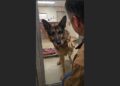
On the other side stood a dog.
He was a broad, older pit bull-type dog with a graying muzzle and a sturdy body that had softened slightly with age.
The dog was looking directly at Arthur.
Neither moved.
Ten Quiet Minutes
For several seconds, I remained under my umbrella and watched.
Arthur raised one hand.
He placed his palm against the chain-link fence.
The dog came a little closer.
His tail moved slowly from side to side.
There was no barking or frantic excitement. In fact, the entire exchange was remarkably quiet.
Arthur did not offer food.
He did not call the dog by name.
He simply rested his hand against the metal while the dog stood a few feet away.
After a while, the dog moved close enough to sniff near the fence.
Arthur smiled.
It was not the polite smile I saw when staff members asked how his morning had been. This expression seemed less guarded.
For nearly ten minutes, they remained there.
Then the dog looked toward the street.
Arthur lowered his hand.
Almost as if both had learned the same routine, they turned away at about the same time.
Arthur headed back toward the building.
The dog walked off in the opposite direction.
I Followed the Dog
I made a decision that probably said as much about my age as my training.
I followed him.
Not closely.
The dog was not wearing a leash, and I did not know his temperament or where he belonged. So I kept enough distance that he did not appear concerned by me.
He moved through several residential streets at an unhurried pace.
There was nothing mysterious about his route. He stopped to sniff a tree, paused while a car passed, and investigated a patch of wet grass.
After a few blocks, he turned into the yard of a small house.
A man was working near a window inside.
When I approached the gate, the dog walked toward the porch as though he had completed an ordinary afternoon outing.
The man came outside.
He looked to be in his thirties.
“Can I help you?”
“I work at Green Pines,” I explained. “Is this your dog?”
He looked down.
“Hector? Yes.”
That was the first time I heard the name.
David Had No Idea Where Hector Went
The man introduced himself as David.
He was an illustrator who worked from home, which explained why Hector had some freedom around the property during the day. David believed the older dog generally remained close to the house.
When I told him Hector had apparently been visiting the nursing home every afternoon, he stared at me.
“For how long?”
“Possibly three months.”
David looked at the dog.
Hector stood beside him, showing no indication that his secret schedule had just been discovered.
I described Arthur and the daily visits.
David listened carefully.
“So he just stands there?”
“More or less.”
“And the man knows him?”
“I don’t think so.”
That was the strange part.
As far as I could tell, Arthur and Hector had never met properly.
A chain-link fence had always separated them.
Still, the routine had become important enough that Arthur went outside at the same time every afternoon.
Apparently, Hector did too.
Hector Had Probably Learned the Routine Too
It would be easy to say Hector somehow sensed that Arthur needed him.
I could not know that.
Dogs often become remarkably sensitive to routines. They notice familiar times, locations, movements, and people. A repeated interaction can become part of a dog’s day without requiring the animal to understand a person’s emotional history.
Perhaps Hector had once noticed Arthur near the fence.
Maybe Arthur had spoken to him.
Perhaps the dog enjoyed the quiet attention and returned the following day.
After enough repetitions, 3:15 may simply have become part of Hector’s afternoon.
Whatever started it, something had kept both of them coming back.
David seemed moved by the thought.
“Can I bring him over tomorrow?” he asked.
I told him I would speak with the appropriate staff.
Because Green Pines was a care facility, we could not simply bring an unfamiliar dog inside without permission. Staff needed to consider residents, allergies, safety, and Hector’s behavior around wheelchairs and unfamiliar people.
Fortunately, David was willing to cooperate.
Arrangements were made for a controlled visit.
The Next Afternoon, Arthur Was Already Waiting
At 3:15 the following day, Arthur headed outside.
He knew nothing about my conversation with David.
I followed several yards behind.
This time, however, we did not go all the way to the fence.
The garden gate opened.
David stepped through with Hector on a leash.
Arthur stopped his wheelchair.
For a moment, nobody said anything.
Hector looked toward him.
Then the dog began walking forward.
David kept the leash loose and allowed Hector to choose his pace.
When he reached Arthur, Hector stood beside the wheelchair and sniffed his hand.
Arthur’s face changed.
His eyes filled with tears.
Then Hector rested his head gently across Arthur’s knees.
Arthur lowered both hands onto the dog.
He began to cry.
Not loudly.
He simply bent forward, one hand resting against Hector’s graying neck.
“His Name Was Hector Too”
We gave Arthur time.
Eventually, he looked at David.
“What did you say his name was?”
“Hector.”
Arthur closed his eyes.
For a few seconds, he said nothing.
Then he told us about another dog.
In 1951, when Arthur was eight years old, his father had given him a pit bull named Hector.
The details came slowly.
Arthur remembered the dog waiting near the school when classes ended. He remembered walking home with him. He remembered the familiar presence of a dog who had become part of childhood before Arthur was old enough to imagine that such things could end.
Three years later, Arthur’s family moved.
For reasons he did not fully explain, Hector could not go with them.
They had to leave the dog behind.
Arthur never forgot him.
“I waited for him for a long time,” he said.
His hand remained on the modern-day Hector’s head.
Then he looked down at the dog beside his wheelchair.
“And now here he is.”
No One Pretended It Was the Same Dog
Of course, Hector was not the dog Arthur had known as a child.
That dog had lived many decades earlier.
Arthur understood that.
So did we.
What seemed important was not literal confusion but the way the name and the animal in front of him had unlocked a memory he had carried quietly for most of his life.
Hector could not know Arthur’s childhood story.
He could not understand that another dog with the same name had once waited outside a school in 1951.
What Hector could do was recognize Arthur as a familiar person from the fence.
He could approach him calmly.
He could accept touch.
And, as he had done for weeks, he could remain nearby.
For Arthur, that was enough to connect two distant parts of his life.
David seemed deeply affected.
He crouched beside Hector and listened as Arthur continued talking.
That afternoon, their usual ten-minute visit lasted much longer.
David and Hector Began Coming Back
The next visit was planned.
Then another followed.
Soon, David and Hector became regular guests at Green Pines.
The visits were handled more carefully than the accidental meetings at the fence. Hector remained under supervision, and residents could choose whether they wanted contact with him.
Some were immediately interested.
Others preferred to watch from across the room.
Hector did not seem bothered by wheelchairs or walkers. He moved slowly around residents, pausing when someone reached toward him and walking away when he lost interest.
Arthur remained his most consistent companion.
Often, Hector settled beside Arthur’s chair while David talked with other residents.
The change in Arthur was subtle at first.
He spoke more.
He stayed outside longer.
Instead of heading directly back to his room after the afternoon visit, he sometimes remained in the common area.
The dog had not transformed his life overnight.
Still, Hector had become part of a routine Arthur clearly valued.
Other Residents Started Telling Their Stories
Something else happened during those visits.
Hector gave people a subject to talk about.
One resident remembered a beagle she had raised when her children were small.
Another told us about a farm dog that used to follow her father to the barn every morning.
A man who usually contributed little during group conversations described, in surprising detail, a German shepherd his family had owned after the war.
The stories were not always about dogs.
Animals led to homes.
Homes led to childhood.
Childhood led to parents, brothers, first jobs, neighborhoods, marriages, and places that no longer existed.
As a social work intern, I began to understand what my supervisor had meant about observation.
A quiet resident might appear disengaged simply because no one had found the right doorway into conversation.
For some people at Green Pines, Hector became one of those doorways.
David Started Drawing What He Saw
David brought a sketchbook one afternoon.
At first, he drew Hector sleeping near Arthur’s wheelchair.
The picture was simple.
Arthur sat with one hand resting on the arm of his chair. Hector lay beside him, his gray muzzle near the front wheel.
When Arthur saw the drawing, he studied it for a long time.
“You made me look too serious,” he told David.
David laughed.
“Then you’ll have to smile next time.”
That became the beginning of another routine.
David began drawing residents during Hector’s visits.
He drew one woman offering the dog a treat.
Another sketch showed Hector asleep beside a man reading the newspaper.
Sometimes David drew only hands: an older hand resting carefully on the dog’s head, or fingers curled into the fur behind Hector’s ears.
The drawings captured ordinary moments.
That was what made them powerful.
The Hallways Felt Different
No one claimed that a visiting dog solved the challenges of aging or residential care.
People at Green Pines still dealt with loneliness, declining health, grief, limited mobility, and complicated family relationships.
Hector could not change those realities.
However, his visits created moments of interest and connection.
Residents began asking when he would arrive.
Staff members sometimes stopped for a minute to greet him.
David learned names.
Arthur learned more about David’s artwork.
Meanwhile, I began sitting with residents longer rather than filling every silence with another question.
That may have been the greatest change for me.
Before meeting Arthur, I often thought good social work meant finding the correct thing to say.
Increasingly, I understood that presence sometimes mattered more.
The Drawings Became an Exhibition
Eventually, someone suggested displaying David’s sketches.
The idea grew.
Staff cleared wall space in a common room and arranged the drawings with simple labels. Families were invited, and residents helped choose which pictures they wanted displayed.
There were no elaborate decorations.
The artwork did not need them.
One portrait showed Arthur and Hector near the garden.
Arthur sat in his wheelchair with one hand lowered toward the dog. Hector stood beside him, looking toward the fence where their strange friendship had begun.
When Arthur saw the finished portrait, he became quiet.
I stood nearby but did not interrupt.
Finally, he said, “That’s us.”
David nodded.
“Yes.”
Arthur studied the picture again.
For months, he had gone to the fence alone.
Now the moment had been placed on a wall where everyone could see it.
Arthur No Longer Waited by Himself
The old 3:15 routine did not disappear completely.
Arthur still liked the garden.
On pleasant afternoons, he sometimes rolled toward the far fence and stopped near the place where Hector had first appeared.
However, he no longer needed to depend on a ten-minute meeting through chain-link.
David and Hector came through the gate now.
Sometimes they sat with Arthur.
Sometimes Hector wandered toward another resident.
Occasionally, the dog lay in the grass and slept while everyone talked around him.
The visits became less mysterious and more ordinary.
In a way, that made them better.
Arthur’s friendship with Hector was no longer something hidden at the edge of the property.
It had become part of the life inside Green Pines.
What I Learned From the Fence
Near the end of my internship, I walked through the garden alone one afternoon.
I stopped beside the old fence.
Three months earlier, I might have seen Arthur sitting there and assumed he wanted solitude.
Instead, he had been participating in a relationship none of us had noticed.
The dog on the other side could not understand Arthur’s memories of 1951. Hector did not know that his name belonged to a childhood companion who had remained vivid in an old man’s mind for decades.
Still, the modern-day Hector had returned.
Arthur had returned too.
Day after day, they had chosen the same place.
Perhaps that was the lesson I carried with me.
Not that dogs can read our histories.
Not that every coincidence has some deeper meaning.
Something much simpler stayed with me.
People reveal themselves in routines, in pauses, and in the places their attention returns to.
Sometimes the most useful thing we can do is notice.
On my last week at Green Pines, I saw Arthur outside at 3:15.
David sat beside him with his sketchbook.
Hector rested near the front wheel of Arthur’s chair, his muzzle gray in the afternoon light.
Arthur was no longer staring through the fence.
He was talking.
And someone was there to listen.
Editor’s Note: The characters in this story are fictional. Through these stories, we hope to share the intelligence, loyalty, compassion, and loving nature of dogs with people everywhere.