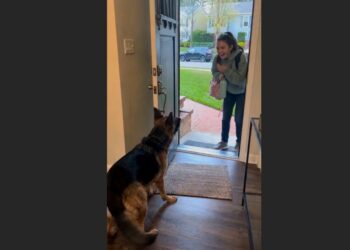
Every afternoon at exactly 3:26, a six-year-old German Shepherd named Ranger sat beside a mailbox on a quiet neighborhood street.
When the school bus approached, his ears lifted.
He stood.
Watched the yellow bus slow down at the corner.
And waited while the children stepped onto the sidewalk.
Then, after the last child had gotten off and the bus disappeared around the corner, Ranger sat down again.
He never chased the bus.
He never barked at the children.
He simply watched.
Nobody in the neighborhood knew why he did it.
The house behind the mailbox had been empty for nearly a year. Ranger had apparently been living around the property since spring, sleeping somewhere nearby and rarely wandering beyond the driveway.
The mail carrier had taken to leaving food and water for him.
Other neighbors occasionally noticed him sitting beneath the mailbox.
But Ranger never seemed interested in going anywhere else.
Then a 65-year-old retired teacher named Patricia Wells moved into the house next door.
She noticed him on her very first afternoon.
The German Shepherd was sitting beside the mailbox, looking toward the street.
Patricia stopped.
“Who are you waiting for?” she asked.
Ranger didn’t move.
He simply kept watching the road.
Patricia had recently retired after years of teaching elementary school. Her children lived several states away, and she was still adjusting to the quiet of her new home.
She knew what it was like to miss people who weren’t there.
But she couldn’t have imagined how much that dog beside the mailbox would come to mean to her.
Or that, one afternoon, he would finally stop waiting for the school bus.
The House Nobody Lived In
The empty house had become a familiar part of the neighborhood.
Its driveway was quiet.
The front door remained closed.
Nobody came outside in the mornings to collect a backpack or hurry a child toward a waiting car.
The people who had once lived there were gone.
But their German Shepherd had remained.
Ranger was six years old.
He wasn’t aggressive toward the people who passed.
He didn’t chase the mail carrier or cause trouble for the neighbors.
He simply stayed close to the old property.
The mail carrier began leaving food and water so he would have something to eat and drink.
Some residents wondered who was responsible for him.
Others assumed someone was keeping an eye on him.
But nobody seemed to know the complete story.
Every afternoon, when the school bus approached at 3:26, Ranger appeared beside the mailbox.
The routine was so consistent that people began noticing the timing.
He would stand when the bus stopped.
Watch the children get off.
Then settle back into his place.
He wasn’t waiting for food at that hour.
He wasn’t following the children down the street.
He seemed particularly attentive to the bus and the people stepping off it.
Whatever had brought him there, the same moment kept drawing him back.
Patricia’s First Afternoon
Patricia Wells had moved next door hoping to settle into a quieter life.
At sixty-five, she’d recently retired from teaching elementary school.
For years, her days had been filled with children.
Classroom conversations.
Lessons.
Questions.
And the familiar activity of a school day.
Now she was retired.
Her own children were grown and living several states away.
She loved hearing from them, but phone calls and letters weren’t the same as having someone nearby.
The new house felt unusually quiet.
On her first afternoon, she was outside when she noticed the German Shepherd sitting beside the neighboring mailbox.
He was alone.
There was no leash attached to him.
And nobody appeared to be calling him home.
Patricia watched him for a moment.
“Who are you waiting for?”
The dog looked toward the street.
She followed his gaze.
There wasn’t anyone approaching.
Still, Ranger remained where he was.
Patricia didn’t know his name yet.
She didn’t know how long he’d been there or whether someone was caring for him.
But something about his patient stillness stayed with her.
The following afternoon, she looked for him again.
The Bus That Arrived at 3:26
After a few days, Patricia began noticing Ranger’s routine.
Every afternoon, shortly before the school bus arrived, he was near the mailbox.
Then, at 3:26, the bus pulled up at the corner.
Its doors opened.
Children stepped down.
And Ranger stood.
He watched attentively.
Patricia had spent enough years around school buses to recognize the familiar rhythm.
Children getting off.
The bus waiting until they were safely clear.
Then the driver continuing along the route.
But she’d never seen a dog respond to it quite like Ranger.
He didn’t run toward the children.
He didn’t attempt to climb aboard.
He simply observed.
And when the bus departed, he sat down again.
At first, Patricia wondered whether he’d once belonged to a family with a child who rode that bus.
Perhaps he’d been accustomed to greeting someone after school.
It was only a possibility.
She didn’t know enough about his past to be certain.
But the explanation seemed plausible.
She remembered the empty house.
Then she looked back at the German Shepherd still sitting beside its mailbox.
She wished she knew who he had been waiting for.
The Rainy Afternoon
One afternoon, rain began falling before the bus arrived.
Patricia looked out from her house.
Ranger was still beside the mailbox.
He hadn’t moved to her porch or sought shelter near her door.
He remained close to the driveway.
The rain darkened the sidewalk around him.
Patricia hesitated.
She had only been watching him for several days.
He wasn’t her dog.
She didn’t know whether he’d welcome company.
But seeing him sitting outside in the rain troubled her.
She picked up an umbrella and walked toward him.
Ranger noticed her approach.
He didn’t run away.
But he didn’t come forward either.
Patricia stopped beside the curb.
She kept her movements calm.
Then, despite the damp concrete, she sat down a short distance from him.
She held the umbrella above herself.
Ranger remained where he was.
For a while, neither did anything.
They simply sat together, listening to the rain.
Then Patricia heard the approaching school bus.
The Children Who Weren’t His
At 3:26, the bus stopped at the corner.
Ranger stood.
Patricia watched him carefully.
His ears were raised.
His attention stayed on the bus doors.
The children began getting off.
One after another, they stepped onto the sidewalk and made their way home.
Ranger watched them.
He didn’t approach.
He didn’t appear interested in following any particular child.
Then the doors closed.
The bus moved away.
And Ranger slowly sat back down.
Patricia noticed his ears lower.
She looked toward the road.
The bus was gone.
The children were gone.
And Ranger was sitting in the same place he’d occupied before they arrived.
Patricia turned toward him.
“You miss somebody.”
Ranger looked at her.
She couldn’t know whether he’d understood the words.
But she understood what she’d seen.
A dog who waited for the same event every afternoon.
Who stood when the bus arrived.
And who settled back beside an empty house when it left.
Patricia remained beside him.
She didn’t try to make him follow her home.
She didn’t pull him away from the mailbox.
She simply sat there until the rain stopped.
The Folding Chair
The next afternoon, Patricia returned.
This time, she brought a folding chair.
She’d discovered that sitting on the wet curb wasn’t particularly comfortable at her age.
The chair made it easier.
She placed it a short distance from the mailbox.
Then sat down.
Ranger watched her.
He didn’t leave his place.
But he didn’t seem troubled by her presence.
When the bus arrived at 3:26, he stood as usual.
Patricia remained seated.
The children got off.
The bus departed.
And Ranger returned to the ground beside the mailbox.
Patricia stayed a little longer.
The following afternoons developed into a routine.
Sometimes she spoke to him.
Sometimes she simply watched the street.
Ranger continued waiting for the bus.
But he began looking toward Patricia when she came outside.
By the end of the week, she no longer felt as though she were interrupting him.
She was becoming part of his afternoon.
And the dog who rarely wandered away from the driveway had started expecting her company.
Coffee for One Became Coffee for Company
About a week later, Patricia began bringing a thermos of coffee.
She’d settle into her folding chair with the thermos beside her.
Ranger would sit near the mailbox.
The street would be quiet until the school bus arrived.
It wasn’t much of an outing.
They didn’t go anywhere.
They didn’t play fetch or take long walks.
But Patricia began looking forward to it.
After so many years teaching, retirement had left her with long, unstructured afternoons.
Her children lived far away.
The new house was peaceful, but sometimes it felt too quiet.
Sitting beside Ranger gave her a reason to step outside at a familiar hour.
She could watch the neighborhood.
Listen to the sounds around her.
And spend a little time with the old house’s most faithful occupant.
Ranger didn’t need conversation.
He didn’t expect entertainment.
And Patricia didn’t need him to do anything special.
They could simply share the afternoon.
When the bus came, Ranger would stand.
Then sit down again.
Patricia would finish her coffee.
And eventually, she’d fold up her chair and return home.
The routine seemed to suit them both.
The Letter From Her Son
One afternoon, Patricia received a letter from her son.
She decided to take it outside with her.
At the usual time, she carried her folding chair toward Ranger’s mailbox.
The German Shepherd was already there.
Patricia sat down.
Opened the envelope.
And began reading.
It was a short message.
Her son had written about his own family and shared news that made Patricia smile.
Her grandson was starting kindergarten.
For someone who had spent so many years teaching elementary school, the detail meant a great deal.
She could picture the excitement of a child’s first school year.
The unfamiliar classroom.
The new routine.
And the beginning of a chapter that always felt important to children and parents alike.
Patricia read quietly for a while.
Then she noticed Ranger moving closer.
He approached her chair.
She folded the letter.
Ranger lowered his nose toward the envelope.
And gently touched it.
Patricia laughed.
“You want to know what it says?”
The dog remained beside her.
So Patricia opened the letter again.
And began reading aloud.
A Story About Kindergarten
Patricia read her son’s message to Ranger.
She told him about her grandson starting kindergarten.
About the new school year.
And the family news she’d received from several states away.
Ranger sat nearby.
He couldn’t understand the letter the way Patricia did.
But he could hear her voice.
And he seemed comfortable remaining close while she spoke.
Patricia found herself enjoying the conversation.
For years, she’d read books and instructions aloud to children.
She was accustomed to speaking in a calm, familiar voice.
Now she was sitting beside a mailbox, reading a family letter to a German Shepherd.
The situation made her smile.
She continued until she’d finished.
Then she folded the paper.
Ranger remained close.
Patricia looked down at him.
“Well,” she said gently, “now you know.”
It was a small, ordinary moment.
But after weeks of quiet afternoons, it felt like something new.
Ranger had approached her on his own.
And she’d shared a little part of her family’s life with him.
The Letters They Shared
From then on, Patricia began bringing pieces of mail with her.
Sometimes they were letters from her children.
Sometimes birthday cards.
Other afternoons, she carried advertisements or bills.
It didn’t matter much what the envelopes contained.
She’d sit in her folding chair beside the mailbox.
Open the mail.
And read aloud.
Ranger usually remained nearby.
Sometimes he sat close to her chair.
Other times, he rested beside the curb.
When the bus approached, he still stood and watched.
But after it left, he seemed increasingly content to remain beside Patricia.
She began talking to him about her days.
The new house.
The quiet afternoons.
And the family members she missed seeing regularly.
She didn’t expect him to understand everything.
But she found that speaking aloud made the long afternoons feel less lonely.
The routine became something she anticipated.
At 3:26, the bus would come.
Ranger would watch.
And afterward, Patricia would finish reading whatever mail she’d brought with her.
It was an unusual friendship.
A retired teacher and a German Shepherd.
Sitting outside an empty house.
Sharing letters neither had expected to read together.
The Friday Visitor
One Friday, someone else arrived.
A woman from the county animal shelter came to the property after the shelter received several calls about the dog.
People had noticed Ranger living near the empty house.
They were concerned about his welfare.
The shelter worker needed to check his identification and determine his situation.
Patricia was nearby when the woman approached.
Ranger noticed the visitor.
Then he moved toward Patricia.
He stood close enough for her to place a hand on his collar.
Patricia remained calm.
She didn’t want him frightened by the unfamiliar person.
The shelter worker explained what she needed to do.
Ranger would have to be checked for identification.
They wanted to know whether he belonged to someone.
Whether he was missing.
And whether there was a family who could be contacted.
Patricia looked at the dog beside her.
She’d spent so many afternoons wondering about his past.
Now there was finally a chance to learn something.
The Microchip
The shelter worker scanned Ranger for a microchip.
The scan provided an identification number.
The information led to his records.
And those records confirmed something Patricia hadn’t known when she first met him.
His name really was Ranger.
He hadn’t been given that name by the neighborhood.
It was the name connected to his original family.
The records also led to information about the people who had once lived in the empty house.
They had moved away months earlier.
And Ranger had been left behind.
Patricia looked toward the house.
The closed front door.
The empty driveway.
The mailbox where Ranger had spent so many afternoons.
Then she looked down at the German Shepherd standing beside her.
Suddenly, his behavior seemed different.
She still couldn’t know precisely what he thought when the bus arrived.
But she understood that the home he’d known was no longer occupied.
The family was gone.
And he had remained on the property.
The same place he’d apparently continued returning to since spring.
The Family Who Never Came Back
Ranger’s original family had moved away.
Whatever the circumstances surrounding that move, the dog had been left behind.
For months, he’d remained near the property.
He hadn’t established a new home elsewhere.
He hadn’t begun following the mail carrier away from the neighborhood.
And he hadn’t wandered far from the driveway.
Every afternoon, he continued watching the school bus stop at the corner.
Patricia wondered whether someone in the family had once come home on that bus.
Perhaps a child had stepped off at 3:26.
Perhaps Ranger had recognized the time and the familiar sound long after the family disappeared.
She couldn’t prove it.
Nobody had told her exactly how his afternoon routine began.
But she could see why the bus might have mattered to him.
Dogs become accustomed to predictable events.
The arrival of familiar people.
The sounds of vehicles.
The patterns of daily life.
And those associations can remain even after circumstances change.
Ranger had no way to understand the family’s move in human terms.
He couldn’t know whether anyone intended to return.
But the house was empty.
And he had continued waiting.
“I Think He’s Waited Long Enough.”
Patricia stood beside Ranger.
Her hand rested on his collar.
She looked again at the house.
It had been empty when she moved into the neighborhood.
For weeks, she’d watched this dog return to the same mailbox.
She’d sat beside him in the rain.
Brought a folding chair.
Shared her afternoon coffee.
And read her children’s letters aloud while he rested nearby.
She had grown attached to him without planning to.
Now she knew he had been left behind.
She looked toward the shelter worker.
Then down at Ranger.
“I think he’s waited long enough.”
It wasn’t a dramatic speech.
She didn’t need to explain how lonely her retirement had sometimes felt.
Or how much she’d begun looking forward to their afternoons together.
She simply knew she wanted the dog to have a home.
And she had one next door.
After the shelter addressed the necessary ownership and care arrangements, Ranger was able to go home with Patricia that evening.
Not to the empty house he’d been watching.
But to the house beside it.
The one where a retired teacher had been waiting for him every afternoon.
His First Evening at Patricia’s House
That evening, Ranger entered Patricia’s home.
It was a new place for him.
Different rooms.
Unfamiliar surroundings.
And a person he’d come to know gradually during their afternoons together.
Patricia understood that he might need time to adjust.
She didn’t expect him to forget his earlier home in a single evening.
The house next door had been part of his life for years.
And the habit of waiting by its mailbox wouldn’t necessarily disappear immediately.
But he no longer needed to remain outside to receive food and water from the mail carrier.
He now had someone responsible for his daily care.
Someone who knew his name.
Someone who had spent time earning his familiarity rather than expecting instant affection.
Patricia was pleased to have him there.
Her new home had felt unusually quiet since she’d retired.
Now there was another living creature sharing the space.
Ranger had a place to rest.
And Patricia had a companion she’d never expected to find when she moved into the neighborhood.
The Next Afternoon at 3:26
The following afternoon, Patricia sat on her porch.
Ranger sat beside her.
The street looked much the same as it always had.
The empty house was still next door.
The mailbox stood beside the driveway.
And the school bus was due at its familiar time.
When the bus approached, Ranger lifted his head.
Patricia noticed.
She wondered whether he’d get up and walk toward the mailbox.
Whether he’d return to the same place he’d occupied for so many afternoons.
At 3:26, the bus stopped.
Its doors opened.
Children stepped down.
Ranger watched for a moment.
Then he turned his head toward Patricia.
She smiled.
“Not waiting anymore.”
Ranger moved a little closer.
And rested his chin on her knee.
The bus doors closed.
The vehicle continued down the street.
And for the first time since Patricia had begun watching him, neither of them followed it with their eyes.
They remained on the porch.
Together.
The Mailbox That Had Held So Many Afternoons
For months, the mailbox had been the center of Ranger’s routine.
People walking through the neighborhood had come to recognize him there.
The mail carrier knew he needed food and water.
Patricia knew that if she looked outside shortly before 3:26, she’d probably find him nearby.
And every afternoon, when the bus arrived, Ranger stood.
Then sat down again.
Now the mailbox was simply part of the neighboring property.
Ranger no longer needed to spend his afternoons sitting outside the empty house.
He could remain with Patricia.
He could rest on her porch.
And he could learn a new routine with someone who intended to care for him.
Patricia knew his adjustment might not happen all at once.
Familiar habits can persist.
An animal may continue responding to sounds and events associated with an earlier life.
But Ranger had begun forming a new relationship even before moving into her home.
He’d learned that Patricia came outside at the same time.
That she sat nearby.
That she spoke gently.
And that her presence was familiar.
Now those afternoons could continue without the uncertainty of where he belonged.
The Teacher Who Missed Her Family
Patricia had spent her career teaching children.
She’d been surrounded by young voices and the daily routines of school.
Retirement had been a major change.
Her own children were adults.
They lived several states away.
She could hear from them through letters and phone calls, but she missed having people nearby.
Moving into a new house had made that quietness even more noticeable.
Then she met Ranger.
He was sitting beside a mailbox.
At first, she simply watched him.
Then she noticed the school bus.
Then she began sitting beside him.
What started as curiosity became a routine.
And the routine grew into affection.
Ranger hadn’t been the companion she’d expected to find.
She hadn’t moved to the neighborhood intending to adopt a German Shepherd.
But after weeks of sharing afternoons with him, she realized how much she enjoyed his presence.
The feeling was different from the activity of a classroom.
There was no lesson to prepare.
No assignment to grade.
No conversation that required an answer.
Just a dog who seemed content to sit nearby.
And a woman who was glad to have company.
The Letters Still Arrived
Patricia’s children continued writing.
Her grandson was still beginning kindergarten.
There would be new stories from school.
Birthday cards.
Family updates.
And the ordinary mail that arrived each week.
Patricia no longer needed to carry everything to the curb.
She could sit on her own porch.
Or inside her home.
Ranger could settle nearby.
And she could read aloud if she felt like it.
The mail wasn’t important to the dog in the same way it was to Patricia.
He couldn’t understand the family news.
But he recognized her voice.
And he’d become familiar with the calm routine of sitting beside her while she read.
That simple activity had been part of how their relationship developed.
It had given Patricia a reason to speak.
And Ranger a chance to spend time with someone who didn’t rush him.
Now they could continue that routine in a place where both belonged.
There was something fitting about a former elementary school teacher finding companionship through reading aloud.
Not to a classroom full of children.
But to a German Shepherd who’d spent months waiting beside a mailbox.
The Difference One Afternoon Made
Patricia often thought about the first rainy afternoon.
She’d looked outside and seen Ranger sitting by the mailbox.
The rain was falling.
He hadn’t moved.
So she picked up an umbrella.
Walked over.
And sat beside him on the wet curb.
At the time, she didn’t know his history.
She didn’t know the family had left him behind.
And she couldn’t explain why he watched the school bus.
She simply saw a dog who was alone.
She decided to keep him company.
That was the beginning.
The folding chair came later.
Then the thermos.
Then the letter from her son.
And eventually, the afternoon when Ranger moved closer and listened while she read about her grandson starting kindergarten.
None of those moments had been extraordinary on its own.
But together, they formed a relationship.
By the time the county shelter worker arrived, Ranger already knew Patricia.
He’d spent weeks sitting beside her.
And when the unfamiliar visitor approached, he moved toward the woman he’d come to recognize.
The friendship had begun long before any adoption arrangements were made.
He Hadn’t Been Waiting for Patricia
Patricia understood that Ranger’s original routine hadn’t been about her.
When she moved into the neighborhood, he was already sitting beside the mailbox.
He was already watching the school bus.
And he’d already been left behind by the family who once lived there.
She hadn’t been part of those earlier years.
She couldn’t replace whatever connections he’d once had.
And she didn’t want to pretend she could explain every part of his behavior.
Perhaps he’d once greeted a child returning from school.
Perhaps the bus had become associated with another familiar part of his former life.
Or perhaps there was some detail nobody in the neighborhood knew.
But Patricia didn’t need every question answered before caring for him.
She knew what she’d seen.
A dog who remained close to an empty house.
A dog who responded to the same event every afternoon.
And an animal who gradually became comfortable sharing that time with her.
She couldn’t change what had happened to him.
But she could change what happened next.
And that was enough.
The First Afternoon They Didn’t Watch the Bus Leave
The most memorable moment came after Ranger moved into Patricia’s house.
The following day, she sat on her porch.
Ranger rested beside her.
At 3:26, the school bus arrived.
He lifted his head.
The familiar yellow vehicle stopped.
The doors opened.
Children got off.
For a moment, Ranger watched.
Then he turned toward Patricia.
She smiled.
“Not waiting anymore.”
He rested his chin against her knee.
And while the bus drove away, neither looked after it.
It was such a small change.
No barking.
No excited running.
No sudden dramatic behavior.
Just a dog remaining beside the person who had taken him home.
Patricia couldn’t know whether Ranger had completely stopped expecting someone from his past.
And one afternoon couldn’t prove that every old habit had disappeared.
But the moment meant something to her.
For weeks, she’d watched him sit beside the mailbox after the bus left.
Now he was sitting beside her.
And he seemed comfortable staying there.
A Different Kind of Homecoming
Ranger’s story began with a routine that nobody understood.
A German Shepherd beside a mailbox.
A school bus arriving every afternoon at 3:26.
A dog standing to watch the children get off.
Then sitting down again when the bus left.
The house behind him was empty.
The family who had lived there had moved away.
And Ranger remained.
People noticed.
The mail carrier left food and water.
But for months, nobody seemed able to give him the home he needed.
Then Patricia moved next door.
She was sixty-five.
Recently retired.
And adjusting to a quiet house after years of teaching and raising her own family.
She began watching Ranger from her porch.
Then she sat beside him in the rain.
The next day, she brought a folding chair.
Later, a thermos of coffee.
And eventually, letters from her children.
She read to him beside the mailbox.
Bills.
Birthday cards.
Advertisements.
Family news.
Including a letter about her grandson starting kindergarten.
Ranger began looking forward to her arrival.
Then one Friday, a county shelter worker came to check on the dog.
His microchip confirmed his name.
Ranger.
And the records led to the family who had left him behind.
Patricia looked at the empty house.
Then at the dog who had spent months waiting beside it.
“I think he’s waited long enough.”
That evening, Ranger went home with her.
No Longer Alone at 3:26
The next afternoon, Patricia didn’t need to carry her folding chair to the curb.
She sat on her porch instead.
Ranger was beside her.
At 3:26, the school bus approached.
For a moment, his ears lifted.
He watched the children step onto the sidewalk.
Then he turned toward Patricia.
She smiled.
“Not waiting anymore.”
He rested his chin on her knee.
And the bus drove away.
Neither watched it leave.
For months, Ranger had stayed beside an empty house, responding to a familiar afternoon routine.
Patricia had spent her early retirement adjusting to a home that felt far too quiet.
Neither had planned to find companionship in the other.
But they had.
First through a rainy afternoon.
Then a folding chair.
A thermos of coffee.
And letters read aloud beside a mailbox.
Now they shared a home.
Ranger had someone to feed him, care for him, and welcome him inside at the end of the day.
Patricia had a companion waiting nearby when she sat down with her coffee or opened a letter from her children.
The mailbox remained next door.
The school bus still stopped at 3:26.
But those things no longer defined where Ranger belonged.
He had a home with Patricia.
And for a woman who had been wondering how to fill the quiet afternoons of retirement, he had become an unexpectedly important part of her life.
Sometimes a new beginning doesn’t arrive with a dramatic moment.
Sometimes it begins when someone notices a dog sitting alone in the rain.
And instead of walking past, they pull up a chair.
Editor’s Note: The characters in this story are fictional. Through these stories, we hope to share the intelligence, loyalty, compassion, and loving nature of dogs with people everywhere.