Roxie arrived at the shelter on a Tuesday morning in a plastic veterinary transport crate.
The paperwork clipped to the top was brief.
Female. Mixed breed. Approximately four years old. Smoke inhalation. Minor burns to front paws.
It was the kind of language designed to record injuries, not explain what an animal had been through.
My name is Clara, and I had been working at the shelter for six years.
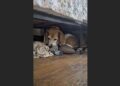
When I opened the crate, I saw a dog pressed so tightly against the back wall that she seemed to be trying to disappear into it.
Her paws were bandaged.
Several small patches of fur had been singed.
Her eyes were wide.
And although the veterinary clinic had treated the most immediate physical effects of the fire, Roxie was nowhere near ready to behave like an ordinary shelter dog.
For the first three days, she barely moved when I entered the room.
On the fourth morning, I sat several feet away and spoke quietly without reaching toward her.
After nearly twenty minutes, Roxie shifted forward.
Barely an inch.
I remember smiling as though she had crossed the entire room.
That was when Beatrice, our longest-serving volunteer, appeared in the doorway holding a newspaper clipping.
“I think you need to see this,” she said.
The photograph showed a firefighter covered in soot carrying a dog away from a burned house.
The dog was Roxie.
And the firefighter’s name was Tristan Reed.
The Fire Had Destroyed Almost Everything
What we eventually learned came in pieces.
Roxie had been inside a family home when the fire broke out.
By the time firefighters arrived, smoke was pouring from the structure.
Her owner had been found alive but seriously affected by smoke inhalation and was transported to the hospital.
Roxie was still inside.
The scene had been chaotic enough that nobody initially knew exactly where she was.
Firefighters were dealing with the burning structure, the possibility of collapse, and the urgent work of making sure no other person remained trapped.
Somewhere during those efforts, Tristan learned there was a dog in the house.
He kept searching.
Not continuously inside a burning building for four uninterrupted hours, as later retellings sometimes simplified the story, but through a long emergency response in which crews repeatedly worked around intense heat, smoke, and unstable conditions.
Eventually, Roxie was found.
The newspaper photograph showed Tristan outside afterward, blackened with soot, holding her against his turnout gear.
She looked small in his arms.
Terrified.
Alive.
Roxie Went From the Fire to Veterinary Care
The smoke exposure was the main concern.
She had inhaled enough smoke to require observation and treatment.
Her front paws had suffered relatively minor burns, likely from moving across dangerously hot surfaces.
Fortunately, the injuries were not expected to cause permanent mobility problems.
The veterinary team treated her burns and monitored her breathing.
Physically, she began improving.
But there was another problem.
Her owner remained hospitalized.
The home was uninhabitable.
There was nowhere for Roxie to return.
That was how she came to us.
She Did Not Understand Why Everything Had Changed
People sometimes describe a dog after a fire as though the animal is replaying the event in human terms.
We cannot know that.
Roxie did not understand insurance claims, hospitalization, property damage, or why the person she lived with had suddenly disappeared.
But animals absolutely respond to frightening experiences and abrupt environmental change.
For Roxie, the sequence had been enormous.
Heat.
Smoke.
Noise.
Strangers in heavy protective gear.
Veterinary treatment.
Separation from her owner.
Then another unfamiliar building filled with barking dogs and new smells.
Her withdrawal did not need a dramatic explanation.
She had been through more than enough.
For Three Days, We Asked Almost Nothing From Her
Food was placed nearby.
Water stayed within easy reach.
Her medication was given with as little handling as possible.
We kept the environment quiet.
When I entered, I sat sideways rather than directly facing her.
Sometimes I read paperwork aloud.
Sometimes I told her completely unimportant things.
What the weather was doing.
Which dog had stolen a towel.
What I had eaten for breakfast.
The words were irrelevant.
The tone was not.
Roxie learned that my arrival did not always mean someone would touch her, move her, or ask her to do something.
On the fourth day, she shifted forward.
One inch.
That was progress.
Then Beatrice Found the Article
She laid the clipping on my desk.
The photograph was grainy but unmistakable.
Roxie’s markings matched.
Her burned paws were visible.
The firefighter holding her was identified as Tristan Reed.
According to the article, he had been part of the crew that worked the house fire and had personally carried Roxie out.
I read it twice.
Then I looked toward Roxie’s room.
“Do you think she’d remember him?” Beatrice asked.
“Maybe.”
Dogs can retain recognition of people through scent, voice, appearance, and strong associations.
But the circumstances of Roxie’s rescue had been extreme.
Tristan would have been wearing protective equipment.
He would have smelled of smoke, gear, sweat, and the fire scene itself.
Whether Roxie associated him with safety, fear, or simply one confusing moment among many was impossible to know.
So we did not build a plan around a reunion.
Not yet.
Roxie’s Body Healed Faster Than Her Behavior Changed
Within a few weeks, her bandages came off.
The burns improved.
Her breathing stabilized.
Her coat began filling back in where it had been singed.
Behaviorally, things moved more slowly.
Sudden metallic noises made her startle.
If the shelter lights went off unexpectedly, she sometimes became restless and vocal.
Storms were difficult.
So were alarms.
We worked with her gradually.
Predictable routines.
Quiet handling.
Food enrichment.
Short walks.
No forcing her toward something simply because we wanted her to “face” it.
Some days she advanced.
Other days she wanted more distance.
Recovery did not move in a straight line.
She Started Eating Better
That was one of our first encouraging signs.
At the beginning, Roxie often waited until the room was empty before approaching food.
Then she began eating while I sat several feet away.
Later, she accepted treats tossed gently near her.
Eventually, she took one from my hand.
I resisted the urge to immediately pet her.
The treat was enough.
The following afternoon, she approached again.
Little by little, she began showing us more of herself.
She liked cheese far more than any dog reasonably should.
She preferred soft bedding.
She had a habit of turning three times before lying down.
And once she trusted you, she leaned surprisingly hard against your legs.
Beatrice Kept Thinking About Tristan
She brought it up carefully.
Not as a cure.
Not as though seeing the firefighter would magically erase Roxie’s fear.
But as a potentially meaningful familiar contact.
“What if we simply ask?” she said.
So we did.
The fire station confirmed that Tristan was willing to see her.
The question then became whether the visit would benefit Roxie.
We spoke with the people overseeing her care.
There was no guarantee she would recognize him.
No guarantee the station environment would be comfortable.
We agreed to keep the visit brief and leave immediately if Roxie showed sustained distress.
A week later, on a Tuesday morning, Beatrice and I put Roxie in the car.
The Drive Was Difficult
Roxie did not love vehicles.
She trembled on the back seat.
We used a secure harness and gave her enough space to settle.
Beatrice sat nearby without constantly touching her.
I drove.
For most of the trip, Roxie’s body remained tense.
Then we turned into the station lot.
Large red bay doors filled the windshield.
There were new smells everywhere.
Diesel.
Rubber.
Metal.
People.
Roxie’s nose began moving rapidly.
She stood.
Not relaxed.
Not panicked either.
Alert.
Very alert.
Tristan Was Inside the Apparatus Bay
We entered slowly.
Roxie stayed close to me at first.
Several firefighters were working around the vehicles.
Nobody crowded her.
They had been told in advance that this was not supposed to become a dramatic group reunion.
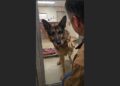
Then a tall man near the back of the garage turned around.
Tristan.
He saw us.
His expression changed immediately.
“Is that her?”
I nodded.
He did not run forward.
That detail mattered.
He crouched where he was.
Then he spoke her name.
“Roxie.”
She Stopped
Her entire body became still.
She stared.
Tristan stayed crouched.
No reaching.
No attempt to force recognition.
Roxie’s nose lifted.
She sampled the air.
Then she took several quick steps forward.
Stopped again.
Tristan said her name a second time.
That was when she crossed the remaining distance.
Roxie Went Straight to Him
She moved much faster than I had seen her move since arriving at the shelter.
Tristan opened his arms only after she reached him.
Roxie pressed against his chest.
She sniffed his face.
His jacket.
His hands.
Then she began licking his chin.
Tristan laughed.
A second later, he was crying.
“I’ve wondered about you every day,” he said.
Roxie’s tail was moving.
Not wildly.
But clearly.
She leaned harder against him.
Several firefighters standing farther back turned away to wipe their eyes.
Beatrice was openly crying beside me.
I was not doing much better.
We Still Could Not Know Exactly What Roxie Remembered
The moment was powerful.
But I did not need to claim that she understood Tristan as “the man who saved my life.”
Dogs do not frame events in human narrative language.
What Roxie may have recognized was his scent.
His voice.
His body language.
Some sensory combination connected to a person she had encountered during an overwhelming event.
Whatever the mechanism, her behavior around him was unmistakably different from the caution she usually showed with unfamiliar people.
She sought him out.
Stayed close.
And relaxed.
That was enough.
She Fell Asleep Near His Boots
We stayed almost an hour.
Roxie spent much of it near Tristan.
At one point, he sat on the floor.
She settled beside him.
Eventually, her head came down across one of his boots.
Her eyes closed.
The station carried plenty of potentially unsettling sounds.
Equipment shifting.
Voices.
A distant door.
Roxie noticed some of them but did not retreat.
Tristan continued talking quietly.
Mostly ordinary things.
“I was hoping you were okay.”
“You look better.”
“You gave us a scare.”
Roxie slept.
The Visit Did Not “Fix” Her
That distinction became important later.
When we returned to the shelter, Roxie did not suddenly become fearless.
A dropped metal bowl still startled her two days later.
She still disliked abrupt darkness.
She still needed careful handling around unfamiliar situations.
But we did notice changes.
Her appetite improved.
She began approaching the front of her space more readily.
Tail movement became more frequent when familiar people arrived.
She showed more interest in walks.
Maybe the reunion contributed.
Maybe it coincided with weeks of medical recovery, predictable care, and growing familiarity with the shelter.
Most likely, all of those things mattered together.
There was no reason to turn a complicated recovery into a single magical moment.
Three Weeks Later, We Received the Call We Had Been Hoping For
Roxie’s owner was recovering.
He had survived the smoke exposure.
And he wanted to know when he could see his dog.
I remember sitting down when I heard that.
All along, Roxie’s stay with us had been temporary in principle.
But after weeks of caring for her, everyone had begun protecting themselves emotionally.
We knew reunification might take time.
We knew housing could become complicated after a fire.
We knew circumstances sometimes prevent people from immediately reclaiming animals they deeply love.
This time, arrangements could be made.
Her owner came to the shelter.
We Let Roxie Approach at Her Own Pace
He looked different from the photographs we had been shown.
Thinner.
Tired.
Still recovering.
He sat in the visiting room.
Roxie entered with me.
At first, she stopped.
Then her nose lifted.
Her body changed.
She moved forward.
Slowly at first.
Then faster.
Her owner knelt.
Roxie went into him.
He buried his face in her neck.
Neither one needed us.
We quietly left the room.
Their Reunion Was Different From the Station
With Tristan, Roxie had shown alert recognition followed by excitement.
With her owner, there was something more familiar in the rhythm of the interaction.
She moved around him.
Sniffed his clothing repeatedly.
Pressed close.
Moved away.
Returned.
Her tail continued moving.
He kept one hand on her side.
At one point, he laughed through tears.
“She always has to make sure I’m really there.”
Again, we could not know exactly what Roxie understood.
But there was no doubt that this person mattered to her.
Going Home Was Not Immediately Possible
There was still no original home.
The fire had destroyed too much.
Temporary housing had to be arranged while rebuilding plans moved forward.
Roxie’s owner could not simply return to the life they had before.
Neither could she.
So the next months became less about restoration and more about building a new routine.
Different rooms.
Different smells.
Different surroundings.
Same relationship.
Roxie stayed with him through that transition.
Tristan Continued Asking About Her
Not constantly.
He did not try to insert himself into the family’s life.
Every now and then, a message came through.
How was Roxie?
Was she eating?
Were her paws fully healed?
We sent updates when appropriate.
Eventually, Roxie’s owner contacted him directly to thank him.
The two men had experienced the same fire from opposite positions.
One trying to survive it.
The other trying to bring living beings out of it.
Neither seemed interested in turning the event into something grander than it had been.
Roxie was alive.
That was the part that mattered.
Rebuilding Took Months
The old house could not simply be repaired in a few days.
There were inspections.
Plans.
Construction crews.
Insurance conversations.
Delays.
Decisions about what could be saved and what could not.
For Roxie, those details meant little.
Her world was simpler.
Where did she sleep?
Who fed her?
Who walked her?
Which sounds predicted safety?
Which people came back?
Her owner focused on keeping those parts consistent.
Some Fear Remained
Smoke smells could still unsettle her.
Certain alarms caused pacing.
Fireworks were difficult.
Her owner learned not to treat those reactions as disobedience.
They worked around them.
Safe spaces.
Predictable exits.
Distance from triggers when possible.
A veterinarian was involved when needed.
There was no expectation that surviving a fire should make Roxie permanently brave.
Survival does not erase sensitivity.
Sometimes it creates it.
Eventually, the New House Was Ready
It was not an exact copy of the old one.
That would have been impossible.
Some things were deliberately changed.
Others returned in familiar forms.
Roxie’s bed.
Food bowls.
A blanket that had survived because it had been elsewhere during the fire.
Photographs.
Small pieces of continuity.
Her owner introduced her gradually.
Roxie explored each room by scent.
She paused frequently.
Then continued.
By evening, she had selected a resting place near the living room.
Dogs have a practical way of making a new space less theoretical.
Put down a bed.
Fill a water bowl.
Let routine begin.
They Held a Small Gathering After the Work Was Finished
Not a grand celebration.
Just family, friends, neighbors, and several people who had helped during the months after the fire.
Tristan was invited.
He almost declined.
His role, he said, had ended on the day of the rescue.
Roxie’s owner disagreed.
Eventually, Tristan came.
He arrived without ceremony.
No uniform.
No press.
No photograph arranged in advance.
Just a man walking up to a house that existed because a family had managed to rebuild after losing the previous one.
Roxie saw him from across the room.
This Time, She Did Not Run
That may have been my favorite part when they told me about it.
Roxie looked at Tristan.
Her tail moved.
She walked toward him calmly.
Tristan crouched.
She sniffed his hand.
Then pressed her shoulder briefly against his knee.
He smiled.
“Hey, girl.”
Roxie stayed for a moment.
Then wandered back toward her owner.
No frantic licking.
No overwhelming reunion.
She did not need one.
Her world was steadier now.
Someone Later Said Roxie Put Her Paw in Tristan’s Hand
It became the kind of detail people loved repeating.
Almost like a thank-you.
I would not describe it that way.
Roxie had learned to offer a paw as part of ordinary interaction.
When Tristan lowered his hand, she placed one paw against it.
He held it gently for a second.
The meaning belonged mostly to the people watching.
And that was all right.
Human beings create symbols because symbols help us carry complicated memories.
For Tristan, that paw probably represented a dog he had once carried from a burning house.
For Roxie, it may simply have been a familiar social behavior with a familiar person.
Both could be meaningful without pretending they were the same thing.
Rescue Was Only the First Step
People often remember firefighters at the dramatic moment.
The doorway.
The smoke.
The animal in someone’s arms.
Those images matter.
But Roxie’s story continued long after the flames were out.
Veterinary staff treated her lungs and burns.
Shelter workers managed the transition.
Volunteers sat quietly while she learned that unfamiliar rooms could be safe.
Her owner recovered.
Housing was arranged.
A home was rebuilt.
Roxie’s routine was rebuilt with it.
That entire chain mattered.
Tristan Never Called Himself a Hero
When someone eventually asked him about Roxie, he reportedly redirected attention toward the crew.
Firefighting is rarely the work of one person.
One firefighter may be the person in a photograph, but a rescue depends on teams.
Water supply.
Search.
Ventilation.
Medical response.
Command.
Backup.
People doing different jobs under dangerous conditions.
Tristan happened to be the person who reached Roxie and carried her out.
For Roxie, that made him significant.
For Tristan, it was part of the job his crew had come to do.
Clara Never Forgot the First Three Days
Years later, if someone asked me which image of Roxie stayed strongest, it was not actually the reunion.
It was the transport crate.
The dog pressed against the back.
Eyes open.
Body rigid.
That was where her recovery began.
Not with running across a fire station.
With one inch.
One movement forward after three days of barely moving at all.
People underestimate those moments because they do not photograph well.
There is no dramatic music in sitting quietly several feet from a frightened dog.
But trust often begins there.
Roxie Eventually Became Ordinary Again
Not unchanged.
Ordinary.
That distinction mattered.
She ate breakfast.
Went for walks.
Slept in sunny places.
Asked for attention.
Ignored attention when she preferred sleep.
She still had sensitivities.
She also had good days that contained nothing worth writing about.
Those may have been the clearest evidence that her life had stabilized.
Trauma no longer occupied every moment.
It became part of her history rather than the entirety of her present.
The Fire Left Scars No Photograph Could Fully Show
Some were physical.
Small changes to the pads of her paws.
Areas where fur grew back differently.
Others were behavioral.
The startle response.
The dislike of certain sounds.
But scars are not the same as permanent suffering.
Roxie learned new routines.
Her owner learned how to support her.
And the people around them stopped expecting recovery to mean forgetting.
Tristan Had Given Roxie Something Very Specific
A chance.
Not a perfect future.
Not guaranteed healing.
Not freedom from fear.
A chance to get out of the house alive.
Everything afterward became possible because of that.
Veterinary treatment.
The shelter.
The reunion with her owner.
The rebuilt house.
Afternoons in the sun.
Years that would otherwise have ended in smoke.
That was enough.
And Roxie Gave the Firefighters Something Too
People who work emergencies do not always learn what happens afterward.
They transport someone.
Carry an animal outside.
Hand a patient over.
Then the next call comes.
The story leaves with the ambulance, the family, or the veterinary team.
Seeing Roxie weeks later meant Tristan got something first responders do not always receive.
Proof of continuation.
The frightened dog in his arms had survived.
Her paws were healing.
Her breathing was normal.
She was standing in front of him.
Then she chose to come closer.
Today, Roxie’s Life Is Quiet
That is how I prefer to imagine her.
No sirens.
No smoke.
No shelter corridor.
A familiar home.
A person she knows.
A bed in a room where she feels safe.
Perhaps an afternoon nap interrupted only by someone opening the refrigerator.
Tristan is part of her history now.
So are the veterinarians.
The shelter.
Beatrice.
All the people who held one piece of the story long enough for someone else to take the next.
Rescue Is Rarely One Moment
The newspaper photograph made it look like one.
A firefighter.
A soot-covered dog.
A burning house behind them.
But photographs stop time.
Real recovery does not.
Roxie’s rescue continued for weeks.
Then months.
It happened when Tristan carried her out.
When veterinarians treated her.
When we gave her space instead of forcing contact.
When her owner fought his way back to health.
When Roxie entered another unfamiliar home and slowly learned its routines.
And when the rebuilt house finally became just a house instead of evidence of everything that had happened.
That is what I remember most.
Not that Roxie recognized the firefighter who saved her.
Although I believe she recognized something familiar in him.
What matters more is that after one terrifying day destroyed nearly every part of her normal life, enough people stayed involved long enough for normal life to become possible again.
Tristan got her out of the fire.
The rest of us helped her find her way forward.
And eventually, Roxie no longer needed either rescue or recovery to define her.
She could simply be a dog again.
Editor’s Note: The characters in this story are fictional. Through these stories, we hope to share the intelligence, loyalty, compassion, and loving nature of dogs with people everywhere.